



The material on this website has been produced for public information, and may be freely quoted in pursuit of the Watchdog's aims, but not used in any distribution produced for sale or financial gain without the Watchdog's written permission.
All extracts must acknowledge the Bath Heritage Watchdog as the source.
Foreword
The Bath Heritage Watchdog began at a public meeting on 14th November 2006, where it became clear that there was considerable support for an organisation that would fight to preserve notable buildings and structures, and to oppose inappropriate developments that might put them or Bath's World Heritage status at risk. Given the encouragement from that meeting, it was decided to set up a formal organisation. If you are interested in the remainder of the history, it can be found on the Constitution page.
One of the priorities was to create this website so that those interested can keep up to date. It will be updated as often as necessary. Links to other pages of this website will normally replace the page you are reading. Links to other websites will normally open in a second window.
Don't forget that Watchdog is staffed entirely by unpaid volunteers, and this website, leaflets and display materials all cost money. Please use the Fund Us button occasionally so that we can continue to provide these services.
Latest
- Bath Fashion Museum - Last updated 22 June 2025.
- On 18 May 2025 we reported (below) that the Fashion Museum had secured a promise of funding, and we pointed out that the purpose of the funding was primarily to discover if the former Post Office building could be adapted for exhibiting the collection, a piece of research that should have been completed before choosing that building for the location.
- There is now a Bath Echo article announcing events where the public can view and comment on early stage designs. Whilst we still have the view that the Post Office building is listed and therefore not really suited for the scale of modifications that delicate historic fabrics on public exhibition will require, we are pleased to see that there will be opportunities for the general public to examine the ideas for both the the exhibition spaces and the other internal and external facilities. The article gives dates when and where the public can attend, though it is disappointing to see that the first opportunity was on the day that the article was published, ending on the day when this website update will be uploaded.
- Roseberry Road - Last updated 15 June 2025.
- Roseberry Road was a semi-derelict area, badly bombed during the war and the residual buildings were used for small industrial purposes. Then came planning application 15/01932/EOUT which was approved, setting out the principle that the existing buildings could be cleared allowing the erection of six buildings to provide flats, business floorspace, shopping, parking, access roads, trees and other landscaping. Watchdog objected on the grounds that most of the buildings were too tall, some had a non-typical appearance that would look out of place in the area, and some were clad in non-typical materials. The one building that did look more acceptable than the rest was originally called Block C which was build-to-rent residential apartments. It was effectively clad in a Bath stone veneer on a steel frame as the exterior finish. We considered it to be too tall but it did have the appearance and rhythm that gave a nod to historic Bath.
- There followed a reserved matters application and a series of non-material and other variations, which were not open to public comment though they did adjust what was originally permitted. These were not significant enough to remove our original objections, but they did secure sufficient permissions to allow the site to be developed to completion.
- It therefore came as a surprise to see 25/02263/FUL appear, requesting permission to reclad the residential apartment block, which is what Block C is now known as. The original permission was to clad the outside of the steel frame with panels faced with Bath stone, a technique we had seen before in the construction of Southgate. The subtle difference was that Southgate panels were manufactured with fixings that attached to the steel frame, whereas the Roseberry Road arrangement (in a document we knew we couldn't comment on so we didn't pay attention to it) has the cladding panels fixed to the frame with adhesive. The reason why this proved unsuitable is that steel expands and contracts with the change in temperature more than the stone panels that are glued onto it. The steel by expanding and contracting had therefore gradually broken the glue bond holding the panels in place, and the panels were becoming dislodged, and netting had been put up to protect anyone below being injured by a falling panel. Apparently the stone product had not been fully tested with the steel structure chosen, and when the failure was first becoming apparent the developer raised a proposed rectification as a Condition discharge (23/00793/COND) which was signed off. It was only after that was about to get underway that the review team identified that the cladding could not be used on that type of steel frame without mechanical fixings, and the manufacturer was unable to provide examples of it being used satisfactorily on other projects.
- That left the Buy-to-let Property team with finding an alternative solution, and they couldn't find one that matched the original external appearance with the steel frame currently in place. Their "needs must" solution is to use a slate product which does use an existing product from historic Bath, though it wouldn't have been often used for a wall rather than a roof.
- There are lessons to be learned both by developers (don't be a pioneer for any solution not yet proven) and for Case Officers (insist that changes to solve identified problems are VAR applications not COND applications). Hopefully that will prevent similar problems from occurring in the future.
- Old Labour Exchange - Last updated 15 June 2025.
- We have had our attention brought to the recent planning applications 25/01191/LBA and 25/01192/AR where permission was given as submitted despite an objection to the hanging sign on the grounds that the historic stonework was too fragile to support the weight of the sign and its bracket. The Case Officer's argument was that it was permitted under 17/04271/LBA so it should be permitted now.
- We did some digging, and discovered that although permitted under the earlier application, it was not installed. When we looked at the objections we noticed that there had been one from the Bath Blitz Memorial Project which included a photograph of the location where the sign would go which showed some cracking in the stone. We then examined applications 18/02712/AR and 18/03789/LBA where signs with different signage content were proposed, and these applications were refused, and their appeals were dismissed. The Planning Inspector went into some detail but ultimately concluded for the Listed Building application "I conclude that the harm caused by the proposed signs would be contrary to the expectations of Sections 16(2) and 66(1) of the Planning (Listed Buildings and Conservation Areas) Act, 1990 insofar as it requires the decision taker to have special regard to the desirability of preserving a listed building…or any features of special architectural interest which it possesses", and of the advertising application "commercial signage needs to be considered in terms of aesthetic and visual impact and potential harm to historic fabric" (our emphasis) "and conflict therefore arises with Policy D9 of the Placemaking Plan".
- It is clearly a pity that the Case Officer didn't examine the appeal that came between the previous and current applications, which made it clear that there was another relevant policy in the Placemaking Plan she should have noted. Her assessment that the sign preserves the significance of the Heritage Asset is the complete opposite to the opinion of a Planning Inspector who would be much better qualified to assess this. She also used her own judgement on whether the stone was sound in preference to the research that had clearly taken place on the planning application she referred to which provided photographic proof that it wasn't.
- We can only hope that as before, the hanging sign attached to the fragile listed stonework will not be installed. A metal sign on a metal bracket would do a lot of damage to anyone beneath if the fixings give way and it will be the owner of the sign that would then face the Health and Safety probe. A variation on the permission granted is an alternative course of action. The objection to the hanging sign did say that if it was mounted higher, on the new fabric rather than the old, there would have been no objection.
- Street Furniture - Last updated 8 June 2025.
 Watchdog took an active part in the design workshops for the Streetscape Manual that was adopted in April 2005. This set the principle that in a historic environment the designs of street furniture is that it should add to and reinforce the image of Bath, to be achieved by considering visual appearance and enhancing the local distinctiveness. There was to be an annual review of the adopted Manual and the effectiveness of its implementation, and we were not invited to those reviews. We did however have an input to the first version of the spin-off document, the "Street Furniture Pattern Book". That is now updated to Version 2 dated January 2023. In that version, cycle storage was designed to look like the "parklets" that have been placed outside some retail outlets in Bath. There are mixed views of whether the parklets really fit into the streetscape of historic Bath, but at least the parklet style of bicycle storage in the 2023 Design Guide (pictured here) is part of a consistent street furniture pattern.
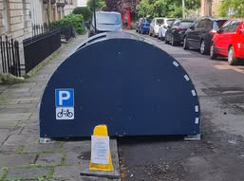 The reason for bringing up the history of the Street Furniture Pattern Book is that the current council seems to either have no knowledge of its existence (we found the links we use here through search engines not via the council's search facility) or else it was a deliberate choice to ignore it. There has been a fair amount of comment on social media about the "latest visual blights" (a popular description) of the newly installed cycle hangers. Even the comments supporting the function they provide (as cycle storage) take issue with the appearance, with Anderson Shelters, pig's sties and Nissen Huts being common comparisons. Also we note that most are taking up pavement space as well as road space, and not all pavements are wide enough for this not to be a problem. Whilst the installation has been done under Road Traffic legislation, it is an interesting point that even so the placement outside a listed building does affect the environs and perhaps listed building permission should have been applied for, especially if the cycle hanger is positioned above a dwelling's historic vault? After all, if the vault is damaged, it is the house owner who has the legal obligation to repair it.
- Bath Fire Station - Last updated 1 June 2025.
- Early in 2025, it was announced that the Fire Station in Bath would be replaced by a more modern facility. This provoked some active resistance to the idea of the building being demolished. The news item at the time showed a photograph of the fire station. It has Art Deco styling which would have been appropriate for the 1930s when it was built, yet it also has the proportions and the symmetry to match the classical style of Georgian Bath. For a functional building it was entirely appropriately styled for Bath. The article goes on to report that the Twentieth Century Society has submitted an application to Historic England to have the fire station listed. This will hopefully be successful before demolition starts, because the council over many years has had a covert policy of removing all unlisted inter-wars buildings from the face of Bath. The listed Post Office building survives, the unlisted but beautifully styled Churchill House was replaced by what the locals scathingly call the Busometer long ago. We were originally told that Churchill House had to go because the bendy-buses couldn't enter the bus station with it in position (a blatant lie because the exit from the bus station is too tight a turn for a bendy-bus to get out if one ever went in), and the Busometer was originally considered essential for the operation of the bus station, yet has now been repurposed and no longer serves that role. The council is often economical with the truth, but on this occasion replacing elegance with ugliness wasn't a sensible move.
- We can't find any reference to the outcome of the Twentieth Century Society's application (which Watchdog supports), so we assume it is still pending. Meanwhile the aim of demolition is still being pursued with the Bath Echo and the Chronicle now publishing information on the public consultations to take place.
- One thing that has been glossed over is exactly where the fire service will operate from while the current building is demolished. The current site was chosen because it is beside a bridge over the River Avon and can therefore gain ready access to both the BA1 and BA2 addresses. Surely, wherever the replacement location is will either provide a worse service to some parts of Bath which suggests that building extensions behind the existing building would be a better idea, or else it would be suitable for permanent use leaving the existing building in situ to be repurposed for some other use. From a financial perspective, it is surely going to cost more to set up the interim temporary fire station, demolish the existing building, clear the site and construct a new one then move back from the temporary location, than it will be to refurbish and perhaps reconfigure the current building which is recognised as being in an important location and with careful planning could continue to be in use as the work progresses.
- The Rec - Last updated 1 June 2025.
- 11 May 2025 Original: The news that there is a Veteran Tree in the garden of 8 Johnston Street casts another problem over the proposed new Rugby Stadium, especially when according to the article the council regards it an an Ancient Tree, which describes a Veteran Tree which is also an important contributor to the view. Veteran Trees do not have a restriction on the root protection area, and the size of the protected area is determined by the diameter of the trunk, not the extent of the foliage. It will therefore be the legal reason for not permitting the North Stand as currently designed because part of the foundations will damage the protected roots.
- 25 May 2025 Update: On the Agenda for the June meeting of the Planning Committee are three "Variation" applications for the Rec, all of which include removing the obligation to dismantle the East Stand, leaving it in place for another two years. Among the various Tribunal hearings attempting to reconcile charitable land with a lease which should not have been issued to a professional business, it was ruled as a compromise that the East Stand could be permitted provided it was removed for three consecutive months out of the playing season. Technically, allowing it to remain all year is a Contempt of Court, yet the applications go to the Planning Committee with a recommendation to permit.
- Also, the applicants have claimed in the Chronicle and in the Bath Echo that their stadium would not harm the Veteran Tree, but they have just said the accusation is "factually incorrect", they haven't explained how they came to that conclusion. The Root Protection Area appropriate for the tree of that size as defined in the British Standard is far larger than is shown in the application drawings.
- 1 June 2025 Update: There has been an update from ICOMOS put on file. Effectively it admits that if the roofline of the stands were to be lowered as they recommended in their earlier Technical Review the ability to conceal the pitch illumination into the roof would be lost, which would be more harmful. The review therefore accepts that the modification to the roofs that they proposed could not be delivered. The ICOMOS update came from France so perhaps they did not notice how their wording could be twisted to mean they have no further problems with the application. That must therefore be clarified before the Planning Committee discuss the risks to the WHS obligations. If the suggestion is no longer possible, then the objection submitted earlier remains in place and that clearly shows how harmful to the OUVs is the design now placed before the Planning Committee.
- The other things the Committee should note is the paper just listed as being from Clive Onions as though he is just another member of the public. Yet he is a Consultant Civil Engineer with his own business listed at Companies House and he has experience in drainage, flood risk assessment, and flooding events and he very clearly knows more about the inadequacies of the flood risk documentation in the planning papers than the authors of those papers.
- Finally, the Resident's Association (PERA) local to the site has gone through the traffic management figures in the planning file and has noted that the figures offered in the summary for the stadium use omits a lot of the numbers in other submitted documents, and provides provable total figures that show the figures in the summary are greatly underestimating what the complete set of documents add up to. That objection also needs to be brought to the Committee's attention. The Committee needs to bear in mind that although planning decisions are recognised in law as being a matter of judgement, the decisions made on incorrect briefing material is a recognised deficiency that allows a decision to be quashed.
- 15 June 2025 Update: The draft minutes of the 4 June Committee Meeting have been placed on the Committee website. The Ward Concillor explained exactly why the East Stand needed to be removed during the summer. Despite this, the other Ward Councillor moved the motion to permit. It is notable that the Chief Executive of Bath Recreation Ltd, the business that is legally obliged to deliver the Objects of the Charity, and therefore tasked by the various Tribunal rulings that the East Stand must be dismantled for three consecutive months of each year, spoke in favour of retaining the East Stand. That would appear to be Contempt of Court if anybody chooses to pursure it. The Committee voted unanimously that the East Stand should not be removed, which shows that every one of them considers the East Stand to be more important than the World Heritage Site views. Bath deserved better.
- LIDL at Lambridge - Last updated 25 May 2025.
- 18 May 2025 Original: Last summer Lidl withdrew their earlier planning application, and now they have lodged a new application. It will be in the council's "New Applications" list next week because the site notices were posted after the list that we use to decide what should be on our New Applications page was published. However both the Chronicle and the Bath Echo have announced the new application and both of those news items include a link to the planning application for anybody who wants an early sight of the application. The Bath Echo has also provided an update on the public responses to the application in the first days, pointing out that because it is a new application, all the responses to the earlier application were voided when the application was withdrawn, so everybody who wants their views to be considered for the replacement application must supply them again.
- It is interesting to note that quite a number of public comments have been lodged (both for and against) in just the first hours after the site notice went up. When ICOMOS reported that the original application put the World Heritage Site inscriptions at risk, it is probable that they will be similarly against the replacement application, provided they are notified of its existence.
- 25 May 2025 Update: The replacement Planning Application has just been put in the council's "newly validated" list and thus is included on our "New Ones" page. There has been an article pointing out that it is not much different from the original one (which ICOMOS said harmed the Outstanding Universal Value of The City of Bath WHS), but it now puts another set of traffic lights very close to the set at the junction of the road to Lower Swainswick. That won't improve the traffic flow!
- Bath Fashion Museum - Last updated 18 May 2025.
- Following the failure to obtain "Levelling Up" funding in 2022, the council retained its ambition to use the former Post Office Building for the Fashion Museum collection. Therefore the news that the National Lottery has granted nearly £800,000 for the Fashion Museum looked like a really useful sum. However, in the news item it reveals that the money is "to develop and consult on plans to reopen the museum in the old Post Office".
- The council insisted that the collection should be housed in a Grade II listed building and has so far spent nearly half a million pounds on storing the collection in a controlled environment to preserve it pending getting a new museum environment available, so it is staggering to discover that it now expects to spend just over three quarters of a million pounds on preparing plans, an activity that should have been done before insisting that what appears to be difficult to modify building is the only place that will be considered to house the collection. If the old Post Office does prove to be impossible to modify without destroying the reasons why it was made a listed building, why wasn't that established while other more suitable buildings were still available?
- The other problem discovered by the Cleveland Pools Trust is that Lottery money is only promised. It was necessary to spend their own money on the work and then claim it back, and reimbursement was dependent on the Lottery Awards staff agreeing that it had been properly spent. So the council is likely to face the same hurdle for Fashion Museum funding. Has it got sufficient available funds to pay the bills before claiming the money back?
- The Former Homebase Site - Last updated 11 May 2025.
- 27 April 2025 Original: Among the applications on the agenda for the Planning Committee on 7th May is 24/03831/FUL which is recommended to "Delegate to Permit". It replaces application 20/00259/FUL which was refused by the Planning Committee but later granted permission by the subsequent Public Inquiry, though it has now timed out. The brief to the Planning Committee recommends that the principles in that decision process should be heeded when the replacement application is discussed.
- The interesting feature of the Public Inquiry is that the height of the proposed development (4 storeys) was considered significantly harmful to the World Heritage Site that it was only the proposed use as a care community that provided sufficient public benefit to overcome the objection to the height in that location, allowing consent to be granted. Yet the replacement application proposes a mix of 2-storey, 4-storey and 6-storey buildings without the clear public benefit of providing a care community allowing 4 storeys, and the Case Officer despite noting the importance of the Inquiry findings has not noticed the conflict with the advice to the Planning Committee that permission can be negotiated.
- Of particular note is that ICOMOS and Historic England originally objected to the adverse impact on the WHSs. Some relatively minor amendments were made. Historic England noted that harm still remained but considered it less than substantial (not a definition recognised by the World Heritage Committee), and significantly no approach was made to ICOMOS to examine the changes and re-comment. Unlike heritage assets managed under the listed buildings legislation WHS harm is not measured by the same yardstick, and failing to get an update from ICOMOS still leaves their original objections in place. Whether the Planning Committee recognise this remains to be seen.
- 11 May 2025 Update: Despite the very clear indication from ICOMOS that they were unhappy with the design of the earlier proposal for the Homebase Site, they were carefully kept uninformed of the update so the Planning Committee should not have determined the application in the absence of an update to an original unfavourable WHS impact report. Unfortunately they gave permission, apparently forgetting that ICOMOS does not bluff, and the description of "Parisian Quarter" is a clear indication that it will clash with the Outstanding Universal Value of Bath.
- The New WECA Mayor - Last updated 4 May 2025.
- The voting for the new WECA Mayor resulted in the election of Helen Godwin. In the report of her victory the successful West Of England Mayor said things would be quite different under her than under the previous mayor, who also represented the Labour Party.
- The article is short in detail about what to expect. We can only wait and see whether "building homes in the right places" is likely to put at risk the two World Heritage accolades. The open spaces between built-up areas are important features of the Outstanding Universal Values and should not be assumed to be available for housing.
- Proposed Recycling Centre - Last updated 4 May 2025.
- Following the consent given to the planning application 24/03168/REG03 by the April Planning Committee, the financial consequences of that decision have now emerged, and the sum is already getting an adverse reaction. "How do you spend £10 million and end up with a recycling centre that is inferior to the one it replaces?" says it all. Typically, the council's response to questions is to say nothing other than what has already been published, which could indicate they have things to hide.
- The Rec - Last updated 20 April 2025.
- Anyone reading the recent submission from Julian Brown would easily come to the conclusion that it is an Objection rather than the General Comment it has been listed as.
- However, the real surprise is the comment from the Bath World Heritage Manager, listed as Conservation Historic Environment with the conclusion "No Objection subject to conditions". He of all people should be fully aware that his job title carries the expectation that the UNESCO World Heritage Committee as put forward by ICOMOS is that the degree of harm to the OUVs of the two World Heritage has been declared unacceptable in a very detailed review by ICOMOS UK. In their report, which they summarised as "moderate and in some cases major adverse impacts remain" resulting in "significant permanent harm" to both OUVs, should have been heeded. He should also be aware that even lower levels of harm (which is not the ICOMOS UK view, quoting "moderate" as the lowest possibility) are contrary to the amount acceptable in the Operational Guidelines, whatever the LPA and Historic England think. Bath deserves better than this flawed opinion from someone who should know what his job entails.
- More student accommodation - Last updated 20 April 2025.
- In the Chronicle is a news item about plans for student accommodation on the Claverton Down campus. The plans are not finalised yet with just a request to the council on environmental requirements so far. The news item does give dates and locations where the public can provide their input, which is why we are advertising it here.
- Our first thoughts are that this has taken far too long for the university to get to the planning stage for on-campus accommodation. The Core Strategy, adopted in 2016, required student accommodation to be provided on campus, and for the intervening 9 years, many HMOs have been created and PBSAs built across Bath, and the on-campus Wessex Building claimed to provide student accommodation was repurposed as office accommodation. It is only now when councillors are recognising that Bath has reached or is exceeding saturation point for the proportion of students to permanent residents, that the policy in the Core Strategy is being considered. If the next on-campus student accommodation now being discussed does get planning permission it needs to be with a Condition that it can never be used for anything else, given the farce of the Wessex Building with planning permission for student occupation not being used as such. It is also essential that it comes with a Condition that it can't just be used for first year students, which is the current university attitude. It can't continue like that, forcing students into seeking their subsequent accommodation outside the campus.
- Proposed Recycling Centre - Last updated 13 April 2025.
- The planning application 24/03168/REG03 was discussed during the 9 April Planning Committee meeting and it was given planning permission. The Bath Echo reported the protest against it outside the Guildhall, and also published an item on the decision process and the dismay afterwards. Of particular interest is the fairly obvious split along party lines despite the reminder from the meeting Chair that the voting shouldn't do that.
- The fact that the council had disposed of the Midland Road site without identifying what would replace it clearly put the decision makers between a rock and a hard place. The Cabinet decision in 2021 that the proper replacement site was in Odd Down doesn't appear to have been mentioned, yet it is an obvious ground for a legal challenge to the decision reached, alongside the other legal issues we mentioned in our 30 March comment below. We will watch what happens next with interest.
- The Rec - Last updated 6 April 2025.
- Any notable comment by a well-known name is bound to attract attention, so it is no surprise that Ken Loach's comment on the proposed stadium should make the newspaper. He does say what many of the objectors have submitted in their comments, but he does it in the words used in the past by royalty, which adds power to them. Nevertheless those with real power, such as ICOMOS, have made their objections very clear, see 2 March entry below. Also, most of the objections quote planning reasons for refusal, whilst comments from supporters mostly make emotive points. It is the content not the number of each type that should guide the decision. A planning application is not a popularity contest to be won by the most votes.
- Bath Press Site - Last updated 6 April 2025.
- 23 March Original: We were surprised to read in the Chronicle that In January it was claimed that the Bath Press site was purchased, "already having planning consent" and now in March, work was about to start. The so-called permission was in a Planning Committee meeting on 16 November 2022, and the actual decision from page 8 of that meeting was "that officers be delegated to permit", subject to four sets of additional work. The planning website does not show the outcome of those activities, and does not list the Planning Decision that references them. Therefore there is a possibility that the buyers of the site were falsely informed of the planning status, and any commencement of work now would be premature without the Decision Notice being issued.
- 30 March Update: When we saw in the Chronicle an article that said that work was starting on the site, we did some further investigation. This showed that although we discovered that the more recent application 21/05672/EFUL was still pending as we had noted, there is an earlier planning permission granted to 15/02162/EFUL, which had a series of applications for signing off planning conditions and several subsequent Non-Material Applications which have approved changes to some details of the plans. There are still pending a couple of challenges to the S106 Agreement, but whether these are approved or rejected would not stop the construction work from starting. Provided the 15/02162/EFUL permission (as amended by the various NMAs) is delivered, the work on site can go ahead.
- The only oddity is that the planning permission was for 244 dwellings and the Chronicle article mentions "146 new homes". That might be covered by the latest Screening application but the planning website is not allowing the documentation to be read at the time of writing this.
- 6th April Update: The Screening application seeks comment on the proposal for "blocks that are up to 6-storey in height". As this was a site with just a 2-storey building on it, in front of a terrace of 2-storey houses, the design looks to be unacceptably excessive. Unfortunately the public can't comment on screening applications, so we can only hope that the previous height constraints on applications for this site are remembered.
- Proposed Recycling Centre - Last updated 30 March 2025.
- The planning application 24/03168/REG03 is an agenda item for the 9th April meeting of the Planning Committee, and it is probably no surprise that there is a recommendation to Permit. After all, the council is the applicant and the decision maker, and clearly wants to ignore the report in the Bath Echo and the "open letter" reported in the Chronicle and the threat of a legal challenge because "in summer 2021 the council's cabinet had unanimously agreed the Odd Down facility to be the only suitable replacement for the Midland Road recycling centre". The Planning Committee hasn't the authority to override Cabinet decisions, so it remains to be seen whether they realise that and reject the Case Officer's recommendation or whether they confirm it and leave themselves open to having to defend it in court.
- We think that there could be other legal challenges too. Our original assessment "We retain the view that if the gantry is a necessary feature of a Recycling Centre, then neither the obligations in the Health and Safety legislation nor in the Equalities Act will be met" still stands.
- Sulis Down Development - Last updated 16 March 2025.
- We commented in September that the development had been refused by the Planning Committee despite the Case Officer's recommendation to permit, and we thought the council's decision to refuse was correct for a number of reasons. The applicants appealed that decision and opted for a Public Inquiry. The Inquiry was held at the end of January 2025, and the Appeal Decision to dismiss the Appeal was published on 14th March 2025.
- The Inquiry sat for 7 days between 28 January and 11 February, with the Inspector examining the area around the site on 3 February and a site visit taking place on 6 February. The land had been part of the Green Belt but B&NES had taken it out of the Green Belt and had had accepted the principle that it could support perhaps 300 dwellings. Phase 1 for 171 dwellings was given permission in August 2019 and is largely completed. Phase 2 as described in the masterplan continues the Phase 1 road from west to east. The appeal application covers Phases 3 and 4, and is for up to 290 dwellings, and the outcome of the Appeal is that the adverse effects outweigh the benefits.
- Cleveland Pools - Last updated 16 March 2025.
- There has been some discussion within social media about whether the Cleveland Pools would ever re-open. It is understandable therefore that the the of the Cleveland Pools Trust has gone public with a commitment that the Pools will re-open but there is currently no forecast of when The Chronicle has an on-line article focusing on the background to the restoration of the Pools, though in the printed copy there is rather more information. The Bath Echo has a more detailed article roughly confirming our assessment of the situation on 2 June 2024. There is sufficient reassurance that the Cleveland Pools will reopen, but the cause of the flooding problem and the responsibility for funding the necessary repairs has to be concluded first.
- Pulteney Weir Radial Gate - Last updated 9 March 2024.
- There are very similar articles in the Chronicle and the Bath Echo announcing a feasibility study for replacing the radial gate with a small hydroelectric scheme. We don't have a problem with the idea of using the river for generating hydroelectric power, but as will be shown below, there is a big problem with installing it in place of the radial gate. The claimed function of the radial gate in the news articles is to let more water downstream to avoid flooding. That is not its designed function, just an assumption made from time to time by people with no knowledge of hydraulic engineering. Also, those who consider it unsightly should remember that the Pulteney area was designed under the direction of the Council's appointed architect and it won civic awards after its completion.
- In Bath Central Library in the reference section is a document "Bath Flood Protection Scheme" written by Frank Greenhalph who designed and had installed in 1974 the Bath Flood Defence Scheme. Before wasting money on a feasibility study on its replacement, those who think the sluice is disposable should read that document which explains that it is to alleviate the flood risk UPSTREAM of Pulteney Weir, not to add to the flow downstream. The next document to read is "The Hydrolab Report (Project 2281)" issued in March 2003 by consultants Lewin Fryer and the Environment Agency, which concluded that if the sluice gate were to be removed an alternative sluicing mechanism would have to be installed to prevent the build up of silt upstream of the weir. In keeping the water level higher upstream of the weir it slows the water flow and that deposits the silt the water is carrying. That conclusion is exactly what Greenhalph had assessed nearly 30 years earlier.
- It is also worth noting that the Radial Gate sluice mechanism is owned by the Environment Agency, B&NES only owns the platform above it which was included in the design because the council wanted to use it for a cafe (which was never built). The original design of the mechanism was that the operation of the sluice was activated by floats reacting to the water level upstream of the sluice; no electrical or hydraulic mechanism was needed for the sluice to operate provided the float chambers were kept clear of silt, and the sluice performed its flood protection function (clearing upstream silt) whenever the sluice was not closed and was less than fully open. It has been noticed recently that the sluice remained shut when the water level was high enough for it to have opened, so whoever decided that was a good idea has increased the upstream flood risk.
- The other characteristic of the Greenhalph design was to make the flow channel wider, straighter and deeper and that resulted in the designed maximum flow rate (originally quoted in Imperial measures which translates to 365 cubic metres a second). Greenhalph emphasises the importance of the channel being maintained to the design dimensions which required the banks to be where he placed them and the depth being 10 feet (3.05 metres) throughout. Maintenance of the channel was a role of the Bristol Avon Local Flood Defence Committee initially, and the Committee invested in a small dredger which went regularly along the Greenhalph scheme, plus a few barges to carry away the silt dredged up. We have been told that the dredging went downstream as far as the start of the tidal reaches, but we haven't found any documented evidence of that. It is probably true, because the more frequent recent overflows into the flood plain around Keynsham indicated that the river there is silting up. This dredging arrangement worked perfectly until 2005 when the Government disbanded all local arrangements and placed the responsibility for the Avon with the Environment Agency.
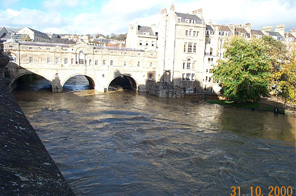 Things went downhill rapidly after that. The dredger and barges were sold, and channel maintenance ceased. A few reports somewhat later showed that the flow rate through Bath was constant and the channel was declared "self cleansing". It is true that the channel depth now remains fairly constant, but the depth isn't the original design depth. In 2007, a malfunction of the Twerton sluice drained the section from Pulteney weir to Twerton, and photos of the channel near Sainsbury's showed that the original design depth of 3 metres was reduced to 1.7 metres. The proof of the impact of this came in 2000 when the peak flow through Bath was 285 cubic metres a second (compared with the design of 365 cubic metres a second and after the Government's advice on climate change that peak flow rates should be increased by 20% and that means 438 cubic metres a second should be accommodated) and the residential parts of Bath almost flooded. There have been photos of the Rec showing the flooding there. The photo of the weir submerged and almost invisible shows how high the water got when the accumulated silt reduced the flow capacity by almost a quarter. We have also seen a photo from the same date showing Bath Cricket Club on the other side of North Parade with the pitch underwater.
- With at least two carefully researched reports explaining why the radial gate is essential for clearing the deposited silt dropped when the flow is impeded by the weir and thus keeping the the upstream section protected against flooding, and evidence of the negative impact of the Environment Agency ignoring the need to clear the deeper silt not cleared by the radial gate to show that the replacement of the radial gate with an electricity generation installation will destroy the protection that Greenhalph designed. The idea of hydroelectric power from the river is good, but where it is proposed to be sited is wholly unacceptable.
- Culverhay School - Last updated 2 March 2024.
- An article in the Chronicle and a similar one in the Bath Echo informs that despite the expectation that the Government's Department for Education would pay for the build and operation of the two new special schools on the site, that agreement has not been confirmed that the funding would be provided. In the background is the news that the Chancellor of the Exchequer has required Government departments to reduce their budgets. There must be a possibility that the funds for the development of the Culverhay site might be axed.
- It is therefore worrying that the plans to demolish the current buildings might be going ahead without the guarantee that the replacements will be built. This looks a dangerous assumption. The current building was designed as a school, and although it might not be ideally configured for the special school functions, it is far more useful being retained as a fallback that could be adapted, than creating a derelict site with no council money available to build anything on it. The demolition activity should be put on hold until the promise of Government funding is delivered. That will at least allow a financial comparison between the cost of sending children out of area and the cost of creating some sort of local facilities out of the existing building.
- The Rec, update - Last updated 2 March 2024.
- The council had been waiting for an update from ICOMOS, and this is now on the planning file dated 19 February 2025. It is worth reading in full, but in a nutshell in it there is a very clear statement that as currently presented it would create "permanent and significant harm to the World Heritage Sites and their OUV", and "the 2023 comments remain pertinent". This contrasts with the opinion in the applicant's Heritage impact Statement that the harm is "less than substantial". ICOMOS politely call it an underestimate, and make it clear that they are opposed to the scheme. In view of the "significant harm" description, the risk of the WHS entries being removed has to be taken seriously. It is also revealing an internal contradiction in the Historic England comments. Historic England placed importance on waiting for the technical review by ICOMOS, and that is now available and is very clear that the revised plans still create permanent and significant harm to the OUVs, and yet Historic England describe that as less than substantial harm and therefore they have no objection to the proposals. The director of World Heritage at UNESCO has published a requirement to "avoid negative consequences for present and future generations" and that makes no concessions for the level of harm; effectively any harm is unacceptable, and ICOMOS's assessment of significant harm supersedes any opinion expressed by Historic England. A WHS can't be treated like a historic building.
- It is a noteworthy coincidence that the Chief Executive of the Bath Preservation Trust has a letter published in the 20th February edition of the Chronicle, claiming to have given due consideration to the setting and significance of the World Heritage Site (note the singular, despite there being two WHS entries), and concludes "the time has come to support the proposals". We will just point out that the "P" in BPT stands for "Preservation" and in 2002 the High Court ruled the Rec is Charitable Land, and the Charity Commission have published the Objects for the land which includes the obligation to retain it as an open space not favouring any particular sport, club or organisation. Various Tribunal hearings afterwards have left the Objects unchanged, and the Trustees appointed by the Tribunal are required by the Public Trustee Act to uphold the Objects of the Charity. During the 2002 hearing, Bath Rugby did admit that they as a commercial organisation do not accord with the Objects, but whether to do anything about that was left in the hands of the Charity Commission who were content to let the leased area be used by Bath Rugby until the lease expires, but who probably would immediately object to any extension outside that limited area into the remaining area which is currently and correctly retained as an open space. Thus the necessary "Preservation" should not go against the legal rulings on what the land can and cannot be used for. Perhaps the BPT Trustees need to research the subject more thoroughly.
- PBSAs and HMOs - Last updated 23 February 2024.
- Original 9 February 2025 item: We have been saying for a long time that it is not the number of student HMO and PBSA properties that indicates how balanced the population is in any given area, it is the ratio of numbers of students to permanent residents that matters. Others have complained about the impact of so many students in Bath who leave in the summer and the loss of their trade forces several businesses to worry about whether they will remain viable during the July to September lean period.
- The growing number of PBSAs has been recognised as a concern during the exercise to provide an interim update to the Local Plan, and that resulted in a statement that more of such accommodation should only be approved if a university admits to the need and will use the accommodation when it becomes available. Elsewhere in the local plan was a target reduction in office space over a period of time and that amount of reduction has already been far exceeded, and Policy ED1B requires refusal where it would harm the council's ability to plan positively for economic development (hence the adverse comment from Economic Development mentioned below). Office accommodation with parking should make this site attractive, yet nobody apart from Economic Development seems to have recognised this. The application contains an inadequate Economic Marketing Report which is simply an opinion rather than a description of what is being advertised at what price and what responses have resulted: it is easy to show a lack of interest by inadequate advertising or unrealistic pricing. Policy ED1C requires the space to have been marketed for 12 months on reasonable terms and there is no evidence of this being done; and NPPF Section 81 also places emphasis on business needs being particularly important.
- This raises the question of why this application 24/03730/FUL which seeks internal modifications to replace some now scarce office accommodation (with parking) with a PBSA arrangement for 34 students is being treated favourably. The north wall of Berkeley House is on the Enterprise zone boundary, and it should therefore be refused under Policy B5 as well as ED1C. Yet Planning Policy doesn't appear to know what the policy update included because they haven't objected to the application for that reason and despite no commitment from either university about the need, but they do defer to Economic Development who are very strongly against approval. Aside from the apparent lack of internal consistency among the council consultees, we have to wonder how the Case Officer can recommend Delegate to Permit against the expectation of university commitment alongside that strength of objection from Economic Development. Perhaps the Planning Committee will also take the view that it is a wrong recommendation?
- Previous PBSA's have been approved only when no parking provision for the students is accepted as a condition, yet the 22 Berkeley House parking spaces are retained for application 24/03730/FUL. This is also contrary to council policy and such an inconsistency will not go unnoticed in future applications for yet more student accommodation.
- As an aside, there are these 34 student beds and there are two new applications to convert residential properties into HMOs this week, and these will have a direct effect on the council's income because student accommodation provides no council tax, compared with the business rates of almost £200,000 that the office accommodation currently provides and the Council Tax that the residences contribute. How much of this years 5% increase in council tax could have been avoided if previous planning applications had included a value for money consideration?
- 23 February 2025 Update: At the Planning Committee Meeting, the Oldfield Park Councillor gave his objections as Ian Halsall, Ward Councillor, and he then had to stand down from his normal role as Chair of the meeting and he left the meeting because he could not also vote. In his absence the remaining Members voted to approve the application. There were some half-truths in the debate that followed, like avoiding mentioning the council Policy for preserving the housing mix, by referring to "concentration of a social group such as students" rather than looking at the mix as a whole. Similarly it was claimed that there was no policy "to protect this area from the loss of employment space" but because the front wall of the building is in an area so protected, so this building is rather different from this area.
- The real problem though is that Oldfield Ward was allocated a single councillor, unlike nearly all others which have two. If Oldfield had two Ward Councillors rather than one, the first could have attended the Planning Committee to take part in the debate (which might then have had more impact than a memory of what was said a while before), and the second one could have presented the Ward viewpoint.
- Hindu Temples - Last updated 16 February 2024.
- In the printed Chronicle there was an article occupying half a page announcing the opening of a Hindu Temple at the University of Bath, and although we have now found an item in the Chronicle online, it was well hidden. The article makes it clear that this was for use by students and staff at the University and it was not intended to be a replacement for the Temple on the Culverhay School site. The article mentions the Culverhay School location as Rush Hill, and implies that it is still there and in use, despite our observation in June 2024 that it was under notice to vacate the site by July 2025 and there has been no news since then about where it might move to.
- We did a bit of digging and found the article published when the Temple first opened. The opening was attended by the High Commissioner for India among others, and it was the first in Europe dedicated to Lord Shree Jagannatha, the supreme god of Hinduism. As part of the setting up of the Temple, four idols of deities were flown in from India at a cost of £10,000. This Temple has an international reach, and must not be treated as unimportant and disposable.
- The article we referenced in our July 2024 item showed that the annual celebration of Ratha Yatra attracted around 1000 people from far and wide to observe the three hour procession. This is NOT like a parish church, it has a national (and perhaps international) following, and there could be no better place for it than in a World Heritage site.
- In that article announcing the demolition to build two schools for pupils with special needs, it was made clear that not all of the Culverhay site will be needed for the new schools and part of the site could be used for alternative community use. Cllr Paul Roper, the council’s cabinet member for economic and cultural sustainable development said it was possible the Hindu Temple could be moved into part of this area. The existing Temple isn't huge: three big halls, one small hall and parking was its description when it opened. Now that the Planning Committee has decided it is preferable to wreck the Tufa Field than to place the residences of the people with special needs alongside the school that many of them could be attending, there is no better use of the spare space than to leave the Temple there permanently; after all, it is a known location. Cllr Roper said it was possible but it has yet to be determined. Make that decision as soon as possible, Cllr Roper. Moving a complete temple with all of its contents from one place to another is not a trivial exercise, and the sooner the decision is made, the sooner planning the move can begin.
- Corn Street Housing - Last updated 2 February 2024.
- The reserved items application was added to our New Applications list as validated on 12 January and there is now a Bath Echo article announcing that the public's views on it are being sought. The artist's impression in the article shows that there is still a fixation on having the style of the Western Riverside development replicated in other areas of Bath despite the UNESCO World Heritage Committee criticising the style as having an adverse impact on the Outstanding Universal Value of the World Heritage Sites and asking for an improved style. This is important because Corn Street will be visible from trains arriving in Bath Spa station and could be the first impression a visitor sees.
- There used to be a definition of "Bathness" that if someone was led blindfolded to a building and when the blindfold was removed they thought they could be in Bath because of the appearance, then it would be a suitable design. If the artist's impression is delivered, it would fail that test. Yet Aequus is a wholly owned subsidiary of B&NES council and the council could influence its style preference, so there is little justification for the one chosen.
- There is a limit to how many warts can be built among the classical designs before UNESCO say it has gone too far and withdraw the WHS inscriptions. That would be a severe embarrassment for DCMS who is the "State Party" for World Heritage matters, because the loss of the Great Spas of Europe inscription would also delete the inscriptions in the seven other countries in Europe that it covers.
- Bath Fire Station - Last updated 26 January 2024.
- There is an interesting article in the Bath Echo pointing out that the current fire station is a classically inspired quality building with its final design being by a female architect, a rarity at the time it was built, and that adds considerable historic interest to the building. It also adds that the original finishes still survive in situ. There is a similar article, perhaps authored by the same reporter, in the Chronicle which additionally includes the original 1937 architectural plans, though their introductory mention of "campaigners" calling for the fire station to be listed is clarified further down (and in the Bath Echo) that the 20th Century Society has submitted an application to Historic England for the building to be listed. Watchdog welcomes that initiative and hopes that it succeeds.
- An interesting feature of the fire station is the admission that the location is very important. The replacement plans are for the relocation to a "temporary location" so that demolition and a replacement building can take place, but there is no indication of where that "temporary location" might be; and if the current location is ideal, then surely any alternative location will have an unwelcome adverse effect on the service provided?
- The other oddity is the insistence by the spokesman for the fire service that the design proposals are still in the early stages and consultation continues on what the new building should provide, which does suggest that replacing the building is just a pre-decided objective not a service requirement at this stage. From a financial perspective, it is surely going to cost more to set up the interim temporary fire station, demolish the existing building, clear the site and construct a new one then move back from the temporary location, than it will be to refurbish and perhaps reconfigure the current building which is recognised as being in an important location and with careful planning could continue to be in use as the work progresses.
- The Rec Listed Building Application - Last updated 26 January 2024.
- The 23/03559/LBA application has now been updated with additional documents. Included is a December 2024 Heritage Assessment. In the 150+ pages focusing on listed buildings, conservation area characteristics, planning guidance and the history of the site, there is still no mention of the key fact that the High Court recognised the land conveyed to the then council in 1953 as Charitable Land, and a series of Tribunal hearings after that clarified for the Charity Commission exactly how it was to be managed as "outdoor recreational facilities for the benefit of the public at large" as the Trustees see fit, "provided that (i) the charity shall not show any undue preference to or in favour of any particular game or sport or any particular person, club, body or organisation, and (ii) the charity shall not use the Bath Recreation Ground otherwise than as an open space." The Core Strategy and Placemaking plan has a section "Bath Spatial Strategy" which only allows the development of a stadium "subject to the resolution of any unique legal issues and constraints" and the Charity Commission Objects are such an immoveable constraint. Indeed one of the Tribunal hearings identified the presence of Bath Rugby's facilities as being inconsistent with the Objects and left it to the Charity Commission to decide whether or not to challenge the legality of the lease issued to a commercial business to occupy and build on part of the charitable open space. The Charity Commission so far has decided to wait until the original lease expires rather than suffer the expense of court hearings, and within that timescale any new leases can be tolerated for the space that the original lease covers. They might not be so relaxed about a development outside the area covered by the lease though. In that context, the pretence in the planning application that the constraint does not exist is not to be overlooked in the evaluation of the application. It should also be noted that the claim in the application that the proposed stadium would have only a minor impact on the WHSs has already been soundly debunked by ICOMOS, and should not have been repeated in the 2024 update to the Heritage Assessment.
- The Rec - Last updated 19 January 2024.
- There is an article in The Chronicle describing the applicant's claims about the "major" alterations to the Bath Rugby planning application and how it will help preserve the unique character of the central Bath location, without explaining how extending outside their current footprint is compatible with the Charity Commission's requirement endorsed by several legal cases that "the charity shall not use the Bath Recreation Ground otherwise than as an open space". Moreover, there was a letter printed in the January 16th Chronicle but not viewable online that reminds readers that the "size, scope and nature of the revised proposals are no different in scale, massing and bulk to the original". We looked up the author and he is part of a business that is "a multi disciplined architectural and interior design practice" and has a background in presenting proposals for planning permission, so that opinion has to carry considerable weight.
- We also noticed that there is a similar article in the Bath Echo urging people to have their say on the updated plans. This is sound advice. Despite over 3000 comments on the original proposal, the case officer could treat these as out of date, and it is important that those comments, suitably updated to reflect the latest documents, are made again.
- We also note that the application had been under the October 2024 notice from National Highways that a planning decision must not be delivered for a defined period of 6 months (expiring in April) because the compliance with DfT Circular 01/2022 must be shown. There is a document among the new set that shows that the all the routes out for the match spectators will be reduced for all the ones that National Highways might be concerned about, and increased for the ones that they are not. Spectators will go wherever they wish, mostly along the roads they are already accustomed to use, and therefore the latest forecasts offered don't seem credible. It remains to be seen whether National Highways will take a similar view.
- We also note that the latest Heritage Statement specifically excludes the impact on the WHSs, and also fails to mention the Objects for the Charitable Land which include being retained as an open space (with a temporary exception for the land occupied by Bath Rugby for the duration of the lease which was in force on the date the Objects were finalised) and barring any undue preference for any particular sport or club or body or organisation. They should form part of the decision process (indicating a mandatory refusal) despite the application ignoring them.
- The Year 2024 - Last updated 14 January 2024.
- The 2024 Year Report is now online on our Year Reports page. The website traffic statistics for 2024 are derived from over 12,000 internet address entries, and are quite similar to those for 2023.
- We did look a the new applications that had been validated in the weeks between Christmas and this update, but none were considered significant. There were revised documents for the proposed stadium on the Rec, but the alterations didn't deliver anywhere near the changes required to make the application overcome all the very detailed objections, especially the ICOMOS list of adverse impacts on the Outstanding Universal Value of both of the World Heritage Site inscriptions.
- The Biter Bitten - Last updated 22 December 2024.
- That headline came from one of our members, referring to the article in the Bath Echo where the leader of the council is asking the public to oppose the proposed 24-hour bus lane along the A4 Keynsham bypass.
- Social media is awash with complaints that the current Lib-Dem council has ignored the results of almost all of their consultations: imposing Residents Parking Zones where the majority of those consulted didn't accept what was proposed; imposing Low Traffic Neighbourhoods in places where those few residents who like the idea of reduced traffic past their front door carried more weight than the vast majority of those affected by increased traffic on alternative routes; and imposing unwanted 20mph speed restrictions on roads. These did not fulfil the DfT's Statutory Guidance of obtaining public support for the need, despite Section 18 of the Traffic Management Act 2004 making it mandatory to comply with the Statutory Guidance. The residents have ample examples of consultations offered because it is a legal requirement to mount one, and then having the results of the consultation ignored because there is no legal obligation to heed them. Having fouled its own nest, the council isn't likely to generate much public enthusiasm to help this council's new objective.
- The Keynshan Bypass is a similar intention to ignore public feedback. The Bath Echo item reports "Despite opposition to the bus lanes in a public consultation held in 2023, WECA is pressing ahead with the controversial plans for 24/7 bus lanes on the bypass". This appears to be the WECA Mayor's swansong, taking revenge on the councils who gave him a bad name in Central Government by not working harmoniously with him. It will probably be made firm policy before the current Mayor leaves office. Residents can only hope that his replacement will be a bit more public oriented.
- Milsom Quarter - Last updated 15 December 2024.
- According to the Bath Echo item, the decision to close down Jolly's has taken the council by surprise. Although the council mentions discussions with a "third party" this, in context, looks like being additional to Jolly's remaining trading, not to replace the existing shop.
- The article mentions "plans to spend millions upgrading it" and that appears to be Application 24/03946/REG13, granted permission on 10 December 2024. The upgrade includes "extensive window and door repair/replacement, repairs to structural and timber roof members, storm water repairs/upgrade works and upgrade and replacement of mechanical, electrical and public health services installation".
- Looking at this from the perspective of the tenant shop owner, if the landlord is going to be working in the building during the time when the tenant is trying to trade in it, there will inevitably be conflicts, and it will make sense to clear stock and fittings out of the way by closing the business. Clearly the council has not reached an agreement with the tenant on how both activities can co-exist, so the tenant has chosen to get out of the way.
- Thermae Bath Spa - Last updated 15 December 2024.
- 8 December 2024 Original: There was a Chronicle item on 4 December covering the damage a reversing lorry did to one of the listed pillars outside the entrance to the Thermae Bath Spa. In the interests of staff and customer safety, the Spa was closed. Another Chronicle article on 6 December said that a team of structural surveyors worked overnight and throughout the following day and the Spa was hoping to reopen at midday on 6 December. It has made the pillar structurally safe but proper restoration of the pillar will need to follow in slower time. Two days between the Spa closing because of the damage and the Spa reopening after the damaged pillar was made safe is an impressive achievement.
 The underlying issue hasn't been addressed though. First there is a common cause between two sets of damage to listed structures. In May a lorry turning round knocked over a gatepost, and in December a lorry turning round damaged a listed pillar. On both occasions the lorry involved had to turn round because the exit in forward gear was not available because the council had introduced restrictions on the through route. There are many listed structures along roadsides, and there are valid reasons why lorries have to arrive in a road that has been made a "No Through Route" The engineering around the barrier needs to provide adequate turning space for these larger vehicles to prevent other heritage structures from being damaged.
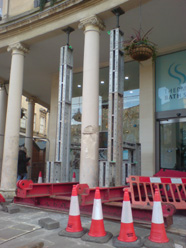
- 15 December 2024 Update: After our item last week we were sent a photo of what the urgent action to make the damaged pillar safe looked like. We are showing it here so that those who cannot go along to see it for themselves can see what has been done. The temporary repair is placed either side of the damaged pillar and it stands on a base designed to spread the load over a wider area so that the props don't damage the surface beneath them. The doorway behind the props used to be the main entrance to the spa facilities, and that is now permanently closed with the customer entrance now being the doorway round the corner to the left. The spa continues to be fully available to the public.
- The Empire - Last updated 8 December 2024.
- The Bath Echo article on the problems with the slab which supports the pavement near the south-east end of the Orange Grove facade, has triggered a memory from one of the "Save Churchill House" campaigners. The former campaigner wonders if the comment in the planning application (24/04436/LBA which we feature as an application of interest this week) that states "All of this area gets extremely wet following periods of inclement weather" may have a different source than rainwater.
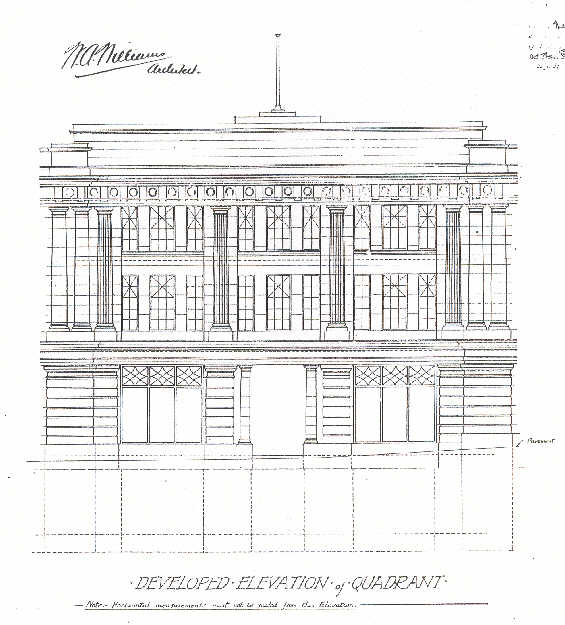 The research for the "Save Churchill House" campaign included reviewing the architect's documentation which showed not only the drawings (eg on the right) but also that when the location for Churchill House was chosen (where the "busometer" now is) there was a spring emerging which drained into the river. The architect designed a novel solution. The basement was constructed to be fully waterproof, so that it floated like a concrete boat on the spring. As the upper storeys of the building were added the extra weight gradually sank the basement and the spring found an alternative route to the river under and around the basement.
- Thus when the building was demolished for the Conditioned archaeological investigation of the site, the site flooded once the basement bottom and sides were breached and no investigation was possible. The bus station developer therefore had a running water lake to deal with and solved that problem by pumping cement into the spring, which after 6 days of pumping was finally sealed. The bus station was then built there after the lake had been pumped out.
- However springs cannot just be sealed and they go away; instead they find other subterranean routes to the surface. Some months after the spring was blocked a new spring exit was formed at the Empire end of the Parade Gardens. Therefore the area around the Empire that gets extremely wet could be a raised groundwater level bleeding into the void beside the Empire rather than rainwater penetration. Nevertheless, regardless of where the water comes from, it does need to be drained to prevent it accumulating, and the planning application does offer a workable solution.
- Oldfield Park Mystery - Last updated 1 December 2024.
- Although we haven't yet looked at planning application 24/04180/OUT, we have had a quick look at the Bath Echo item following a comment from one of our members living near the location. The mystery is that the proposal is to "complete a row of houses", yet the original Edwardian terrace ends at number 23. There is a number 24 adjoining the St Malo site but it is not in the character of its neighbour at 23. In order to complete the row in a suitable style, number 24 would have to be removed, but it is not mentioned in the Bath Echo article, and it is outside the red line of the application location. Thus the mystery is how completing the row of houses can be achieved with a non-conformant dwelling between the Edwardian terrace and the proposed development which would "match the materials, design, heights and plot widths of the terraced properties" (quoted from the pre-application advice). To continue the terrace, the new buildings need to join to the terrace, not be isolated from it.
- The other mystery is how the Planning Statement can claim to be not within the setting of listed buildings when the site is clearly visible from St Alphege Church which is Grade II* listed, and is right next door to the school which is mentioned as being opposite the proposed site. This appears to be an offence under Section 65(6)(b) of the Town and Country Planning Act.
- Proposed Recycling Centre - Last updated 24 November 2024.
- 17 November 2024 Original: Further to our comments below on the 13th and 20th October 2024 and 3 November 2024 there has been a substantial update to the planning application, but the fault we reported last week (which received a reply that it was being worked on without a forecast date) was still preventing the public from viewing the revised documents on Saturday, though our link to this application does work today, Sunday. The Bath Echo and a dedicated B&NES website suggest that the main public complaints have been largely ignored. "Putting lipstick on the pig" was how one of our members described it.
- There are a large number of replacement documents and the sample we examined doesn't identify what has changed from the earlier documents making it difficult to investigate what has been changed in what is now proposed. The danger is that all the earlier public comments could be classed as obsolete despite referencing design statements that have not been amended. We recommend that everybody who commented before should comment again to out-manoeuvre the "obsolete" option.
- Although there is a ramp as an alternative to the stairs to the gantry, we couldn't find anywhere a statement of the gradient of the ramp. The Equalities Act does state a maximum steepness of an "accessible" ramp, and a typical moderately fit wheelchair user could probably get the wheelchair and its user up the ramp, but the user with the thought that they might not be able to hold back the wheelchair going down that legally maximum gradient can find the gradient terrifying. One Watchdog member worked alongside a wheelchair user for a while, and he was always asked to hold back the wheelchair as it went down the "compliant" exit ramp to the building. Going forward in a wheelchair and holding it back use different muscles, a fact that the legislation overlooks. Another issue is that some furniture has casters and could be wheeled up the ramp, but if the person doing so loses control of it, the runaway could do a lot of damage to anyone lower down on the ramp.
- We retain the view that if the gantry is a necessary feature of a Recycling Centre, then neither the obligations in the Health and Safety legislation nor in the Equalities Act will be met. However when the council is both applicant and decision maker, it is not a given that it will be refused for those reasons.
- 24 November 2024 Update: There is an "open letter" reported in the Chronicle jointly written by the businesses and organisations that will be adversely affected by the Recycling Centre if it goes ahead in Locksbrook Road. These are established employers who have put their names to the letter, and together these employers of "hundreds of people" in the Locksbrook area believe the opening of the Centre will disrupt their normal operation and threaten the long-term viability of existing jobs, as well as significantly reducing the quality of life of the residents in the area. We can only hope that the council does heed that message.
- World Heritage Management Plan - Last updated 24 November 2024.
- 10 November 2024 Original: On Thursday 14 November there is a meeting of the Cabinet. One of the items on the Agenda is a discussion of the draft World Heritage Management Plan. This is the first plan to combine "The City of Bath" and "The Great Spa Towns of Europe" inscriptions into a single document. The document is effectively a six year plan for the management of developments and policies for the WHSs.
- We note that the City of Bath plan includes the objective "The Landscape Setting and Nature Recovery" and the Great Spas plan includes the objective "Therapeutic Spa Landscape", neither of which seem compatible with the council's obsession with building on the Tufa Field and destroying two rare Tufa Flushes in the process, nor the enthusiasm for a development on the Rec which will be completely contrary to the Charity Commissions objective of retaining everything apart from the area currently leased to Bath Rugby as "an open space" for "outdoor recreational facilities for the benefit of the public at large and in particular for use for games and sports of all kinds, tournaments, fetes, shows, exhibitions, displays, amusements, entertainments or other activities of a like character" without "undue preference to or in favour of any particular game or sport or any particular person, club, body or organisation".
- The various court hearings were held before Tribunals in the Chancery Division of the High Court, and were concerned solely with establishing the Objects of the Charity in the context of The Charities Act 2011. It is significant to note that the Tribunal specifically stated that in establishing what the Act requires as far as the Charity Commission is concerned, it does not invalidate the covenants that the council is obliged to keep. It was explicitly stated that "this finding [the rulings under the Charities Act] does not mean that those covenants and conditions are not enforceable in law. The covenants and conditions are to be interpreted and enforced as a matter of property law. This Decision will have no effect on the enforceability or otherwise of those covenants and conditions as a matter of property law". It will be interesting to see if the Cabinet appreciates the legal minefield that the Rec introduces if development on it remains a council objective within the Management Plan, particularly after ICOMOS on behalf of the UNESCO World Heritage Committee had pointed out the serious damage that the proposed new stadium would do to the Outstanding Universal Value of both WHS inscriptions.
- 24 November 2024 Update: There is now a Chronicle article on the Management plan which reports all 47 Actions in the plan. This has given rise to some interesting public comments.
- The ICOMOS Technical Review of the planning applications for the proposed stadium on the Rec uses the exact words: "ICOMOS considers that these adverse effects on the Outstanding Universal Value of the City of Bath World Heritage property are neither limited nor compensable and that, therefore, the integrity of the property is non-negotiable, even when the adverse effects are considered 'minor' or 'less than substantial'.". This is a veto; "non-negotiable" clearly means the WHS inscriptions will be removed if the stadium is granted permission. Yet the planners have not refused the applications, and we have to wonder why not? Do they seriously believe that the proposed stadium is worth losing 12 WHS inscriptions across 7 countries in Europe? ICOMOS does not bluff!
- As far as the latest plans for the Western Riverside are concerned, ICOMOS has commented on the damage they would do to important views ("These examples demonstrate the seriousness of the threats to the integrity and authenticity of the landscape garden Bath townscape from the implementation of the pending projects"). The expression "two properties" in what follows are the The City of Bath" and "The Great Spa Towns of Europe" inscriptions rather than using properties in the conventional usage. ICOMOS add: ICOMOS therefore urges the State Party to undertake an urgent assessment of the potential cumulative impacts on the Outstanding Universal Value of the two properties that could result from the forthcoming projects. It is suggested that the review of still live Bath Western Riverside projects should be submitted to the World Heritage Centre for ICOMOS comments.".
- Given the UNESCO 2022 guidance for Impact Assessments in a World Heritage Context ("Outstanding Universal Value is immutable and damage to it cannot be offset or balanced by public benefits") these are serious criticisms because of the The Great Spa Towns of Europe inscription. Bath is one of 11 Spa Towns distributed over 7 countries, and all have developed around mineral water sources. Because they are a group, if an one of them loses its inscription, all the others lose theirs too. Bath can therefore cause international repercussions if they don't heed ICOMOS's warnings.
- The Tufa Field - Last updated 17 November 2024.
- The council's plan worked, unfortunately. The Planning Committee approved with a "Delegate to Permit" decision the original "Land To The Rear Of 89 To 123 Englishcombe Lane" despite the fiction that the Tufa Flushes could be recreated elsewhere, on land the council didn't own and had no control over. Then they used this permission as a precedent for the subsequent "Supporting Living Units" application as proof that the principle of development had already been established, and therefore the later smaller application could be permitted. Once that decision had been published and the window of opportunity for a Judicial Review had expired, the council then withdrew the earlier application, something they promised to do in 2021 but only did so when it had served its purpose of being a quotable precedent.
- The Tufa Field website includes references to past attempts to build on the site: "There have been other attempts to develop this field in the past, each stumbling on the geological, the access and the cost aspects of developing such a difficult site". During the Planning Committee meeting one of the members commented on the site being waterlogged with ankle deep walking experienced on the occasion of a visit, and this was ignored in the drive to get a Permitted decision. Getting the decision and delivering it are different problems though, and we can only wait and see what happens. Perhaps the two most recent tufa flushes that would be built over could survive after all?
- Proposed Recycling Centre - Last updated 3 November 2024.
- Further to our comments below on the 13th and 20th October 2024, a new objection has been published in the Bath Echo. Effectively it highlights that the council's Cabinet had agreed in 2021 that the former Fuller's Earth site, now operating as Waste Recycling @ Bath Ltd had all the necessary permissions to operate as a recycling centre and this is recognised in the council's waste strategy. Thus there is proof that the claim that Locksbrook Road was the best of 50 sites that had been considered is false. If the Odd Down site already has the necessary permissions then the justification for choosing an alternative site that will need its own planning permission is doubtful.
- The threatened legal challenge if the Locksbrook site is granted permission looks likely to succeed given that background. We also think that the Locksbrook design is incompatible with the expectations in the Equalities Act.
- Proposed Stadium On The Rec - Last updated 27 October 2024.
- A new Consultation Response has been lodged on the planning application 23/03558/EFUL from National Highways, South West Region. In a four page document it recommends in compliance with DfT Circular 01/2022 "that planning permission not be granted for a specified period" of six months. This is because despite requesting further information from the applicant in April 2024, it was only partially provided and the moratorium on permission being granted has now been extended by six months to enable the outstanding matters to be addressed and for National Highways to assess what is provided.
- Additional advice is also provided by National Highways to the Local Planning Authority of the relevant sections of the NPPF and a new Standard for managing carbon in building and infrastructure, produced in response to the Climate Change Committee's 2022 Report to Parliament which includes a future obligation to provide a whole life carbon assessment of construction projects. These are expected to influence the interpretation of Local Plan policies.
- We note that the moratorium is only against granting of planning permission; there is no restriction on a decision to refuse.
- Yet Another PBSA - Last updated 27 October 2024.
- Although we did not identify application 24/03730/FUL as one to bring to public attention, one of our members spotted a news item and pointed out that the recent Local Plan Partial Update introduced a new Planning Policy 2A. This states that "All proposals for Purpose-Built Student Accommodation will be required to demonstrate that: ... The use of the site for student accommodation is appropriate in relation to neighbouring uses" and "The proposal will not result in a significant negative impact on retail, employment, leisure, tourism, housing or the council’s wider strategic objectives".
- The location of Berkeley House is The Square, a site for office use, and this building only became vacant because after 14 years of occupancy the company is moving to Bath Quays. Introducing students into a business enclave will make the rest of The Square far less popular as an office environment, so this application clearly fails the "appropriate in relation to neighbouring uses" requirement. It is also apparent that with one business occupying the building for so long, it is properly suited to use by offices and therefore not retaining it as offices fails policy B1 which seeks to increase the stock of office premises, only releasing those buildings least suitable for continued occupation. There is also a number of parking spaces associated with this building, and PBSAs elsewhere have been covered by a requirement that occupants should not bring cars, so a site with parking should be retained as offices with parking provision.
- When we checked Policy 2A we also discovered that "Proposals for Purpose-Built Student Accommodation will be required to demonstrate that: There is a need for additional student accommodation of the type and in the location proposed, evidenced by a formal agreement between the developer and a relevant education provider located within the District". This was specifically to limit the opportunities for speculative development. Having read the planning documents, there is no formal agreement, nor is there any suggestion that one will be sought.
- There is reference to the acceptability of converting office space into residential accommodation, and the application refers to this, carefully omitting to say that this application is for Sui Generis use and not residential. We can see no planning policies that would make this application acceptable.
- Proposed Recycling Centre - Last updated 20 October 2024.
- 13 October 2024 item: The Chronicle reports that there is growing resistance to the council's application 24/03168/REG03 for a recycling centre in Locksbrook Road, which is intended to replace the current one in Midland Road. There are many objections to it covering location, traffic issues, usability etc all of which are valid. The key issue for many is the council's promise that the Midland Road facility will not close until there is a "like for like" facility open in Bath, and this proposed replacement is certainly not like for like.
- The existing facility has receptacles for heavy and bulky items that are below the level where the cars park, so that disposal is relatively easy. The new facility proposes such items should be carried to a higher level than the car park so that they can be dropped down into the receptacles. A large proportion of the people using the current facilities would be unable to get heavy or bulky items to the height necessary to dispose of them. How many heart attacks or spinal injuries in people unwisely attempting it will it take for the council to admit the design is completely wrong?
- The council will be "marking their own homework" when this application is considered, and they can therefore grant permission despite all the objections. They should bear in mind that building it doesn't guarantee that sufficient of the public will use it the way it is described to be used. The alternatives for the potential users who are wary of the impractical nature of the facility include to fly-tip their unwanted items instead, or simply leave them in the car parking area and driving off. Although there are alternative recycling facilities in Keynsham, the traffic delays at peak times may make the journey there and back unappealing or take more time than the potential user can spare.
- This is one facility where the public's objections need to be taken seriously and a design they approve of in a location they consider acceptable should be provided instead, or else just leave the Midland Road facility operational permanently. Despite its problems, it remains far more practical than the proposed replacement.
- 20 October 2024 Update: There are two very substantial objections now added to the planning website. The first is a 30 page analysis by two Environmental Scientists from the universities of Exeter and Bristol which identifies a number of areas of policy where the planning application has ignored policies which should fail the application, or has failed to update historical evidence to make it relevant at the time the application was submitted. The second is a 16 page professional consultancy report commissioned by concerned residents identifying unwanted consequences and various central and local planning policies that should rule out permission being granted. Bath Spa University has also commissioned a consultancy company to put forward the effect of the planning application on its forward policy for the area, which covers similar reasons for refusal. Together these objections appear to provide a template for a Judicial Review of any approval permission, should anybody wish to overturn such a decision.
- Architect In Residence - Last updated 6 October 2024.
- Both the Chronicle and the Bath Echo report the appointment of Bob Allies as Architect In Residence to develop guidance for design excellence in Bath. Although described as an innovative appointment, this isn't an entirely new concept. The post of Bath City Architect began as a self-appointed role in 1733 which was formalised by The Corporation Of Bath in 1780 and lasted until 1902. Holders were designers of many buildings that still survive and the names of Baldwin, Palmer, Lowder, Manners and Davis occur often in the Historic England Listed Building entries, along with John Wood (father and son) and Robert Adam who all produced variations of the Palladian style. Effectively, many of the buildings that are key components of the World Heritage Site are their work, and John Wood (the elder) did much of the layout design for the Georgian city.
- Although the post ceased to exist, their design principles were followed by the City of Bath council while it existed. That set of principles appears to have disappeared with that council's demise. It is probably a contribution to the observation that if Bath is viewed as a panorama from the surrounding hills, the structures that look out of place are all recent buildings. One of our members discussed with a retiring architect why this might be, and discovered that the other possible factor was the shift in architectural training from the old "supporting wall" concept with the limitations and benefits of that approach to the use of steel frames with stone cladding which brought more flexibility in shape and character but a shorter usable lifetime. That is why the Georgian buildings are usable despite being over 200 years old, all with a similar design because of what is possible with supporting walls, and none of the more recent steel framed structures which allow larger spans of flat roofs and larger windows are likely to last a century; only the older architects know how to calculate the structural loads on buildings designed with load bearing walls because it isn't normally taught now.
- If the Architect In Residence can produce a design guide to promote the character of newer buildings in the context of the Outstanding Universal Value of the World Heritage sites and the council enforces it for new projects, the risk of losing the accolades will be reduced. It isn't impossible to do physically, because the old Churchill House was a steel framed building, yet it had a classic Georgian exterior (similar to Cleveland Place) to fit in with its neighbourhood despite being an Art Deco building inside. What is needed is for the council policy of not imposing any design constraints on what might be acceptable to be repealed as soon as the Architect In Residence has produced an acceptable (to UNESCO and their agent ICOMOS as well as locally) design guide for new developments in Bath.
- Housing Targets - Last updated 6 October 2024.
- Also in the news is the concern about the Governments new housing targets, labelled "unrealistic" in the local headlines. The article does skim over some of the problems, and what they boil down to is that setting the targets is the easy bit, delivering them is largely outside Local Authority control. There are clear parallels here with the Government setting targets for sales of zero carbon (effectively all-electric) vehicles, and the lack of any incentive to achieve these targets for the public who are continuing to buy diesel vehicles because they are cheaper to buy, and to run if any electric car owner relies on public charging points rather than domestic supplies.
- In various places in the media there are complaints that the wrong types of housing are being given permission: families with young children want a house with a garden for their children to play safely in and are faced instead with blocks of flats with communal outdoor space, which contribute better to the Governments targets for new housing but are not actually the houses that are in demand.
- Developers who want to build and sell what they have planning permission for, claim they are stalled by a shortage of skilled builders and shortages of some essential materials. Other developers had no intention to build, but land with planning permission and the minimum work done to get a "work started" certificate is a valuable bankable resource that can be sold on at a profit at any later date. Others build slowly, drip-feeding their output into a market of high demand and thus they can charge premium prices.
- What the Government needs to do is to update the legislation. There ought to be a legal right for Local Authorities to refuse planning permission if the infrastructure is inadequate for it and the appropriate Quangos have no action in hand to enforce improvements. In the legislation there are target default intervals for work to be started, but none for when the development must complete. The legislation allows a planning permission that time expires to be refreshed, and there is very little the Local Authority has in its armoury to refuse to do so. The old King Edwards School in Broad Street has suffered decades of such procrastinations. If only the Local Authority had been given the legal right to confiscate (or at least compulsorily purchase with no appeal option) any land where the development hadn't started within a fixed interval of the original planning permission, or had achieved a work started status but hadn't completed by a fixed timeframe, then there might be a better chance of actually delivering the Government's targets.
- Finally there needs to be an exemption for World Heritage Sites, where Bath in particular shouldn't be forced into permitting building on any land which is contributing to the required mix of structures and open space in the OUV. Too many green spaces have already been lost to developments because too few of the council decision makers put preservation of WHS views above housing targets.
- The Tufa Field - Last updated 29 September 2024.
- 22 September 2024 Item: Despite the 2021 council statement "Mr Guy said the council was committed to ecology and protecting green spaces so the plans for the tufa field would be withdrawn", that hasn't happened; both 18/01516/REG04 and 24/01168/REG03 are still extant and the latter goes before the Planning Committee on Wednesday. We are providing here a link to the plans so that our assessments which follow can be verified by anybody seeking to check the evidence.
- Our first assessment is that the Committee Brief is incomplete, and in some cases is completely wrong. The reference to the previous application 18/01516/REG04 fails to mention that the decision of the Committee was to "Delegate to Permit" and despite the promise that this decision would not go ahead that decision has never been withdrawn nor sent back to the Committee so that they can refuse it. The result is that the Case Officer now or at any time in the future has the legal power which will last indefinitely, to grant planning permission. Even if the 24/01168/REG03 permission for the Assisted Living development is granted, there can therefore be a potential future when a new council after another Local Election can replace it with the original 37 homes, already permitted by the Planning Committee, demolishing what is there in order to do so.
- On the 6th of June 2024 the Cabinet voted to approve the demolition of the Culverhay School site in order to allow the Department for Education to fund and build 2 new schools. This would occupy part of the site with the remainder available "for housing or community use", means that the claim that there is no alternative site for the location of the supported living units than the tufa field is no longer true.
- The address of "Land To The Rear Of 89 To 123 Englishcombe Lane" is a geographic reference, but the site has always been known as The Tufa Field". There is a website that goes into some detail of what Tufa Flushes are, how they are formed and where they are on the site. There is one permanently flowing stream with its associated Tufa Flush, and two semi-permanent springs that appeared first in 2013 and although those streams may come and go depending on the amount of rainfall, they have flowed for long enough to have created their own permanent flushes to the east and west of the permanent stream. All three provide a very specific and rare habitat, supporting marginal plants, amphibians and invertebrates that are not found elsewhere. Whilst there is a claim that the permanent stream will not be part of the proposed construction, the other two are very definitely going to be destroyed by being built over.
- This is being hidden by the Committee Report failing to mention the word "tufa" anywhere in the brief except to say that the comments included the concern of the impact on the Tufa Flushes, a concern that is not addressed at all in the advice to the Committee. Even the Biodiversity Report lies that the answer to the question "Does the development site have irreplaceable habitats" is No. This is a similar lie to the one in the 18/01516/REG04 application that claims that the tufa flushes could be reproduced elsewhere when they only form when certain natural geological and water content conditions are present, hence the ones in this field being the only ones in the entire county. If the site is used to house those requiring assisted living, those residents could easily wander over the one flush supposedly preserved and destroy it with their walking on it.
- As a designated Site of Nature Conservation Interest, the legislation requires "exceptional reasons" for damaging it, identified as infrastructure projects not accommodation for people with learning disabilities. This is also a field with special scientific interest, covered by the Government's list of Special Areas of Conservation identifying tufa sites ("Habitat 7220: Petrifying springs with tufa formation") because the total area of this habitat type is small; and it needs to remain undeveloped because no amount of fictitious biodiversity is going replace that habitat loss nor improve an entire undamaged site by introducing people to damage the irreplaceable. Despite what the council's planning policies say, the legislation will always take precedence.
- In the light of all these legal constraints, the recommendation to the Planning Committee to permit looks inappropriate, and the Committee must override it.
- 29 September 2024 Update: The application was discussed at the Planning Committee on 25th September and the key feature of the site, the rare tufa flushes, were hardly mentioned at all according to the reports in the Bath Echo and the Chronicle. The meeting is available on youtube, and the Agenda Item starts about 26 minutes in, but the presentation and discussion run for about an hour and three quarters and you learn little beyond what the media reports. No heed was paid to the Committee Member who visited the site and found herself walking "ankle deep" across it, disproving the claim in the documentation that the groundwater level was far below the surface. Effectively the Committee rubber stamped the application paying no heed to the inconvenient truths we listed above. There was also filed briefly a complaint that the Committee Brief was aimed at making it easy to ignore the disadvantages by not mentioning them in the Brief, and that the Biodiversity Report failed to mention the council's criminal act in 2020 of maiming the protected species of slowworms with a mower. Despite the Committee Chair statement that approval was "not a given" just because the council was the applicant, that isn't apparent from the press reports of the meeting.
- Whether this is going to be an expensive mistake remains to be seen. The Tufa Field website reports abortive attempts in the past to develop the site when their ambitions were thwarted by cost or practicalities. They also report that the council has made several attempts to damage the ecology of the site from destroying the butterfly food source during their breeding season and refusing to deal with an invasive plant species reported to them repeatedly, to physical damage from unnecessary investigation and "improvement" works. Those deliberate harms make it possible to show a biodiversity improvement is possible. The website contributors commit to closely scrutinising everything that happens from now on.
- Sulis Down Development - Last updated 15 September 2024.
- The planning application for phases 3 and 4 pf the development went to the Planning Committee in April and after three and a half hours of discussion it was rejected by a large majority. It is interesting to note that the according to the Chronicle the applicants are claiming the meeting, and the one before it which required the developers to provide more information, were both "chaotic and unreasonable" and blaming "the engagement of the public in attendance". This despite the whole purpose of decisions made in the Planning Committee being that the public should be in attendance, and selected members of the public would be able to put their views across to the Committee Members.
- The applicants, the Hignett Family Trust, have opted for a Public Inquiry which will be held in January 2025. As the site was in the Green Belt until the council removed it and identified it as suitable for 300 homes, and an earlier phase of the development has already approved 171 homes, so the application for 290 exceeds this suitability estimate. There is a Committee Brief saying that it could be approved "providing placemaking policies can be met", hence their recommendation to approve. However, the application is almost entirely housing, which isn't going to make a sustainable community. A community would expect a community hall for events, a pub, perhaps a church, medical facilities, schools, shops, and places for refreshments when out. Without them, it will force the community to travel to such things, and almost certainly there would be an expectation for private or on street parking of at least 2 cars per residence.
- There are also constraints such as the level of traffic that this would create, far in excess of the traffic assumptions based on a survey conducted during the school holidays. Also the land is in the Cotswold Area of Outstanding Natural Beauty, so building there needs to meet the requirement for "exceptional circumstances" and it is in the controlled setting of the two World Heritage Site designations so its appearance from and into the WHS has to look appropriate and not damage the ratio of buildings to open space which that requires. The design of the buildings should also look appropriate in character and materials.
- The final concern should be whether the infrastructure could cope with the additional developments. Is the electricity supply that far from the city centre and in a former Green Belt where few buildings would be provided for, going to be sufficient? Is the available water supply going to be sufficient for the number of residences proposed? Is the additional amount of sewage going to be too much for the existing pipes, and can the treatment works process it when it arrives or will this be yet another excuse for pumping it into the river untreated? How are the roads going to handle the combination of school runs and rush hour commutes to work, because the development does not include schools nor employment locations? Are there sufficient GPs, dentists and vacant school places for the number of residents and their children moving in?
- The council correctly refused the application in our opinion above, and it needs to prepare a very detailed brief for the January Inquiry. Allowing the Inquiry to grant permission in the absence of a detailed reinforcement of the Planning Committee decision would create a scenario of future chaos for the area, which Bath does not deserve.
- Bath City Farm - Last updated 8 September 2024.
- Following our report dated 18 August 2024 the Bath Echo has provided a follow-up article confirming that the donation target has been met with a small overshoot. Our check on the link to the donations page shows that despite the match funding offer expiring on 2 September the page is still open for donations. Anybody able to do so is encouraged to register their donation for Gift Aid which will increase the farm's benefit from the donation.
- Wells Road - Last updated 1 September 2024.
- One "tie-break" vote at the planning Committee gave permission for 23/02012/FUL to go ahead. Both the Chronicle and Bath Echo reports were written by the same reporter so there is no need to read both. The risk to the World Heritage status of Bath is very real. UNESCO through their administrative arm of ICOMOS has already put Bath under notice for failing to deliver what UNESCO's World Heritage Committee asked for, and the World Heritage Register for any particular site is put under review every two years.
- For many years it was traditional for the planning Chair when casting the deciding vote to refuse whatever application has split the Committee. The rationale was that if if permission is granted the only way to stop the development was via a Judicial Review in the High Court. If the permission was refused, the applicant had a right to appeal to the Planning Inspectorate (who might decide the refusal was a correct outcome) but most applicants looked at the discussion in Committee as minuted and modified the proposals just enough to get permission for the re-presented application - a win-win outcome. Clearly the casting vote on this occasion hadn't thought the outcome through. Designability is a disabled charity and the Equalities Act requires "reasonable adjustments". Their current accommodation is to be demolished and Kosy Co Living hasn't got alternative accommodation (see below), so where is the council going to provide alternative accommodation so that their business can continue to function?
- The Chronicle then published a follow-up article which proved the casting vote was wrong. It revealed that one member of the Planning Committee, Cllr Deborah Collins, stood down from the Committee so that she could represent her Ward and voice her objection to the application. That fact would have been known to the Chair of the Committee, so he would have been aware of the latent vote against. Thus by voting for the application he has delivered a notional slap in the face of the Ward Councillor, which doesn't put him in a good light at all.
- The August timing is unfortunate because people take holidays then. So it is understandable that Cllr Born might not have been available on the date of the meeting to express the objection, leaving Cllr Collins with little alternative. But the irony that if Cllr Collins had attended the meeting as a voting member rather than as an objector the application would have been refused 5-4 will not be overlooked by those who fought so hard to have the application refused, some of whom may well have voted for Cllr Halsall at the last Local Election and now be disappointed in his failure to preserve an old tradition.
- The other factor which seems to have not been recognised by most of the Committee is that co-living accommodation isn't in a Use Class where the occupants can be limited to young professionals. The Company's House register shows that Paul Brundell, CEO of Kosy Co Living is the only named Director of the company, and that the £1.1 Million contribution comes from having mortgaged the site. In those circumstances, income to repay the loan will be more important than unoccupied accommodation waiting for the "right" applicants. Students are prepared to live in accommodation that is too small to attract young professionals who would be looking for longer term accommodation and more space than is offered by the development.
- Wells Road - Last updated 25 August 2024.
- One of the items on the agenda for the next Planning Committee is 23/02012/FUL. Both the news item and the Committee Brief remark that there used to be a Georgian house of similar height there, but the Committee needs to bear in mind that it had been demolished before Bath was given its first World Heritage Site status, and the current building of two stories facing the railway will be replaced by five stories in the same location, dwarfing the other structures at the foot of Wellsway. Although there is a Heritage Impact Statement in the application, this excessive height is not given any emphasis, yet it will be dominant in the views of train passengers approaching the station, and that would be a significant harm to the World Heritage Site. Although the Committee Brief correctly recognises it is "less than substantial harm to the OUV and the WHS" it must be borne in mind that substantial harm is the loss of the World Heritage designation, so "less than" can still be too serious for the constraints in Policy HE1 to allow.
- The second consideration is that one of the businesses occupying the current structure is the Designability charity, which provides equipment to support the disabled. If the planning permission is granted, the charity will be evicted to allow the demolition to take place. Under the Equalities Act, reasonable attempts must be made to allow the charity to continue its work for the disabled, and neither the applicants nor the Committee Brief show how that will be delivered. The application therefore fails to comply with the Equalities Act and should be rejected for this failure alone.
- Finally, the co-living accommodation falls short of the standard size for residential use, so this element is a PBSA disguised as a mixed use development. The current council policies require rejection of speculative PBSA development, yet neither of the universities has committed to using the property if built.
- The Committee Brief, because it omits these issues, should be regarded as inadequate.
- Recycling Depot in Bath - Last updated 25 August 2024.
- The latest planning application 24/03168/REG03 is launched after a consultation exercise earlier this year. The accompanying news item goes into some detail of what the outcome of the consultation was. In a nutshell, a recycling depot is required in Bath, but the location chosen and the usability design of the facilities are both unacceptable. Whilst there might be alternative locations suggested, the primary purpose of the planning consultation is to highlight the planning policies that might support or reject the application as presented.
- Theatre Royal - Last updated 18 August 2024.
- Among the new applications this week are applications for planning permission and listed building consent for alterations to the Theatre Royal to create a new community venue. The details in the applications required to enable planning officers to reach a decision are not always the easiest for a layman to understand, and we are pleased to see that the Bath Echo has provided a plain English description.
- Bath City Farm - Last updated 18 August 2024.
- Following our report dated 21 July 2024 below, the charity has announced that they have passed the halfway point of their crowdfunding target. The appeal runs until 2 September (though no doubt donations after that date will still be welcomed). The significant feature of that date is that until then individual donations of up to £250 will be match-funded so that those donations will be worth double to the charity. We have members who support the farm as individuals and therefore we thought we should emphasise the match funding arrangement and provide the link to the donations page.
- Westgate Street - Last updated 11 August 2024.
- 23 June 2024 item: Among the new planning applications this week are a set for 27 Westgate Street. That address has a rather complicated history which the applicants might not be aware of, so it is worth mentioning here.
- In 2021, planning permission was granted for the replacement of the existing shop front and new signage. That permission came with a Condition that the existing fascia board should be removed within 4 months of the planning decision (which would have been 22 April 2022), the shop front was to be modified to show three windows alongside the doors and the roller blind was to be removed. Significantly, the extraction duct was given temporary permission and was to be removed and the damage made good when the trading area fit-out that was then in use no longer remained. There doesn't appear to be any earlier planning decision allowing the extraction duct to have been installed, so that part of the 2021 planning application would have been retrospective, hence the temporary permission because an established business was using it.
- The 2021 planning application originally applied for a fascia that would have been inappropriate for a listed building (and which similarly had already been installed) and in order to get the planning permission that was eventually granted, there was an alteration to the plans to require its replacement with a timber fascia and hand painted signage on it, which is council policy for fascia work on listed buildings. To add a further complication, that planning decision remains extant until December 2024. The shop front work has not been done and the revised facia design has not been installed, but because the extraction duct is still in place and the permission has made it a temporary permission for the duration of the then business, then the legal default position is that any change to the business fit requires the extraction duct to be removed.
- The past history of changes to Westgate Street includes shop fronts that in hindsight should not have received permission. There was a council aim to ensure that any alterations to those frontages should make them more appropriate for the listed building. It is therefore disappointing that the current planning applications assume that because there are frontages of no particular merit there is no requirement to improve them; which is not the view of the Conservation Officers.
- 11 August 2024 footnote: The pre-application advice was that the existing extraction system was unacceptable in a listed building yet the current applications assume that they can just keep it because it is already in place. That is a position that therefore fails and a properly argued justification for it must be made. When the drawings show the extraction system venting the shop and the kitchen is shown as a separate space at the back of the property, there is no obvious justification for extracting air from the shop area now proposed. This should be sufficient reason for refusing permission.
- Assembly Rooms - Last updated 4 August 2024.
- At first sight it seemed odd that new applications for alterations to the Assembly Rooms should have been lodged in July when the original applications in January 2024 are still pending with Historic England and the Georgian Group asking for some changes to better preserve the character of the building. The Bath Echo has helpfully provided a plain English overview of why this has been necessary.
- Another accolade for Bath? - Last updated 28 July 2024.
- There is an article in the Chronicle saying that Bath has been short-listed for a possible "Best small city in the UK" award. One of the main features in the award consideration is the "Milsom Quarter" which would include the Fashion Museum. That in itself is an honour, but we wonder if the additional visitors it attracts might discover adverse news reporting (for instance reduced trust in the council) if they do any further research, which might affect the "Leadership and Governance" assessment because it was discussed in Parliament and will be recorded in Hansard.
- On arrival (probably by car) they will be pleased to discover that the Clean Air Zone will not charge private cars, though the supplemental charge for parking a clean-running diesel will look out of place, as will the penalty charge issued if they arrive in a camper van and believe it will be treated as a car, and also the inability of Blue Badge holders to park inside the Milsom Quarter. Perhaps policies might be reviewed if the council starts to consider that what might be beneficial for Bath residents might be viewed as a deterrent to visitors from outside Bath. Opinions on social media can be very influential.
- That said, we wish the council success in its application and we will be watching the outcome with interest.
- Bath City Farm - Last updated 21 July 2024.
- Where else in Bath can a family have a free day out at no cost (apart from getting there and any refreshments bought after arrival)? Watchdog as an organisation has not openly supported Bath City Farm other than recognising that it is part of the green views that are mentioned as a contribution towards the Outstanding Universal Value of the World Heritage Sires and a well liked community facility which is free for the public to visit. However, we do recognise that some Watchdog members do support it as individuals, which is why we are mentioning two significant news items.
- The first is a Bath Echo news item about a planning application 24/01833/FUL about a new community therapy space in a converted shipping container as part of the farm's mental health programme. We have looked at the application and can see nothing that could be used as a reason for refusal. It is May 2024 application but it was not validated until July when the elevation drawings were put online, and the Site Notice hadn't been put in place at the time of writing this, meaning that a decision can't be made until the consultation period expires. It is nevertheless going to be a cost to the farm to install and operate, which brings us to the next news item.
- In the Chronicle is a news item reporting that the farm is launching a crowdfunding appeal. In exchange for providing mental health therapeutic programs to the community in an environment where nature and people friendly animals contribute, the farm is now asking the community to raise enough to fill its forecast shortfall so that this service to the community can continue. We have tried the link in the news item and the crowdfunder isn't yet in place. Nevertheless we are bringing the need to public attention, expecting it to be ready for donations soon.
- The 37 acres (about 15 hectares) of managed farmland in a prominent location is much more valuable as a contribution to the OUV of the World Heritage Sites than whatever might happen to the land if the farm goes under.
- LIDL at Lambridge - Last updated 14 July 2024.
- On 5 July, Lidl's planning application was withdrawn. Both the Chronicle and the Bath Echo published an article.
- There was a timescale conflict in that the Planning Committee was intending to consider the application during the 31 July meeting but the Highways concern was that the traffic surveys were done at the wrong time of the year and didn't cover a wide enough area so that their position is that they needed an analysis after the summer months with schools and universities on holiday. Lidl appears to have anticipated their application could be refused by the Committee based on the documentation available at the end of July, and therefore they withdrew the application beforehand.
- The information in the withdrawal request is that Lidl intend to try again, so this appears to be only a temporary pause in their plans.
- Hindu Temple at Culverhay - Last updated 14 July 2024.
- On 16 June we reported that as part of the redevelopment plans for Culverhay School site, the Hindu temple occupying part of the school was put on notice to leave (see item below). No explanation was given for the choice of July 2025 for them to vacate the premises.
- That became clear with the articles in both the Chronicle and the Bath Echo that on 7 July a major annual festival, Ratha Yatra (Hindi for Chariot Festival), took place. It suggests that the annual festival date might be behind the July 2025 deadline, though that has not been confirmed by either the council or the temple.
- The significant information from the news reports is that the festival drew nearly a thousand Hindus from across the country and the chariot procession lasted almost 3 hours. The temple is clearly of national importance as a religious destination and the council can't treat it like a parish church, they must find an alternative location in time to re-create the temple environment before the eviction from Culverhay is enforced. Anything less could be seen as religious discrimination.
- Sladebrook Road Development - Last updated 7 July 2024.
- In the Bath Echo is an article reporting that a group of houses built in Sladebrook Road had won an award for Residential Project of the Year, an addition to the Best Residential Development in Bath award a couple of years before. They were built by Aequus Developments, which is a council owned development company. The image in the article showed pairs of semi-detached dwellings. We thought that a development that was houses rather than flats was a good idea because Bath has lost a lot of family dwellings by conversions to HMOs and is now short of houses for families. A hunt through the planning history revealed that the planning application given permission was 19/01873/FUL and the dwellings were a mix of 3 and 4-bedroomed houses.
- However, when we examined the planning documentation it showed that the permission was for a group of dwellings with almost no outdoor space in order to get as many houses as possible on the plot (originally occupied by St. Joseph's Church). Families occupying such houses will normally want a back garden big enough for children to play in, and a pocket sized area in the front of the properties doesn't meet that expectation.
- This leaves us with mixed feelings. We are pleased to see that much needed family houses are being built, in a style that fits the area and with a quality that wins awards. However we are disappointed that the layout in the rest of the street where each dwelling has a reasonable sized back garden was not echoed in this development, resulting in "family homes" that are not quite suitable for families with young children.
- 5G Network Infrastructure - Last updated 7 July 2024.
- Opinions delivered as comments on the planning application for the installation of 5G network equipment in Bath have polarised into those for it and those against.
- However, the application for a Certificate of Lawful Proposed Use (24/01855/CLPU) has been issued with an approval certificate on the grounds that it meets the conditions for Permitted Development in the planning legislation quoted in the application's Delegated Report.
- Beckford's Tower - Last updated 30 June 2024.
- Beckford's Tower on Lansdown has been undergoing extensive conservation repairs, during which a newly revealed grotto was found and reported. The work is now complete and the Bath Echo and the Chronicle both report that it is now open for the public to view.
- Details of opening times and how to obtain tickets are on the Beckford's Tower website.
- Culverhay School - Last updated 16 June 2024.
- When the decision was made to demolish Culverhay School and replace it with two schools for children with special needs and for vulnerable pupils with the possibility that part of the site might also be made available for housing or community use, there was nothing in the Cabinet Brief about where all the existing site occupants would go. Thus although the presence of the Hindu Temple was recognised, nothing was proposed for it other than "Serve Notice". Whilst the Hindu Temple was in Culverhay School on a temporary basis until a permanent temple could be built, and the temple had been in occupation for three years, it was accepted by the Cabinet that there was a best time for the temple to move out so that the Notice would allow the temple to remain until July 2025, that doesn't cover the expectation in the Cabinet Brief to move occupants off-site.
- It has therefore resulted in an article in the Bath Echo (also in the Chronicle with more pictures) about the possibility of the Hindus in Bath having nowhere to worship for a period of time. It is also the only temple in Europe dedicated to Lord Shree Jagannatha in Europe so that a temple spokesman reported that "People come from all around the world to visit the temple", such that the impact of a closure without replacement would have far-reaching consequences. Because this is a place of worship, and the only Hindu Temple in Bath, the council is surely required under the Equalities Act to avoid religious discrimination by providing an alternative location (whether temporary or permanent) where worship could continue. When Cllr Roper claimed "We are not just kicking them out" and a temple spokesman saying "it would take at least 6 months to build a temporary site that the temple could move into" there is just time to provide worship continuity if the problem is given sufficient priority.
- 23 June 2024 footnote: The consequences of the loss of the Hindu Temple has been taken up by representatives of the Hindu community. The Chronicle has an article on it, and there is a letter in the printed edition on the same subject, but that letter is not currently readable online.
- That problem aside, the significant point about the Cabinet's agreement that "part of the Culverhay site should be made available for housing or community use", means that the claim that there is no alternative site for their "supported living units" than the tufa field is no longer true. The use currently proposed for the tufa field meets both of the housing and community uses of part of the Culverhay site decision, now approved by the Cabinet. Given the amount of detailed objections to 24/01168/REG03 both from public comments and consultation responses, the recent availability decision on part of the Culverhay site could overcome many of the disadvantages of that application.
- Roman Baths - Last updated 16 June 2024.
- For about 2000 years from the Roman occupation of Bath, there has been a belief that the hot springs have some medicinal properties. It is interesting to see from recent research that there could be some underlying science supporting that belief.
- To save readers from looking it up, "archaeal communities" are groups of single celled organisms similar in appearance to but biologically different from bacteria,
- Bath Rugby East Stand - Last updated 9 June 2024.
- Despite our observation on the legality of retaining the East Stand on the Rec as requested by Appligation 24/01261/VAR, which we published on 26 May (below), temporary permission to retain the stand in place until 30 May 2025 was given by the Planning Committee. It remains to be seen whether this decision will be the subject of a legal challenge.
- Cleveland Pools - Last updated 2 June 2024.
- Watchdog has been a supporter of the reopening of the Cleveland Pools since the Cleveland Pools Trust was formed and has regularly commented on the progress that eventually reached the "First public use" milestone last year. There have been many problems along the way and the Trust has dealt with them all with determination. We have no doubt that the latest unexpected problem will be similarly overcome, though it might take some time.
- A Chronicle article explains why the Cleveland Pools will not be opening to the public in the spring as originally planned. The problem is that the plant room which was designed to be waterproof flooded in January damaging the equipment inside which needs to be repaired or replaced. The problem facing the Trust is identifying who is responsible and thus liable for the restoration or replacement of the damaged equipment.
- When a room intended to be waterproof nevertheless floods, there are two main avenues to investigate: either the design wasn't foolproof and a path that let the water in wasn't identified as something to be sealed; or else the design was good but the construction was faulty in some way and that created a path for the water to get in; and there is a remote possibility that both might apply. It is also relevant that at the time that the water got in for the first time it was during a time of exceptionally heavy rain, and thus the plant room was nearly but not quite to expectations, which will pose some difficulties in establishing exactly what happened and why. In addition, until it is established who should be paying for the repairs, decisions on repair or replacement cannot be made. The Chair of the Trustees is confident that the problem will be solved and we will watch for developments.
- The 5th June Planning Committee - Last updated 26 May 2024.
- Among the planning applications on the Agenda is 24/01261/VAR, which is where Bath Rugby have applied to vary the Condition requiring the East Stand to be removed during the summer. There are a number of reasoned objections to this, but the Case Officer is still recommending that the application is permitted. The Committee brief is not shown among the planning documents, so that the reason for this recommendation is currently unavailable.
- The most significant comment is by the Chief Executive of Bath Recreation who are the Trustees for the Rec. He has written a letter of support to the applicants, with not a single mention of the legal obligation on the Trustees to deliver the Objects of the Charity (Number 1173521-1) which includes "The charity shall not show any undue preference to or in favour of any particular game or sport or any particular person, club, body or organisation, and
the charity shall not use the Bath Recreation Ground otherwise than as an open space". - It remains to be seen whether the Charity Commission with its legislative objective to "promote compliance by the charity trustees with their legal obligations in exercising control and management of the administration of their charities" will insist that the Trustees must deliver the Objects of the Charity.
- Given this legal obligation, the Case Officer should not be recommending permission be granted, thus condoning the unlawful position taken by the Trustees.
- Sydney Road - Last updated 26 May 2024.
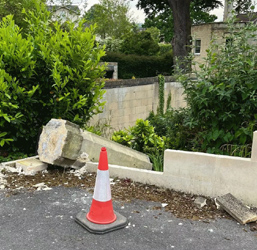 Watchdog does not usually comment on traffic schemes, but the picture on the right was brought to our attention because the Sydney Road has listed buildings in it and the barriers across the carriageway force any traffic arriving at the barriers to return the way they came. The problem is that the road wasn't designed for larger vehicles to turn round, and one lorry did the pictured damage to a stone gatepost. While the lorry driver's insurance will probably pay for the repairs, the unlucky owner of the gatepost will have to raise a planning application if the address is a listed building, and also organise the repairs. It is the potential impact on listed buildings that makes this traffic management decision an issue for Watchdog to comment on.
- We were provided with a link to the Chronicle article that the picture came from. The associated report reveals that there was an expectation that no traffic would attempt to use the blocked-off road. So we are giving some information that the Cabinet Member for Transport should know but clearly doesn't.
• Google will be interested in a road closure because they have a rolling programme of filming the streets for "Streetview". What Google does not do is share the information or use it for any other purpose.
• Drivers and their businesses do their route planning using SatNav systems. SatNavs are updated from TROs. ETROs are temporary alterations and they do not update SatNavs. Any driver using a SatNav will be directed down Sydney Road because as far as a SatNav application is concerned, it remains a through route. Using ETROs for LN management guarantees that SatNavs will continue to treat the roads as through routes.
• A driver might notice some roadside signage and take an alternative route despite the guidance from the SatNav, but if there is a significant traffic distraction, looking for signs affecting a route will be a secondary concern, especially if that route might have been used successfully many times before and with the SatNav voice directing the driver down the road. The position of the barriers needs to be in a place where a large vehicle can turn round, and it currently isn't. The position of the coach pictured in the Chronicle article blocks the entire road and pavement for walkers and cyclists as well as motor vehicles, and while the LN is the subject of an ETRO that doesn't update SatNav maps it is likely to be repeated several times more during the "experimental" period. - Bath Quays North - Last updated 19 May 2024.
- On 5 May 2024 we reported an item on the Agenda for the Planning Committee meeting on 8 May is the Reserved Matters application for Bath Quays North site. It is interesting to see how the conflict between "the Council's flagship regeneration project" and the policies that apply in that location is treated in the brief to the Committee Members. Where the Outline Approval requires something that isn't provided it is claimed to nevertheless be unreasonable to refuse and yet when something exceeds what the Outline approves, the extras are claimed to not matter. The planning history show that the original Outline Permission was amended by both a Non-Material Amendment and a Variation so the outline permission isn't as immoveable as the Committee is being advised. Another Variation application could reset some design parameters.
- We added: More seriously, there is a presumption in the NPPF and in various planning policies that the development must look as though it belongs in the character of the area or else be refused, and the OUV for "The City Of Bath" emphasises the limited palette of materials, which the application on the Agenda does not comply with so that whilst it is true that the harm is "less than substantial", it is in the higher range of the "less than" category. The brief does inform the Members of these shortfalls, but nevertheless the Case Officer has recommended that permission be granted. This is skating on thin ice. The objection from Historic England is detailed and comprehensive, and Historic England has a automatic right to refer a decision that they disapprove of to the Secretary of State with a request that the SofS should call it in for his own determination. Following the Case Officer's recommendation could involve the council in a full Public Inquiry. That is something for the Committee to ponder over.
- 19 May 2024 footnote: The application was reported in a Chronicle article, in a bit more detail than the official Minutes. For instance, wrongly describing the site as "a tip in the middle of Bath" when the site was a well-used car park until very recently, didn't get into the official minutes. The application was permitted by 7 votes to 2 despite four of the Members criticising the design. It was interesting to note that the Case Officer informed the Committee that Historic England "had reservations" when their criticism was actually "strong reservations" and "the scheme requires further alteration", so much more detailed than that. The Deputy Head of Planning effectively closed down the criticisms of the design by saying that a refusal would require an explanation of why the design was not in keeping with the character, yet that information is covered by Historic England criticism and some of the public comments. Also overlooked was the opportunity to build modern offices inside a shell that looked like the character of the area, yet in the 1930s Churchill House combined an Art Deco interior with a Georgian appearance exterior, and there have been a number of developments since the end of WW2 that also proved it would have been possible.
- It remains to be seen whether Historic England will use their automatic right to ask the Secretary of State to call in the decision. It also remains to be seen what ICOMOS will decide to do once construction gets under way because Historic England didn't call in the decision and it becomes obvious that the obligation on the Secretary of State to preserve the character of the World Heritage Site has been ignored. It is ICOMOS rather than UNESCO who recommend what action the World Heritage Committee should take, so the lack of comment from UNESCO is not significant.
- Milsom Quarter - Last updated 12 May 2024.
- The on-line Chronicle added an article on 8th May advertising drop-in sessions on 8th to 11th May, and the printed Chronicle dated 9th May devoted a few column inches of words to the subject, omitting reference to the 8th and omitting the Artist's Impression placed on-line. When drop-in sessions take a bit of preparation, it should have been possible to have given more notice of the dates. It does suggest that the hosts were attempting to limit the number dropping in. The article does give a link to a proposed on-line engagement, but that is not as informative as a face-to-face discussion.
- Our first thoughts having seen the Artist's Impression is to wonder how the occupants of the shops in Milsom Street are expected to get their stock delivered because any vehicle stopping to unload in the residual width of the roadway shown, will block all other vehicles hoping to also deliver to other premises until their unload is completed. It also looks as though the disabled with limited mobility relying on their car and Blue Badge to get within their walking distance to the shops will be denied access to the entire quarter. This looks like an offence against the Equalities Act, and we wonder whether it might provoke a test case in court for the council to defend.
- More HMOs - Last updated 12 May 2024.
- The Bath Echo has an article identifying the concerns of the Odd Down Councillors about the loss of residential properties now that their area is attracting HMO developments. From a developer's point of view, HMOs take an existing property and modify its internal layout and perhaps add an extension. This is always a cheaper investment per future resident than building from scratch, and cost-conscious students prefer them because they are nearly always cheaper (and usually with fewer restrictions) than PBSA accommodation which is where the complaints of too many vacant rooms are coming from. Now that Oldfield Park and Twerton are effectively saturated with HMOs under the current planning policies, it is inevitable that other areas are now the target of developers.
- Although it is true that HMOs can accommodate students or young professionals, those landlords of HMOs very much prefer students because the students vacate the premises in the summer and the rooms can then be holiday lets for additional income. While young professionals will technically occupy a building that in council parlance is an HMO, they will prefer an unmodified house which will not have a September to June letting period.
- We have always said that the housing mix should be assessed on numbers of people in the various categories rather than the number of properties of different types. This is because in some areas of Oldfield Park, a typical 3-bedroom family home can be modified to a HMO housing 7 or 8 inhabitants. There is at least one street where the HMOs are around a third of the properties, but accommodate more occupants than the other two thirds of the street. There is currently an exercise of preparing for a future Local Plan, and if Councillors are concerned about "exponential growth" in their areas they should be lobbying for a "per head" rather than "per property" control of the housing mix in future.
- Hartwells Site - Last updated 28 April 2024.
- Application 23/03955/RES has been approved, with 7 Conditions to be met. Two are to be signed off before construction starts and four are to be approved before the development is first occupied. We will be watching for these to be submitted for approval.
- Frome House - Last updated 28 April 2024.
- We have been keeping an eye on the applications for discharging the Conditions attached to the Appeal Decision. While we recognise that there are documents which allow 23/04143/COND to be discharged, it reaches that conclusion with the submission of Hard and Soft Landscaping plans dated 29/11/23 which haven't yet been lodged on the planning website for the Conditions application despite being dated 5 months previously. Each planning application is supposed to be self sufficient, and that includes any documentation also filed elsewhere.
- Application 24/01168/REG03 - Last updated 21 April 2024.
- Whilst there is no legal limit to the number of concurrent planning applications that can exist for a particular piece of land, the land in question here, described as "Land To The Rear Of 89 To123 Englishcombe Lane" has an application for 24/01168/REG03, yet the Planning Committee has already approved 18/01516/REG04 so that it is in the hands of the Case Officer to grant planning permission at any time in the future. Despite the 2021 council statement "Mr Guy said the council was committed to ecology and protecting green spaces so the plans for the tufa field would be withdrawn", that hasn't happened, so that even if the latest application is permitted and built it could still be replaced by the 2018 permission at any time afterwards. There are only two ways of delivering Mr Guy's promise: to formally withdraw the planning application; or to consider it again in the Planning Committee and reach a decision to refuse. When the Committee made its "Delegate to Permit" decision it was passed by just one vote and that was because one Member who spoke against the proposals was banned from voting on a technicality. Thus there is a genuine reason for considering it again with a mind to refuse it.
- As far as the current application is concerned, the documentation doesn't mention the three tufa flushes in this field. Tufa flushes are areas where the tufa deposits spread out around the source spring carrying nutrients and giving rise to characteristic lime-loving flora, rather than the slightly more common tufa springs sites which are just the characteristic limestone deposits. The tufa flush near the centre of the site which has been there the longest has been retained as land not to be built on, but the other two near the eastern and western ends formed about 10 years ago, and are considered permanent because the characteristic flora and fauna have been retained, despite the 2020 attempts to remove them and the slow-worms that lived there, an action contrary to the Wildlife and Countryside Act 1981 and the Countryside and Rights Of Way Act 2000 which increased the range of penalties in the Countryside Act. There is photographic evidence that the council as landowner committed or allowed to be committed, damage to a protected species in 2020, and that offence is not yet time expired.
- The other significant omission is that tufa deposits require running water with a particular chemical composition, either from springs emerging in the site or water from springs emerging above the site then running through it. The eastern and western tufa flushes appear to have originally emerged within the site and that requires the water table to be very close to the surface. The planning application places buildings over these springs and claims that the water table is far below! If springs are blocked they will simply emerge somewhere else, and the entire site is surrounded by residential developments any of which might then be adversely affected.
- The other constraints on the site, are being a designated Site of Nature Conservation Interest, an SSSI Impact Zone, an important view across the World Heritage Sites, plus covered by the Government's list of Special Areas of Conservation identifying tufa sites ("Habitat 7220: Petrifying springs with tufa formation") because the total area of this habitat type is small ("Tufa formation is associated with hard water springs where groundwater rich in calcium bicarbonate comes to the surface. On contact with air, carbon dioxide is lost from the water and a hard deposit of calcium carbonate (tufa) is formed"). These have also been omitted from the planning documentation, despite tufa flushes being recognised as hot spots for botanical diversity. The entire site has been undeveloped since the second world war (when it was probably a "Dig For Victory" site) and it has been rarely grazed since, thus providing a large area of resident species as well as food supplies for foraging bats and birds and foxes. There is no chance of the existing biodiversity being enhanced by building over any part of the site, despite the claim that it will be achieved.
- The decision of allocating the site to "supported living units" may be designed to make the development on a protected site more attractive to the decision makers, but they should remember that other sites could have been chosen, and the legislation defines "exceptional reasons" as infrastructure projects not accommodation for people with learning disabilities. There is a declared Climate Emergency and Policy NE2 reinforces the World Heritage Site SPD, NE2A is supposed to protect the views that ICOMOS have repeatedly pointed out are more important than developments that would destroy them, and NE3 is supposed to protect habitats. None of these allow supported living units as exceptions. This is a council originated planning application, and the council should have known that its own policies ruled out developing this site.
- World Heritage Day - Last updated 14 April 2024.
- The world Heritage Day events are now past though there is also a more general website on Bath's two World Heritage inscriptions which is not date related and which gives a more general insight. This might be of interest to anybody unable to attend on 21 April.
- 3 Park View - Last updated 7 April 2024.
 We missed this planning application 24/00910/LBA as one of importance when we reviewed the new applications because it appeared to be repairs to a listed house that were unremarkable. However once the public notice had been put on display on 25 March a local resident sent us an email suggesting we had a closer look at the application because the Heritage Statement was inaccurate. We have since done some research, and the statement does make some false assumptions.
- The Park View site is one of a small number of locations in Bath where the house is separated from the front garden by the access route which covers a range of addresses. There are similar arrangements for Larkhall Place, and Devonshire Buildings has some addresses with an additional garden or structure across an access path or road. However those examples include the gardens etc in the list entry for the house. That is not the case for Park View.
- The primary problem with the Heritage Statement is that it quotes List Entry 1394334. That is the entry for the house (or more accurately, the terrace of houses). The Heritage Statement assumes that the front gardens are listed with the house, and that is not the case. The front gardens have a separate listing entry, number 1394338. Therefore the work on the garden structures needs its own Listed Building Application because it relates to a different list entry.
- We are also concerned that the air raid shelters description is a dismissive "shed". That may be how they are used currently but they have a historical importance because so few of the wartime shelters now survive, and those that do really need to be retained in their original format. We are therefore bringing the alteration risk to these shelters to the attention of the Bath Blitz Memorial Project.
- 28th April Footnote: There is now a Chronicle item on this application.
- 19th May Footnote: The "Existing and Proposed Shed" drawing has been marked as "Withdrawn" but the "Heritage, Design and Access Statement" still shows work being proposed on the bomb shelters so the application is now internally inconsistent.
- Council Policy Change - Last updated 31 March 2024.
- Although not a heritage issue it does have a relevance within the Bath World Heritage Site, and we think it is useful to bring to readers' attention a new council policy coming into effect from 1st April.
- The Chronicle article describes the introduction of a charge to replace a wheelie-bin lost or stolen. Whether the charge also applies to a bin damaged, either by the collection team, by vandals, or by being blown over by gales is not clear. The council website vaguely says that replacements for damaged bins may be charged.
- Reports from some of our members that some of the collection teams do not return bins to the place they were collected from indicates that there may be some anxiety over bins temporarily lost. We suggest that for peace of mind wheelie-bins should be clearly marked with an identifier which will make it easier for stray bins to be returned to their owners, and more difficult for a marked bin to be taken by someone else missing their bin.
- Homebase Site - Last updated 24 March 2024.
- In the Bath Echo is an item announcing a public exhibition of the latest plans for the former Homebase site on a date now passed. However despite the link to the new owner's website, it doesn't show exactly what is planned for the Homebase site on the date of this update, just a general intention. Rather confusingly, the owner's website refers to the site as "Pines Way" yet that address is generally understood to refer to the offices between Pines Way and the Lower Bristol Road. The vehicular access to Homebase used to be via Ivo Peters Road.
- We gave our impression of the development in our 21 January update below, including the information that the original planning application was refused and that refusal was overturned on appeal, primarily because the provision of accommodation for the elderly on level ground with good connections to facilities was such an overriding public benefit. It is still extant as a planning permission and could still legally be built. The replacement scheme does not have that public benefit. If the combination of buy-to-let housing alongside commercial and retail spaces is similarly refused when that planning application is submitted, it seems unlikely that an appeal without that public benefit of accommodation for the elderly would succeed, especially when ICOMOS has recently pointed out that the remainder of the Western Riverside development with its high-rise residential accommodation already puts both of Bath's World Heritage Site designations at risk.
- Tufa Field - Last updated 17 March 2024.
- We were made aware of the existence of a new proposal for building on the tufa field by a Chronicle article. It was too late to attend the exhibition so we are providing here a link to the plans so that others in a similar position can see what is proposed. For those unfamiliar with the tufa field there is a website created by those who don't want this unique habitat to be destroyed.
- The first point to make is that the Chronicle article claims that the previous application had been scrapped and gave a link to a 2021 council statement "Mr Guy said the council was committed to ecology and protecting green spaces so the plans for the tufa field would be withdrawn". The plans (18/01516/REG04) had gone to Committee and the Committee decision was "Delegate to Permit" after one of the Committee Members who had spoken against it during the virtual meeting was banned from voting under the virtual rules, so that the Case Officer was given the authority to approve, a position which never times out, and that still remains the situation today because Mr Guy never followed his words with the necessary action. To withdraw the permission, it needs to go back to the Committee where it must be refused. As far as building anything on the tufa field is concerned, the 2023 update to the local plan, triggered by declaring an ecological emergency, should rule it out.
 The claims for improved biodiversity should start from the position before the council sent a lawnmower round the field in 2020 and mangled some slow-worms (see picture, which will not be an isolated example) which are just one of the protected species. Further damage was clearly planned in 2023 when a forklift truck that should only have been used on level ground tipped over as it tried to enter the field. It would have crushed wildlife under the tyres had it succeeded.
- After such previous damage achieved and unsuccessfully attempted, claiming that the ecology which has the entire field to itself can be improved by restricting it to just a part of the field, which apart from slow-worms is also home to badgers and provides invertebrate food for bats. This is not only a legal offence - "The Wildlife and Countryside Act 1981 identified the slow-worm as a protected species that cannot be killed or injured, and imposes a fine of up to £5,000 for each offence. The Countryside and Rights of Way Act 2000 further updated the Countryside Act and added the option of a six month custodial sentence in addition to the fines" - but also ruled out by the update to the planning policies such that NE2 reinforces the World Heritage Site SPD, NE2A is supposed to protect the views that ICOMOS have repeatedly pointed out are more important than developments that would destroy them, and NE3 is supposed to protect habitats This field has special scientific interest because tufa springs are particularly rare, and it is within a Site of Nature Conservation Interest. The original claim was to reproduce in Pennyquick the UK Priority Habitat that this field is. This has never been shown to be successful so there is no mitigating evidence, required as a demonstrable last resort. Thus there is no possibility for the harm to the nature conservation value of the site to be offset and any plans to build on it must be refused outright.
- It is also relevant that the legislation defines exceptional reasons as infrastructure projects not accommodation for people with learning disabilities. Also the decision makers must not be misled that this is the only possible site for such accommodation when there is no Use Class for such accommodation so once built it can be used legally for general housing instead; This site is not a compatible site for Policy H1 facilities but others will be.
- The next objection is that the field should never have been designated as suitable for development because flooding is a potential risk. The water table is particularly high in this site because tufa springs only occur where the potential surface of the groundwater is above the actual surface and thus springs occur. Any foundations that occupy areas saturated by groundwater force the groundwater elsewhere and the field is surrounded by residences thus put at additional risk. Avoiding an increased flood risk is a Strategic Objective in planning system terms and the NPPF expects a supporting flood risk assessment. Policy CP5 references this requirement. For this reason an EIA is mandatory for any proposals for this site.
- The final reason for objecting is policy D5 which requires designing out potential seagull nesting and roosting areas and the buildings shown in the link to plans show flat roofs, very attractive to gulls when other roofs in the area are unsuitable.
- We encourage readers to object and encourage the use of the arguments above.
- Bath's Visitors - Last updated 10 March 2024.
- It is good to read in the Bath Echo that visitor income has been forecast to exceed pre-pandemic levels, and it is good to read that it will increase further in the future, but the income is only part of the story. Whilst the Fashion Museum was forced to leave the Assembly Rooms when the National Trust foreclosed the lease and the council had no control over that, the council did make the decision for where it should go afterwards. The choice of the former Post Office for the museum and a separate "Collection Centre" in Locksbrook for the benefit of the universities was to make the council's application to the Government for Levelling Up funding for the "Milsom Quarter" more likely to succeed with a "community asset" hook. Making the application cost £55,000 and it didn't succeed.
- We note that the future work list retains the idea of using the Post Office, despite the alternative locations that were rejected being perhaps far more suitable than the Grade II listed Post Office provided the ambition to locate it in the Milsom Quarter as part of an extensive masterplan was no longer treated as a sacred cow. It is by no means certain that the modifications to make the former Post Office suitable for the collection of rare and delicate fabrics would be possible within the restrictions imposed by the Listed Building legislation. Is there a "Plan B" if the former Post Office cannot be suitably adapted or if the adaptations would not be affordable? Similarly, the Cornmarket building is Grade II listed and the masterplan suggests that "the Cornmarket site" should be for housing which would be contrary to the legislation protecting listed buildings so that they are not treated as disposable. Could the Cornmarket be used for the Fashion Museum instead of the former Post Office? It is a convenient walking distance from the Roman Baths and would be big enough for the museum open to the public and also the university interests originally planned for Locksbrook.
- The issue that the future work list overlooks is that when the collection was in the Assembly Rooms, visitors paid to see it and thus provided the council with an income stream. After it was removed from the Assembly Rooms the delicate fabrics had to be stored in a controlled environment to retain the fabrics in good condition, and a year ago it was reported to be costing £150,000 a year for that storage; it is not known whether that remains the price. There needs to be a reconsideration of the "four of five years" timescale for getting the collection once again open to the paying public so that it changes from a revenue drain to a revenue earner once more. The other thing that needs to be reconsidered is the idea of the separate "Collection Centre" which appears to be an idea to make the Levelling Up bid more attractive, when making the relocated museum more attractive should be the aim. The paying public would want to see as much of the collection as possible in the museum visit. As a minimum, everything that could have been seen in the Assembly Rooms should be viewable in the new location, and if there is more space available then more should be on show.
- March Planning Committee - Last updated 3 March 2024.
- One of the items on the agenda is for 53 Rockliffe Road, and the Committee Report is now available, but it has some omissions.
- The site has an interesting history, being originally a builder's yard then left unused until a planning permission 17/03178/FUL was obtained to add the land to the garden of 53 Rockliffe Road. It therefore inherited the Use Class C3 from that address. That planning permission included a Condition that a hard and soft landscape scheme should be approved by the local planning authority, and another that required the approved scheme to be delivered and the approved planting that doesn't survive must be replaced within 5 years of the development being completed. The scheme was approved in 17/05066/COND but that approval made it clear that the Condition requiring its delivery was still outstanding, and that Condition included the restriction "The works shall be carried out prior to the occupation of any part of the development", and erecting a building on it that was not part of the landscape approved is a form of occupation. That approved scheme has not been delivered so there is still an outstanding Enforcement situation requiring the delivery to be completed before occupation for anything else. Therefore, theoretically the current application to build on the site is at least 5 years premature. That hasn't been mentioned in the brief to the Committee members, and although they have legislative authority to grant a permission with different Conditions they are required to consider the existing Conditions not complied with in their deliberations, which will include failing to deliver biodiversity gains because Condition 3 (for a replacement wildlife habitat for approval by the LPA) has not been delivered; and it is after that expected gain from the approved planting that should be the yardstick that the proposed development has to improve on.
- Also, the NPPF reminds of policies to resist inappropriate development of residential gardens. It doesn't clarify what "inappropriate" exactly means, but the brief to the Planning Committee should have mentioned that the NPPF requires suitable justification, and the outstanding requirement to actually make it a garden makes that justification problematical.
- What the Planning Committee decide remains to be seen, but there are planning reasons for refusing any new use of the land until after the garden area has been delivered in accordance with the approved landscape permission rather than being left derelict. It is also relevant that once a dwelling is built it must have an address, which can't be 53 Rockliffe Road when the entrance to it is in Forrester Avenue, and therefore the land has to cease to be part of its garden once it becomes residential, in order to avoid the NPPF trap of "inappropriate development" which would automatically follow an additional residence built in a location that remains in the garden. That is not mentioned in the Committee Report either, but it is an inevitable outcome omitted from the Design and Access Statement.
- It is fortunate that where the building is proposed to be erected is difficult to see from the public realm nearby, but the Committee might also consider whether the "brutalist" design would mar the views of the WHS from more distant elevated locations.
- Proposed Stadium On The Rec - Last updated 3 March 2024.
- A new objection from Kirsten Elliott has appeared on 23/03558/EFUL which is worth reading. The most interesting observation is that some documents were handed to the Rugby Club's solicitors who are now not allowing anybody to see them. This appears to be because they contain information which show that there are reasons to refuse the application because the application contains false claims. Whoever passed the documents over should immediately demand them back (allowing the solicitors to make copies first if they wish) because at present the solicitors have effectively confiscated them to prevent the public knowing what they contain. As a general rule, if documents are passed to anybody, what is passed needs to be copies (certified "True Copy" if necessary) and not the originals.
- Additional Housing - Last updated 25 February 2024.
- The Chronicle has an article on the housing expectations recently published by the Government. The article looks at the council's reaction to it which doesn't seem to properly address the constraints. Despite a World Heritage Management Plan which clarifies how the Outstanding Universal Value should be protected, and a World Heritage Supplementary Planning Document which emphasises the essential protection of the WHS and its setting, and the NPPF which warns that inappropriate developments within the WHS or its setting can cause substantial harm to the OUV, protection of the WHS does not seem to be a major influence on planning decisions.
- We are concerned that the approach taken previously to maximise the accommodation numbers is to build upwards which is contrary to the OUV requirement to preserve the WHS as something "of human scale", which according to ICOMOS-UK would normally be interpreted as no more than 4 storeys from the street level; and 6 storeys in exceptional circumstances should be the maximum. It is also part of the OUV that open spaces among the buildings are significant and need to be preserved, yet developers are being given permission to build on important pieces of open land, and attempts by the residents to get green spaces offered proper protection are routinely left pending or rejected by the council.
- This lack of proper care for the OUV has recently led ICOMOS to raise some very detailed complaints about some local plans. The initial warning was that the World Heritage Committee had asked that the second and third phases of the Western Riverside Project should be revised to protect important views and to achieve a more acceptable density. The State Party (DCMS) claimed that it was too late, despite no planning permission being sought by then for the later stages; and the Local Authority completely ignored the Committee recommendation. Then followed some detailed ICOMOS criticisms on other planning applications, first the former gas works, then the stadium on the Rec. Historic England has recognised that the Lidl development at Lambridge also has a significant adverse impact on the OUV and recommends that ICOMOS should be asked to examine the Lidl development application and expects a similar ICOMOS objection there too. The warnings from ICOMOS must be taken seriously. Dresden lost their WHS inscription by not changing the design of a bridge, Liverpool lost its WHS inscription by approving its unacceptable plans for its historic waterfront; yet Edinburgh did take its warning seriously and changed a development design to retain its WHS inscription. By ignoring the recommendation on the design of the later phases of the Western Riverside development the council is already on thin ice but hasn't publicly recognised this. It needs to colour future planning decisions though.
- Each of these ICOMOS objections has a clear veto on "harm to the OUV" grounds, yet there is no indication that they are likely to be refused on those grounds, and we have to wonder why not? If they are refused then the applicants have a right to appeal, yet with the very clear warning that approval would cause serious harm to the OUV and put both the WHS designations at risk it is not at all likely that the Planning Inspectorate would embarrass their Minister by overriding the refusal. After all, the Great Spa Towns of Europe WHS, inscribed in 2021, is a group of 11 towns across 7 countries in Europe laid out around natural springs, and a loss of that inscription by any one of the 11 locations will also destroy the inscription for the others. DCMS will not want to be responsible for that outcome.
- As far as housing within Bath is concerned there is a conflict between accommodation unit number targets and actual requirements. So far the numbers game has taken priority with emphasis being on one and two bedroom flats as much as possible, which gets the higher number of accommodation units for a given land area. It gets the target more easily attainable but forces many families wanting a house with a garden for their children to play in to live outside Bath and commute in for their work and/or social entertainment.
- The council is running a consultation on where the new and additional housing might be built and we hope that some of our readers might have suggestions to contribute, ideally steering their comments towards keeping family oriented employees living near their place of employment in the type of accommodation that suits family life.
- Dark Skies Objective - Last updated 18 February 2024.
- The West of England Metro Mayor is encouraging residents and businesses to help reduce light pollution. As a general rule, Bath is a low illumination city and we have noticed the occasional planning application where proposed external lighting has been negotiated out to preserve this character, so there shouldn't be a problem.
- However, when we did some random enquiries about locations where that hasn't happened and then checked their planning permissions to see what had been said about the lighting reported, we discovered that some of the worst offenders didn't have planning permission for it. Two examples will suffice for the principle but there are others. The two we checked the planning permissions for were the Newark Works, where we found a document assessing the impact of light spillage which goes into considerable detail on the light spill impact on the river corridor but makes no mention of the Lower Bristol Road frontage which has grown a rash of unauthorised up and down lighters which are not mentioned in the listed building application despite changing the external appearance, and they have not been assessed for light spillage. The second one was 42 Third Avenue where planning permission was granted for conversion of workshops and showrooms into residential accommodation, yet in addition to that work a row of uplighters was added alongside two sides of the development, additions which were not mentioned in any of the relevant planning applications. Perhaps Enforcement could insist that these external lighting arrangements without planning permission are never used.
- Whilst we accept that it is not practical to check every planning permission delivered to see if there were any additions, we are concerned about the "silence means consent" assumptions that some developers adopt. We recommend that a standard Condition is added to each planning permission granted which specifically bans any additional external lighting that isn't part of the planning application, for the avoidance of doubt.
- LIDL at Lambridge - Last updated 11 February 2024.
- On the planning application for the proposed LIDL supermarket off the London Road at Lambridge there has been a set of about 60 revised drawings and other documents. This is a major amendment to the original application and it could therefore invalidate many of the comments submitted by the public. Those who have submitted their comments, whether they are for or against, should assume that unless they submit new comments on the replacement documentation their original comments will be given little weight by the Case Officer. New comments will be accepted for the remainder of February.
- Claverton Pumping Station - Last updated 11 February 2024.
- Although located outside the World Heritage Site boundary the pumping station is part of the supporting infrastructure of the Kennet and Avon Canal which begins in Bath, and Watchdog assisted the volunteers in preparing their planning application for the installation of their Red Wheel Award on the Grade I listed building so we have previous association with the site. The latest problem is described in a news item describing a problem with the 200-year old waterwheel and providing their link to their fundraising page which shows that when the "Just Giving" appeal closed the required sum to repair the damage had been reached. We are nevertheless mentioning it here as the explanation of why the wheel will not be seen in operation until after the repairs are completed.
- Proposed Stadium On The Rec - Last updated 4 February 2024.
- On 10 December 2023 we offered our comments on the planning application for a stadium on the Rec. We observed that DCMS asked ICOMOS-UK to examine and comment on application 23/03558/EFUL. The result was a 12-page objection to it "in its current form" though the potted summary "It appears that the greatly increased capacity and significantly upgraded hospitality functions could not be achieved without harm to the OUV of the WHS in this very sensitive location" gives a flavour of the whole document, which we think should be read in full.
- There is also criticism of the Heritage Impact Assessments provided by the applicants: "The outcome of the [Heritage Impact] Assessments appear to markedly underestimate and minimise the significance of the impact on the OUV of the two World Heritage Sites. The UNESCO Guidance at p.45 states clearly that ‘By definition, WH properties are sensitive and internationally important so even a small change may have a significant impact’. Awareness of this fundamental aspects of WHSs does not appear to inform the conclusion of the HIAs". This is confirmation of the impression gained from reading the application documents that all problems have been minimised by the applicants.
- Finally, the threat of the consequences if the application is permitted is very clear: "If granted permission in its current form it would impact highly negatively on both World Heritage Sites. Furthermore, this impact would also apply to all the other ten component sites of the Great Spa Towns series in six European partner countries that were inscribed alongside Bath as part of the 2021 transnational inscription championed by both national and local government. The proposed stadium should therefore not be granted planning permission". The 11 were identified on the planning file in Philip Fawkner-Corbett's objection.
- On 28 January 2024 we noticed that there is a 13-page comment by Farrell & Co dated 18 January 2024, criticising the "professional" consultation advice in the planning Documents List which is supposed to inform the decision makers, and identifying the important issues that they should have recognised but did not. We looked at their website and they are a well established company advertising architectural services which includes constraints of the site and of council planning policy, and expertise in responding to aspirations. The comment identified on the planning file is identified under the description "Martin Farrell" and has very wrongly been identified as a General Comment when anybody reading it (which we recommend) will very quickly conclude that it is a very detailed Objection Comment.
- Since then there has been a report ("ICOMOS Technical Review") which covers the history of the Rec from a usage point of view (ie ignoring the legal aspects and using quotes from the World Heritage Management Plan rather than council planning policies) and assessing how it relates to the World Heritage. The review supported the conclusions of the ICOMOS-UK Consultation Response that the proposed stadium would significantly harm the OUV of the WHS.
- The last World Heritage Management Plan we could find on the B&NES website covered 2016 to 2022 which would cover the Great Spa Towns of Europe inscription in July 2021, but there ought to be a replacement Management Plan from 2023 onwards, but it is not indexed for searches on the website. The World Heritage Site Setting Supplementary Planning Document is dated August 2013, and that specifically expects: Firstly to ensure protection of the WHS. This includes the following aspects: the Outstanding Universal Value including the Site’s integrity, the Site’s authenticity and the Site’s significance; Secondly to ensure that the setting is appropriately protected and properly managed; Thirdly to enable the significance of the WHS to be revealed and appreciated. The NPPF also tries to protect World Heritage sites: Significance can be harmed or lost through alteration or destruction of the heritage asset or development within its setting; and that ‘Substantial harm to or loss of designated heritage assets of the highest significance, notably ... World Heritage Sites, should be wholly exceptional
- Despite this, the recent planning decisions permitting buildings that do not adhere to the OUV expectation of retaining the "human scale" of developments demonstrate that the SPD is either not understood or has been ignored. The legislation attempts to protect World Heritage (for instance the Permitted Development legislation has a catch-all exclusion of alterations to a roof of a building in a World Heritage site, which covers demolition as well as modifications which is why Waterworks Cottage was excluded from Permitted development under Part 11, yet the Case Officer ignored this) and the SPD expects a compatible design to its neighbourhood and this too was ignored. The World Heritage Advisory Board is now suggesting that the World Heritage function should be moved from Heritage Services to Planning. If that is approved, will further farcical planning decisions follow? What is actually needed is for Heritage Services to be given a planning veto rather than being disbanded.
- The Boater - Last updated 28 January 2024.
- The new planning application for signage at The Boater in Argyle Street is like a curate's egg (good in parts). The signs are at the back at the entrance to the garden. In that location they do not invalidate any of the characteristics identified in the listing, and they mark the rear entrance to the pub from Spring Gardens Road where currently the pub is not identified so that those who don't already know that it is giving access to The Boater will not use it. The signs are of a style that respects the listed building. We also recognise that the garden area is not well lit so the traditional style lanterns on the gateposts make sense from a safety perspective.
- That is the "good". The part we are thinking is not appropriate is the illuminated totem. Given the size of the sign proposed for the gate, a smaller sign alongside it does not seem necessary and trough lighting on a listed building is not normally considered acceptable. We recommend that this feature is removed. If it stays, then the normal material for listed building signage is painted timber, not aluminium.
- Homebase Site - Last updated 21 January 2024.
- In the Bath Echo is an item outlining the sale of the former Homebase site and the new owners are planning an alternative scheme for buy-to-rent and affordable housing instead of the previous application for retirement flats and offices, which was rejected by the Planning Committee but granted on appeal (though the article doesn't mention the appeal).
- This looks like yet another example of an applicant obtaining planning permission and then selling on the land with planning permission at a profitable price.
- However, the Planning Inspector made a site visit before the hearing and the Appeal Decision for 20/00259/FUL makes interesting reading. Two of the four reasons for refusal were removed during the preparation of the Statement of Common Ground, which suggests that if the decision process had been deferred for further negotiation, these reasons could have been removed beforehand, leaving just the character of the area and the impact on nearby residents in the Appeal against the refusal for care residences with ancillary communal care and well-being facilities and offices.
- The Appeal focused on Policy SB7(B) which describes a new city quarter that complements the Bath Western Riverside. Having made that association, and the council having agreed that the current two-storey structure added nothing to the area, the council's argument that the use of buff brick and sheet metal was prohibited by the Western Riverside SPD was dismissed when it was conceded that nevertheless the SPD had been regularly ignored and both of these materials feature prominently in the Western Riverside development. The argument that the heights of two of the proposed building were excessive was shot down by the observation that even taller buildings had been approved and built on the Western Riverside, and the SPD accepts buildings up to the height of the tallest proposed building. Those excessively tall buildings in the Western Riverside were permitted despite significant objections in the consultation period, so "hoist with your own petard" springs to mind.
- The telling issue in the Appeal was the council's attempt to protect the Outstanding Universal Value of the WHS. The main council representative asked for the top two floors of the 6-storey building to be removed to preserve the views across the WHS whilst the council's heritage officer pointed out that to preserve all the views across, the height should be 2-storeys across the development, the height which had been described by the council as "an anomaly". The Appeal Inspector accepted that some harm would be caused, but also recognised that the NPPF allowed harm to be balanced by public benefit, and accommodation for the elderly on level ground with good connections to facilities was such an overriding benefit. The Appeal was allowed, and it is still extant and could be built with that permission. Hence our assumption that the intention all along was to provide a planning application to obtain consent and then sell on the site. The acceptance of the pre-commencement conditions is irrelevant if there is no intention to proceed.
- The decision was made in 2021, and since then there have been several complaints from ICOMOS that the council's plans would create serious harm to the OUV, contrary to the Planning Inspector's opinion that the harm would only be slight. The replacement affordable housing application (not yet submitted) has none of the offsetting benefits of using the only large level site for services for the elderly. The lesson for the council is that reasons for refusal have to be carefully worded to make future appeals less likely to succeed, and the assessments of importance by ICOMOS must override the generalities in the NPPF where they conflict. The replacement application when lodged should immediately be referred to ICOMOS, as required (but often ignored) in the Operational Guidelines (Section 118bis).
- Assembly Rooms - Last updated 21 January 2024.
- The planning applications from the National Trust covering the work that they want to do to the property now that the lease to the council has been terminated, were submitted and appeared in the list of new applications during the week commencing 7th January. The applications cover all that is proposed, but they make difficult reading for the average member of the public. For those who would like to know what is proposed in layman's terms, both the Bath Echo and the Chronicle have now published their articles.
- The Year 2023 - Last updated 14 January 2024.
- The website statistics for 2023 are now online on our Year Reports page.
- Floods - Last updated 14 January 2024.
- The council is responsible for risk management of flash flooding events and flooding from minor watercourses, and the Environment Agency is responsible for managing flooding caused by the River Avon. The river not only carries a lot of water during flooding events, it also carries a large volume of silt, as the Chronicle item on the Claverton Pumping Station confirms ("We’ve had ten or so volunteers down there over the last three days just clearing up tonnes of mud"), and before the Government in 2005 made the Environment Agency responsible for major rivers the Bristol Avon Local Flood Defence Committee had been responsible for the River Avon. The 1974 Greenhalgh Flood Protection scheme, documented in the Bath Reference Library and verified by the 2003 Hydrolab Report sponsored by the Environment Agency, specifies the minimum watercourse depth that should be maintained to provide the design capacity of the scheme of 365 cubic metres a second and ensure the effectiveness of the scheme installed, and the Committee bought a dredger to maintain what Greenhalgh specified.
- The council's approach has been to increase the areas which can store excess water until it can be taken away by the river, and this engineering work was completed during 2023. The Environment Agency has also been focused on storage capacity, but relying on water storage on the low lying flood plains instead of ensuring that the river depth is enough to carry away a larger volume of water, and this appears to be a faulty policy: the Greenhalgh design was based on flow rates, not volumes. Yet measurements made after the Environment Agency became responsible (and had sold off the dredger that had been in use) showed that west of Bath the silt had reduced the river depth to about half the target.
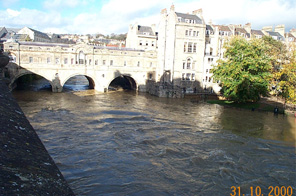 Thus when the New Year period of excessive rainfall caused the river to rise 1.5 metres overnight, the Greenhalgh design was overwhelmed temporarily and with the radial gate wide open Pulteney Weir disappeared underwater. The Chronicle coverage was accompanied by an admission that the Rec had flooded (proving that it is an active flood plain and is Zone 3B) and it raised a comment from the photographer on that news item that he had never seen the water that high before. However, we had; one of our members took this photograph in October 2000. The measured flow rate at the time was 285 cubic metres a second, well below the designed capacity originally being the aim for the dredger, yet Bath came within a few inches of flooding. This shows the detrimental effect of the Environment Agency's current policy. Whether the council can persuade the Environment Agency to restart regular dredging of the watercourse remains to be seen.
- Waterworks Cottage - Last updated 7 January 2024.
- The November 2023 Planning Committee refused permission for 23/02958/VAR, but quoting the excuse that the planning decision had not been issued, the decision was referred back to the Planning Committee on 13 December. Both the Bath Echo and the Chronicle provide some insight to the discussion and conclusion, and the Minutes of the meeting provide some further details, including the response to the Ward Councillor that "it was confirmed that the previous prior approval application [for the demolition] was in accordance with regulations" which has never been explained with reference to the legislation so this remains an opinion which we think is wrong.
- The e-mail from the applicant's agent is on the planning file, and this seems to have been taken at face value by the Committee members, when the implicit threat of "However, should planning permission be refused and they be forced to Appeal, then they will argue against any condition that seeks to restrict permitted development rights" when a refusal decision does not have Conditions attached so this position is meaningless.
- Nevertheless, the majority of the Committee ignored their purpose of making planning decisions in accordance with Planning Policies and the planning legislation none of which allow possible subsequent events to be part of the decision process. Another better example of doing the cheap thing rather than the right thing is difficult to imagine. It looks like an open goal if anyone wants to challenge the decision in a Judicial Review and that would cost the council more than handling an appeal.
- The other potential problem on the horizon is that ICOMOS-UK have given several warnings about the World Heritage attributions being at risk from recent planning applications, and about the evidence that their recommendations from the previous Mission have not been heeded. The World Heritage Committee meets in the summer of each year and they might recommend another Mission to Bath to see things as they now are and interview interested parties. There are several interested parties that might bring the Waterworks Cottage saga to their attention.
- Combe Down Allotments - Last updated 7 January 2024.
- Although outside our normal focus of attention, we have noted the Bath Echo item on the possible loss of the Combe Down allotment site, with no indication of what might replace it, and this is an undeveloped green space within the World Heritage area which might become a planning application for buildings, and that could be detrimental to the Outstanding Universal Value. So we looked up the planning policies and this is a site that provides community value, so any loss of that community value needs to be replaced elsewhere, and when there is a waiting list for other allotment sites those can't be claimed to be replacements.
- Also we looked up the legislation concerning allotments, and found this: "Where a local authority has purchased or appropriated land for use as allotments the local authority shall not sell, appropriate, use, or dispose of the land for any purpose other than use for allotments without the consent of the Minister of Agriculture and Fisheries . . and such consent may be given unconditionally or subject to such conditions as the Minister thinks fit, but shall not be given unless the Minister is satisfied that adequate provision will be made for allotment holders displaced by the action of the local authority or that such provision is unnecessary or not reasonably practicable". The council lease the site in order to rent out individual allotments so it is "appropriated" and the legislation suggests that the council has to request Ministerial permission for it to be anything else, in which case it should ideally be provided elsewhere. The Bath Echo item gives a link to a petition, and among the comments on the petition is the suggestion that the council might compulsorily purchase the site. If the council has to secure Ministerial permission for it to be anything other than allotments, that could be justification for such a course of action.
- Former Gasworks Site - Last updated 17 December 2023.
- Originally, this was allocated Planning Reference 23/03780/REG03 as a council application. It has been renumbered 23/03780/FUL and the applicant has changed to St William Homes LLP, the same as the application for the other part of the gasworks site. It looks as though the council has quietly disposed of the land.
- The description of the work to be done remains unchanged; it just covers site clearance and remediation works. The cynics of our members are expecting to see another pile of rubble opposite the pile where the Bath Press building used to be. Bookends!
- Looking at it practically, we assume money changed hands which will add to the council's funds, and it insulates the council from the accusations of demolishing the Pipe Bridge having previously promised the public that it would be retained. Demolition can now be blamed on St William Homes.
- Waterworks Cottage - Last updated 10 December 2023.
- The November 2023 Planning Committee refused permission for 23/02958/VAR and that refusal is recorded in the Minutes. Apparently the applicants complained and the same application is now listed for another decision process on 13 December.
- The Courts have for a long time suggested that local planning authorities were not able to issue a second planning decision on one application: see, e.g. R v Yeovil Borough Council Ex p. Trustees of Elim Pentecostal Church, Yeovil 70 L.G.R. 142; (1972) 23 P. & C.R. 39 at 44; Heron Corp Ltd v Manchester City Council (1977) 33 P. & C.R. 268 at 271–272. There is also clarifying Case Law from a 2014 Appeal hearing that says "If a planning permission has been granted, whether on appeal by the Secretary of State or by an appointed person, or on an application for planning permission by a local planning authority, there is no power to "withdraw" that planning permission on the basis that there has been an administrative error at some stage in the decision making process." Whilst the case under discussion was a permission granted and then an attempt was being made to refuse it, the underlying legal principle seems to be that the first decision remains despite an administrative error during the decision process being discovered afterwards. In the case of the Waterworks Cottage application, the applicant can use the appeal process against the decision made to refuse, but the council can't consider again the same application.
- Footnote: When we looked at the documents on the planning application to see if the comments above had been heeded, we noticed that there was a new comment (it is marked as a General Comment, but it is very clearly an Objection) from "Colin Scott", but the document is redacted and we can not identify where he writes from. In it there is chapter and verse of the regulations concerning Permitted Development, and that included reasons why the belief that Waterworks Cottage could be demolished under Permitted Development is wrong, and these are different reasons than ours on 2 July 2023 below. It looks as though the assumption in the Committee Brief that the demolition is a Permitted Development needs to be revised. We will watch what happens in the Planning Committee now with interest.
- Former NatWest Bank, Moorland Road - Last updated 3 December 2023.
- Despite our concrns that application 23/02920/FUL for 6-7 Moorland Road should not be permitted under Delegated Authority because the Case Officer failed to heed the planning policies against it, permission has been granted. This now sets a planning precedent for any subsequent appeals aginst refusals which could ultimately destroy the District Shopping Centre. Why was the Planning Committee Chair not alert to this?
- Bartlett Street - Last updated 3 December 2023.
- The new application this week is for the demolition of 11-12 Bartlett Street and the replacement being a Class E business use for the ground floor and basement with two residences on the first floor. The design is described as "contemporary" and it aligns with the horizontal features of 9 and 10 so it shouldn't look particularly out of place despite that. However, the emphasis seems to be on being contemporary in preference to being practical.
- The ground floor entrance leads to the business premises and one thing that a typical business expects is some form of fascia on which to advertise their business and yet none is proposed. The other omission is the health and safety barrier protection for the workmen who will be needed to tend the green roof section. It seems to be fashionable to propose green roofs these days, but they are not plant and forget additions, they have two major disadvantages: they need maintenance, and they look like attractive nesting sites for seagulls. The rationale is that it will attenuate the water run-off, but it is a small proportion of the total roof area and it won't make a significant difference to the development's run-off. The probability of a seagull nest so close to a business entrance is bad for the business because when the young gulls are ready to fledge the parents get very aggressive towards people nearby.
- Former NatWest Bank, Moorland Road - Last updated 26 November 2023.
- The Ward Councillor requested that application 23/02920/FUL for 6-7 Moorland Road should go to Committee if the Case Officer is minded to approve it. We thought that this was highly desirable because this is a District Shopping Centre and is used as such. We also thought that it was not the applicant's place to identify the type of business that might occupy the token afterthought of a tiny commercial space which had insufficient room for storage in any significant volume, so even a solicitor's office or an Estate Agents would find it unsuitable, and with the existing garage demolished no business that needs staff to get out and about would want to use the commercial space that has no on-site parking in a shopping centre where short-term parking is the norm and is often filling the available spaces in the street.
- Despite this, the Chair of the Planning Committee has refused to allow open discussion of the plans. This decision includes a draft of the Case Officer's report which does recommend approval, despite the CP12 planning obligation to preserve or enhance the existing district shopping centre, and CR3 which forbids the change of use of shops to another use, which should be read as the ENTIRE ground floor being the primary shopping frontage. That requires as a very minimum, all the ground floor must be for business use, and ideally the existing garage should be retained for that business. How the Case Officer concluded that there is "no vehicular access" to the site that includes a garage has not been adequately explained. Also, the "proven lack of interest" is easy to generate by making the rental pricing unattractively high or the Terms unacceptable. Retail units in Moorland Road don't stay empty for long at the normal prices, and not all of the current businesses rely on a window display.
- One of the Ward Councillors requested a decision to approve should be taken in Committee, so the other now needs to take the Chair's short sighted decision to refuse that through any complaint or appeal processes available. It should not have been a single person decision; in the past it required two Committee Members to offer their opinions.
- Waterworks Cottage - Last updated 26 November 2023.
- On 5 November 2023 we provided a detailed criticism of application 23/02958/VAR which showed that there was too much attention paid to what the applicants indicated the legislation said rather than referring to the legislation itself and reading what it actually said. We assumed that the Committee Report was prepared by somebody inadequately trained in order to reach a recommendation to approve.
- Luckily, as reported by the Chronicle, the Planning Committee followed the legal advice that a variation to the approved drawings required the application as a whole to be considered not the variations separately, and that fundamental changes were outside the scope of the variation process. Ultimately the Case Officer's recommendation was overruled and the application was refused by 9 votes to 1.
- It remains to be seen whether the applicants will appeal the refusal, but when the variation was to revert to a design that a previous Appeal Inspector had deemed unacceptable, it seems unlikely to succeed.
- Council Budget - Last updated 19 November 2023.
- The Council leader has issued a statement about an expected budget overrun. Whilst the extra demands on the budget are recognised, there are underlying causes which were under council control where the lack of funds did not seem to be important.
- The council had no control over the decision by the National Trust to evict the Fashion Museum, but the loss of the council income stream seemed unimportant to the council after the decision was made. The ambitious "Milsom Quarter" required the Fashion Collection to go into the former Post Office despite it being unsuitable without alterations which might not be possible in the listed building. If attention had been given instead to finding somewhere quickly to host the collection or a reasonable part of it and restore the income stream from the visitors the council would not now be finding an annual sum just to to store the collection.
- Whilst it is true that the grant from central Government has reduced, a significant slice of this reduction is that central Government is no longer replacing the lost Council Tax that PBSAs and HMOs are exempt from. Despite this, it appears to be Council Policy that the Universities can have as many students as they please occupying properties which could have been family residences paying Council Tax, and trying to recover from that position was too little, too late. HMOs often have such significant alterations made inside (how else can a 3-bedroom house accommodate 7 or more students?) that they can never affordably be restored to family homes.
- The fairly pointless "Ring of Steel" that allows terrorists free vehicle entry outside the functioning hours and permanently unrestricted entry to terrorist pedestrians and cyclists is seen by the residents as pedestrianisation by the back door. Lifting bollards cost a lot of money and for a council short of money they are a self-inflicted wound. The further effect is that if getting to the shops is made more difficult or short term parking is too expensive for occasional visitors, footfall reduces and shops don't make enough profit to stay in business and empty shops pay no rent.
- With a shortage of family homes in Bath because the more affordable properties are now used by students, Bath is relying on workers commuting in to fill some vacancies and the cost of commuting and parking for a day every day makes a big dent in the income of lower paid workers. With less to spend, they will not be frequenting the shops and restaurants so much, and that too will affect the profitability of businesses.
- Frome House - Last updated 12 November 2023.
- Frome House, on the Lower Bristol Road was originally refused as 21/04147/FUL and this refusal was appealed. The applicants then submitted a smaller scale application 22/01299/FUL which was far less harmful to the nearby listed structures so we had no need to comment on it from an appearance perspective, but it was refused for other reasons. That too was appealed. We provided an extensive objection to the first application on appearance and heritage grounds but this was not properly emphasised at the hearing, and as a result on 20 April 2023 both refusals were overturned rather than just the second one we thought might succeed. We have been watching what happens next ever since.
- This week the question of which application would be taken forward has been answered by 23/04143/COND which makes it clear that it is the earlier application that is being taken forward despite it being the most damaging to the heritage assets of Bath. In view of the warning that ICOMOS has already sent to DCMS about negative and unacceptable impacts on the Outstanding Universal Value of the two World Heritage Sites, this will be yet another nail in the coffin of both of Bath's World Heritage Inscriptions.
- Unfortunately there is nothing we can now do to prevent the applicants from building what was given consent on Appeal. However this should be a lesson for Case Officers and Planning Committee Members, and to some extent the Heritage Officer who on this occasion failed to advise on the potential damage to the WHS and thus undermined one of the Appeal arguments put forward by the council. The appeal process only looks at the stated reasons for refusal, and if the Decision Notice for the first application had properly included the conflict with the policy to preserve the Outstanding Universal Value of Bath, that appeal would probably have been dismissed.
- Waterworks Cottage - Last updated 5 November 2023.
- Not content with fooling the Case Officer into believing that demolition of the cottage was acceptable as Permitted Development by quoting a small part of the Act when it the whole Act is examined it says that within a World Heritage Site modification of the building is excluded from the Permitted Development relaxations, then it follows that demolition, which is just an extreme case of modification, is also excluded. We notice that in the agenda for the next Planning Committee is an application (23/02958/VAR) for variations on the planning permission 23/00895/FUL. The Committee Brief has not appeared on the VAR planning file so we could not comment on it until the Committee Papers gave the Case Officer's recommendation to permit.
- Included in the drawings but not mentioned in reaching the recommendation is that Plot 2 has been expanded to the same dimensions that were in the refusal which was appealed. The Appeal Inspector who declined the appeal noted that the plot had a large overall footprint when compared to the typical composition of the closest existing plots close to it, and also that it was an edge-of-settlement site offering a harmonious transition between urban Bath and its picturesque rural surroundings. Application 23/00895/FUL specifically stated that Plot 2 addresses the Planning Inspector's concerns about plot size, and that was part of the decision to permit. To now attempt to override the Inspector's concern by attempting to amend the Condition 15 list of drawings permitted is doubtful legally (it could form a legitimate basis for a Judicial Review of any permission granted because the legislation doesn't support retrospective alterations to a permission already granted, without a review by the High Court) and any change to the site footprint must have a new planning application raised for its consideration. The comments reported in the Committee Brief cover this, so why the recommendation to permit ignored them is not understood. Perhaps the Case Officer training is not sufficient?
- The other issue that the Case Officer has not considered is that whilst the legislation has a definition of when work starts, there is no legal restriction on how long the development should then take, and the existing Condition 7 puts pressure on the developer to deliver it (in this case by preventing occupation). Condition 7 states that the landscape works shall be carried out "no later than the first planting season" yet the impression gained from how the suggested change will affect the development is that it must wait until the first planting season, which is not what the existing Condition says. The proposed amendment replaces a condition which sensibly ensures that it is delivered with one where the developer can effectively finish (and perhaps sell) the accommodation and then ignore Condition 7, in full confidence that Enforcement will probably not pursue it, because they so rarely do. Likewise Condition 8 was specifically included to meet the various concerns about harm to the wildlife that either inhabited or migrated across the application land, as mandated by the Wildlife and Countryside Act 1981 and the Natural Environment and Rural Communities Act 2006, and Condition 9 placed constraints on the developer to ensure that it took place. Condition 9 is not now part of the VAR because the proposed amendment to it was withdrawn, but from the developer's point of view once the development is occupied they will have achieved what they wanted to develop, and if Condition 7 is amended as they propose, then Condition 8 and therefore Condition 9 will coincide with the landscape implementation, and the damage to the habitat will have been done before they are even required to monitor it.
- The Ecology consultation response recommends refusal and adds "Please contact the Ecology Officers for further discussion, prior to issuing the decision, if the decision will differ from the above advice or requested condition/s". There is no indication that any such further discussion took place. When the Ecology objections included legislative reasons for refusal, this would be another grounds for a Judicial Review if permission is granted.
- We think that the only acceptable way to deal with the VAR in Committee is a partial consent, allowing Condition 5 to be amended but refusing everything else.
- Application 23/03668/FUL for 111 West Avenue - Last updated 5 November 2023.
- This application suggests in the description that it is a change of use, and this (false) description has fooled the pre-application person in the council to consider it as a replacement PBSA, which it is not, because it will not be "purpose built". This is a modification to an existing residential property to become a large HMO by the construction of additional parts of the retained building, and the existence of a significant number of other HMOs in the immediate locality should rule out obtaining planning permission according to the council's planning policy.
- It is also to be noted that although it is claimed to be for Norland students (despite Norland's promise not to further affect the local area, made in order to gain planning permission for the former City of Bath school additional building) the HMO use type (even a sui generis large HMO) cannot be restricted to any particular school and this could easily be or become just another student residence for any educational establishment. Oldfield Park is already overwhelmed by those.
- Hartwell's Site - Last updated 29 October 2023.
- In the New Applications list this week is the Reserved Matters application for the Hartwell's site. In a quick skim through we noticed that the Newbridge Road frontage is not a copy of anything local in Newbridge Road, but it does take cues from it. For instance, there are Gable Front designs nearby, and there is also a terrace with dormer windows in the roof nearby, so the design of a Gable Front with three rows of windows can be reviewed as an amalgam of these. Whether it is acceptable to then have a roof space above the top windows instead of the top windows within the roof space will be something for the planners to decide. We believe the Building Heights Strategy conflicts with this 3-storeys plus roof arrangement when part of the site is within a Conservation Area.
- Although the Planning Statement explains that part of the site dips into a quarry and allows taller buildings to be proposed there without exceeding the ridge height of the rest of the site, the resultant 5 storeys plus roof structure will neither comply with the World Heritage Outstanding Universal Value of Bath which expects "human scale" designs of which ICOMOS has recently reminded Bath and DCMS, nor comply with the Building Heights Strategy when the adjacent structures are 2-storey industrial buildings.
- However the other complication is that since the Outline Permission was granted after an appeal which was a public hearing, the Local Plan has been updated, and Policy B2A effectively requires speculative PBSA applications to be refused unless there is a proven need, and we didn't spot B2A mentioned, nor any such claim of a proven need in our skim of the documents. The documentation provided is insufficient: proof of the need must be provided and the now mandatory Heritage Impact Assessment must be provided for ICOMOS to assess because it is now a mandatory requirement in UNESCO’S Operational Guidelines for the Implementation of the World Heritage Convention for Heritage Impact Assessments (HIAs) to be undertaken in line with formal Guidance, (para118bis) introduced in 2021.
- Moorland Road - Last updated 22 October 2023.
- In response to the objections on application 23/02920/FUL for 6-7 Moorland Road, the former NatWest Bank, on the grounds that it is part of a shopping street and it therefore shouldn't have residential accommodation on the street level, the applicants have removed one unit of accommodation and repurposed it as a Class E unit, and they have tried to justify the change by suggesting very limited uses for it, nearly all of which are already present in the street. Those who shop in Moorland Road will have ideas on what would be nice to have, and that will be unlikely to be more of the same.
- It should be recognised that hospitality uses require storage space for refrigeration alongside preparation areas; retail uses require space for stock in reserve. Even some of the ideas put forward by the applicant will want back office space as well as public facing accommodation, and the space that was the first part of the bank as the public walked in is just not big enough. It is a token change not a realistic Class E space.
- The location is identified as a "District Shopping Centre" and CP12 quotes "Uses which contribute to maintaining the vitality, viability and diversity of centres within the hierarchy will be encouraged. Active ground floor uses will be maintained and enhanced" [our emphasis]. The bank used the entire ground floor (and more) and therefore that should be the minimum expectation for the reuse of the property. It is abundantly clear that any residential accommodation on the ground floor is completely contrary to the planning policy and the application must be refused. Once one property is allowed to break that characteristic, planning appeals against other similar applications will gradually destroy the character of the entire shopping centre. CP12 is in place to prevent that and it needs to be strictly observed.
- Central United Reformed Church - Last updated 22 October 2023.
- In last week's New Applications were plans to obtain a change of use for the former church in Argyle Street and to make some fairly limited changes to the listed structure. However, somewhat buried in the documentation was a Heritage Impact Statement that emphasised the grandeur of the former worship space and the importance of retaining it and the Sweetland Organ, and a First Floor Proposed drawing showing structures to be removed "shown in red" which isn't easy to see because the document has been put on file in greyscale. The location of the organ is shown shaded so this is probably one of the red areas. Given the Heritage Statement identified the possibility of using the worship space as a public space that could be used for concerts and the organ would be an ideal contributor to such concerts, the identification of it as something to be removed is clearly premature when applications for use of parts of the building are still being requested.
- Nowhere in the rest of the description of the plans for the building is there any reference to how the organ (pictured in our 4 June 2023 entry below) is to be removed, nor any indication of what would happen to it. Our earlier item identified the organ as part of the Grade II structure, and any parts of the structure to be removed have to be justified by offsetting public benefit, and at this time the applicants have no idea whether there will be a benefit from its removal. Also, our earlier item stated "the organ is of national as well as local importance and every effort should be made to retain it in working order within the city" so the absence of a specific statement of the future of the instrument is similarly unacceptable. Listed Building consent cannot be granted until the public benefit of its removal and the future of the organ once removed are both unequivocally clarified. Our recommendation is that drawing FF_2048 - PLAN 1 is redrawn showing the organ still in position.
- Footnote: After we published the above, the Chronicle published an article about the planning application. We note the information "it should be possible to retain other fittings including the pulpit, organ and stained glass" which is reassuring that there are no immediate plans for removing the organ. However the organ is in full working order (an organist in Bath contacted us with the information "It would be sad to see this organ lost. It is the largest remaining Sweetland in Bath and one of the largest of his ever dwindling list of remaining organs. It was only rebuilt in 1989, not that long ago in pipe organ terms, where the church spent a considerable amount of money getting it restored") so it is immediately usable if it remains in place, and if it is eventually removed it needs to be professionally dismantled so that it remains in a workable condition, ideally to be reused and still in Bath.
- Assembly Rooms - Last updated 15 October 2023.
- From the council's point of view, the decision by the National Trust to terminate the lease to the council which was used for the Fashion Museum was a double blow because they not only lost the income from visitors to the popular attraction, they also had to find (and then pay for) alternative accommodation for the collection until a new location for the exhibits was prepared. The discovery by the National Trust afterwards that beneath the area that the council had leased there was an 18th century cold bath awaiting discovery is yet another Georgian structure that could encourage visitors to Bath.
- Planning Application 23/00328/FUL - Last updated 15 October 2023.
- On 30 July 2023 we noted that "a very comprehensive objection ended with a threat of Judicial Review if it wasn't refused" was followed by the decision to permit. We subsequently undertook to keep an eye on what happened afterwards.
- On 9 October 2023 a document showing that there was a Judicial Review and that the planning permission was quashed appeared on the planning file, with the council offered a choice of persuading the applicant to withdraw the application or of re-determining it in the light of the High Court decision.
- Green Park Station - Last updated 8 October 2023.
- The planning application 23/03464/LBA for the repairs to the fire damage to the Grade II listed Green Park Station was on our list of new applications last week, and now there is a Chronicle article broadly outlining the work to be done. It is a bit vague about which shed was the start of the fire, but it would have been the one immediately below the hole in the roof. The other adjacent damaged wooden sheds would have been the result of the fire spreading sideways as well as upwards.
- We have had a look through the site planning history and those wooden sheds were never given planning permission. It is regrettable that whoever decided to just install them without planning staff scrutinising the proposals, has contributed to the very significant damage to the listed structure they no doubt believed would be improved by their additions.
- The Chronicle article suggests an unsuccessful competition with the Great Western Railway as the reason for the station's closure, but the Beeching Report was purely looking at profitability and Green Park Station served the unprofitable Midland Railway services as well as the popular Somerset and Dorset line to the south coast, and Beeching was not interested in saving parts of the total services.
- The Recreation Ground - Last updated 1 October 2023.
- The Chronicle published an article announcing the plans for a new stadium on the Rec with a mocked-up aerial photograph of what it would look like. The public comments on the article as seen at the time of writing this range from "let's get it built" to "a complete waste of money" to "the future white elephant". The application for a "permanent stadium" looks like an attempted land grab, because currently Bath Rugby has a lease with a fixed expiry date after which the land must revert to an open space. The very detailed ICOMOS Technical Review which is filed in the planning documents for the Gasworks Site (22/03224/EFUL) but emphasises that the Statement of Outstanding Universal Value of Bath covers the landscape as an integral part of the city and views across and into green spaces are important. A number of current planning applications have put a highly negative and unacceptable impact on the Outstanding Universal Value of the two World Heritage Sites, so much so that DCMS has been recommended to suspend the implementation of the Bath and North East Somerset Local Plan 2011-2019 and to rework it. The applications 23/03558/EFUL and 23/03559/LBA are in our New Ones list this week, and they crash into the ICOMOS warnings. The applicant's warning in the Chronicle article that they might not stay long term looks like an attempt to put pressure on the council to approve it, but as shown below, the council does not appear to be able to legally do that without being in Contempt Of Court.
- There have been numerous court cases (some but not all are reported on our The Rec page). Most of them have been Tribunal hearings which examined how the charity should operate, and these were very clear in their Orders that they were only looking at the application of Charity Law and that there are other pieces of legislation which might also apply and could be used. The first legal approach was through the High Court (Case Reference [2002] EWHC 1623(Ch)), and that ruled that the Rec was to be held as charitable land and that the council agreed to conditions in the 1956 Conveyance associated with the purchase, and therefore they could not legally grant permissions which the covenants in the Conveyance made unacceptable. There was an observation in the final Order that although the conditions had allowed rugby to be played on the Rec as an amateur club, the transfer of the lease to the rugby club when it became professional was a Breach of Trust and the construction of the Leisure Centre was also a Breach of Trust. The Order provided no advice about what, if anything, should be done about the Breaches of Trust. It is interesting to note that rugby representative at the hearing accepted that the Breach of Trust observation was valid.
- The Tribunal hearings recognised that the Covenants and Conditions are enforceable, but as a matter of Property Law and that was not a concern of a hearing looking into the the Charities Act. Ultimately the various Tribunal hearings identified the exact footprint that Bath Rugby could occupy, and also ruled that the East Stand could occupy a specific area outside that footprint but that area of land had to be restored to usable open land for three consecutive months of each year. The entire Rec must be restored to open land on expiry or surrender of the 1995 lease, so all the other structures within the leased area must be removed then. The Trustees appointed by the Tribunal are required by the Public Trustee Act to uphold the Objects of the Charity, and that includes the obligation to maintain the Bath Recreation Ground as an open space with a temporary exception for the land covered by the 1995 lease which could not be extended in land area or duration. The Objects also required the Trustees to not show any undue preference or favour to any particular sport or game, person, club, body or organisation.
- Having looked at the overview of an application which shows that Bath Rugby want to extend outside the area defined by the Tribunal and make the temporary East Stand permanent, it is apparent that the council must refuse it under the 1953 Conveyance covenants it is bound by, the Trustees must oppose it in order to observe the Objects they are legally bound by, and the Charity Commission must ensure that the Trustees do so. Anything different will have the legal profession engaged in some very lucrative law suits for a while!
- The Gasworks Site - Last updated 1 October 2023.
- Perhaps in response to the ICOMOS warnings, the Gasworks Site planning application has been updated with 126 revised drawings and documents, which is almost a complete re-issue. The application file has not been amended to allow additional comments, which cannot be right.
- Footnote: When we checked the planning file at the beginning of November, it was once again open for public comment.
- Lidl at Lambridge - Last updated 24 September 2023.
- There has been a flurry of comments on planning application 23/02212/FUL, the plans for a Lidl supermarket on what is currently undeveloped land at Lambridge. There was a letter to the Chronicle (in the printed version but not currently online) going into considerable detail about how the development is a threat to both of Bath's World Heritage Site awards, which is additional fuel to the fire threatened by ICOMOS UK over the Gasworks site (see the 3 September item below). It is also notable that Bath's MP has made a similar warning in some detail, not filed as a planning objection but quoted in some of the other objections from members of the public; and the Conservation Officer's consultation response also provides that warning among other important objections.
- The other significant point that has been raised by several public objections noting the claim by Lidl that they are offering a biodiversity increase of 40%, which is obviously not going to be provided on the Bath site when Lidl will be replacing a lot of the existing open land with a building and a car park. The assumption is that Lidl will be buying in "biodiversity credits" to offer that improvement, but those credits will be delivered elsewhere and thus of no value whatever to Bath.
- Moorland Road - Last updated 17 September 2023.
- There is a "comment" from the Bath Preservation Trust on application 23/02920/FUL for 6-7 Moorland Road, the former NatWest Bank, which really should have been an objection. Having identified that CP12 quotes "Uses which contribute to maintaining the vitality, viability and diversity of centres within the hierarchy will be encouraged. Active ground floor uses will be maintained and enhanced" [our emphasis] it is abundantly clear that residential accommodation on the ground floor is completely contrary to the policy and the application must be refused.
- Planning application 23/03143/NMA - Last updated 17 September 2023.
- This planning application sought to amend Condition 3 of the Appeal Decision for application 19/04909/FUL, and as such it is a Condition issued by the Planning Inspector with the authority of the Secretary of State. The Condition was designed to protect the Stone Pine Tree in the Norland property next door. As worded it put the onus wholly on the developer to safeguard the root system of the tree.
- We were provided with a silent copy of an e-mail sent to the council on the 10th September pointing out that the major difference between the original Condition and the change applied for was that the change provided for a crane to be used within the root protection area where nothing should encroach under the original Condition. In giving permission for that, the council rather than the developer became responsible for any damage to the tree that may be caused, and that is very much a material amendment. The original Hillside Trees report was clear that the Root Containment System was designed to support light loads only, and cranes in use are not going to be light loads. Nevertheless, on 15th September the planners permitted the NMA.
- This could come back and bite them. The council will just have to hope that their decision doesn't harm the tree because replacing something that age (around 140 years old by the widely used growth formula) and size would be very difficult and expensive. They will also have to keep a frequent eye on the site from now on, because now that the developer is no longer wholly responsible for the survival of the tree, they parked a large car within the Root Protection Area on the day that the NMA decision was issued!
- Bath Postal Museum - Last updated 17 September 2023.
- We are saddened to read of the closure of the Bath Postal Museum. Originally the museum was in its own building in Broad Street, the building from which Bath's main post office had operated and from which the first post stamped with the "penny black" was sent. For visitors to the museum while it was there it was not just an opportunity to see the collection but it was also the chance to see the Grade II listed building which was the early post office.
- In 2006 a large rent increase forced the museum to relocate. It moved into a smaller basement location below the then Main Post Office, and when that post office moved out, we did wonder how long the museum would survive without the customer footfall going past its entrance. We now know that it was until soon after the death of the museum's founder. This was a very interesting museum and although there are hopes that the collection will be taken up by other museums to keep them on show, it won't have the same context or public draw that it originally had.
- On reflection, it was probably the landlord who priced the museum out of Broad Street that started the museum's demise, but that is history now and it can't be changed.
- Footnote: In our original item we suggested that the council could have kept the museum open by charging a minimal rent. However in the latest printed Chronicle (though not currently online) is the news that the council has allowed the museum to operate rent free, and there are other reasons why the museum cannot continue to remain open. We apologise for our wrong assumption.
- Cleveland Pools - Last updated 10 September 2023.
- Watchdog has been a supporter of the project to restore and reopen the Cleveland Pools since its early days, and we have kept abreast of the issues and solutions throughout the progress of the restoration. So we are delighted to read in the Chronicle that the Pools are once again open to the public. There is a (fully booked for swimming) opening day on 10 September, and the facility will be managed thereafter by Fusion Lifestyle who will handle bookings and the maintenance of the facilities. They are a charity rather than a private business.
- There has been some criticism in social media that the Pools are not accessible for the disabled. That is a little unfair because there are disabled facilities inside, the problem is that the arrangements the project planned to use for getting the disabled into and out of the site have so far been foiled by the lack of success in finding products that can cope with the steep entry slope. They will keep looking, and if they find a solution we will report it here.
- The Gasworks Site - Last updated 3 September 2023.
- The plans for 22/03224/EFUL received a scathing criticism from ICOMOS UK, and it is useful that the applicants have announced that the plans will be revised. However the article mentioned that this will include the site being "partially built to a lower height".
- ICOMOS UK are the UK representatives of the UNESCO World Heritage Committee, and they don't bluff or engage in brinkmanship. If they are sufficiently unhappy with development plans they will remove Bath's World Heritage entries, and Bath has two of them to lose because for administrative simplicity (one World Heritage Management Plan will cover both the City of Bath and the Spa of Bath) the historic urban landscape is common to both.
- We recommend that the applicants read the ICOMOS UK criticisms very carefully; there is an Objection Comment and a Technical Review which includes the advice "Bath is a city founded on the principles of human scale and proportion; it has no tall buildings. The appropriate scale for the development of Western Riverside must respect the scale of the city. Respect for contextual scale will help protect views of the wider landscape" and "the current plans have a highly negative and unacceptable impact on the Outstanding Universal Value of the properties and should not be approved". Also, the council's applicants for 23/01762/EREG03 should do the same, because they have copied the design style of the Gasworks site and can assume the same criticism. The Technical Review covers both planning applications, even though (so far) it has only been filed on one of them. It also places obligations on "The State Party" which is DCMS, and this might lead to central Government input into the planning processes.
- To clarify what the World Heritage Committee originally disliked about the 2022 application, they stated the following:
• It is now a mandatory requirement in UNESCO’S Operational Guidelines for the Implementation of the World Heritage Convention for Heritage Impact Assessments (HIAs) to be undertaken in line with formal Guidance, introduced in 2021. We have looked through the document sets for both the 2022 and the 2023 applications and couldn't see a HIA among them. Having been told that such assessments are mandatory, this is not an obligation that can be ignored. - Both sets of applicants should bear in mind that a World Heritage Site which loses that award will be regarded by many tourists as no longer worth visiting, and Bath benefits greatly from the money that tourists spend while they are here. The World Heritage accolades need to be retained at all costs; once lost, they will be gone forever.
- Moorland Road District Shopping Centre - Last updated 27 August 2023.
- Immediately following the article below looking at the expectations of preserving the viability of the Moorland Road District Shopping Centre according to CP12:
The centres within the hierarchy of shopping centres set out below and as defined on the Policies Map will be maintained and enhanced:
District Centres: Moorland Road, Bath
there is a new planning application this week seeking to convert the former National Westminster Bank into residential accommodation. - Maintaining and enhancing the District Centre means preserving the street frontages as business premises, whether it is a retail outlet, a service provider (such as a hairdresser) or a public service premises such as cafes, take-aways, churches, property rental agents, pubs etc. In the past, vacant premises didn't stay vacant for long once they were advertised as being available, and there is no reason to suppose that this premises in a prominent position in the street couldn't be repurposed as a ground floor business. The one thing that will destroy the District Centre is the gradual erosion of the active frontage model; in this instance the ground floor of the former bank in a prominent position in the street is proposed to be converted into residences.
- We have no objection to the upper floor of any of the shopping centre buildings being used as residences. There are already some properties in Moorland Road with that arrangement. However, there is no justification for three units of accommodation being proposed for the ground floor of a former business premises in the shopping centre which should be hosting a replacement business. Policy CP12 requires that this latest planning application should be refused in order to maintain the District Shopping Centre.
- Moorland Road District Shopping Centre - Last updated 20 August 2023.
- An article in the Chronicle highlights the problems being experienced in Moorland Road which according to the now updated Local Plan and Placemaking Plan should be protected from such problems by CP12:
The centres within the hierarchy of shopping centres set out below and as defined on the Policies Map will be maintained and enhanced:
District Centres: Moorland Road, Bath - Including a DISTRICT shopping centre in a RESIDENTS parking zone will nether maintain nor enhance it. One of our members reports that the first casualty of the confusing situation reported appears to be a charity shop, which had been in the street for a considerable time yet sometime in the last week it became empty and deserted. Charity shops accept items that are gifted, they operate using voluntary staff, they are VAT exempt and normally pay a reduced property rent. If they can't survive in the confusion of a set of RPZ signs and a delay to implementation that not everybody knows about, what hope is there for the remaining independent traders?
- In the background, the Scala car park acted as an unofficial overflow car park for Moorland Road, and the maximum stay of 2 hours (1 hour free, extended to 2 hours if a £1 coin was used) allowed time consuming services like hairdressers to have enough time for their trade. When planning permission to remove most of the Scala parking spaces was granted, it was after the consultation on the RPZ, and no thought was given to the impact on the shopping centre from the loss of its overflow parking, yet no doubt when the consultation responses were submitted they were made in the knowledge at that time that the Scala car parking would continue to be available.
- According to the latest "Focus" the delay to 29th August was to advertise amendments, though the suggestions seen so far appear to be limited to how long a vehicle can stay, which does nothing for the charities who collect items and distribute to the needy or to the charities who have volunteers who live in other RPZ zones and arrive by car to work. Originally that was to be resolved before the Oldfield RPZ became active. It hasn't been, and the letter sent to residents simply asks for feedback on times and locations changes and not on the impact of the scheme to those affected. Supposing the charity shop in Moorland Road relied on volunteers out of the RPZ 28 area and they pulled out simply because their own RPZ vehicle permit would no longer be usable near the charity shop? This was a known problem so why was the Oldfield RPZ made active before such issues had a sensible solution? Is the Moorland Road Library going to be the next set of volunteers who find the segmenting of Bath too inconvenient when they are offering their time free of charge?
- The practical answer is to exclude the entire street from its junction with Shaftesbury Road to its junction with West Avenue from the RPZ permit parking, with a 2-hour limit on all the available parking along the now excluded street. The time limit will remove all commuter parking thus replacing some of the missing Scala spaces, and each business along the street should have a small number of Time Exemption cards to display in vehicles to allow unlimited stays in Moorland Road for essential business staff, charity and library volunteers, and vehicles used for product deliveries. Anybody resident above a shop in the street should be entitled to register their car(s) for Zone 28 allowing them to park in the surrounding streets.
- Tufa Field - Last updated 13 August 2023.
- A Chronicle report drew our attention back to the Tufa field, otherwise known as "Land to the rear of 89 to 123 Englishcombe Lane" or Planning Application 18/01516/REG04. This report was the first reference we have seen about the website "The Tufa Field", which we think should be brought to a wider audience. Looking at the Chronicle picture, the forklift has wide tyres and could have done a lot of damage to the wildlife in the field had it successfully entered, and why a forklift was there when such equipment is normally used indoors or in private yards has not been explained. It also looks as though forecasting November and acting in August could be seen as an attempt to blindside the objectors. If that really is the case then such conduct merits an explanation.
- In March last year we reported that the Committee decision is contrary to local and national policies:
• "This site is in the WHS SPD as an important green hillside. Policy NE2A (Landscape Settings of Settlements) protects from development encroachment the landscape which is of importance to the distinct form and character of the city including the green hillsides which contribute to views from the city, and thus it needs to protect the character of the World Heritage Site's important green hillside".
• "Policy NE3 (Sites, Species and Habitats) rules out this field: "Development that would adversely affect, directly or indirectly, internationally or nationally protected species and/or their habitats will not be permitted". The associated description specifically rules out Sites of Special Scientific Interest (which this field is), and UK Priority species (which includes slow-worms) and UK Priority Habitats (the tufa springs). There is no suggestion anywhere in that policy that trying to recreate the habitat and relocate the species is an acceptable mitigation.• We also pointed out that "The Wildlife and Countryside Act 1981 identified the slow-worm as a protected species that cannot be killed or injured, and imposes a fine of up to £5,000 for each offence. The Countryside and Rights of Way Act 2000 further updated the Countryside Act and added the option of a six month custodial sentence in addition to the fines. It does depend on how that phrase is interpreted by the courts, but potentially the pictured injured specimen photographed after the lawn mower is one offence, and is indicative that there would have been many more similarly photographed at the same time but not published which might be evidence of others, and the courts could interpret that as requiring a penalty for each". - Following the Local Plan Update we reported in January 2023: "The improved ecological restrictions should now invalidate the Planning Committee's decision that the Tufa Field could be Delegate to Permit (which is still pending) and this application should now be brought back to Committee to be formally refused".
- When Cllr Guy promised that the Tufa Field would not have the development that the Planning Committee delegated to permit built on it, everything stopped temporarily but he has done absolutely nothing to ensure that doesn't happen and someone in the council is still actively wrecking the wildlife habitat, contrary to Policy NE3, so why is that being allowed?. Also, as it stands, the Case Officer is still in the position of granting permission, and if that happens, 37 residential dwellings and associated works will legally be able to be carried out. The Local Plan Update effectively rules out that future, but it isn't retrospective, so 18/01516/REG04 needs to be urgently brought back to the Planning Committee to have the previous decision formally revoked.
- The Churchill phrase "ACTION THIS DAY" looks appropriate..
- Empire Hotel - Last updated 6 August 2023.
- The new applications this week include one from Framptons who are replacing the recent "La Tasca" business in the Empire Hotel. A quick skim of the plans suggests that they are restoring rather than removing earlier historical features and there is a Heritage Statement which has what is supposed to be an active link to an earlier, more detailed report but the link is not active. For those who would like to read the earlier document (which is very comprehensive), it can be found as a document named "HISTORICAL BUILDING REPORT" in Application 17/00643/LBA.
- The other thing we noticed in the plans was a basement level dining area accessed via a spiral staircase. Whilst some take such a structure in their stride, there are occasional news snippets which indicate that others find the continuous curve disorienting, and that could have an impact on the clientele wishing to use the lower dining area. Certainly from a practical point of view the curve will put a physical limit on the size of furnishing and materials that can be carried up or down it. We will see what the council consultees think of it.
- Planning Application 23/00328/FUL - Last updated 30 July 2023.
- We notice that this application, for a residence to be erected in the grounds of 43 Upper Oldfield Park, was permitted. This site was controversial when the main building was refused and then permitted on appeal, so we had done some research into the legal position when this application was lodged covering part of the original site and a very comprehensive objection ended with a threat of Judicial Review if it wasn't refused. We wondered if the decision might be thought sufficiently controversial that it would be considered by the Planning Committee, but that didn't happen.
- We noticed that permission was granted this week despite that. It remains to be seen whether a Judicial Review will follow. Our understanding of the planning legislation is that given the planning history of this site, the latest permission is open to a legal challenge, and there are Sections in the Act that suggest that such a challenge could succeed. We will be watching what happens next.
- Lidl at Lambridge - Last updated 23 July 2023.
- Although the window of opportunity for public comment has now closed, the most recent submissions include several support comments (which roughly translate to "Yes please" without any reference to planning policies), and a number of objections that do identify policy and legislative reasons for refusal.
- In particular, there are legal reasons and Historic England guidance which explain why the green space in a Conservation Area is required to be retained, and there are serous errors in the documentation submitted including describing the land as undeveloped when it has been regularly used as a sports ground with a lighting gantry and a small stand and it is regularly mown. Also the boundary of the site defined by its redline is wrong so that part of the land of a neighbouring property appears to be included (and indeed a tree on that property was illegally felled because of it) and the wildlife use survey can be proved inaccurate because there is video evidence to the contrary.
- One nearby property was refused permission for a minor alteration because it would be visible from the land now part of the Lidl proposal, yet no recognition has been given to the fact that intervisibility is a two-way process and that neighbour is fully justified in objecting to a major development in an area that they view from their property.
- It is clear that the application needs several revised documents merely to make it factual. Our other concerns on 9 July about the development remain valid.
- Waterworks Cottage - Last updated 23 July 2023.
- We note that the Committee Brief again refers to the "extant approval to demolish" the cottage as part of the recommendation to permit. We still maintain our view that within a World Heritage Site if modification of the building is excluded from the Permitted Development relaxations, then it follows that demolition, which is just an extreme case of modification, is also excluded.
- If the Committee is going to debate the application as presented in a FUL format, then there is insufficient offsetting public benefit from demolishing the cottage from a planning policy point of view because it is a Non-Designated Heritage Asset and Policy HE1 requires it to be conserved. If there was no assumed Permitted Development precedent, the demolition aspect would be required to be refused both by the Local Plan and the NPPF guidance. So this aspect of the application should be refused (by a Split Decision if necessary) as part of this application. The assumed Permitted Development would then be the only means of removing the cottage and that would require it to be done in accordance with its associated Method Statement which is more onerous than the proposals in the application and much more compliant with the Conservation of Habitats and Species Regulations 2017. If the Committee believes that the loss of the cottage is unavoidable, then at least it should be removed in a way that complies properly with the legal habitat obligations.
- Footnote: The Planning Committee was briefed by the Case Officer in the 28 June 2023 meeting that the demolition of the cottage was already agreed, despite our e-mail to her that pointed out that the Permitted Development legislation should be read in its entirety to see why the part that the applicants had focused on did not need to specifically exclude World Heritage Site locations because other parts were also relevant and did so. We will watch with interest whether there is a legal challenge to the decision reached on the grounds that the Members did not have all the necessary facts available to help them reach their decision.
- Bath Western Riverside Phase 2 - Last updated 16 July 2023.
- We commented on 11 June (see below) on the risks to the World Heritage listing that the development was running in the light of the advice from the World Heritage Committee, yet in the press attention was on the possibility that the plans showed the use of a separate entrance to the affordable flats. The council response to the criticism is in the printed Chronicle this week though it isn't currently online. It says that there are "no fixed plans for separate door to enter affordable flats".
- This is a spin doctor's "technically correct" reply. It is technically correct in that until there is a planning decision no plans are fixed. The reality is that unless there are amended drawings removing the separate door, the situation will become fixed with any planning permission using the current documentation set. We thought we should bring this to the public's attention.
- Lidl at Lambridge - Last updated 9 July 2023.
- Among our new applications this week was the proposal for a Lidl Store on some open ground at Lambridge. This has been publicised in the press in the recent past giving the public the opportunity to consider their personal views, but the planning application has only been online for a short time and already there are over 500 public comments. Opinions are divided, with some in favour and some opposed; the majority are opposed. A quick sample of both sides showed that the opponents have quoted mainly sound planning policy reasons compared to the supporters who are largely focused on improved shopping opportunities, which doesn't appear to have any planning policy support. It is notable that Bath's MP has argued publicly against the development. Whilst in planning terms her objection can be regarded as just another public comment, it should be borne in mind that she shares the floor of the House of Commons with both the Secretary of State who has the right to call in a planning decision and DCMS who will probably wish to avoid criticism from Unesco.
- It is also worth bearing in mind what the World Heritage Committee recently reminded the council:
• It is now a mandatory requirement in UNESCO’S Operational Guidelines for the Implementation of the World Heritage Convention for Heritage Impact Assessments (HIAs) to be undertaken in line with formal Guidance, introduced in 2021. We have looked through the document set for the Lidl application and couldn't see a HIA among them. The World Heritage Committee has DCMS as the "State Party" and DCMS must comply with the Operational Guidelines, so the B&NES omission despite the reminder given could result in a Ministerial complaint. - The location is near but inside the boundary of the World Heritage site and anybody approaching from the East currently sees residential buildings in a mostly classical style amid green spaces, which later gives way denser classical styled buildings and then to shops in a similar style. The Lidl building will in comparison look like a large modern warehouse as the first significant sight in the World Heritage Site. This is not the appearance that would fit comfortably with Planning Policy HE1 and more specifically Policy B4. There doesn't seem to be much offsetting public benefit for another supermarket roughly midway between the other similar local shopping, the Co-op in Larkhall and Morrisons a short distance away on the London Road.
- We also have doubts about the ability to comply with the Conservation of Habitats and Species Regulations 2017. The application documents do recognise that there are some species on the site, but it doesn't recognise that there are other species that visit the site but don't remain there. The primary concern should be for the Greater Horseshoe Bat. Unlike other bat species, the Greater Horseshoe does not hibernate in winter. The area identified by Lidl has been open land next to other open land partially used as playing fields. These would be unlit during the hours of darkness, and the Greater Horseshoe Bat is known to follow the river corridor, so their use of the current land as a source of insects for food is highly likely. The Lidl building would not only remove the grass that accommodates the bat's insect prey but it also will provide illumination, both from the building and from the lights on the cars bringing customers to the shop "until 2200". The Greater Horseshoe Bath hunts in darkness so the illumination will drive them away; the very outcome that the Habitats legislation sets out to prevent. In the light of that habitat consideration, the planning application ought to be Full Application with EIA, and this should be requested forthwith.
- Finally, although a sedum (stonecrop in common parlance) roof is attractive to bees and butterflies and can be offered as an environmental benefit, it will also be very attractive to seagulls as a nesting site, bringing the menace of aggressive birds to an area not currently suffering badly from such a problem. The gulls are protected by law so there is an obligation on the council not to encourage them to spread when the ability to manage the problems once introduced is so limited.
- Waterworks Cottage - Last updated 2 July 2023.
- According to the latest Chronicle Item, the Planning Committee voted to defer a decision pending a site visit to see the location in its context. Whilst this is a very sensible approach, they should be doing more than checking on the impact of the proposed development, they should also be examining the Case Officer's erroneous decision that the Cottage could be demolished without needing approval. As we said in January, we commented on the wording in the Permitted Development legislation which suggests that structures within a World Heritage Site are protected from demolition under Permitted Development because it is not possible to demolish without modifying the appearance of the building by removing the very first piece, and MODIFICATION of anything within a World Heritage Site is expressly forbidden as Permitted Development in the legislation. We believe that the decision that demolition is allowed by Permitted Development should have been refused again, like it had been more than once before, and ideally the council should revoke that mistaken "not needed" decision for the reason above. It is also worth noting that Highways asked for a swept path analysis for emergency vehicles through a road junction and all that has been provided is for an ambulance, yet a fire engine is equally important and much bigger. It doesn't look as though that size of vehicle has been examined.
- The Full Moon in Twerton - Last updated 2 July 2023.
- There is a Chronicle article on the planning application, which appeared in our "New Applications" list on the 11th June, to turn the Full Moon into a 6-bedroom residence. The article claims that there was one offer which did not proceed in a 6 months marketing exercise, though it is possible that in the context of post-pandemic recovery alongside high inflation and encouraging reviews on social media from past customers, the council might consider that the yardstick that the pub needs to prove it cannot be viable as a pub might not have been properly conducted.
- That said, the description of the work proposed to make the pub into a residence does pay heed to the need to preserve the fabric of the listed building. Also, although Twerton might seem to be an unlikely location to attract buyers for a 6-bedroom residence with 3 bathrooms, it would provide much needed social housing for a large family in an area served by a selection of local shops.
- Oldest Stothert and Pitt Crane - Last updated 25 June 2023.
- Watchdog was invited to the "unveiling" of the newly restored S&P crane originally made in 1864, though it was far too big to "veil" in the first place.
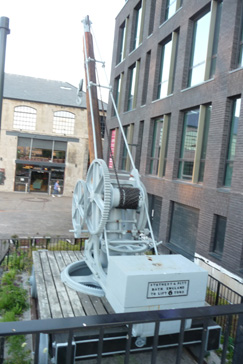 We first encountered the news of the restoration of the crane in 2019, when the Bath Newseum website provided an article "Saving a crane that helped build Bath" when a former employee of S&P discovered that the hand operated crane which had spent its working life in a quarry in Corsham loading blocks of Bath stone onto railway wagons was still in existence, though in a dilapidated state. When the quarry had closed, one of the workers didn't like the idea that the crane which had given such a long and reliable service should be scrapped, and he managed to obtain it himself and transport it to his back garden where it remained, gradually deteriorating, until he died. His wife was concerned about how unsafe it looked and Peter Dunn, an ex-S&P employee, heard that she wanted to be rid of it and he arranged for a small group of other volunteer ex-S&P employees to dismantle it and transport it to Peter's back garden, from where it was hoped to restore it to its original condition. There is a video clip in the link above where he explains what needed to be done. The main problems were timber that had rotted and iron which had rusted, all of which needed money to pay for the processing work and replacements.
- The next major development to be reported was in 2021, from another former associate of S&P. At the time that the crane was made all timber work on cranes was under the control of the Carpenter Shop foreman, Mr Frederick Hawker. That Mr Hawker later set up his own company, Hawker Joinery, later renamed F W Hawker & Sons. The great great grandson of the company founder offered to provide the timber needed for the restoration. By that time, ownership of the crane had transferred to The Bath Stone Quarry Museum Trust that would ultimately donate the crane once restored to the City of Bath. The Trust had also offered to match fund the donations so that the money would go twice as far.
- Now solvent, the restoration continued to completion, with the last purchase being the replacement for the original now too-rusty chain from the winding drum to the hook. The crane was then placed in the location where it would have been for its final tests when it was originally made. It had come full circle! A clearly proud Peter Dunn provided the main speech for the unveiling.
- Former Bath Press Building - Last updated 25 June 2023.
- The building which had been occupied by the Bath Press is apparently again for sale. There is an article saying this in the printed Chronicle but it has not appeared online at the time of writing this.
- Watchdog was involved in all the (apparently sham) workshops to discuss what uses for the building should be considered. We proposed some practical long-term uses which would free up accommodation used elsewhere in an area where redevelopment would be useful. Thus relocating the Post Office's Sorting Office and the Police Station looked sensible and yet when we asked to look at the interior of the building to see what the existing layout was we were told that it was too dangerous to go inside. We didn't believe it, but arguing that to the owner of the building would be a waste of effort In the end the plans they had for the building all along were revealed in an application to demolish and build a Tesco supermarket.
- When that was refused by both the council and the Planning Inspector dealing with the subsequent Appeal, some proposals which the council thought acceptable got planning permission, despite the building featuring on the cover of the council's own Locally Important Building draft policy. That permission got as far as demolishing the original building, including the wonderful Board Room with its timber panelled walls and arched ceiling, and although we secured the retention of the longest classical facade south of the river and the very stylish chimney of the "Fifth Phonetic Institute" built by Sir Isaac Pitman by means of Conditions, the rest of the Institute building was not saved. Since then the site with its now overgrown piles of rubble has changed hands several times and the current owners seem keen to abandon it to another owner without completing the precursors required to turn the "Delegate to Permit" Committee decision on their latest planning application into a permission granted. What a waste of what was originally a perfectly serviceable Locally Important Building!
- World Heritage At Risk (Again)? - Last updated 11 June 2023.
- This week we have concerns about a decision recently made, and an planning application recently lodged. The second is probably more significant than the first but we will deal with them in the order reported to us.
- 1. Coronation Avenue was so named because it was started in 1901, the year of Edward VII's coronation. Numbers 1-39 are a continuous terrace of houses, then there is an access path to allotments and 41 onwards starts another terrace. It is possible to get some views of the terrace of 41 onwards, and that shows that various dormers have been added in a variety of sizes and materials without any standardised character and it looks a visual mess. The significant feature of 1-39 is that the rear windows look over the allotments which means that the general public using the paths or the allotments have a clear view of the terrace of houses, and that terrace is devoid of dormers or any other roofline intervention. Such an unspoilt appearance is rare and is worth preserving. Nevertheless loft conversions have been possible in this terrace using just Velux windows for light as can be seen on numbers 1, 5, 9, 15 and 27. There were attempts to get permission for dormers on a few of them, but number 11 was refused on the grounds that it would be incongruous and visually harmful to the locality, and number 15 was warned it would be refused for the same reason and the application was withdrawn and Velux windows were used instead. Thus application 23/01361/FUL for number 13 becomes the first ever permission granted for a dormer on this terrace and it sets an unfortunate precedent which will undermine the powers of other planning officers; even if other addresses apply and are refused, this precedent could encourage appeals and the appeal process usually looks at the area to assess what the council considers to be acceptable. The Outstanding Universal Value of the World Heritage Site, and the World Heritage Management Plan both emphasise the importance of maintaining a homogeneous appearance across the site, and the addition of a dormer on a previously unadorned terrace does have an impact on the OUV despite the Case Officer's opinion. The Victorians and Edwardians mimicked the Georgian characteristics of decorative columns in the mullions around bay windows. If they used dormers (which they rarely did), they mimicked the Georgian style for them.
- 2. The new planning application is 23/01762/EREG03 looks like a supplementary scheme covering the part of the former gasworks not included in 22/03224/EFUL. The planning statement says that there has been a joint design review process, and the pre-application advice was obtained before either of the planning applications were raised. Unfortunately the 2022 application was not well received by ICOMOS's UK agents, and because there was a joint design review, the same fate is likely to befall the 2023 application.
- To clarify what the World Heritage Committee disliked about the 2022 application, they found the following:
• It is now a mandatory requirement in UNESCO’S Operational Guidelines for the Implementation of the World Heritage Convention for Heritage Impact Assessments (HIAs) to be undertaken in line with formal Guidance, introduced in 2021. We have looked through the document set for the 2023 application and couldn't see a HIA among them. The World Heritage Committee has DCMS as the "State Party" and DCMS must comply with the Operational Guidelines, so the B&NES omission despite the reminder given could result in a Ministerial complaint.
• B&NES was specifically asked to "respect the need for the development of BWR to support the OUV of the property, through architecture of high value fully integrated into ‘the city’s strong visual coherence and its wider setting’. The "strong visual coherence" is the homogeneity of the WHS, the human scale (which is why the height is to be properly managed) and the views into, across, and out of the WHS need to be preserved.
• The B&NES plans for the Western Riverside were examined in 2008 when a Monitoring Team visited the city. Their report was then considered by the World Heritage Committee the following year and the minutes of the meeting show that the Committee saw the original plans as an approach to creating a visual barrier across the middle of the "property" (ie the World Heritage Site). Their decision included "[The committee] urged the State Party to ‘submit to the World Heritage Centre and ICOMOS, for review, a time-bound revised plan for the second and third phases of the Bath Western Riverside project, including revised density and volume of the ensemble, so as not to impact on the Outstanding Universal Value of the property, its integrity and on important views to and from the property’. That revised plan has never been provided. UNESCO formally complained to DCMS who replied explaining that the planning legislation required the Local Planning Authority to consider designs submitted in planning applications and to advise on desirable improvements but it did not authorise the LPA to redesign anything. That argument has now fallen by the wayside, because the originator of the 2023 application is B&NES so they do have the freedom to submit acceptable designs, yet have not done so. - The Committee has already warned B&NES that a "cumulatively negative impact could reach highly damaging levels that might ultimately be considered as a threat to City of Bath's World Heritage status". This cannot be seen as an idle threat: Liverpool and Dresden have already been deleted from the World Heritage list for not heeding similar warnings. Thus Bath is already on thin ice. Bath profits from visitors, and a WHS which loses the accolade is often considered to be no longer worth visiting.
- Wells Road - Last updated 4 June 2023.
- The original proposals for Units 1-4 Wells Road were withdrawn after a lot of criticism of the height and appearance. Among the new application listed this week is the replacement application. Three things stand out: The description on the application claims to be a 4-storey building, yet the North and West elevations clearly show five and there are floor plans for floors 0 to 4 so the description lies to make it sound more acceptable; the ground floor space available to the current occupants is shrunk to half in the new building, and one of the existing units had a staircase to the first floor as well, which is not provided in the new building; and the existing commercial premises share 16 parking spaces and 9 of them are no longer there with the new building.
- The combination of these is the conclusion that the current 2-storey barely visible building will be replaced by something dominant in that location. The new building is going to be far too tall for the location, and the needs of the existing occupants have not been adequately accommodated. The Great Wine Company is a popular business selling to the public, and their products are frequently sold by the case which is sufficiently heavy that arriving by car to carry the purchases away is the norm. At busier times, every single parking space us used by their customers, so reducing the number available by more than half is going to seriously deter potential customers. Also, Designability is a charity that currently has two units on the ground floor and a staircase to more accommodation above, and that too is to be squashed into a single unit on a single floor. Both would have to be evicted in order to demolish the current building, and it is difficult to see how either of them are going to survive in the proposed cramped conditions allocated to them afterwards, even if they manage to continue in existence while the new building is erected and decorated.
- Given that the loss of industrial floorspace has already far exceeded the planned reduction, this application doesn't look at all acceptable.
- United Reform Church - Last updated 4 June 2023.
- In January we included an item pointing out that we didn't think the former Post Office building was an ideal home for the Fashion Museum to relocate to, and we suggested the the Central United Reformed Church might be more suitable. Subsequently the council's application for Levelling Up funding for the "Milsom Quarter" which was to include the Fashion Museum was unsuccessful, which we also reported.
- Last week we received an e-mail from Angela Calvert-Jones, a local event organiser with ambitions for an extended Fashion Museum that would also provide a celebration of Bath's frequently neglected history, which resonates with our view that there is more to Bath than Roman and Georgian eras (which is why we - unsuccessfully - tried to save the only tin church in a World Heritage Site and the only remaining "make do and mend" repaired building that was still completely usable in its wartime state).
- Her e-mail helpfully provided information on the Central United Reformed Church, identifying the Estate Agent dealing with the property (Perry Bishop in Silver Street, Cirencester) and the size of the building (Over 10,000 sq.ft. of accommodation over 3 floors, and the main chapel dates back to 1789), proving it is generously sized for her extended museum. We are publishing it in case anybody from the council wishes to explore the idea further.
- She also explained in her email why she has a personal interest in the church and what it contains is clearly a candidate for preserving as part of Bath's neglected history. We originally quoted what she told us about what is inside the church (and we have a member who is an organist and will be very interested in the description). After the original text was published we received a "thank you" for including the Sweetland information on the website, and we were provided with a bit more information and a photo of the organ in the church, so we have updated the entry to include these additions.
 My particular interest is the fine organ within Central United Reformed Church. The 3-manual organ was built by my Great Grandfather William Sweetland whose organ factory was adjacent to his home at Cleveland Place West overlooking the river. The instrument, one of 300 or so built by him, is of particular importance due to it being the largest of the hundred or so remaining examples of his work. Time and changing tastes together with the closure of churches and chapels during the 20th century have resulted in the loss of many instruments - probably about 200 - and the process continues, hence the importance of preserving the Central URC instrument. It would be a great loss to the City if this instrument were to suffer the fate of the show organ of another Bath organ builder, Griffen & Stroud, which, after wrecking by the installer of speakers for an electronic instrument within its case, is now beyond repair.
- There were originally about 30-40 Sweetland instruments in the City, but the majority no longer remain due to falling church attendance and changing trends. A number were bombed during the war including a fine organ at Prior Park, the home of John Wood the builder of Georgian Bath, and one in the Chapel at Bath Mineral Hospital. It is very important to recognise that the organ in the Central United Reformed Church, because of its size and weight, is recognised as "permanently fixed" and therefore part of the Grade II listed building structure despite there being no visible ties into the fabric. It cannot therefore be moved or removed without listed building consent; and if removed it needs to be preserved in usable condition or else it would reduce Bath’s Sweetland organs to just five.
Sweetland established a long standing and successful business with instruments installed throughout England, Scotland, Wales and as far away as Genoa. In addition, he invented and patented several devices to improve the action of organs. He also invented a new stop, the Euphonium, and a rank of these pipes has been preserved inside the Argyle instrument along with other of his inventions. Thus the organ is of national as well as local importance and every effort should be made to retain it in working order within the city. His instruments have been played by many renowned organists, including Thomas Trotter the Birmingham City organist who is also the organist of St Margaret’s Church, Westminster Abbey. - The eventual outcome of Central United Reformed Church and the Sweetland organ will certainly be of great interest We have included this description of the organ in the hope that whatever happens to the Central United Reformed Church in the future, the new owners take all necessary steps to preserve this unique instrument for posterity. Whilst it remains inside the listed building the Planning (Listed Buildings and Conservation Areas) Act 1990 will offer some protection, but it will need specific protection if it is ever removed.
- Cleveland Pools - Last updated 28 May 2023.
- The Cleveland Pools Trust raised planning applications to cover the additional defects that were identified during the work previously permitted. This week those planning applications were permitted, thus removing the final planning hurdle to completing the restoration of the Pools site. Obviously, the work still needs to be done, but as the planning applications followed a detailed report by structural engineers experienced in heritage projects there should be no further defects identified and the end of the restoration is in sight.
- The Trust is to be congratulated for their dedication in getting all the necessary work identified and then approved.
- Land behind Lansdown View - Last updated 28 May 2023.
- This planning application was refused by the council and subsequently allowed on appeal. The Appeal Decision contains an interesting observation that the appellants may need consent from separate landowners to implement the permission, and the permission does not override the need to obtain consent from all landowners. The original application which was refused attracted 54 objections, so obtaining those consents is by no means assured.
- Lidl at Lambridge - Last updated 21 May 2023.
- Following a public consultation during last week, the public response, as reported by the Chronicle, has been mixed, with some in favour and some against. Watchdog did not attend the consultation but we have some concerns about the design and the location.
- Firstly, the location is a main entrance into the World Heritage Site and it should advertise what is to follow. As open land it does this, because a feature of the Outstanding Universal Value is the combination of buildings and green spaces, but if it is a building that greets the visitors, it should follow the WHS expectation that it should be homogeneous with what follows, so it should recognise the importance of Bath stone, pitched roofs and adherence to the "golden ratio". The illustration in the Chronicle article shows none of those characteristics. As a minimum the design needs to be modified to make it acceptable as a WHS gateway building. That must include removing the green roof because it will act as a gull magnet spreading the gull menace to an area not currently suffering badly from gulls.
- The other problem is that this location is part of the river flood plain. As open land it can absorb a considerable amount of rainfall. A building on it nullifies this capability for an area of ground, so this must add to the potential flood risk further downstream; and further downstream are a number of vulnerable Georgian (eg Norfolk Crescent), and Victorian buildings in Georgian style (eg St Johns Road), which could suffer as a result. Any plannng application must therefore include flood compensation proposals.
- Those who use the existing Lidl are aware that it is too small to cope with the customer demand and it frequently runs out of stock. We had members who originally tried to persuade Lidl to buy the entire former Cabinet Makers building, but Lidl wrongly insisted they didn't need to do that and those chickens came home to roost. We understand that another branch to support the latent demand would make commercial sense, but we remain unconvinced that this location is the appropriate place for it.
- King William, Thomas Street - Last updated 21 May 2023.
- A notification of the decision to withdraw the planning application 21/05175/FUL has been sent to us, and the correspondence on the planning file shows that the premises has continued to operate as a pub so a change of use application is no longer appropriate. However the associated 21/05173/LBA and 21/05176/AR have not yet been formally withdrawn despite now being redundant.
- Bath Rugby - Last updated 14 May 2023.
- Among the new applications this week is one where Bath Rugby is asking for a "scoping opinion" for their plans for a new stadium on the Rec. This is a facility enabled by regulations issued in 2017 allowing an applicant minded to make an Environmental Impact Assessment to ask the Local Planning Authority for an opinion on what should be covered by the EIA when submitted. The LPA must first assess whether they have been provided with sufficient information to deal with the application, requesting more if there are omissions, and then they have 5 weeks to obtain the opinion of "consultation bodies" and respond to the request with an opinion on what must be in the EIA when submitted. After the 5 week window has expired without an opinion being provided, the applicant then has the right to ask the Secretary of State to make a direction instead.
- We couldn't see any information in the legislation clarifying whether the public can or cannot contribute to the process. The LPA should clarify what information needs to be included in the EIA. Whilst this is described as an opinion it has to serve some purpose, and the only obvious one we can see is that it might limit any EIA assessment to only the areas covered in the opinion.
- The key constraints that must be included in the opinion are:
• The Rec is an active flood plain and as Flood Zone 3 land there are Government restrictions on what can be developed there. This will allow a sports pitch, facilities for the teams and officials, and spectator stands, but will exclude many of the other ancillary uses, especially anything educational. The Environment Agency called in the council's approval for the Dyson Academy for a Public Inquiry into whether it could be allowed in the Newark Works site which had a history of flooding, and there are ample photos of the Rec being flooded to ensure that extreme care will need to be placed on whether the plans to be put forward by Bath Rugby would suffer the same fate if approved. Also, as an active flood plain, any additional structures on the flood plain or any alterations to the level of the surface will remove some of the flood protection capability that currently exists and the Environment Agency can veto any permission granted which could add to the flood risk elsewhere. This will include rainwater run-off (as occurred in 2000) as well as the river overtopping its banks.
• The Rec is charitable land subject to Objects of the Charity which includes the constraint that it is "for the benefit of the public at large" rather than for the benefit of the tenants with leases on the land. This has specific constraints ordered by various court rulings that include "the charity shall not use the Bath Recreation Ground otherwise than as an open space" (with the temporary exception that the land covered by the existing lease with Bath Rugby can remain in place unaltered until it time expires, and the East Stand can occupy a specific piece of additional land for 9 months of the year, reverting to open land for the other 3 consecutive months); and the restriction that "the charity shall not show undue preference to or in favour of any particular game or sport or any particular person, club, body or organisation". The council cannot legally grant planning permission for any development which might prevent the Trustees of the Charity from observing these objects of the charity.
• The open area known as The Rec is a significant feature of the World Heritage Site, and the World Heritage Committee is already expressing its concern about other proposed developments within the WHS potentially putting the WHS heritage status at risk, and reminding B&NES that since the 2021 update of the UNESCO Operational Guidelines every significant development now requires a mandatory Heritage Impact Assessment to be included in the application documentation set and notofied to ICOMOS-UK, so any development on the Rec which interferes with established OUV sight lines across the Rec is likely to be strongly criticised by ICOMOS-UK and placed on the agenda for a World Heritage Committee discussion. - Just after the scoping opinion application was lodged, two articles covering the future stadium plans appeared in the Chronicle. The first announces the new plans, a public consultation on 18th May in the South Stand, and provides a link to the plans. The second invites public comments on the plans and provides a link to be used for public feedback.
- Frome House - Last updated 7 May 2023.
- The appeal decisions for both of the Frome House developments (21/04147/FUL and 22/01299/FUL) have allowed both applications, though because both are to occupy the same area of land it is left to the applicants to decide which one (neither is also a valid option, though it is unlikely after taking the trouble to appeal) to carry forward.
- Appeals are conducted based on the reasons for refusal in the Planning Decision. We provided very sound reasons why the first Frome House application failed to preserve the character of the World Heritage Site, and the Case Officer failed to mention any of our reasons and that is why World Heritage impact was not significant in the Appeal arguments, and those omission chickens certainly came home to roost. Having read the Appeal Decision, it does appear that there are conflicting policies and the council and the Appeal Inspector have taken different orders of precedence. Even the recent Local Plan Partial Update which sought to clarify some parts of the Local Plan failed to be sufficiently definitive, allowing the two opposing parties to take different views. In many respects this was inevitable because a partial update couldn't make drastic changes to the existing policies; that will have to wait until the time to prepare a new plan.
- In preparation for the new Local Plan we offer a couple of suggestions.
• Rather than identifying restricted areas of Bath where policies apply (For example PBSA restrictions claimed for by the council for Frome House and dismissed in the Appeal) it would protect the World Heritage character better if the boundary for restrictions in development became "within the WHS". Given the rather vicious criticism of the Gasworks site proposals from ICOMOS-UK Bath needs to pay far more visible attention to protecting the WHS.
• Also, the dictionary definition of a "Campus" as an area dedicated to students, whereas Locksbrook is a residential area with some industry and some student facilities. The incorrect use of the words "Lockbrook Campus" has now lost the council two separate appeals (the other one was student accommodation in the Plumb Centre in Locksbrook Road). It creates a very grey area where the Core Strategy requires new student accommodation to be built "on campus" which could over time destroy the Locksbrook area as a location for local industry when the loss of industrial floor space has already exceeded the target originally set.
• Finally, the general aim to preserve office accommodation has been ignored in appeals due to lack of proof of the need, so it needs to be clarified that loss of more existing accommodation can result in refused permission unless it is for conversion into social housing (not "affordable housing"). - Fashion Museum - Last updated 30 April 2023.
- The Chronicle has published the explanation, obtained from a Freedom of Information request, of why the Levelling Up application was refused. From this we learned that there were alternative buildings considered, and that putting together the application cost £55,000 on top of the £150,000 a year to store the collection until it can once again be put on public display. We commented in March (see below) that the former Post Office might not be the ideal building for displaying historic delicate fabrics, and now we have read that it was the more costly option and there were reservations about the changes that would have to be made to the Grade II listed building. We wonder whether it might have been a better option to have separated the need for a new museum location from the wider ambitions for the "Milsom Quarter"; and the setting up of a Collection Centre for the benefit of the universities seems to have been to tick a particular box for applying for Levelling Up funding for "community assets" rather than promoting a rapid return to providing museum visitor income.
- We noted the complaint of "a deeply flawed funding process", but wonder if the same accusation would have been made if the application had been successful rather than being refused. The Levelling Up money was a specific sum to be shared by different projects, and trying to allocate it to those offering the greatest probable benefit is a fairly normal process.
- Green Park Station - Last updated 30 April 2023.
- We were informed that in the early hours of 23 April there was a serious fire in Green Park Station. A check over the more likely online news sources that day only found this.
 Green Park Station is an important listed building where repairs to the roof were already in hand, so we hope that the damage is repairable. If we get any further information we will go for an intermediate update, though it seems that the link above is also updating, so our update may not be necessary.
- The cabins that were the cause of the fire were installed without planning permission and Enforcement were not interested in getting retrospective applications raised, so council officers have had no opportunity to review what was proposed and consider if it was safe. That is a pity, because a fire which started in the early hours when the cabins were unattended has caused a lot of peripheral damage.
- Footnote: The Chronicle did provide an article a few days later, though their picture didn't show the damage the fire caused. However we were provided with the picture shown here which shows that one of the cabins was probably the seat of the fire which spread to the neighbouring cabins, and the flames then burned the back wall and the roof above. It looks as though the structural ironwork wasn't damaged.
- Green Spaces - Last updated 16 April 2023.
- Although Larkhall was a village outside of Bath in Georgian times, there are Georgian buildings such as Larkhall Place to show that they did have residences there, and Larkhall is within the World Heritage Site boundary and is included in the World Heritage Site Management Plan. The council's policies on preserving green spaces that add to the character of a locality should therefore apply equally to the edges of the WHS and the more central areas.
- We were therefore concerned to read in the Bath Newseum website that there was not only an (apparently erroneous) task of removing a well established hedge from St Savious's Little Park, that when council officers concerned about the removal of the hedge checked the instructions with senior officers they were clearly told to take out the whole hedge. The head of B&NES has been made aware of this situation, and he should as a priority identify who the senior officers were, and seek a proper explanation of how and why the confirmation of the removal of the hedge was given in the face of the council's policy of preserving and enhancing biodiversity. This sorry situation should never again be possible.
- It is good news that replacement shrubs will soon be put in place, but it will be a considerable time before they are mature enough to restore the level of biodiversity that the original hedge supported.
- Street Clutter - Last updated 9 April 2023.
- There has been a number of letters in the printed Chronicle recently (unfortunately not placed online so we cannot link to any of them) and some discussions on social media along the same lines, about recent additions to the street scene. Views seem to be mixed about whether what has been put in place or is currently planned is a good or bad thing.
- We have not contributed to the discussions, but we do recognise that there is a World Heritage consideration and having seen the most recent World Heritage Committee advice to Bath's planners which includes the warning "cumulatively the negative impact could reach highly damaging levels that might ultimately be considered as a threat to the City of Bath’s World Heritage status" we do recommend that those in the council making decisions do examine the World Heritage Management Plan to ensure that street furniture which doesn't have to go through the normal planning application scrutiny remains compatible with the Plan which is the agreement between the council and the World Heritage Committee.
- Lots of places do not have a World Heritage recognition yet can attract tourists, but anywhere that did once have such an accolade and then loses it will gain a public assumption via feedback sites that it is a destination no longer worth visiting, and that could have a serious impact on the area's businesses which rely on visitor spends.
- Waterworks Cottage - Last updated 2 April 2023.
- The Chronicle has published an article on the continued intentions to demolish Waterworks Cottage and replace it with new buildings. In January we commented on the wording in the Permitted Development legislation which suggests that structures within a World Heritage Site are protected from demolition because it is not possible to demolish without modifying the appearance of the building by removing the very first piece, and modification of anything within a World Heritage Site is expressly forbidden as permitted development in the legislation. We believe that the decision that demolition is allowed by permitted development should have been refused again, like it had been more than once before, and ideally the council should revoke that mistaken "not needed" decision for the reason above. Now that the developer has indicated that "the demolition is now in the process of being actioned" this corrective action becomes more urgent.
- That said, demolition by permitted development requires a Method Statement showing how it would take place, and the last one submitted has the appearance of being designed to avoid another refusal rather than being a practical method to achieve demolition. If demolition is to take place, then that permitted development Method Statement must be followed exactly; no different demolition approach should be allowed. Thus it becomes important to refuse any application for development that mentions demolition as part of the proposal, so that the submitted Method Statement remains the latest one. Any application mentioning demolition should be refused on the grounds that this is a locally important building with a significant historical importance and there is no public benefit from its demolition (alongside any valid criticisms of the new buildings and/or harm to protected species if appropriate).
- Then the developer is reduced to applying for just a new development based on the assumption of achieving an empty site having carried out the demolition following the permitted development Method Statement. Doing the demolition before gaining permission for that application is then the worst possible approach. It would leave them with the real problem that the site is in the transition space between urban and rural, and with the cottage gone it restores the former rural open space that was there before special dispensation was given in 1846 to build a reservoir and a pumping station along with the cottage, the cottage being an essential part of the Waterworks requirement in order to have a person on site to man the pumping engine. Then the current obligation in the World Heritage Site Management Plan to retain the environment surrounding the World Heritage Site of which the open space in place of the cottage would be part, is then a current planning based reason for refusing any new building there. In short, the demolition of the current cottage becomes the reason for refusal of any new development in that location, and the developer has to choose between the land with a cottage on it or the land remaining empty after the cottage is removed.
- The sensible thing for the developer to do is to recognise the barriers to their development ideas and sell the freehold of the site to someone who intends to live in the cottage. In the original application for the site (refused by both the council Case Officer and the Appeal Inspector), the cottage was being retained so it can't now be argued to be unsuitable.
- The Rec - Last updated 26 March 2023.
- We noticed the Chronicle article on the suggestion of a new stadium on the Rec and the opposition to it in one of the letters printed. We will not be in a position to comment on the plans until a planning application is submitted and we can see the details.
- However we recognise the problems such a development will pose in planning policy terms. Having noted the uncharacteristically vicious comment ("highly damaging impact on the OUV") from the Chair of ICOMOS-UK World Heritage Committee to the planning application for the former Gasworks Site, it looks as though the eventual planning decision will be chosen between refusing permission under Policy B4 ("There is a strong presumption against development that would result in harm to the Outstanding Universal Value of the World Heritage Site ...") and permitting the ambitions of Bath Rugby to take over land that was transferred into council control as "open space for sport and recreation with no preference for any particular game or sport or body or organisation". This boils down to choosing whether retaining the current World Heritage accolade or development on the Rec blocking important views across it is the path which the council wishes to take; the threat of removing the World Heritage status has already been made by ICOMOS ("might ultimately be considered as a threat to the City of Bath's World Heritage status"). This will not be an idle threat because Liverpool and Dresden were stripped of their World Heritage status for permitting developments which the World Heritage Committee had declared inappropriate.
- We also point out that the Trustees are obliged to ensure that the Objects of the Charity are delivered and that includes retaining the open space and showing no preference, so we would expect them to be actively against the stadium development. Time will tell.
- Fashion Museum - Last updated 26 March 2023.
- Following on from the good news below that a temporary home has been found for the Fashion Museum collection is the bad news in the latest Chronicle article showing how much of Council Tax money will be committed to the seemingly leisurely "four or five years" timescale for getting the collection into a location where the public can view it, and pay to do so.
- The original Chronicle article below reveals that the Old Post Office building was in a fit state to be reused for short term lets, which begs the question why spending £150,000 per year for four or five years on storage with no return seems preferable to using a similar amount of money on getting the exhibition on public display and earning an income in a shorter timescale.
- We note in the article that a suggestion has been made to change the governance of the Fashion Museum. We have members who visited the collection in the Assembly Rooms and were happy with the curatorial care that the collection received, so we hope that future plans do not harm what was working well enough before.
- Fashion Museum - Last updated 19 March 2023.
- Whilst it is good news in the Chronicle that the Fashion Museum exhibits have now got suitable temporary storage in Warminster for the collection, we still have some concerns about the timescale for reopening in the Old Post Office, and also the suitability of the target building itself for the collection that is to be housed there.
- Taking the timescale first, the current estimate is that it will open in four to five years time. This is despite the collection being popular with visitors while it was in the Assembly Rooms and the entrance fees providing a significant income for the council. It would be useful to see how the council has financially justified this relatively long interval with its associated loss of income, along with an explanation of why it would not be possible to open sooner.
- When the collection was housed in the Assembly Rooms, much of it was in the basement which is ideal for ancient fabrics which can be physically damaged or discoloured by sunlight, or both. The Post Office building has many windows and this must make it necessary to either block out the daylight through them or build internal structures to shield the collection. In a Grade II listed building, neither is desirable, and we question why such an unsuitable building was chosen. In January we pointed out that other perhaps more suitable accommodation from an illumination point of view might be possible.
- The Chronicle article also mentions the creation of a "Fashion Collection Archive in Locksbrook", to a similar timetable to the opening of the Museum in the Old Post Office, which suggests that the Museum will not be showing all of its collection, despite the building in which it is to be housed being larger than the building it has moved out of. Perhaps in due course the rationale for a remote archive will become clearer.
- Former King Edward's School - Last updated 12 March 2023.
- There is a Chronicle item on the Council's concern about the building that has remained empty for nearly 40 years, and options were to be discussed in a Cabinet meeting, with one possibility being Compulsory Purchase.
- Having looked through the planning history of the site (divided in the planning file between "King Edward's School" and "10 Broad Street" which doesn't make the complete picture easy to find via the "Planning History" tabs) it looks as though our concerns were not so much the work proposed for the structure itself as the practicalities of the proposed use, pointing out the servicing of the deliveries and the collection of waste in a location with a narrow pavement alongside a busy road, and the fact that the city centre has a serious gull problem and the idea of outside catering in the former playground would serve as a magnet for gulls and thus some strong criticisms of this in customer feedback. None of the permissions granted since we first raised these problem areas in 2010 has included sensible solutions to these drawbacks.
- The most recent planning decisions were in 2021, granted with a Condition that work should commence within 3 years. That gives the owners the easy objection to any Compulsory Purchase proposal made now that they intend to start work before the expiry date. We remain of the opinion that the owners (Sam Smith's Brewery) just want to land-bank the asset because a hotel in this listed building is unlikely to be profitable. Thus if the price is high enough they might cash in their asset, but failing such an agreement we can't see the standard Compulsory Purchase calculation offering an attractive sum and that idea would probably have to be deferred until the currently extant planning permissions have time expired. Even then, we wonder what plans are there for the property once the council owns it? It would ideally be for a use which does not require daily deliveries or collections.
- Mineral Water Hospital - Last updated 5 March 2023.
- Our attention was drawn to the Chronicle article about the sign that has appeared on the door of the Mineral Water Hospital headed "Town And Country Planning Act 1971". Our first observation was that the 1971 Act is no longer in force, having been superseded. However when we compared the 1971 text with the current 1990 version we did see that the essence of Section 128 of the 1971 version is carried forward into Section 238 of the 1990 Act, including the definition of Consecrated Land being both land formally identified as such, and land associated with a building used or formerly used for religious worship. The structure adjacent to the area mentioned in the notice was the Chapel. So there is a potential element of fact in the sign, but the association with the Chapel would need to be proved; mere juxtaposition is not proof.
- We found (in the 1990 Act) an obligation on the owners of the consecrated land to publish their intentions for the removal and reinterment of "human remains" and to fund the expenses of representatives of or relatives of the deceased who choose to undertake that task for themselves, but whether human ashes qualify for the definition of "Human Remains" is not clarified in the Act. Those relatives or representatives certainly have the right to seek legal clarification of that, but it would be a Civil case, and therefore could not result in imprisonment.
- We did then look at the the argument that the conversion of the building into a hotel should recognise that the car park and garden area behind the former hospital is a Scheduled Ancient Monument, and the Delegated Report associated with the permission granted did adequately cover this aspect though it didn't quote the listing entry identifier (which we found).
- We couldn't find any reference in the planning file of the possibility of it being consecrated land though, and the presence of the Chapel only makes it possible, not proved. Therefore the "private group of persons" mentioned in the notice will need to show verifiably authenticated records of human ashes scattered in the area, and legal confirmation that human ashes are recognised as "Human Remains" in the Town and Country Planning Act before such a claim of it being consecrated land, with the complications for the development that would bring, could be addressed (and not under the 1971 Act, which is obsolete). The scare story of "the curse of Bath" is perhaps an indication that they won't be doing that.
- Traffic Signage And Barriers - Last updated 26 February 2023.
- We have had the Weston Low Traffic Neighbourhood and the alterations to the Upper Bristol Road brought to our attention for similar reasons. The council's policies for the World Heritage Site and the Conservation Areas within it are that there should be a minimum of street clutter to interfere with scenic views. The picture in the LTN article shows a set of large planters showing traffic information, and the imposition of a 20mph limit on the Upper Bristol Road requires a rash of traffic signage because there is legislation requiring repeater signs at relatively short distances or else the default 30mph limit is restored. Neither of these introductions are therefore compliant with published council policy.
- Bearing in mind that there was a Chronicle article following the introduction of original set of 20mph zones where the then council (not the current one) admitted in a Freedom Of Information enquiry that in about half of them the incidence of serious or fatal accidents increased from the previous norm, we have to wonder why new 20mph limits have been treated by the current council as beneficial, when the accident statistics didn't show a safety bonus and the slower traffic speeds increase the number of vehicles travelling in a lower gear, thus creating more pollution per mile. Both the diversions round the road closures and the need for lower gears undermine the aims of the Clean Air Zone.
- Claverton Pumping Station - Last updated 19 February 2023.
- In 2012, Claverton Pumping Station was notified by the Transport Trust (a national charity established to promote and encourage the preservation and restoration of Britain's unique transport heritage) that they were being awarded a "Red Wheel" plaque. Watchdog was approached to assist the Pumping Station to obtain the Listed Building Consent necessary because the expectation of the Red Wheel plaques is that they need to be displayed so that they can be easily seen by the public on the heritage that is celebrated. The staff at the pumping Station had never been involved with listed building applications before and needed guidance, which we provided.
- Planning permission secured, we were invited along to the plaque unveiling ceremony, which we reported on this website afterwards. At the time the wooden paddles were under restoration so we couldn't see it pumping that day, but the restoration of the timber paddles was completed and the public has seen it working afterwards.
- We were therefore saddened to read in the Chronicle that after over 200 years in use, the first 140 or so operating as the only means of topping up that part of the Kennet and Avon Canal, a serious engineering fault has developed. The Trustees appear to think it will be repairable but it will be expensive. We think it would a tragedy if such a unique piece of engineering (designed by John Rennie as part of the Kennet and Avon Canal construction) is not restored to working order because of the cost, and we are publishing here the link to the Just Giving page for use by anybody who shares our view.
- Former Gasworks Site - Last updated 12 February 2023.
- In our 15 January update we commented on the letter that the Bath Preservation Trust sent to a number of addressees including ICOMOS-UK. We now see that ICOMOS-UK have responded at Chairman level with a very critical objection to the application itself, and also the fact that despite B&NES responding to the 2008 Mission Report claiming that they would "take every opportunity to work with developers in order to optimise the form and quality of the later phases of the development", and having received the recommendations from the 2009 World Heritage Committee meeting that considered the Mission Report, they did absolutely nothing, and even reneged on their promise to make the Building Heights Strategy an SPD and reduced it to unenforceable guidance. The observation that "the current proposal for the gas works site does not in any way reflect these recommendations or even the constraints that are in place for the BWR site" is uncharacteristically severe language compared to the ICOMOS-UK norm. Their closing criticism is that "It is our view that the submission is both extremely disappointing and inexplicable" which says it all. They are really not happy with B&NES.
- They add the information that in 2021 UNESCO's Operational Guidelines for the implementation of the World Heritage Convention added a mandatory requirement for Heritage Impact Assessments which provide a formal appraisal of the impact of the proposals on the attributes of the Outstanding Universal Value (with their emphasis on the city's strong visual coherence and its wider setting), and this is an indirect criticism of DCMS who did not inform Local Planning Authorities of the additional WHS requirement as well as a direct criticism of B&NES for accepting the planning application without such a document.
- The objection criticises the "anywhere architecture" of the gas works application, and also includes the direct threat that "negative impact could reach highly damaging levels that might ultimately be considered as a threat to the City of Bath's World Heritage status". The former WHS designations of Dresden and Liverpool were removed after just one such warning, so it is probable that there will be no further chances for Bath. Case Officers and Planning Committee members should take note: the ICOMOS-UK criticism requires that the application must fail Planning Policy B4 at the very least.
- 18 February 2023 Footnote: We notice that the Environment Agency has formally objected to the plans as presented and has put the council on notice that as a result they cannot grant planning permission without prior approval of the Secretary of State.
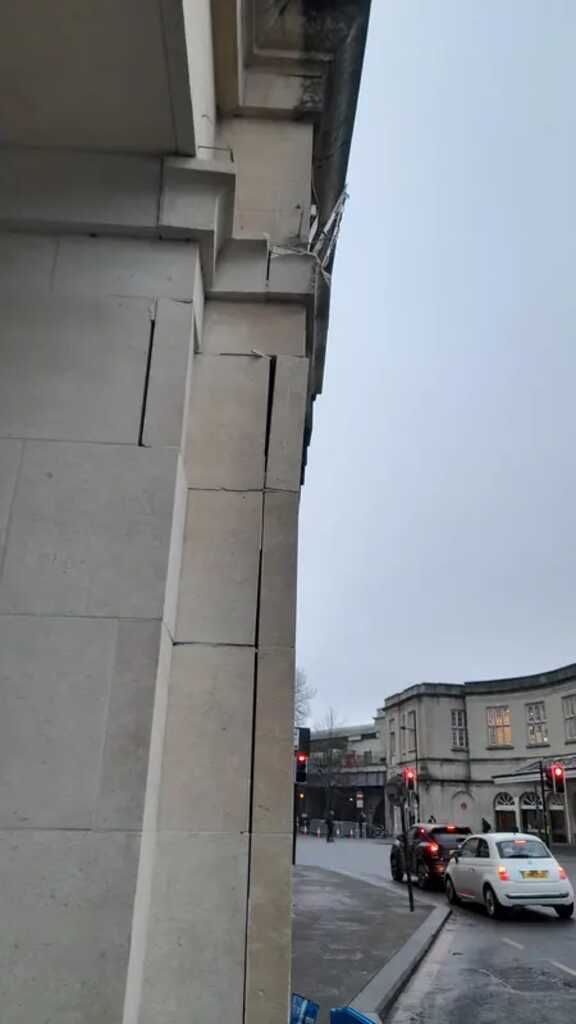 Southgate - Last updated 12 February 2023.
- We were provided with a photograph taken by Dave Andrews. (Click on the picture for a larger image) Given the view of the railway station in the background this would appear to be of the west end of the Dorchester Street frontage of the former Debenhams. Given the way that Southgate was constructed, with anchors embedded in the Bath stone veneer to a concrete supporting block which then hooks onto the steel frame of the building, it doesn't seem to be a structural problem for the building itself, and the top block which is leaning the most seems to be held in place by a structure on the outside of it so it doesn't look in immediate danger of falling. Nevertheless, the Southgate Management Company has installed barriers to protect the public in case anything does fall.
- Our guess is that the visible absence of mortar in some joints allowed water to collect and the recent frosts have pushed the blocks out of position as the water became ice.
- It should not be left indefinitely though because the larger gaps would hold more water which would either leak into the building behind or would lodge in the gaps to become frozen again widening the gaps further.
- Low Traffic Neighbourhoods - Last updated 5 February 2023.
- Although traffic engineering is outside Watchdog's remit, such that other than noting that there was a meeting on February 2nd and so many people arrived to have their say that the capacity of the venue was exceeded and some had to be turned away which indicated that there are strong feelings about such proposals, we are not going to give our opinion on the traffic issues.
- However, The Chronicle did publish a photograph of the method of blocking the street that the council had employed. In a World Heritage Site the use of palletised crates bearing traffic signs is not beneficial to the Outstanding Universal Value. Given the recent open letter to UNESCO drawing attention to Bath for the plans for the Gasworks site not being OUV compliant (see 15 January 2023 below) and the advice given by the UNESCO Mission to Bath in 2008: "The State Party (DCMS in Government terms) should keep in mind that not only large-scale development projects, such as the Bath Western Riverside, could adversely impact on the property’s Outstanding Universal Value and integrity; but also the cumulative effect of various smaller-scale projects", the appearance of these road closure interventions if replicated around all the LTNs the council has in mind might be regarded as multiple smaller scale projects having an adverse impact on the OUV.
- The criticism of the Gasworks Site proposals was strongly worded, and it is possible that UNESCO might want to send another Mission to Bath to review the (scant) level of attention the council paid to the recommendations from the previous one. The previous Mission had a wander round the World Heritage Site and a new one is likely to do the same and thus notice the visual impact of unsightly road blocks and the significant increase in traffic signage caused by all the 20mph zones introduced since the previous Mission. That is the reason we are mentioning the reaction to the first LTN that was introduced despite the majority living in the area not being happy with the scheme as implemented, in case that model is followed for the rest of the LTNs.
- Local Plan Update - Last updated 29 January 2023.
- We have received notification that the Local Plan Partial Update (LPPU) was formally adopted on 19th January 2023 and it is now part of the planning baseline against which planning applications are to be evaluated. Having followed the links we were given we able to see the LPPU changes and also the B&NES website page which shows that there is now a set of Composite Plans incorporating the original Core Strategy and Placemaking Plan and the changes made to them by the LPPU as a single set of documents, which should make it easier to understand what the Local Plan policies say. The website page has links to the individual parts of the plan so that it is easy to download personal copies if they are required.
- Although convenient to the public, the council does gain some benefit from the effort of combining the separate documents because there is a future requirement to prepare a Development Plan which will be based on the format of the Composite Plans.
- Watchdog had contributed to the LPPU consultations so we obtained some "quick looks" feedback. The conclusion was that it was good in parts. PBSA applications would need confirmation from the universities that the accommodation was needed before permission for any new PBSA could be given which will restrict speculative development; enlargement of existing HMOs was to be controlled for the first time; the improved ecological restrictions should now invalidate the Planning Committee's decision that the Tufa Field could be Delegate to Permit (which is still pending) and this application should now be brought back to Committee to be formally refused; the words used to describe facilities for the disabled seems to be expressed in terms that the disabled person would be the driver or else a passenger on public transport, a mismatch with the Blue Badge regulations allowing the disabled person to travel and park in any car displaying the blue badge without having to notify anyone in advance. There will almost certainly be other good and bad policies not spotted in our quick look, and we hope that the disadvantages are identified and sorted out during the drafting of the future Development Plan.
- Bath Fashion Museum - Last updated 22 January 2023.
- In October 2022 we commented (see 2 October 2022 below) on the idea of putting the Fashion Museum in the Former Post Office after a long time delay. The latest mention in the Chronicle reveals that it was an unsuccessful attempt to secure some Government "Levelling Up" money. Now that the money isn't going to be provided, it is time to once again remember that the entrance charge for the Fashion Museum (with or without accompanying charge for the Roman Baths) was a successful income stream, and the claim in the article that the museum was expected to reopen "in 2027 or 2028" represents a loss of income that the council tax payers will have to replace either by increased tax or reduced services.
- It is perhaps also worth reconsidering whether after the experience of being forced to leave the Assembly Rooms because the owner didn't want the museum there any longer, it is sensible to go into the former Post Office which would also have an ultimate landlord who could do the same thing? The Post office has many windows and much of the museum collection shouldn't be subjected to bright light so that too should be a consideration. If the Central United Reformed Church in Argyle Street is still for sale, it looks like a much more sensible home for the museum, and the council would own it if it bought it and therefore could regard it as a permanent location, with room for a lot more of the collection.
- Footnote: On 1st March 2023 the "For Sale" notice was still in place on the church building in Argyle Street.
- Waterworks Cottage - Last updated 22 January 2023.
- Also in the Chronicle is a report on the updated drawings for the Waterworks Cottage site, another development we commented on in October 2022. Since then we have examined the Permitted Development legislation and we discovered that structures within a World Heritage Site are protected from modification by permitted development and proper planning permission should be sought, but that same constraint is not replicated in the "Demolition" section. Arguably, demolition is not possible without modification first (the first piece removed is a modification on the remainder of the building) so it is an interesting speculation whether the omission from the demolition section was deliberate because the modification restriction was thought to cover it, or whether this was a simple oversight of the drafting of the legislation and it should have been included. We still believe that the "planning permission is not required" decision was (and still is) wrong, but we couldn't find a similar clause to the one in the Town and Country Planning Act which allows wrong decisions to be repealed, so to get a legal precedent established on whether preventing modification does also implicitly prevent demolition is going to take a Judicial Review.
- However, there does appear to be an approach which might preserve the existing cottage. Having closely examined the Method Statement describing how the demolition would take place, we think it was designed to avoid another refusal rather than being a practical approach to the removal of the building. It looks so labour intensive that the cost would exceed the profit margins from the replacements and thus make it uneconomic. Provided the demolition element of the replacement application is treated as unnecessary because there has already been a Permitted Development agreement, the applicant would have to follow the rather cumbersome Method Statement and it is very unlikely they would want to do that.
- Also, there is ample evidence that there would be potential offences against the Conservation of Habitats and Species Regulations 2017 (judging from the public objections to the Permitted Development Method Statement) and if the demolition was properly monitored there could be harm to protected species acknowledged in the demolition Method Statement sufficient to justify a Stop Notice. It just requires the Case Officer to exclude any reference to demolition in the current planning application because it is a Locally important building which would be reason for refusal if it had not already been covered by the Permitted Development decision. Having said that, the style and massing of the proposed replacements look unacceptable in this location which is transitional between urban and rural, and that transition was a key consideration in a Planning Appeal that was denied for a development in the transitional location in Lambridge some years ago.
- Footnote: On 27January 2023 the application was refused for three reasons: that the design, scale, layout and massing is unacceptable in this location; there is significant harm to the residential amenity of the nearby residential building; and the application lacks all the documents now expected to accompany new construction requirements. That decision still leaves demolition by Permitted Development as a possibility, but that is unlikely to go ahead in isolation because that would leave an empty site which would be virtually worthless without planning permission to build a replacement.
- The 2 February 2023 edition of the Chronicle included an article on the decision process..
- Gasworks Site - Last updated 15 January 2023.
- There is an article in the Chronicle speculating on whether the planning application for the gasworks site could put Bath's World Heritage Site status at risk. The Bath Preservation Trust have reminded the recipients of their open letter of the views of the UNESCO Mission to Bath in 2008.
- Watchdog was one of the organisations which met the Mission team at that time, and in preparation for that meeting we created a set of mock-up drawings of what was planned for the Western Riverside according to the plans that had been published by that time. The Mission requested and was given our panorama of the visibility of the development from one of the popular tourist viewpoints. Between the Mission being invited and the Mission taking place, the Dyson Academy proposal for the Newark Works was abandoned. The Mission therefore did not examine it in any detail but when we asked their opinion of it, they were glad it wouldn't go ahead.
- The Mission subsequently reported back to the UNESCO World Heritage Committee. That report accepted that Phase 1 of the Western Riverside would not harm the Outstanding Universal Value of the World Heritage Site (they refer to it as "the place"), but they had concerns over the later phases and pointed out that "the goal is to achieve a sustainable architecture, by creating contemporary architecture in the same quality as the historic one". They mentioned the Southgate Shopping Centre as an example of integrating contemporary architecture in a historic ensemble, but criticised adorning historic facades with "historic" details which had never existed.
- The Mission Report provided some useful advice:
- "The State Party (DCMS in Government
terms) should keep in mind that not only large-scale
development projects, such as the Bath Western Riverside, could adversely
impact on the property’s Outstanding Universal Value and integrity; but also
the cumulative effect of various smaller-scale projects" and
"to remind the State Party that, in conformity with Paragraph 172 of the Operational Guidelines, it is requested to inform the World Heritage Committee of any new development projects within the City of Bath World Heritage property and the immediate surrounding landscape". - Neither DCMS nor B&NES took notice of this advice.
- The 33rd meeting of the World Heritage Committee considered the Mission Report and came to the following conclusions:
- "The World Heritage Committee
- Expresses its satisfaction that the Dyson Academy Project has officially been withdrawn;
- Strongly recommends that the State Party submit to the World Heritage Centre and ICOMOS, for review, a revised plan showing that all necessary social facilities have been included in the first Phase of the Bath Western Riverside project;
- Urges the State Party to submit to the World Heritage Centre and ICOMOS, for review, a time-bound revised plan for the second and third phases of the Bath Western Riverside project, including revised density and volume of the ensemble, so as not to impact on the Outstanding Universal Value of the property, its integrity and on important views to and from the property;
- Also recommends that the State Party enhance the protection of the surrounding landscape of the property to prevent any future developments which could have adverse and cumulative impact on the Outstanding Universal Value of the property;
- Invites the State Party to embark on a reinforced, integrated and homogenous interpretation for all the attributes bearing the Outstanding Universal Value of the property". - In layman's terms, they criticise the planning permission given to the Dyson Academy, because the council should have been protecting the Outstanding Universal Value; the first phase of the Western Riverside had to include infrastructure such as school, nursery, social meeting place, and interpretation of the World Heritage site and this development's place within it; the later phases of the Western Riverside had to be redesigned for greater permeability and better continuity of the character of the Outstanding Universal Value; it was important to remember that open spaces as well as buildings characterise the World Heritage Site and views across and into and out of it need to be preserved; the cumulative impact of changes within the WHS need to be taken into account; and all the contributions to the Outstanding Universal Value, whether they be Georgian, Victorian, Inter-war years or recent should be equally protected.
- Watchdog followed up the World Heritage Committee recommendations with a letter to UNESCO and ICOMOS UK which was a critique of how the State Party was already failing in its obligations under the World Heritage Guidelines, because Permitted Development protected property within a WHS from amendment but not from demolition (it would be perfectly legal to demolish the Tower of London as Permitted Development for instance), they had no process for getting planning decisions reviewed by the Secretary of State even if they significantly damaged the OUV, and they only reported to ICOMOS the state of Roman and Georgian properties and considered all other buildings to be disposable. In addition, although there is an obligation to inform ICOMOS of significant developments, it rarely happened.
- Of course, none of the advice from the World Heritage Committee was heeded, and if the Bath Preservation Trust letter now jogs memories of our 2009 critique it is possible that another Mission might be proposed. Bearing in mind that Dresden lost its World Heritage status because they refused to modify the design of a bridge, and Liverpool lost its World Heritage status because they developed their docks in an inappropriate character, Bath could be at risk of losing their entry too because of the retention of the original design of the Western Riverside instead of amending it, and for failing to notify ICOMOS of the plans for the Gasworks site.
- Such a loss could be serious. Tourists would visit places which had never had the World Heritage accolade, but would tend to regard anywhere which had been a World Heritage Site and had lost it as being ruined and not worth a visit.
- The Year 2022 - Last updated 8 January 2023.
- The website statistics for 2022 are now online on our Year Reports page.
- Beckford Tower - Last updated 18 December 2022.
- The plans for the restoration and provision of additional facilities at Beckford Tower have now been given approval, which was an essential precursor to obtaining the Heritage Lottery funding that has been granted. The Conditions attached look reasonable, aiming to comply with the Conservation of Habitats and Species Regulations and to accommodate the expectations expressed in the Highways response.
- We were a little surprised that Highways appeared not to know that the Lansdown Park and Ride buses serve all the bus stops along Lansdown Road so the overspill parking could reasonably be in the Park and Ride car park with the people in the cars taking the bus back to Beckford Tower. We hope that this method of avoiding walking back along the road where there is no footway features in the conditioned Travel Plan.
- Planning Committee Agenda Item - Last updated 11 December 2022.
- Watchdog did not comment on the planning application 21/01844/FUL by the Hare and Hounds on Lansdown Road because although we normally point out that making changes to listed buildings should not be made without the appropriate consents, we also recognised that the coronavirus restrictions had hit the hospitality industry particularly hard and with the Government emphasis on the use of outside spaces to minimise the risks of passing on infections it made economic and social sense for the hospitality businesses to provide customer friendly outside facilities. The Planning Committee took a similar view and granted temporary permission subject to sensible restrictions on opening times, light pollution and non-bar activities.
- Thus when 22/03269/FUL was raised, we took the view that removing the things that had received temporary permission would leave damage behind and the balance between the harm from removing it compared with the harm from leaving it in place was too close to call, and the public comments with 3 objections compared to over 100 in support indicated that the general public was clearly happy to support the pub after a year of practical experience.
- It is one of life's coincidences that the news article on the Government allocating £150Million to be used to prevent pubs from closing was published on the day we read the Committee Brief for the later application which will be discussed on 14th December, and there is nothing in the brief to indicate whether the outside amenities make a difference to the viability of the pub. We recognise that the Case Officer was in a difficult position, faced with an application to make the temporary permission permanent supported by the majority of the public comments and the earlier advice to the applicant that the Case Officer would be unlikely to grant permanent permission. The outcome was a recommendation to refuse and an additional entry to the Planning Committee agenda for a public debate and decision.
- Looking through the brief to the committee, we couldn't see any reference to the damage that would be exposed if the facilities given temporary permission were removed, despite the decking over the grass keeping the light from it for over a year so that the vegetation beneath would almost certainly be dead and thus look as featureless as the decking currently in place. There is reference in the brief to other decking elsewhere on the site having been permitted in the past, and reference to the fact that the tables and seating currently on the decking would be permitted on the "grass" (despite our assumption that there would be no grass under the decking if removed) so the argument that the additional capacity for customers would be a problem should have been proved or disproved during the temporary permission and there has been nothing in the press to suggest that such a problem had been experienced. Likewise, the Hare and Hounds is the nearest pub to the new residences on the former MOD Ensleigh site and within easy walking distance, so the expectation of an excessive number of cars bringing customer seems unlikely, and again the year of temporary permission would have proved or disproved the assumption.
- It remains to be seen what the Planning Committee will decide, but if they go along with the Case Officer's recommendation there is enough evidence from the year's temporary permission and the description of the site in the Committee brief for an appeal against refusal to be successful. At least by granting permanent permission the council remains in the position of continuing the sensible Conditions attached to the earlier application, and perhaps an additional one to have the decking coloured so that it would be less obvious from places where it would be visible; Planning Inspectors dealing with appeals do not have to impose suggested conditions offered by the council.
- Footnote: The 14 December 2022 Planning Committee took a vote on the Case Officer's recommendation to refuse, and that was unsuccessful. A second vote on the subsequent proposal to override the Case Officer's advice and permit the application succeeded, with a decision to Delegate to Permit which gave the Case Officer the task of arranging a Section 106 Agreement for the pub to fund a Traffic Regulation Order to control excess parking at the pub.
- Christmas Market Issues - Last updated 4 December 2022.
- There is an article in the Chronicle describing the problems encountered concerning the traffic associated with the first Christmas market since the Coronavirus lock-downs. One of our members brought to our attention the quote from Council officer Simon Martin :"we have opened an extended area of Avon Street car park back now that we have finished white lining the demolished area" pointing out that the Christmas Market was a known event and a little bit of joined-up thinking could have delayed the demolition of the Avon Street car park until after the market had finished; and even if the demolition was unavoidable because of contracted commitments, car drivers are capable of parking tidily without white lines to guide them, so the painting could have been deferred. Although not mentioned in the Chronicle article, the imposition of 20mph limits on roads used as bus routes is causing problems for the buses that are running keeping to their timetables.
- The Christmas Market is always described as "popular" so why were there not workable contingency plans in place providing overflow car parking associated with Park and Rides alongside coach drop-off facilities near the market and sufficient coach parking for the empty coaches afterwards?
- Royal Crescent - Last updated 27 November 2022.
 There is an article in the Chronicle covering the problem of the magnolia growing in the front of Number 16. The plant is large, and the roots are now causing structural damage to the Royal Crescent Hotel.
- We have met the architect Rhys Brookes on a number of occasions in the past and he is very much in favour of conservation, so if he is recommending the removal of the plant to protect the (Grade I listed) building behind it from further damage, it will be important to do so. We hope that the planners take the same view.
- We also know of a similar Magnolia growing in front of Number 13 Camden Crescent (see picture). It is currently nowhere near as big as the Royal Crescent example, but if it wasn't for the fact that the end of Camden Crescent was never finished because it started to slide down the hill, it too would have been in the centre of the crescent. This suggests that they may have been planted as a central feature to enhance the appearance of the crescent, and if so they could be as old as the buildings, though grown from being a pretty flowering shrub to a large threat to the building hosting it, which makes the planning decision a bit more tricky, though still necessary. It also means that if the Camden Crescent magnolia also starts to damage the building, it too will need to be removed.
- The Chronicle article points out that the magnolia has appeared in a number of fictional productions. We believe that CGI could replicate the plant if it is important to the plot, and this media concern should not be a factor in the decision process.
- Lambridge Land Owned By Bath Rugby - Last updated 27 November 2022.
- We reported about a month ago that selling the land to Lidl and Lidl obtaining planning permission to build there are not an obvious sequence of events. Clearly others are of the similar view and the Chronicle reports that there is now a very active local protest against the proposal. We think that there are sound planning reasons why the Lidl application should be refused.
- Cleveland Pools - Last updated 20 November 2022.
- The latest newsletter we have received has the proud headline "The Renovation is Complete" marking the end of nearly 20 years of work. Our various meetings with members of the Cleveland Pools Project always impressed us with their determination to succeed, regardless of the problems encountered along the way. It was apparent from the early days that it was "when" and not "if" they got the restoration done and the pools open for public swimming.
- It was just another set-back that the pontoon with the heat pump had a long gestation in the planning process while the Trustees convinced the Environment Agency that the design was as risk free as it could be, so that although permission was eventually given it was too late to be included in the final stages of the restoration. The heat pump which will take heat from the River Avon and warm the water in the restored pool will not now be operational until early 2023. We expect another news update in January.
- The crowdfunding exercise raised enough to complete the restoration and the donors could optionally register their interest in being one of the 100 competition winners to be invited to the first swim. That event was originally intended to take place on 10th September but it was postponed because that date fell within the period of mourning for Queen Elizabeth II. It took place on 24th September and the local television cameras were there to broadcast it:. The appearance of the restored Cleveland Pools as screened was stunning.
- Because the installation of the pontoon and heat pump wasn't part of the restoration work, it has been designated "Phase 2" and fundraising for it is now in hand. The work will begin next year.
- The Pools will not be open for public swimming until next year, to give time to complete the legalities of transferring the management of the Pools to the chosen operator, Fusion Lifestyle, a highly experienced sports and leisure management organisation which is also a registered charity.
- Former Bath Press Premises - Last updated 6 November 2022.
- Although Watchdog did not comment on the later submission now scheduled for the next Planning Committee meeting, we have been watching the planning file for improvements to the scheme, and we expected the insufficient parking provision to be addressed. However, the Committee Brief now made available doesn't show any improvement, and the Brief makes no criticism of that.
- One of our members with experience of dealing with businesses has commented that visitors to offices are often not local, and they will arrive by car (not a bicycle or public transport) and expect to be able to park on-site. Similarly, VIP visitors (Company Chairman or similar) will expect to park near their business entrance, and any offices with a salesman requirement will have meetings occasionally where the salesmen are required to be there together, and each will expect to have their car readily available to travel to their customers either before or after that meeting. The 8 spaces allocated for 1,600 Square metres of office floorspace is wholly inadequate; and when businesses are looking to relocate, adequate parking provision is usually high on their list of essentials. Permitting this application without making business parking sufficient is very likely to leave the proposed offices remaining empty because other sites with adequate parking will be available and chosen instead. Bath does not need a "white elephant" development.
- The original planning permission design included underground parking for the office accommodation, and this revision omits it. The underground parking was there and was used by the Bath Press business when it occupied the site, and was included in the later (refused) application so it still exists and will either be left as unused underground space, or it will be filled in if the current application goes ahead. Thus it is not difficult to add back the underground parking at the planning stage, and we hope that the Planning Committee do not approve the plans as submitted until a more realistic parking provision for the offices is included. Reality needs to replace dogma!
- Footnote: The 16 November 2022 Planning Committee decided to Delegate to Permit without reconsidering the level of business on-site parking proposed. Thus the 1,485 square metres of flexible employment space would be provided with just 8 parking spaces. The probability is that the flats and houses will be built, but the office accommodation will be kept in reserve until a desire to use it is received from a commercial company.
- Frome House Appeal - Last updated 6 November 2022.
- It is interesting to note that the Appellant has taken issue with the council's case and has issued an attempted rebuttal, but has carefully not mentioned the many public comments which helped the council reach its decision which is the subject of the Appeal. Watchdog pointed out the severe impact that the additional height would have on the views across the World Heritage Site, and that too has been carefully omitted from the rebuttal. We hope that the Planning Inspector takes the time to read the public comments as well as the council and Appellant's arguments.
- Land Behind Lansdown View - Last updated 23 October 2022.
- Watchdog did not comment on application 21/00677/FUL because there were many objections to it and we thought that local opposition would be more convincing than our contribution. There were several attempts to modify the original proposals before it went to Committee where it was refused. The given reasons for refusal can be summarised as overdevelopment of the site, the loss of a "green lung" and wholly inadequate access arrangements.
- Looking through the objections there were also concerns about an increased probability of flooding in heavy rain and the legal right to access "at any time for any purpose" by Lansdown View residents along a roadway that would be widened, but they were not part of the Committee's concern. We hope that the objectors who pointed out these reasons to object make their concerns known to the Planning Inspector before the 30 November deadline.
- Lambridge Land Owned By Bath Rugby - Last updated 23 October 2022.
- Whilst we accept that Bath Rugby is free to dispose of its assets as they see fit, it doesn't automatically follow that planning permission where necessary is a foregone conclusion. The use of the land as training pitches with clubhouse is established use and a change of ownership makes no difference to it.
- However this is currently open land and obtaining planning permission for building a food store on it is likely to be more problematical. It would be on land that has a history of flooding and is on the perimeter of a World Heritage Site so that any proposed design has to fit in; and stores attract shoppers arriving by car (necessary for carrying home a trolley-load of goods). This location is one where the traffic already queues at peak times and additional shoppers' traffic might be considered detrimental. We will leave that consideration to Highways and just look at any planning applications raised from a heritage viewpoint.
- Waterworks Cottage - Last updated 23 October 2022.
- The Applicants jumped through all sorts of hoops to convince the Case Officer that demolition of the cottage under Permitted Development couldn't be stopped. In our 11th September 2022 update below we gave a number of reasons why the decision eventually made did not accord with the legislation; we had made those points in our objection too but that was ignored.
- However, in order to get the (wrong) decision allowing them to go ahead, we noted that they had to provide a Method Statement which limited the extent of the encroachment over the land during the demolition in order to comply with the Conservation of Habitats and Species Regulations 2017, and they had to show that everything arriving or leaving the site had to be small enough to be transported on a vehicle the size of a 4X4 because of the road layout, and they needed to show that emergency vehicles could access the site but they neglected to do so and that wasn't noticed.
- We haven't yet looked at what is proposed in the latest planning application 22/04122/FUL but similar restrictions are unlikely to be avoidable when developing the site, so getting planning permission for building something in place of the old cottage is not a foregone conclusion. Perhaps that is the reason why the new application includes "following demolition of existing dwelling and outbuilding", hoping to get a new demolition permission to replace the Permitted Development permission which they know would be virtually impossible following their submitted Method Statement. However, the Case Officer is now dealing with a conventional planning application and can refuse demolition on the grounds that it is a habitable Locally Important Building with no public benefit from its demolition, and has that Method Statement that protects the ecology and handles the limited access on file and should not accept any less restrictive proposals.
- Bath Rugby - Last updated 23 October 2022.
- There is an article in the Chronicle describing the refusal of an application to the Supreme Court to appeal the ruling of the Court of Appeal of 4 February 2022 as something "allowing Bath Rugby to proceed with its planned redevelopment of its facilities at The Rec". What the Court of Appeal ruled was that the description in the 1922 Covenant of who was entitled to seek enforcement of the Covenant was insufficient. It did not rule that anyone who could show entitlement was barred from seeking enforcement.
- It is also worth noting that the 1922 Covenant is only one hurdle and the assumption by Bath Rugby that "we finally have the certainty we need as a club to bring forward comprehensive proposals for a new stadium" is premature.
- There is the 2014 ruling by the 1st Tier Tribunal examining the proposed Scheme for the charitable land known as The Recreation Ground which limited Bath Rugby's use of the Rec to only that area of land covered by their 1995 Lease (which cannot be extended in duration or in land area other than the area temporarily permitted for the East Stand for only 9 months of each year) and the rest of the Rec must be maintained permanently as an open space. It is relevant to note that the ruling included the statement "The submission from Bath Rugby accepted that the use of the Recreation Ground for elite rugby was not within the objects of the Charity and that the advancement of professional sport is not a recognised purpose in charity law" which proves that they know that under the Charities Act 2011 Bath Rugby cannot build a stadium on the Rec becaue they are a professional sport.
- There is the 1995 Lease itself which has clauses which replicate the constraints in the 1922 Covenant without the restriction of who can enforce it because the failure to adhere to the restrictions is a stated reason for voiding the lease. There is also the long-stop that the Public Trustee Act (which is criminal legislation not civil legislation) allows anybody thus disturbed to take the Trustees and the Custodian Trustee (ie the Local Authority) to court if the lease is not then terminated for breach of conditions.
- Then there are the Objects of the Charity that includes the words "that
(i) the charity shall not show any undue preference to or in favour of any particular game or sport or any particular person, club, body or organisation, and
(ii) the charity shall not use the Bath Recreation Ground otherwise than as an open space." The Trustees of the Charity are legally obliged by the Public Trustee Act to enforce those conditions. Also under the Public Trustee Act the Custodian Trustee is legally barred from taking any action that would hamper or prevent the Trustees from delivering their obligations to uphold the Objects of the Charity, and thus any planning permission to build anything on the area which is to be retained as an open space would be criminally illegal. - Thus by its own admission Bath Rugby knows that the Objects of the Charity and professional sport are incompatible under the Charities Act, and the Lease and the Public Trustee Act also stand in the way of building anything on the Rec. If they want to remain in Bath and build a stadium, they should consider buying the former Gasworks land for it.
- Sydney Gardens Safety Work - Last updated 16 October 2022.
- Watchdog took part in the series of workshops run by Network Rail seeking to find a solution to the problem of retaining Isambard Brunel's vision that his railway would be a feature to be viewed in the "pleasure garden" with the modern imperative of preventing trespasses from accessing the railway and the historic requirement of preserving the character of the balustrade and the necessity of preserving the character that earned that part of Sydney Gardens its Grade II* listing. In the printed copy of the Chronicle but not the online version is the news that the temporary chestnut fencing is now gone, replaced by ironwork that has the character of a structure that Brunel might have used if trespassing had been a problem to solve when the railway was built.
- As part of the work, Brunel's only remaining cast iron footbridge over the railway lines has been repaired, and a railway path has been created as part of the clean-up operations afterwards. We are mentioning it here as a tribute to Network Rail's care in preserving the heritage and as a advertisement for those interested in what has been done to take a look for themselves.
- Cleveland Bridge - Last updated 16 October 2022.
- Watchdog is on the engineering mailing list which gives a better insight into the work as it progresses. The latest update confirms that the monitoring equipment has been installed and calibrated and is now monitoring the impact on the bridge of the increased traffic volume now that two way working allowing vehicles up to 18 tonnes to use it.
- It also provides some additional information that we have not seen in the press, so we are reproducing it here. There is work continuing on the structure that could not be started earlier. "You will see some final masonry works going on as part of its refurbishment. These couldn’t be completed while the scaffolding was in place. They will continue underneath the bridge for a number of weeks and the contractor’s works compound will be scaled back."
- Also there is now a legal basis for pursuing HGVs which do not heed the weight limit currently in force. "I want to reassure you that the bridge load will be closely monitored and the ANPR cameras will be used to capture the details of any vehicles breaching the weight restriction. It is a criminal offence to contravene a traffic regulation order. Drivers that do flout the restriction are being warned that they could face prosecution brought by Trading Standards or by the Police via a Fixed Penalty Notice." Our guess is that it will be fixed penalty notices rather than prosecutions initially, and prosecutions might follow if repeat offenders are identified. Hopefully the drivers will swap stories and they will learn that those who follow their SatNav rather than watching the road signs will be fined and the number of offences will gradually decline.
- Footnote: There was an interesting complaint published in the October 13th edition of the Chronicle. We have commented at various times on this page of the progress of the repairs and it is clear that until the scaffolding was in place it was not possible to do a thorough inspection of the structure underneath the roadway and that inspection revealed more serious problems than had been anticipated, and that inevitably required more repairs and more time to complete them. Complaining that the original timetable was not adhered to takes no heed of the unknown faults that once found could not be ignored. It was therefore a necessity to have one-way alternate working until the repair work was completed because the scaffolding narrowed the available roadway to a single usable lane.
- Beckford Tower - Last updated 2 October 2022.
- It is good news that the Bath Preservation Trust has now secured the necessary funding for the restoration of the Grade I listed Beckford Tower with a grant from the Heritage Lottery Fund. We had wondered why a fairly straightforward planning application had remained dormant for so long, and the article now explains that. There would have been no point in granting planning permission if the applicants were still waiting for the funds to deliver what was applied for. We also know that the Heritage Lottery Fund normally wants a planning application to be raised in order to accept applications for restoration funding, so raising one early would be a necessary precursor to a request for a grant.
- It was interesting to see that repairs to the lantern and guttering are part of the plans. We remember that repairs to the lantern in 2003 included a waterproof membrane to the gutters, so that temporary fix did last well and now there is sufficient money promised to do a more permanent job.
- Bath Fashion Museum - Last updated 2 October 2022.
- It is a little outside our remit but we were surprised at both the cost and the timescale quoted in the Chronicle item announcing the move of the fashion museum collection into the old post office building. For a council short of funds the loss of income from visitors viewing the collection for such an extended period of time must affect the provision of other council services, some of which might be heritage preservation. Also unless the council is purchasing the building there must be some financial outlay for keeping the location available for future use. If a lease is entered into, then that does not guarantee the collection has a permanent home; the Assembly Rooms space was leased and that did not prevent the National Trust from terminating the lease.
- In the Assembly Rooms there were a number of display cases housing the collection and there is no mention of what happens to them. Surely they are reusable in the new location? The post office building was a shop until recently, so to meet the normal expectations of a shop there will be a lift to upper floors, and the necessary Health and Safety precautions in there already, so there must be some scope for a quicker and cheaper relocation.
- We can see the value of the central location, but the rather cavalier attitude to a timescale of up to eight years and a cost of £37 million needs to be re-examined. There are Local Elections coming soon, and the incoming administration of whatever character it might have, should not be saddled with such an inheritance.
- Cleveland Pools - Last updated 25 September 2022.
- There was confirmation on the Cleveland Pools website that the scheduled events on 10th and 17th of September were postponed as part of the period of national mourning. Those who were due to attend these events will be contacted when they have been rescheduled and there is a request to wait for that to happen rather than contacting them or placing messages on social media to ask.
- There is now a Chronicle item indicating that the event originally scheduled for the 10th September took place on the 24th of September. There is no news yet on when the events originally intended for the 17th September will take place.
- Waterworks Cottage - Last updated 11 September 2022.
- Among the decisions notified this week is one that states that prior approval is not required. We note that this decision was made the day after a revised method statement was received, giving no opportunity for public comment on the new proposal. The day earlier was a proposal for fencing to be installed to protect toads and a quick comment from the Toad Rescue Group that the type of fencing proposed wasn't suitable because it wouldn't prevent toads getting past it.
- We accept that the Permitted Development legislation is a rat's nest which is difficult to unravel. However Section B.2.(b)(viii)(bb) clarifies "where prior approval is not required, in accordance with the details submitted with the application". The incompleteness of the details submitted as part of the application, even after the last minute revisions should have ruled out the decision made. The method statements do not explain what the sub-contractors methods will be, the swept path analysis for the "maximum size of vehicles to be used" excludes emergency vehicles which are larger and their swept path is required to prove that they have adequate access, and the fencing proposed to protect toads is not fit for purpose. It should have been refused Permitted Development because of the information not yet part of the application documents.
- Other features in the legislative rat's nest reveals that "community assets" are defined by Section 87(1) of the Localism Act, which therefore makes the cottage an excluded demolition according to Section B3(d) because of this associated legislation. Thus not only is the "not required" decision wrong because of the inadequacies of the documents provided, it remains an inappropriate application for a permitted development demolition.
- Luckily the Permitted Development Statutory Instrument is a supplement to the Town and Country Planning Act and Section 97(1) allows a local planning authority to revoke or modify a planning permission. We recommended that revocation is done as a matter of urgency because the Case officer was far too selective about quoting what the Permitted Development rights were and made a wrong decision as a result.
- Cleveland Pools - Last updated 4 September 2022.
- There is some good news and some not so good news about Cleveland Pools.
- The good news is that the restoration work is just about complete, and the Pools will be open at no charge to the public for either swimming or just a visit on Saturday September 17th. This date was chosen because it is also Heritage Open Day.
- The not so good news is that entry will be by ticket only, and such has been the demand for them that the allocation has been used up already. The advice on the Cleveland Pools website is to check on the website in the coming days for information on the future rolling programme. When we looked at the website today before writing this we noticed that the home page has a further fundraising link for a kiosk canopy (which will offer shelter from rain) and the pontoon which will link the site to the water source heat pump (to heat the pool water) and the landing facility for customer access from the river. The planning permission for the pontoon and heat pump has only recently been given, so this work remains to be done, and until it is completed the water in the pool will be unheated. The "Restoration" tab is worth following though because it reveals some nice pictures of the layout of the pools which you will see when you get there.
- Frome House, Lower Bristol Road - Last updated 4 September 2022.
- We received notification that an appeal has been lodged on 24 Augusr 2022 against the refusal of planning application 21/04147/FUL which looked as though it was out of time for a decision made on 10 February 2022, but when we examined the Appeal Application Form it was dated in June and therefore in time. There was no explanation of why it was so delayed and we had to re-create our record of the application which we deleted when the appeal window expired, so that we could report the appeal being made.
- When we looked at the appeal documentation it included updates to several drawings. The legislation dealing with appeals states "The Secretary Of State may ... reverse or vary any part of the decision of the local planning authority ... and may deal with the application as if it had been made to him in the first instance". This appears to indicate that anything attempted to be changed after the initial planning decision is out of scope of the legislation for the appeal process. It remains to be seen whether the Appeal Inspector takes the same view.
- Plumb Centre, Locksbrook Road - Last updated 28 August 2022.
- Among the new applications this week is one (22/03313/FUL) for temporary use of the "vacant warehouse" for 3 years as a teaching facility for Bath Spa University. Looking back through the planning history, there are two extant permissions for this site. The first, 18/05047/FUL, was refused initially but permitted on appeal which means that if the applicant wishes to proceed with it, it has the SofS's authority which the council must honour regardless of what else happens on the site in the interim. That SofS precedence expires at the end of December 2023. The second, 20/00023/FUL, is a permission granted by the council, which has a Condition that work, which includes demolition, must start before February 2024. The three years timescale exceeds the validity of both those permissions, so is only likely to be achieved after both have expired without work starting.
- Therefore the temporary permission can only be granted with a Condition that it is revoked on the day that the applicants of either of the permissions on the site state that they intend to start work.
- Waterworks Cottage - Last updated 21 August 2022.
- We are disappointed though not particularly surprised to see yet another attempt to gain permission to demolish Waterworks Cottage. The previous attempt was rejected, but the reasons for rejecting it were incomplete and the Case Officer made assumptions about the reasons for rejecting the one before that being a complete set when they were partial reasons too. The failure to provide complete reasons for refusal is giving the applicant false hopes of success.
- The applicant has also only partially dealt with the issues raised in the previous applications. For instance the legislation requires them to consider "protected species" and the only contribution towards that legal obligation is a reference to bats on two summer days, and even that fails to recognise that bats have different summer and winter habitats. There are as a minimum newts, slowworms, frogs, toads and badgers which count among protected species, and some of those are definitely dependent on using the application site.
- The insistence that a "4-wheel drive car" (their description, not ours) is sufficient to deal with everything from scaffolding to skips is clearly a false declaration and is a criminal offence according to Section 68 of the Town and Country Planning Act. These are the shortfalls in our first quick skim of the application, and we will study all the documentation before submitting a significant objection.
- St Marks Road - Last updated 14 August 2022.
- Although we didn't comment on the Bath applications on the agenda of the next Planning Committee, we had looked at the ones in Bath once they were validated and we decided not to comment, and we do look at them again if they appear on the Committee Agenda to see what the Officer's recommendation is.
- In the case of 22/01578/LBA for 31 St Marks Road, we didn't see the need to comment because the neighbours were supporting it and we noticed that all the neighbouring houses in this style already had the wider entrance so making this address match them would restore the visual symmetry of the semi-detached pair. Our view was that this would be an obvious permission granted provided it was recognised that "left" and "right" are used at various places in the documentation to refer to the same pillar, the one without the "31" number.
- We were therefore surprised to see the recommendation to refuse based on the attempt to preserve the original heritage. The existing gateway has a wall of small arches on each side, with a full arch against the pillar bearing the number 31 and a half arch on the side with the pillar that would be moved. It would not originally have been built with such asymmetry so the pillar that would be moved must already have been moved at sometime in the past, so preserving its current position is not going to preserve its originality. It is also worth noting that that pillar shows signs of collision damage indicating that the current entrance is not quite wide enough for more modern cars, so leaving it in its present position would not guarantee its preservation long term.
- The council has a longer term aim of greater use of electric cars, and this application would add an electric car charging point inside the entrance. Not all electric cars could enter the existing entrance, so the Committee has an interesting decision to make whether the provision of a charging point or the retention of the (already moved) pillar in its current position fits the council policies better. We hope the Committee chooses to override the Officer's recommendation and permits this application.
- Footnote: The applicants responded to the Highways objection by moving both pillars rather than just one to achieve the same overall width with less impact on the on-street parking. The Planning Committee assessed the application with that latest amendment and granted planning permission.
- Cleveland Bridge - Last updated 7 August 2022.
- We have received an update report on the progress of the restoration work on the Cleveland Bridge. The engineer's report has established that the current weakened structure is still just capable of supporting heavy traffic, but the safety margin is only 1% (equivalent to the failure of a single hanger bar) so doing nothing would not be a safe option, even with anti-corrosion measures to prevent further deterioration of the hanger bars. There are 8 groups of hanger bars with 11 bars in each group so there is redundancy and load sharing that varies with traffic and that makes computer modelling at individual component level very difficult.
- A further complication is that the highway deck repairs added additional strengthening and there is as yet no information on whether this has altered the pattern of loading on the supporting structures. Three strengthening options have been identified; two are relatively easy but are mutually exclusive so a choice has to be made about which to implement, and the third is a major task to deliver and has an impact on emergency services while work is in progress but has perhaps greater longevity than the other two.
- Thus the decision has been taken to install an intelligent remote monitoring system and to calibrate it with test loads to form a benchmark for the system and any trigger thresholds, and then to collect data on what effects are measured in the structure as loads are gradually increased through two-way light vehicles, to bi-directional traffic of up to 18 tons by early October. This will inform which of the additional strengthening options to deliver to allow the removal of that lower weight limit.
- As a heritage group, we think it is wrong for a Grade II* bridge built in the days of horse drawn wagons to be subject to the combined weight of two of the heaviest lorries on the roads on a regular basis. We welcome the installation of monitoring equipment because that will show live data about how traffic loads affect the structure and will indicate whether or not there needs to be a permanent weight limit to ensure its survival. We recognise that not all lorry drivers observe weight limits (for instance the historic Ballievey bridge in County Down had a weight limit which was ignored in 1988 and the 150-year old bridge and the offending lorry both ended up in the River Bann below) but the chances of two over-weight lorries crossing the Cleveland Bridge at the same time would be much reduced.
- Archway Project - Last updated 31 July 2022.
- We have received a newsletter announcing that their new spaces are now open. The project newsletters will be discontinued later this year and those wishing to keep up to date on future events are asked to sign up to Roman Baths newsletter. The newsletter reported:
- Celebration: Last month we celebrated the opening of the Roman Baths Clore Learning Centre and Bath World Heritage Centre with funders, stakeholders and friends.
- Bath World Heritage Centre: The Bath World Heritage Centre has been open since the start of May. The Centre is open every day and free to enter. Do pop in on your next trip to Bath and talk to the friendly staff and volunteers.
- Clore Learning Centre: The Roman Baths Clore Learning is now open and taking bookings for the autumn term. Children will take part in activities and they will also be able to try archaeology, excavating replica Roman objects in an underground "investigation zone".
- City of Bath World Heritage Youth Ambassadors: The World Heritage Youth Ambassadors programme has been designed for young people to discover more about their local World Heritage Site, to feel part of the global World Heritage movement and to be inspired to help care for and share their heritage, both now and in the future.
- Community Engagement: We continue to deliver Community Engagement sessions both on site and out in the community. Over the summer months we look forward to welcoming groups from Bath Mind and Bath University to the Clore Learning Centre, where we will deliver two series of interactive sessions. If you know a community group who may welcome a talk or who may like to join a series of sessions at the Clore Learning Centre, feel free to email Laura, Community Engagement Officer, to discuss further.
- One that we missed - Last updated 24 July 2022.
- Bath Street is Grade I listed for both architectural and historic reasons as "a set-piece example of late-C18 urban design and architecture at the heart of the city of Bath". Bath Street is owned by the council but is let to various tenants who are required under the terms of their leases to keep their properties in good repair. This obligation has been mis-interpreted earlier this year as an obligation to paint the colonnade on one side of the street, and the paint used is modern paint. Modern paints and natural limestone are a destructive combination. Painting bare Bath stone that is listed is illegal unless planning permission had first been granted, and it wasn't.
- Also, various parts of Bath have been used as scene-setters for various TV and film productions (Bridgerton, McDonald and Dobbs and Butterflies are just some of them). Bath Street with natural stone on one side and modern white paint on the other would not be a suitable background for future productions.
- Luckily, these matters were brought to the council's attention, and as a result a planning application has been raised to remove the paint from both the surface and the pores of the underlying stone. This is not a straightforward job; tests have to be carried out on small patches to establish how much chemical should be used and how long it must be left to be effective in removing the paint without harming the underlying stone, and then tests have to be made to see how well a second method dealt with the residual paint in the pores in the stone. Once the tests have delivered the answers, the main paint strip can take place. That will then make it obvious whether the paint has affected the colour of the stone, because both sides of the street need to look the same, and the option of a colouring lime wash is available if needed.
- We missed the planning application in the 10 July update, which is why we are providing the link to it above. There is a statutory period for public comments, but we expect permission to be granted at the end of it.
- Cleveland Pools - Last updated 17 July 2022.
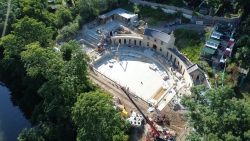 We have received the latest update on the restoration of the Cleveland Pools, which includes an aerial view of the entire site (taken by Phil Cloak). It reports "This month, we have hit some big milestones. The flagstones have been laid in front of the crescent; the interior of the cottage is completed; the WC block is finished; and, with the last of the heavy loads delivered, the crane has been removed. Following the crane removal, we had to move the camera that captures our timelapse video".
- The consequences of moving the camera are that there are now two videos for anyone who wants to watch from the start to the current time. There is a timelapse video from the beginning of the restoration until June and another from then until mid July.
- The removal of the crane crane allows the final stage to start. The update continues: "This means we can start work on the riverside corner of the site – previously inaccessible due to the crane base. After 15 long months of construction, the Pools are nearly complete. In the next few weeks, we will be cleaning, filling, testing and commissioning all the pool systems, and getting the final touches and landscaping underway".
- 24 July update: Richard Wyatt of Bath Newseum followed up the update and managed to get a photograph of the start of the filling.
- Waterworks Cottage - Last updated 10 July 2022.
- We notice that the Waterworks Cottage application was refused on 4 July 2022 quoting, correctly, that it was because the Local Planning Authority had been given insufficient information to be able to discharge its duties under the Conservation of Habitats and Species Regulations 2017.
- Our argument that Section 106 of the Town and Country Planning Act was a reason for refusal was ruled out because it was dependent on paperwork in a specific format, which wasn't made. Having now read through the entire "Other Controls Over Development" Section (102 to 106C) this appears to be correct. However we also pointed to Statutory Instrument 2421 of 2012 (though our accidental typo said 2021 which might explain why it didn't feature in the Case Officer's Report). That Instrument entitled "The Assets of Community Value (England) Regulations 2012" amended the Localism Act 2011 to introduce the concept of a body with a local connection identifying assets of community value, and Locally Important Buildings meet that description. As such they become exclusions to the Permitted Development Rights. We have to assume that because of our typo the Statutory Instrument wasn't found so wasn't mentioned. It will however be relevant if the applicants try yet again to argue that they have permitted Development rights to demolish. They haven't, according to the Community Value exception.
- The other thing we noticed is that sometimes when a planning application is refused, not all the possible reasons for refusal are quoted. In reality, this seldom matters, because it is the refusal decision that is important. In the case of Waterworks Cottage, the lack of access for larger vehicles, particularly emergency vehicles remained an unsatisfied concern. That is not the same as the Case Officer's claim that because Highways safety concerns were not a feature of the previous application's refusal, their concerns over this current application had already been accepted. The absence of something in the reasons for a previous refusal is not proof of acceptance. Also, the Swept Path Analysis is for a 4x4 vehicle and because of the lengths involved scaffolding is never carried on something that small, so acceptance cannot be assumed.
- Waterworks Cottage - Last updated 3 July 2022.
- We notice that despite the expiry for consultations being 29 June, the applicant has been allowed to submit an amended Demolition Environmental Method Statement on 1 July. Despite it not being rejected as being out of time, it doesn't solve some serious problems, one of which is to claim that demolition vehicles would be "large 4-wheel drive vehicles" despite scaffolding deliveries, site huts arriving and demolished materials being taken away in skips, none of which would be possible using the vehicles pictured in the Tracking Drawings.
- It still remains the case that it is a "DEM" planning application and that type of planning application is ruled out by Section 106 of the Town and Country Planning Act and Statutory Instrument 2421 of 2021. It should be refused on that basis. If the applicants want to pursue development on this site they cannot use Permitted Development legislation to do so.
- Former Loch Fyne Fish Restaurant - Last updated 26 June 2022.
- This is a building currently with separate permissions for two different uses. In this week's new applications is one (22/02367/FUL) for a change of use of the lower floors from restaurant to public house with some food provision, and in that application is a description of what that will entail. The separate permission granted in 2001 for the upper floors to provide hotel accommodation retains that use.
- However the planning statement does also list changes to the hotel floors. This includes secondary glazing and the planning history shows that a previous application for secondary glazing was refused permission. It therefore looks a risky strategy to put everything in one application where acceptable public house works might be refused alongside the unacceptable hotel proposals, or acceptable hotel secondary glazing might be refused alongside unacceptable public house works. As the hotel use and restaurant (to be changed to public house) use result from different planning permissions in the past, it seems more sensible to treat them as different facilities in the same building and provide two separate applications rather than the current all-inclusive one.
- Although there was a listed building application for this address last week, that one was just concerned with the external signage, so there will need to be at least one other listed building application raised to cover the structural changes that are described in the change of use documentation, and we recommend that it should be two.
- Avon Studios, Midland Road - Last updated 26 June 2022.
- One of the planning decisions this week is to grant permission for student accommodation in Avon Studios to be repurposed as serviced apartments for two months of each year. For those two months they will not be permanently used as student accommodation and will therefore be excluded from the Government policy that accommodation solely for students is exempt from Council Tax. That should help the council's budget a bit.
- Cleveland Pools - Last updated 19 June 2022.
- In response to the recent Flood Risk Assessment Report, the Environment Agency has withdrawn its objection to the proposed Pontoon and Access Ramp, and has advised a couple of reasonable Conditions, and planning permission has now been granted. This has removed the last planning obstacle to the Pools re-opening later this year.
- 43 Upper Oldfield Park - Last updated 19 June 2022.
- We received a tip-off that we should look at planning application 22/01846/FUL because despite two planning refusals by the council which were overturned on appeal, producing two conflicting decisions, this latest application matches neither of them. When we looked at the documentation we noticed that it was a different applicant to the earlier ones that were appealed, and the Application Form indicates that the land belongs to the applicant.
- There is no indication of when the change of ownership took place, but the two Appeal Decisions are both in the public domain so any "Searches" carried out should have found them, and indeed the Application Form notes one of them, though not the other. The key point to note is that both Appeal Decisions carry the authority of the Secretary of State and nowhere in the planning legislation is there a Section that allows a Local Planning Authority to ignore any planning instruction issued by or on behalf of the SofS. Thus until the SofS planning instructions (issued in the form of Conditions) are delivered the LPA has no legal basis for handling any new applications on the land (the redlined boundaries in the planning applications) identified by the SofS. The LPA should have complied with the law, but so far it hasn't done so. It needs to now.
- Also, the instructions from the SofS are specific to the land subject to the appeals regardless of who owns it, so in taking ownership of the land the applicant of 22/01846/FUL has inherited the obligation to deliver the instructions of the SofS and only having delivered the conditioned landscape scheme and then maintained it for 5 years thereafter is there the opportunity to use the land for anything else. If that was not conveyed by the seller to the purchaser, then the land was transferred under false advertising and the transfer would then appear to be a scam against the current owner.
- Waterworks Cottage Again - Last updated 12 June 2022.
- Swiftly following the refusal of 22/01884/DEM on 1 June, the applicants have submitted a new application (22/02297/DEM noted in this week's "New Applications") where they once again try to argue the reasons why the various points in the Permitted Development Act indicate that the demolition should be allowed to proceed, and additional information was provided to prevent the reasons for refusing the previous application being re-used. What the applicants carefully avoided was mentioning the "excluded demolitions" reasons in the Act why the Permitted Development application cannot be permitted.
- We have explored the relevant legislation, the guidance and requirements that prove Permitted Development cannot be used as a route to demolition, and after we have uploaded this update we will be submitting chapter and verse on how Permitted Development is ruled out so that the Planning Staff have legislative justification for refusing this latest attempt.
- Waterworks Cottage - Updated 22 May 2022, Refreshed 5 June 2022.
- 22 May update: When we saw the previous application affecting this cottage, we pointed out that the cottage is recognised as a Non-designated Heritage Asset and this is a cottage on the edge of open countryside that was only built because it was needed to support the nearby waterworks. The previous application was refused, that decision was appealed and the appeal was dismissed with the appeal inspector confirming it was a Non-designated Heritage Asset and rejecting the appeal on grounds which included the importance of the cottage marking the transition from urban to rural which outweighed any benefit from an increase in residential accommodation.
- With that background plus the requirements in both the NPPF and planning legislation that there must be a significant public benefit offsetting any harm to a Non-designated Heritage Asset, the latest application to simply demolish the existing building fails to meet any of planning expectations of overriding benefit.
- 5 June update: On 1st June this planning application was refused. The reasons for refusal (lack of plans for demolition and traffic management, and failure to consider protected species) are valid, but they are incomplete. When the Conservation Officer reports "This building meets the criteria, as set out in Historic England’s guidance; Local Heritage Listing (2016) and the BANES draft SPD on Locally Listed Heritage Assets, for recognition as a locally listed heritage asset (LLHA). This was recently endorsed by the Appeal Inspector" this is a specific planning reason for ruling out Permitted Development for demolition, and that should be communicated to the applicant in a replacement Decision Notice.
- The Scala - Last updated 29 May 2022.
- Here is something for the Planning Committee to consider. The original application for the redevelopment of the site was (appropriately) refused. The applicants appealed that decision, and having read the reasons for appeal against the reasons for the refusal it looks as though the balance of probability was that the appeal would be dismissed.
- The applicants then raised two new applications, one for a modified scheme and the other for a temporary smaller retail store for customers to use while the main store was under modification. The modified scheme conflicted with a number of planning policies, particularly the loss of most of the community use upstairs which would be converted to student accommodation. There were very clear planning reasons for refusing this second application. However the Committee Meeting approved it on very shaky grounds.
- The applicants then withdrew from the appeal process (it had succeeded in scaring the decision makers into approving the unacceptable so it was no longer needed) and withdrew the application for the temporary building. All the shop floor staff have now received Redundancy Notices because the whole site will now be closed for redevelopment. It was the temporary building that provided the residual parking capacity, so effectively this decision has removed all the overflow parking that the Moorland Road shops depend on. Without the temporary shop, regular customers will have to shop elsewhere, and when that becomes their routine, few of them are likely to return to the Scala when it reopens. The smaller shop now looks doomed.
- The lesson for the Planning Committee members is that when inappropriate planning decisions are made, the knock-on consequences are substantial: staff are being dismissed to join the unemployed, and the footfall in Moorland Road will drop drastically when the parking spaces available reduce drastically. It remains to be seen how many of those shops will survive fewer shoppers. Bath deserved better!
- Green Park Station - Last updated 15 May 2022.
- We were saddened to read in the Chronicle of the damage to the train shed roof caused by storm Eunice. The structure was originally built for an environment based on the heat of burning coal and the humidity of steam so it is no surprise to discover that a "like for like" repair was not considered practical and a planning application would be needed.
- We were pleased to see that the application is among the new ones this week. Although there is the statutory consultation delay, the speed with which the application was prepared suggests that the train shed restoration is not likely to be unduly delayed.
- Council Consultations - Last updated 8 May 2022.
- We have been informed that as a result of the changes proposed in the Local Plan Partial Update, some consequential changes to existing Supplementary Planning Documents have been drafted and are now open to public consultation until 17th June.
- We have made links from the names of the two SPDs affected. From each
of the consultation links there are "Have your say" links to the
consultation response processes. The SPDs are:
• Draft Planning Obligations SPD. This sets out the Council’s proposed amended requirements on developer contributions;
• Draft Sustainable Construction Checklist SPD. This is being updated to take into account new policies on sustainable construction and embodied carbon for both residential and non-residential new build properties. - The Local Plan Partial Update has already had a public consultation exercise, and the next stage in that process is an examination of the update by a Planning Inspector appointed by the Secretary of State. The hearing starting on 21st June will take place over two weeks, the first week in the BRLSI building in Queen Square, and the second week in a room in the Guildhall. Once the hearing is underway, progress information will be published on the council website by the Planning Inspector. The Inspector intends to reach one of three outcomes: the amendments as written are acceptable; the amendments are not acceptable as written but could be made acceptable; or the amendments cannot be made acceptable.
- Cleveland Bridge - Last updated 1 May 2022.
- We have received a further progress report on the Cleveland Bridge works. The modelling exercise has to show that any solution would be 100% certain that it would not lead to structural failure on any other sections of the bridge. To ensure that there is adequate time to model and reject any unsafe options the Temporary Traffic Regulation is being extended by a further 6 months. The other scheduled work on the bridge is continuing and will be completed soon.
- There had been plans to open the bridge to two-way light traffic then, but the technical experts now believe this cannot be done safely and the two-way alternate arrangement currently in place must continue. It allows the bridge to remain open without danger of structural failure.
- 15 Milsom Street Unusual Permission - Last updated 1 May 2022.
- The decision on the recent planning application for this address (22/00699/VAR) did not appear to be lawful because 22/00699/VAR was an application to change the details in an earlier application 21/04238/LBA. However, when we checked, the Head of Planning confirmed that whilst material changes to a permission previously given would normally be requested via a new LBA application, Section 19 of the the Act covers how amendments to previously imposed Conditions associated with a consent are handled and the wording allows such requests to be in a format approved by the Local Planning Authority: and B&NES does allow VAR applications where only Conditions are to be modified.
- We have apologised for our earlier item and have now deleted the suggestion that this particular VAR was not the correct approach.
- Cleveland Bridge - Last updated 17 April 2022.
- We have received a further progress report on the Cleveland Bridge works. Most of it has been included in the Chronicle item, but that item also contains a drawing of how the corroded hanger fits onto the bridge which the report we received doesn't have. The report we received does have some additional details though, including the problem that in order to retain enough structural strength to continue to use the bridge for light traffic only a small amount of concrete can be removed at a time, which is why not all the problems are known at the outset. We found a picture of one small section of removed concrete where the amount of metal corroded away from hanger bars is clearly visible. The part of the bars which was always visible remained sound, but inside the concrete where it couldn't be seen it was gradually corroding during the century it had been hidden.
- Because each hanger is a bespoke size, getting replacements looks difficult and other options are being examined. However, other options would alter the stresses on the bridge structure and computer modelling is in hand to assess the impact across the entire structure in order to determine whether or not it is a viable option. Other repairs can continue meanwhile, but it will be May before the results of the calculations are complete and can be analysed.
- Plumb Centre - Last updated 10 April 2022.
- According to the recent Chronicle item the Plumb Centre site has been sold to Bath Spa University. Technically there are two alternative planning permissions for this site: Application 18/05047/FUL was refused by the Case Officer for 7 reasons and that sensible decision was appealed and the Appeal Inspector for spurious reasons decided to overrule it and grant permission, then a second slightly different planning application 20/00023/FUL which was raised and considered by the Planning Committee who didn't like the application but because the Planning Inspector had made some false arguments in allowing the earlier appeal they thought (wrongly, because the Planning Inspectorate never considers previous appeal decisions if assessing a new Appeal for the same site) that they would automatically lose a further appeal so they had to permit it.
- The site has been sold with two extant planning permissions, and it will not be until applications to clear the associated Conditions (18/05047/FUL had 29 and 20/00023/FUL had 31) that it will become clear which permission is being built.
- There is a potential future problem too. Both planning permissions state when the development must be started; neither state when it must completed. It would be legally possible to build and bring into use the student accommodation and then leave pending the preparation of the industrial use. The occupation by students is only dependent on student management conditions and not on the remainder of the development being completed.
- Cleveland Pools - Last updated 10 April 2022.
- We have received a notice of some free workshops for those enthusiastic about researching social history topics and interpreting them to audiences. The workshops in May aim to develop interpretation skills. That notice came with a flyer and a request that we give it some publicity, which we are doing by putting the flyer online.
- 20 March update: We had another look at the crowdfunding page which was originally intended to cease accepting donations at the end of 17th March and discovered that the closing date had been extended to 8th April. The amount pledged to date had reached 73% which increases to 80% when the Gift Aid estimate is added on. Having got so close to the target, it is understandable that the closing date would be extended. The alternative to the Crowdfunding site for those who do not want to donate online remains an option. Cash or cheques (made payable to "Cleveland Pools Trust") can be dropped off at their office in Percy Community Centre, New King Street, Bath BA1 2BN, and if appropriate there is a Gift Aid form that can be requested. This donation route will remain available after the Crowdfunding page closes.
- 27 March update: Support for the crowdfunding continues. It is impressive how a £20 here and a £50 there gradually adds up, and the amount donated by 27 March is very nearly 75% of the target, which increases to just over 82% when the Gift Aid figure is added to it.
- We have discovered why achieving the target is so important: there is a conditional donation of £10,000 available which the Trust will receive if it reaches the crowdfunding target of £80,000. That extra donation is important because the crowdfunding sum is only part of the total amount of residual money that needs to be raised to complete the Project, and any contributions to the residue are important.
- 3 April update: Support for the crowdfunding continues. With less than a week to go (unless the closing date is extended again) the 3 April crowdfunded figure is 77% of the target, which increases to just over 85% when the Gift Aid figure is added to it. Of course this is just the donations via the crowdfunding page and we have no information on what level of donation has been submitted additionally as cash or cheques.
- 10 April update: With a flurry of donations after our 3 April update, the target £80,000 was achieved with a small excess amount. The crowdfunding exercise closed on 8 April 2022 with £81,414 in donations (a bit under 2% extra) and £7,364 in Gift Aid, making a grand total of £88,778, roughly 10% above the target.
- Raby Place - Last updated 3 April 2022.
- Raby Place had an interesting history because when Brunel was building the Great Western Railway through Bath, Number 18 Raby Place was in the way, and in typical Brunel fashion he took the house apart, built a tunnel roof where it used to be, and then rebuilt the house on top of that roof (thus losing the basement) leaving the street view of the property as it was. It is probably one of very few Georgian properties with a main line railway running directly beneath it. It eventually changed from a townhouse to a Bed and Breakfast Guest House, but it retained its Georgian charm.
- We were surprised to see a Chronicle item about the former Roman City Guest House being used as a party house despite no planning permission being granted for a change of use. Looking back on the history of the property it was seized by the National Crime Agency because it had been derived from the proceeds of unlawful conduct, and in common with other seizures it was subsequently auctioned and it resulted in a planning application 21/04202/FUL by Bath Hot Houses for a change of use from Bed and Breakfast (Use Class C1) to holiday let accommodation for up to 25 people. The reason quoted by the applicants was that "the business is no longer viable due to changes in tourism" which neatly sidesteps the impact on all hospitality businesses of coronavirus restrictions, which have now been lifted. The former B&B use had advertised 8 bedrooms to let so an increase to 25 guests looks excessive especially when the on-line advertisement quotes "6 bedrooms, sleeps 4-25", but that wasn't part of the reasons for refusal. The applicants claim to have appealed the refusal, though there is no sign of the appeal documentation on the planning website at the time of writing this.
- The applicants also raised a second planning application application 22/00723/FUL for a change of use to a holiday let for up to 12 people which is still pending and which has attracted over 100 objections, many of which pointed out that the change of use has (unlawfully) already taken place.
- This means that currently the only legal use for the property is as a Bed and Breakfast Guest House. Such a use requires somebody on-site to make the beds and prepare breakfasts each day which is only practical if there are staff in residence to do the work. It should be a simple exercise for Enforcement to check that it is currently staffed as a guest house, and we have to wonder why that hasn't been done when complaints have been raised over a considerable period of time.
- Footnote: The applicants appealed both the original and subsequent planning applications. The Chronicle reports that both appeals were dismissed.
- Windsor Pipe Bridge - Last updated 20 March 2022.
- One of the new applications this week is for the demolition of the bridge alongside the Windsor Bridge, and this has prompted a Chronicle article on it. The way the Chronicle reports the council's position has all the hallmarks of the council spokesperson exaggerating the problems and minimising the functionality. The Heritage Statement which forms part of the application documentation quotes earlier council documentation identifying the bridge as "an unlisted building of merit" and also "a building at risk" so it clearly isn't as disposable as the newly published claims.
- It is also worth pointing out that the bridge is currently capable of bearing the weight of the gas pipework, so removing the pipes and subjecting the bridge to the much lower weight of pedestrians and cyclists should not put the structure under any significant stress. The planning application evaluation process is also not required to take costs into account, so the council's reasons for demolishing because of the (probably exaggerated) cost of retaining it are not a planning matter, whereas reusing the bridge for the promised use of providing an alternative route for cyclists away from the heavy traffic on the road bridge is a very definite public benefit.
- The Tufa Field - Last updated 13 March 2022.
- There is an item in the Chronicle describing an ideas meeting on a smaller scheme for community housing on part of the field. There are two fundamental things wrong with that idea.
- Firstly, although Cllr Guy publicly announced that the original plans for 37 houses would be scrapped, it hasn't. The Planning Committee decision on it was "Delegate to Permit" and that is where it remains. Thus the Case Officer has the legal right to issue permission, and that right will last indefinitely. The only way to fulfil the promise that the plans will not go ahead is to bring the application back to the Committee with a recommendation that it is refused. There have been no indications that such a course of action is planned, and we wonder if it has been deliberately left as a threat if a lesser but still unsuitable application is not approved in the future.
- Secondly, there are a number of issues with the site that were not discussed in committee, but they need to be heeded in order to avoid the risk of a judicial review of either the original application if a decision notice is finally issued, or of a future application for a smaller but still inappropriate application is given permission. They are:
- • The Wildlife and Countryside Act 1981 identified the slow-worm as a protected species that cannot be killed or injured, and imposes a fine of up to £5,000 for each offence. The Countryside and Rights of Way Act 2000 further updated the Countryside Act and added the option of a six month custodial sentence in addition to the fines. It does depend on how that phrase is interpreted by the courts, but potentially the injured specimen photographed after the lawn mower is one offence, and is indicative that there could have been many more similarly photographed but not published which might be evidence of others, and the courts could interpret that as requiring a penalty for each. The law forbids killing or injuring, and the council's claim that they couldn't find evidence of any slow-worms killed (two weeks later when the evidence would have been cleared up by carnivorous wildlife) is not proof that none were injured and there is photographic evidence that such a claim would be untrue. It is also worth pointing out that if the slow-worms are moved to another site, as the council had proposed, and they significantly reduce in numbers as a result, that would also be an offence under the Act.
- • Given that a handful of dwellings (although described as "community housing" there isn't a specific use class to ensure this) could be built anywhere, there isn't sufficient public good to offset all the caveats in the council's planning policies. This site is in the WHS SPD as an important green hillside. Policy NE2A (Landscape Settings of Settlements) protects from development encroachment the landscape which is of importance to the distinct form and character of the city including the green hillsides which contribute to views from the city, and thus it needs to protect the character of the World Heritage Site's important green hillside. Policy NE3 (Sites, Species and Habitats) rules out this field: "Development that would adversely affect, directly or indirectly, internationally or nationally protected species and/or their habitats will not be permitted". The associated description specifically rules out Sites of Special Scientific Interest (which this field is), and UK Priority species (slow-worms) and UK Priority Habitats (the tufa springs). There is no suggestion anywhere in that policy that trying to recreate the habitat and relocate the species is an acceptable mitigation. Policy NE5 (Ecological Networks) is primarily covering trees and woodland, but it does include habitat protection as an objective, so it reinforced NE3.
- Given the policies above, the Planning Committee should refuse Cllr Guy's choice of this field for housing if it results in a planning application, because building it would be a criminal activity with the option of a custodial sentence, and Local Planning Authorities are required to operate within the law.
- Cleveland Pools - Last updated 13 March 2022.
- We have received a new newsletter providing a link to a time-lapse video of the progress up to the 3rd of March. It also expresses the Project's appreciation for the generous donations so far on the crowdfunding page (where the total of the donations to date including the Gift Aid sum is just over 61% of the target as at 3pm on Sunday) and reminds that the page will cease accepting donations at the end of 17th March. It also adds an alternative to the Crowdfunding site for those who do not want to donate online. Cash or cheques (made payable to "Cleveland Pools Trust") can be dropped off at their office in Percy Community Centre, New King Street, Bath BA1 2BN, and if appropriate there is a Gift Aid form that can be requested. This donation route will remain available after the Crowdfunding page closes.
- The other piece of information is that the prize draw for an opportunity to be one of the first people to swim in the newly restored pools is based on making an application to enter the draw. The draw is open to anybody, whether they have donated or not. Applications must be made either by e-mail to firstswim@clevelandpools.org.uk or by post (ideally on a postcard) to CPT First Swim, Cleveland Pools Trust, Percy Community Centre, New King Street, Bath BA1 2BN. All applications must quote Name, Address, email address and contact telephone number in order to be entered into the draw, and there will only be one entry per person so multiple applications will not improve the chances of winning. The draw will take place on Friday 18th March so all applications must be received before that date. Winners (100 winners, each of whom can bring one guest) will be notified by email within 14 days of the draw (so make sure the email address you quote is genuine and is one you will read). The list of winners will also be published on the Cleveland Pools website.
- The March Planning Committee regarding the Rec - Last updated 6 March 2022.
- The three planning applications on the agenda of the Planning Committee meeting on 9 March are from Bath Rugby applying for variations on earlier planning permissions. We had not commented on the applications during the consultation period because the Pulteney Estates Resident's Association and the Friends Of Bath Recreation Ground were parties to the clarification of the legal cases and were much better placed to use the case outcomes to guide their comments. However, we did obtain copies of the various legal judgments and the 1995 lease for the area occupied (in breach of trust, as Bath Rugby admitted to the First-Tier Tribunal), and we can therefore comment on the accuracy of the briefs to the Committee.
- Firstly we challenge the Case Officer's assessment that "these legal issues are not planning matters in and of themselves". They are, because in law a Local Planning Authority is indivisible and every planning decision is legally the responsibility of the whole council. This is important because the Rec is Charitable Land, and in defining exactly how the Charitable Land shall be administered the First-Tier Tribunal (Charity) of the General Regulatory Chamber on 27 March 2014 ruled that Bath And North East Somerset Council (and any subsequent LPA that may replace it) is the Custodian Trustee of the Recreation Ground as defined in the Public Trustee Act. The Act insulates the council from responsibility for the actions taken by the Managing Trustees of the Charity. The Managing Trustees are similarly legally obliged to deliver the object of the charity which includes retaining the Rec as open ground, though with a temporary exception that the land covered by the 1995 lease (until it expires in October 2069 or is surrendered or revoked at an earlier date) can continue to be used by Bath Rugby.
- However it places a legal obligation on the Custodian Trustee (Section 4(2)(d) of the Act) to "concur in and perform all acts necessary to enable the Managing Trustees to exercise their powers of management or any other power or discretion vested in them (including the power to pay money or securities into court), unless the matter in which he is requested to concur is a breach of trust". It also places an obligation on the Managing Trustees "to perform any trust or duty belonging to a class which he is authorised by the rules" which in this case is the object of the Charity reproduced in full on another page of this website. The Act also allows (Section 10) "A person aggrieved by any act or omission or decision of the public trustee [in most cases the Custodian Trustee] in relation to any trust may apply to ... the Chancery Division of the High Court in Chambers". Note that this is an automatic right to take legal action, unlike a Judicial Review where permission to pursue one must be applied for. As such, the Public Trustee Act needs to be included in the Legislation section of any planning application for the Rec.
- East Stand It should be noted that the Managing Trustees are required by the Judgment of the First Tier Tribunal and thereby by the Charity Commission to ensure that for three consecutive summer months the area occupied by the East Stand must be returned to being an open space (and this has been Conditioned in planning permissions so far), and thus the failure to enforce the removal of the East Stand in the past failed to perform "all acts necessary to enable the Managing Trustees to exercise their powers". Enforcement action is not optional for applications on the part of the Rec covered by the 1995 lease or the extended part permitted by the Charity Commission up to the judgment in 2014 ("1042 square metres or such other amount as is established to be the largest gross amount of the surface area of the land that has been made available by the charity to Bath Rugby for occupation by the East Stand in any year since 2002"). That part of the judgment tacitly allows the East Stand to occupy a specific and finite area on the Rec for 39 weeks of each year only until the 1995 lease expires or is terminated early. The Custodian Trustee must continue to permit the East Stand to be placed just outside the leased area as a temporary measure for as long as Bath Rugby applies for it, but never as a permanent permission.
- West Stand The West Stand is mentioned specifically in the lease as a viewing location among other things, but the lease does not prevent internal or external alterations provided it retains the same footprint. However, the object of the charity requires the location to eventually be returned to an open space when no longer covered by the lease so all permissions for any structure within the leased area must have temporary permissions so that demolition at the expiry of the lease can be enforced. The Policies/Legislation part of the Committee Brief needs to include the Public Trustee Act, the Object of the Charity and the Tribunal ruling on the lease as well as the listed building and Conservation Areas constraints.
- North Stand The structure referred to as the North Stand is shown in the lease as the Clubhouse but it can also provide viewing facilities. Again the lease does not prevent internal or external alterations provided it retains the same footprint, and again all permissions must be temporary or else the Custodian Trustee will prevent the Charity from meeting its objective of returning the area to an open space on the expiry of the lease. The Policies/Legislation part of the Committee Brief needs to include the Public Trustee Act, the Object of the Charity and the Tribunal ruling on the lease as well as the listed building and Conservation Areas constraints.
- Thus although the guidance argues against renewing temporary conditions, the combination of the object of the charity and the dispensation of upholding the lease while the lease remains in force requires that all permissions for development work within the leased area must be temporary, and nothing outside the leased area can be permitted apart from a small additional area where the East Stand can be placed for 39 weeks in each year if requested. The Custodian Trustee is not legally able to give permission for any development on the Rec outside the area shown in the 1995 lease, so all reference to a redevelopment project is fictional. The land is charitable land and the Charity Commission requires it to be an open space, a position endorsed by the 2014 judgment.
- It is also worth pointing out that despite the apparently successful legal efforts of Bath Rugby to get the 1922 covenant declared unenforceable, it still remains so because the conditions of the 1922 covenant are included in the 1995 lease and the lease can be terminated (and thus Bath Rugby lose the use of the land) if they do "anything that may be or become a nuisance annoyance or injury to any adjoining property or its occupiers or to the neighbourhood". If the club act as though the 1922 covenant is unenforceable then the Public Trustee Act allows anybody thus disturbed to take the Custodian Trustee to court if the lease is not terminated for breach of conditions.
- Planning Committee Decision: The minutes of the meeting on 9 March are not yet available, but the Chronicle report on what happened is online. While those with opinions on whether or not more temporary permissions are appropriate, our analysis above shows that because the Rec is charitable land and the presence of Bath Rugby on it is covered by a lease which even the club has admitted is in breach of the Trust objectives, there were only two possibilities for decisions on Bath Rugby's planning applications, and they were to give temporary permission or to refuse. The Committee's decisions were therefore lawful. However the assumption provided by the Case Officer (as reported by the Chronicle) "it could take 12 months to submit and determine plans for the stadium and then three years to get it built" is unlawful under the Public Trustee Act, and his management needs to make that abundantly clear. Similarly, the Trustees cannot promote the possibility without committing an offence under the Charities Act, and the Charity Commission is entitled to pursue a No Confidence action against them if they are not fully committed to upholding the object of the charity
- Footnote: The minutes when published revealed that the Case Officer did insist that the covenants and legal matters were not material considerations for planning. Unfortunately, they are, because the Public Trustee Act affects all planning decisions concerning the charitable land known as the Rec, and planning decisions need to reflect the constraints on the entire council, or else the council could be paying out large sums of money on court costs for overturning planning decisions contrary to the Act. That includes permissions for any developments on the Rec outside the Bath Rugby footprint. Head of Planning needs to verify this with legal advice and then educate staff and Members of the Planning Committee.
- Cleveland Pools - Last updated 20 February 2022.
- 20 February 2022 We have received a mailshot from the Project, announcing that the crowdfunding page is now open and available for donations, and we have been asked to give it some publicity. As a long-time supporter of the Cleveland Pools Project we are happy to do that here.
- The crowdfunding page will be open until March 18th. The Project hopes to get to 40% of its target in the first few days, and half-way through the second day it had reached 10% and was 14% from 270 donations at the time of writing this part-way through the following day so that hope looks obtainable. Those making donations will have the opportunity to enter a prize draw for tickets to be among the first to swim in the pools once opened, and entry into that draw is optional so that those not wanting to swim should not be deterred from donating.
- 27 February 2022 We had another look at the crowdfunding page and the hoped-for 40% didn't happen in the first few days, and it hasn't yet been reached. The donations so far have reached 22% of the target which goes up to just over 25% when the Gift Aid sum is added on. There are still 18 days to run for more donations.
- 6 March 2022 We had another look at the crowdfunding page and the hoped-for 40% didn't happen in the first few days. However the donations so far have reached 38% of the target which goes up to just over 44% when the Gift Aid sum is added on so donations are still being made. There are 11 days still to run for more donations.
- Frome House Refused - Last updated 13 February 2022.
- We mentioned last week that our detailed objections had been reduced to an anonymous single line in the Committee Report. That had some effect in that there was a Committee Update which identified some of the points we raised in our second submission.
- The deliberations lasted about an hour, and during that time there was some discussion about the "shortfall" in student PBSA accommodation which is an entry in the planning policy review (not yet adopted) and is a target to be met by 2029, and it didn't take account of the on-campus proposals which when delivered would result in a surplus rather than a shortfall. The suggestion that there should be a Condition banning students from bringing cars was dismissed as unenforceable and the claim that more PBSAs would release some HMOs back to normal housing was taken away as something to be investigated, with the expectation that almost none would be identified. It was good to see common sense being applied to what had been up to now quoted as standard assumptions.
- This led to a motion to override the Case Officer's "Delegate to Permit" recommendation and refuse the application, and this was successful. The reasons for refusal were unacceptable height, massing and architectural style, harm to the amenities of nearby residents, harm to the setting of nearby listed buildings and the World Heritage Site without sufficient offsetting benefits, the loss of commercial office space and harm to the housing mix in the vicinity. The observation that this is a wrong place for a PBSA because the Bathwick Tyres business on the ground floor would make the residences above unpleasant to live in was discussed but it didn't feature in the Decision Notice. A Chronicle article took a slightly different approach to reporting the outcome, quoting extracts from the public comments and quotes from the applicants.
- One thing that that wasn't mentioned in the Committee discussion or in the Chronicle item is the relative importance of sites and buildings. A World Heritage site is supposed to be overseen by a Government Minister because such sites are believed to be of international importance by the World Heritage Committee. Listed Buildings (with or without curtilage listed structures) are included in a register by another Government Minister based on the advice of Historic England, because the character and setting of each is considered to be of national importance. However, there is very little evidence that the planning staff and Committee Members consider the impact of harm to the World Heritage Site or Listed buildings might have on those who visit Bath to see them, when considering what is often merely a local offsetting benefit.
- We can name several such dreadful decisions of that type in recent years, but perhaps the most horrendous was the permission to destroy the blind doorway to the Friends Meeting House, which a Professor and published architectural historian was so concerned about that he wrote in from Northern Ireland to point out that the blind doorway was a key feature of the listed building because it made the Friends Meeting House unique in the country. Despite his warning that "the harm would not be outweighed by any alleged public benefit", the significance of the building was allowed to be destroyed and the listings register entry invalidated just to give a local bookshop an extra doorway which they could easily have managed without. The Government legislation points out that "heritage once destroyed is gone for good", and even if the damage is later restored it would only be a replica. This reflects badly on both the bookshop that applied for it and even more so on the Committee Members who permitted it. It was only because the Bath Preservation Trust is a registered charity and they couldn't therefore spend charitable funds on the court case they had been preparing to launch, that the council avoided a Judicial Review of that apparently unlawful decision.
- 12 Stall Street - Last updated 13 February 2022.
- We objected to the planning application, condemning the applicants for changing the shopfront appearance before applying for permission and recommending refusal because of the inappropriate colour and inappropriate materials. We accepted that the shopfront had already been pink but noted that the replacement pink is even worse.
- It is a puzzle therefore why the applicant has submitted precedence examples which included the previous shopfront which when we checked had never been given planning permission! The Conservation Officer helpfully points out that the guidance and the NPPF have both been updated since the other examples in Stall Street were implemented, so they cannot now be used as precedents.
- Not only should the retrospective application be refused, but it should also be given a time-limited Enforcement Notice to remove what has already been installed.
- Cleveland Pools - Last updated 6 February 2022.
- We have received another update from the Project, with a link to the latest Time-lapse video and an explanation that the marquee towards the end was in place to keep the frost at bay while the render on the base and walls of the pool, installed ready for the final tiled finish, hardened. The update also explained that the pipework for the pools treatment and heating systems have now been installed below ground so that paths and hard surfaces can now be laid.
- The West of England Combined Authority supported the Project's successful application for funding towards the Water Source Heat Pump, so they were were delighted to welcome the WECA Metro Mayor to see for himself how the Project was progressing and to learn about the novel sustainable water heating system.
- The progress over winter and during various coronavirus restrictions has been good, and the expectation is that the pools will be completed and open to the public in the summer of this year. There is still some shortfall in funding (we have been informed that 95% of the £8Million target has been raised so far and there is just the last 5% to be raised), so the Project plans to launch a crowdfunding campaign on 18th February via Instagram and Twitter and the Project's website, with the offer that all who donate will be entered into a prize draw for a chance to be the first swimmers in the newly restored Pools. Donations before that date can nevertheless be made using the Project's website link.
- Incidentally, we notice that the Environment Agency wants to be convinced that the pontoon will not break free and damage structures downstream, but fails to give any information about the highest water level they want the pontoon to cope with. We have to wonder whether they properly read the documentation which quotes the 1:100 Year Flood Level plus Climate Change AOD and then caters for a water height in excess of this. This has all the hallmarks of a "computer says No" response, untouched by any supporting justification.
- Bathampton Meadows - Last updated 30 January 2022.
- History: Watchdog consistently opposed the use of Bathampton Meadows as a location for an east of Bath park and ride. The legislation would only allow a car park to be installed there if all other possible sites had been identified, examined, and rejected for valid reasons, and that had not been done. Another group who called themselves VeraCityBath got as far as applying for applying for court protection of the meadows for a number of reasons, including the fact that an earlier council study had already ruled it out as unsuitable. Eventually the Department For Transport reduced their offer of funding for the Bath Transport Package thus putting what the council decided was an unaffordable additional burden on local finances and they scaled back their aspirations, and then at the next local elections the Conservatives lost sufficient seats to lose control of the council when the Lib-Dem candidates promised to cancel the east of Bath park and ride, which they did. Some years later, the Conservatives regained control of the council and the Clean Air Zone was outlined to their design. They left the public unsure whether the private car would or would not be charged for entering the Clean Air Zone, and at the ensuing Local Election the Lib-Dems once again took control after promising that private cars would definitely not be charged.
- Moving forward in time, the current Lib-Dem controlled council has promoted a number of initiatives that showed that despite honouring their promise that private cars would not be charged for entering the CAZ, they had an "anti-car agenda" (as the comments in the local press called it), and plans to punish car owners for parking cars with what were called "dirty engines" in Resident's Parking Zones, completely overlooking the fact that a parked car emits absolutely nothing, and there is therefore no justification for the suggested "scale of charges" in place of the current fixed fees. The idea that the owner living inside the CAZ and owning a car with a "dirty engine" can drive round the CAZ with impunity with the engine running but gets penalised for parking it outside their residence with the engine switched off, does not go down well. Nor does the mismatch between the published demographic that Bath has a gradually ageing population and the current assumption that walking, cycling or public transport should force private cars off the road, go down well with the elderly who can't fit the council assumptions when they do their shopping.
- The Present: It is not for us to speculate on the outcome of the next local elections, but neither of the parties likely to win control have covered themselves in glory as far as the permanent residents of Bath are concerned. So we were delighted to read in the Chronicle that ownership of Bathampton Meadows has been transferred to the National Trust, an organisation that is forbidden by law from selling any land they received as a donation or they had bought. That transfer of ownership effectively prevents the Bathampton Meadows from being used as a car park for all time, regardless of any thoughts that any future council might have.
- Different views of the same document set - Last updated 23 January 2022.
- When the council policy changed so that listed building applications were no longer to be decided by the Conservation Officers, and that Case Officers would deal with both FUL and LBA applications, we had a meeting with the then Chief Executive and we were assured that Case Officers would consult with Conservation Officers when dealing with listed building applications and take their views into account. The processes since haven't been perfect, but on the whole it has been operating as predicted.
- We were therefore puzzled by the recent approval of signage on 10 York Street which was brought to our attention. The Conservation Officer was specific about what was required for the hanging sign: There is an existing bracket that, if not historic, is an appropriately traditional style. The bracket shown in the submitted information differs from this and is not of a design appropriate for the traditional building and the historic area of Bath city centre. Therefore, support for the hanging sign is dependant on the retention and reuse of the existing bracket. Yet the Application Form for the development is equally specific: External hanging sign above public entrance into the City of Bath World Heritage Centre, to be fixed to existing signage bracket. Such a mismatch of understanding is unusual, and we have to wonder whether some internal document distribution fell foul of the different procedures necessary during the pandemic.
- While we were away - Last updated 16 January 2022.
- We kept the New Ones page updated weekly. We knew that holiday times are often used by planning applications that at other times of the year would attract a lot of public comments. We thought that the minimum we should do was to give links to what we considered to be significant planning applications.
- We collected the usage statistics from the Internet host of our website, and spent a long time identifying where each of the "Unique Visitors" was located so that we could give a helpful analysis of where in the world our visitors who viewed our website were based. We also analysed all the planning applications we commented on and the outcome of each at the end of the planning process. The results of all this activity is on our newly updated Year Reports page.
- We noted that there was a Planning Committee meeting on 12 January, but it had a short agenda not covering anything we had taken an interest in, so we didn't make a special attempt to bring it to public attention.
- Cleveland Bridge - Last updated 19 December 2021.
- We have been notified that further inspections of the bridge structure has revealed further structural problems to be addressed. The gist of the report we received has now been published in the Chronicle, which has saved us a lot of typing! This is further proof that the Grade II* structure should not be carrying heavy goods vehicles, and any future proposals to impose a permanent weight limit on the bridge will have our support.
- Belvoir Castle - Last updated 19 December 2021.
- Last week we noted that the planning permission for the development in the grounds of the pub, which was quashed by a Judicial Review, has finally (after almost 18 months) put the High Court Judgment online for the public to read.
- We also noted that despite the Judge in assessing "the accusation that the council erred in law in failing to give sufficient reasons for granting permission" specifically stated, in addition to the grounds put forward by the Claimant, that "I would infer that departure from the policy of protecting listed buildings would similarly be sufficient." It is puzzling therefore why the Judgment isn't similarly lodged on the associated Listed Building application. Given that the council in response to the High Court proceedings consented to judgment, conceding that the decision was unlawful on Ground 1 (failure to give reasons), this omission is significant. That council response to the High Court also makes it difficult to do anything other than refuse the applications when they are before the Committee to reassess the applications that were quashed. Our observations that the skittle alley has definitely flooded in the past (our comments were available on our Comments page prior to the Planning Committee meeting and included a photograph proving this). It didn't get a mention in the Committee Report though.
- The other reasons for the Judge quashing the planning decisions for the Belvoir Castle were not commented on by the council but nevertheless are important considerations for the Committee. They were that the council erred in law by taking into account immaterial considerations; and that the council acted irrationally by failing to show that the public benefits outweigh the material considerations in the Officer's report. The article in the Chronicle does include them.
- The High Court Judgment ought to be mandatory reading for all Committee Members, to prevent them making the same mistakes in future. The fact that the judge specifically identified the skittle alley as a Grade II listed building, as does the Planning (Listed Buildings and Conservation Areas) Act, is also a useful reminder that curtilage listed buildings are not disposable as the council treats them: for instance the legislation only allows a listed building to be demolished when there is an extant contract for its replacement, yet the Foundry Building was demolished when its replacement was just an outline permission and the area was then used to store building materials for the new Office Building; and the Former Labour Exchange was the last remaining "make do and mend" example still fit for modern use and it attracted visitors just to see how the roof had been constructed. Those irrational decisions could also have been quashed by the High Court if they had been challenged. After all, listed buildings are of national importance and local benefits do not normally benefit those not in Bath.
- 19 December Footnote: The Chronicle reports that the Planning Committee did refuse the planning applications this time. The FUL was refused for 7 reasons, and the LBA was refused for 3 reasons.
- These are sensible decisions, but the reasons for giving the original permissions in the face of a well argued Committee Brief recommending refusal has never been properly explained. Rational decisions in the first place would have saved all the hassle of getting the High Court to overrule them.
- Cleveland Pools - Last updated 19 December 2021.
- Another example of box ticking rather than understanding the paperwork is the Consultation Response from the Environment Agency on the proposal to install a pontoon floating on the River Avon. This is because a flood risk assessment has not been included.
- The planning application has a description of how the pontoon will connect to the bridge to the land, and the pontoon itself will go up and down according to the water level in the river. Effectively, the pontoon is a moored river craft, and it no more needs a flood risk assessment than any other river craft on the Avon. Given that an almost identical pontoon was given planning permission (now time expired) without such box ticking, the Case Officer is hopefully going to assess the application as submitted without asking for irrelevant additional paperwork.
- The Scala Development 12 December 2021.
- There is an interesting difference of opinion in the article in the Bath Echo, where the dance school which used to teach about 350 people a week is forced to leave because the accommodation space is being reduced conflicts with the view of Rengen which claims improved community space. Given that Rengen intend to accommodate 16 students in part of the area currently used by the dance school, their idea of a smaller space remaining being an improvement should not have been believed by the Planning Committee which should have heeded the obligations in Policy CF1, particularly when Bath's MP was publicly concerned about the reduction in community space. Bath deserved much better.
- Cleveland Pools - Last updated 5 December 2021.
- We have received the latest progress report from the Cleveland Pools Trust, and that informs us that work has been progressing on the crescent buildings and the cottage now has the timber repairs completed and a new slate roof. The old slates have been salvaged for use on the former Ladies Pool changing rooms.
- The most urgent work now is to remove as much material off-site as possible ahead of any prolonged wet weather or flooding from the river which would make the activity problematical.
- The Trustees are still fundraising and have put their donation link on the front page of their website. Other information on progress is under their News link on that page.
- Finally, the Cleveland Pools Trust has updated its time-lapse film of the work in progress, now showing what has been done by 30 November.
- Scala Redevelopment - Last updated 28 November 2021.
- On 14 November we reported: "In the next Planning Committee meeting is the second application for the Scala, the first one having been refused and appealed by the applicant Rengen with the (false) claim that 'the Planning Committee has a history of rejecting schemes for student accommodation'. The application before the Committee has a recommendation to approve, which is rather puzzling. Compared with the application that was refused, the student bedspaces has been reduced by just 4 by taking a whole storey off the building, and it is the number of students that causes the problem with residential imbalance in the neighbourhood rather than how big the building is. Add to this the reduction of non-student residences by 6 and that is serious because it is accommodation for permanent residents that is in short supply. But by reducing the number to under the threshold for including affordable housing all such provision has been deleted, which is even more serious. If it was possible to include affordable housing in the previous application, the fact that none is offered in the replacement application is surely a reason for the case officer to seriously consider refusal?
- In the printed Chronicle dated 11 November but not on-line at the time this was written is an article headed "MP urges student housing rethink" which points out that the area currently used as a community space used by a dance studio will be reduced so that instead of that amount of space there is "little or no space allocated for the studios", yet there is no mention of equivalent space being made available elsewhere as the planning policy requires. That an MP is commenting on a planning application is unusual, and it signals that there is something wrong with the Committee Brief recommendation to permit. Is the council trying to avoid yet another Appeal by recommending permission despite failing some planning policies? We hope that the Committee recognises the shortfalls in the application before them and refuses it like they did the previous application. If it is permitted on appeal, it should be with a condition that only students can ever use it, which might, eventually, convince developers that there is already a surplus of PBSA bedspaces and they won't get sufficient of the income they assume from providing even more.
- 21 November Footnote: The Chronicle reports that the Scala application on the agenda of the 17th November Planning Committee was permitted, though that is not currently shown on the planning file. The article over-simplifies the public comments. Although there were objections to more student accommodation, there were also some which specifically identified planning policies which should have led to refusal. Our own objections showed 12 planning policies contravened and a probable criminal offence under the Equalities Act. In that aspect the Case Officer's Report misled the Committee. It referred to Section 149 of the Equality Act 2010 which is the Section headed "Public sector equality duty" when this is not a public sector planning application, nor an application for the benefit of the public sector. Thus advice to the Committee "The re-siting of the disabled parking bays must also be weighed against the wider benefits of the scheme" is not only incorrect in the context of Section 149 which gives no such leeway, it is also incorrect in the context of Section 15 which is the proper Section for disabled parking obligations. The other seriously misleading claim in the brief is that "making significant inroads into reducing the dominance of the private rented sector in meeting the demand for student accommodation in Bath would be likely to result in a substantial future demand for PBSA" when the planning files show that some existing PBSA operators are already seeking permission for non-student use to make up for a shortfall in expected demand, and planning permissions continue to be submitted and granted for yet more HMO rooms, both of which which proves that "inroads" is a complete fiction. It is a moot point whether the High Court, if considering a challenge to the validity of the planning permission, would consider whether the Committee could have reached a lawful decision after being provided with this misleading report.
- When the meeting minutes are available we will have a better idea of whether the meeting properly considered any of the policy violations, and the impact of the likely reduced footfall in Moorland Road because the Scala parking provision is being reduced too much. Our suspicion is that this application was given approval despite the valid objections on planning grounds to encourage the applicants to withdraw their appeal on the earlier application. It hasn't achieved that yet; the appeal has been put on hold rather than being withdrawn, and thus it remains available for re-activation and thus exerting pressure for more concessions at a later date, and there is still a "temporary store" application pending, located where the Mews Building will eventually be built, which needs to be approved to keep the shop trading during the building work. We have also already noted that the Mews Buildings are designed for easy conversion to student lets, and the construction delay because the temporary store has to occupy the space beforehand, leaves plenty of time for a Change of Use application to be prepared.
- Our members who live in the area and use the Scala for their regular shopping are concerned that with a seriously reduced car park capacity, the replacement of belted checkouts which are ideal for a trolley-load of shopping with self-scan tills which are not, and stock on offer reduced to typical "Convenience Store" ranges and therefore directly challenged by three other Convenience Stores already established in Moorland Road, this planning approval will mark the end of the current anchor store role and the beginning of a slow death of the Co-op Scala as a viable shop. Smaller basket sizes and frequent visits is a characteristic of students, and for 2 months of each year students abandon Bath. If catering for the shopping style of students and a too small car park forces local residents doing a weekly shop to go elsewhere, then the anchor store will have some very lean times each summer. Time will tell.
- 28 November Footnote: The Planning Committee minutes have been put online, and it is striking that so much of the Chronicle's report of the meeting failed to show in the formal Minutes. The draft minutes makes it obvious that the Committee was intending to approve, regardless of the 150+ public comments (which were ignored) and the application documents. One objection from a resident directly affected by the errors identified in the Impact Assessment didn't even have those errors mentioned in the Committee Report.
- The Case Officer reported a deficit of PBSA provision at the end of the Plan Period. However, that was an estimate made before the University of Bath stated that there would be no increase in student numbers, and there is obviously already a surplus which has resulted in planning applications to allow lets to non-students from the accommodation, and applications to convert residences into HMOs or to extend existing HMOs continue to be approved. Students prefer the less regimented HMO offerings. The advice that new PBSA will reduce the need for private letting and HMO properties is therefore completely misleading. We also searched the planning policies and are there are no proper forecasts of PBSA requirements so there can be no declared deficit. The Committee was advised that Policy CP10 does not specify what the mix will be, yet it does, because CP10 specifically describes housing types and sizes and student accommodation is not part of that policy. Similarly, Core Strategy Policy B5 requires student bedspaces to be provided on campus up to an agreed figure and only then can universities claim special circumstances for developments off-campus, so it does apply to sites outside the Central Area and Enterprise Area. The Case Officer lied to the Committee.
- Most of the Committee seemed completely ignorant of the plans they were considering. Cllr Bromley thought it would provide "additional community space" when the drawings show that the community space is significantly reduced. The Officer Assessment makes clear and Cllr Bromley should have noted that 16 student beds take over what is currently part of the community space leaving a much smaller community space, hence there is no excuse for believing there was " additional space" being proposed. Cllr Crossley claimed the proposal provided a "good mix of accommodation" so clearly he didn't listen to the Case Officer's figures of 88 student bed spaces and 9 accommodation units, which clearly isn't a good mix. Cllr Crossley also focused on the positive comments from the Bath Preservation Trust and completely ignored the negative issues that accompanied them in the same comment such as "the community use of the first floor ... should be safeguarded as a critical element of the scheme" instead of the reduced area proposed, and that without the partnership with Norland College they could no longer support the student accommodation and replace it with "an objection in principle" and this site should be "housing for families, young couples or key workers". This partiality is cherry-picking, Cllr Crossley, and that is not what Committee Members are supposed to do.
- In view of all this misinformation, it doesn't seem likely that this planning decision would survive a Judicial Review, particularly when Section 70B of the Town and Country Planning Act gave the council the right to refuse to determine this second application for the same site until after the Secretary of State has issued his decision on the appeal of the first one.
- The appeal against the refusal of the earlier application has been put on hold rather than withdrawn (though this has not yet been reflected on the planning website), despite the Planning Committee decision on the later application to "Delegate to Permit". It therefore remains as a potential stick to beat the council with over any future planning decisions.
- Wansdyke Business Park - Last updated 21 November 2021.
- On 24 October 2021 we reported that the council's refusal on the original application had been overturned on appeal. As expected, the applicants have now withdrawn the later application and have stated that they intent to proceed with the earlier one. In real terms it makes no difference because apart from the provision of more information to make a refusal more difficult to argue, the proposals are identical. Unfortunately, the earlier one includes a commitment to pay a contribution of £10,000 towards a Traffic Regulation Order or a Resident's Parking Zone. It is likely that the current consultation about whether Oldfield Park should be made a RPZ will now be declared as a "Yes" in order to justify taking the money.
- Cleveland Pools - Last updated 7 November 2021.
- Last week we noted that there was a new planning application for Cleveland Pools, which was for a landing pontoon in the river with access from it to the rest of the site. We noted that in 2015, there was a similar application for a pontoon, and the application was given permission, but the permission had lapsed. The new one was identical to the earlier one so there shouldn't be any problem securing a repeat of the earlier permission.
- We have now received another newsletter, referring to the pontoon, and pointing out that even as far back as 2015 they intended that the Cleveland Pools would be heated in a "low carbon and environmentally way". Beneath the pontoon will be a Water Source Heat Pump, which they estimate will save around 1,400 tonnes of carbon compared with a gas system which would typically be used for heating a swimming pool.
- The other thing in the newsletter is a link to the latest "Timelapse" recording of progress, which has been updated to 26 October 2021. If anyone is interested in the other videos of the Cleveland Pools, there is a "Channel" that contains them all, and to which each subsequent Timelapse sequence will be added.
- The other item of importance is the concern that adverse winter weather could increase the restoration costs and they repeat their appeal for donations. This link will take those interested directly to the donation screen, to save typing the complicated looking link.
- Mineral Water Hospital - Last updated 7 November 2021.
- We have had an approach from a non-member suggesting that we should be opposing the conversion of the Mineral Water Hospital to a hotel because not all the functions provided by the hospital have been transferred to the new location, and that makes the sale of the hospital unlawful. Apparently it is the Brain Injury Facilities that have not been carried forward, and this failure falls foul of legislation that requires that all facilities must be provided by the same NHS Trust before an asset can be sold. We are a lobbying organisation with particular interest in listed buildings and World Heritage and not legal experts, so we are not going to investigate an unspecified law.
- However it is a listed building so we did check the status of the planning. The Planning Committee has Delegated to Permit and the final Decision Notice has not yet been issued so the future of the former hospital is still in the council's hands, and we are mentioning the claim made to us so that the council has the opportunity to investigate its accuracy. The Application Form for the previous (refused) application shows "Property Services" on the Ownership Certificate, so the council might be the party committing the offence. The council should not be seen to be condoning any unlawful conduct of the either their staff or any other owners of the former hospital, so they ought to ask their legal adviser to check the claim before making a final decision.
- Also, among the public comments on the latest application is an organisation called The Friends Of The Historic Mineral Water Hospital, and they might be interested in checking the legality of the sale if they see this item.
- Footnote: Despite the above, planning permission was granted on 10 November 2021. The Decision Report does mention that among the objections received were references to Case Law and Legal Issues but it doesn't amplify what they were. It remains to be seen whether any legal challenges will follow.
- The Scala - Last updated 1 November 2021.
- Among the new applications this week is one for the Scala, seeking permission for a temporary store to be erected in part of the site which currently provides parking spaces. We have seen that the previous planning refusal has been appealed, and instead of the customary "Written Submissions" approach that most appeals take, the Scala has asked for a full Public Inquiry. They are entitled to do that, but as a modification of a retail store and residential accommodation in part of the car park, it seems excessive.
- If the style of building shown in the planning documentation is installed then the plans currently put forward require the incoming stock to arrive on a lorry that either has to obstruct Arlington Road because the only other entrance is the customer's one into the retail area and there will be Health and Safety concerns sharing that entrance between customers and palletised goods. If the goods delivery vehicle is the size of lorry that is currently used, it will obstruct the only vehicular access for customers while it delivers too. The Design and Access Statement makes no reference to access for stock so it is inadequate. It also cross references to another planning application for other information, when the council policy is that each planning application is self-sufficient, so more documents need to be lodged before the application can be determined.
- As a footnote, the currently pending planning application claims that the Co-op only needs a convenience store. It carefully fails to mention that there are already three convenience stores in Moorland Road and the unique selling point of the Scala is that it carries a wider range of products than convenience stores. If the Scala succeeds in its aim of becoming smaller it will haemorrhage the customers who find convenience stores insufficient, an outcome that doesn't seem to have been factored in.
- Wansdyke Business Park - Last updated 24 October 2021.
- The council refused planning permission for the industrial business premises to be partially demolished and the remains plus new buildings to be used as a Care Home. The reason for refusal was an unacceptable loss of industrial floor space. That decision was overturned on appeal.
- The reasons why the Appeal Inspector reversed that decision makes interesting reading. In a nutshell, although the Local Plan allowed a loss of industrial floor space and the desired amount of loss has already been exceeded, hence the planning refusal, the residual floor space predicted in the local plan is not worded so that it can be treated as a cap, and thus although there is already too small an amount of industrial floor space remaining, that shortfall cannot be used as a reason why a further loss cannot be given permission. The council is currently preparing a Local Plan Partial Update, and capping the further loss of industrial floor space really should form an important part of that Update to prevent further losses with applicants quoting this Appeal Decision.
- A further hole in planning legislation was identified. For listed buildings there is legislation to ensure that leaving a building to get derelict does not feature in the evaluation of a planning application for that building. However, in the case of the Wansdyke Business Park, the former machine shop which forms the part of the site facing Monksdale Road is a "non-designated heritage asset" rather than a listed building, and although the council and the developer have come to an agreement that it will be retained, the derelict state of the site the developer has created by deliberately evicting all the tenants so that the weather could take its toll, means that it is now a site where industrial use standards could only be obtained by considerable expense and there is a high probability that bringing the existing buildings up to a state where they could legally be let to industrial businesses would not be economic. This formed another part of the reasons for allowing the appeal.
- The Archway Project - Last updated 24 October 2021.
- The Archway Project has a number of ongoing activities. It is creating a Roman Baths Learning Centre in Swallow Street; it is creating a World Heritage Site Visitor Centre in York Street; and it is conducting an archaeological dig to reveal more of the Roman facilities associated with the Roman Baths. From time to time we receive e-mailed progress reports.
- The latest report is worth passing on. Their dig has revealed what they are calling a "Roman Gym", an area where Roman visitors would have worked out to keep fit, and a "Laconicum", a roman dry sweating room; effectively an ancient sauna. Visitors to the Roman Baths will now be able to walk among these newly excavated remains.
- Earlier in October, the Project lodged a planning application for signage for the World Heritage Site Visitor Centre, and we were disappointed to see that the World Heritage symbol (like the one outside the Roman Baths entrance) has not been included. We have objected to the signage proposals and that omission forms part of our reasons for doing so.
- Museum Of Bath At Work - Last updated 17 October 2021.
- As a supporter of the museum, Watchdog receives periodic newsletters, and the recent one provides information on events that took place during the summer, and a summary of future events. We have looked at the museum website and it seems to be in the process of redevelopment and some of the links that used to be there have not yet been restored.
- The other features that do appear on the museum's website and we think deserve wider publicity is the appeal for donations (because the museum was not allowed to open for a long period during the pandemic there has been very little income from visitors to the museum this year). We are bringing to the public's attention the "Adopt a bottle" initiative ("Adopt a Bottle is our new fundraising initiative aimed at individuals and families who would like to make a one-off donation and dedicate their bottle to a loved one") where a minimum donation of £30 and above is expected. There is also the simple request for donations on a page that explains how much the museum needs each year to stay in existence (it isn't a huge sum, but nevertheless difficult for a small museum to find on a continuous basis, which is why regular small sums are also being promoted). The page explains how to donate. There is also an appeal for anyone – perhaps recently retired – who has fundraising expertise to help the Board of Trustees to get in touch.
- Wansdyke Business Centre - Last updated 17 October 2021.
- This week's new applications contains one for this site, where the documentation is boldly stating that it is almost the same as the previous application which was refused and is currently in the Appeals process with no Appeal Decision available yet. The new application apparently provides much more information on the marketing attempts. We haven't studied the application in any detail yet, but a quick look at a couple of drawings shows that they are the same as those used in the earlier application, with one of them amended to 2021 with just the removal of the "Do not scale" warning from the earlier version.
- We also looked at the reasons for refusing the earlier application, and the council's submission into the appeal which went into much more detail about why it was refused. There are many more reasons than the lack of marketing information, so either the Appeal is dismissed and the replacement application is likely to go the same way when it too gets refused for almost all of the same reasons, or else the Appeal is successful in which case the replacement application is so similar that it is almost irrelevant.
- The only reason for the application that we can see is as a bargaining position: if the council permits this latest one, the earlier appeal will be withdrawn. We hope the council isn't tempted along those lines. Our look at the Appeal paperwork suggests that the appeal will probably fail, so such a bargaining position looks very weak, and the same reasons for refusing the earlier application will also apply to the later one because there are so few differences.
- Oddities in the Scala Application - Last updated 10 October 2021.
- We noticed initially that there were more than one document describing some aspects of what was proposed, and we are grateful that the Case Officer sought clarification of which were current and which were superseded so that we were in a position to comment on just the current drawings.
- We normally read the consultation responses and a sample of the public comments for the planning applications we take an interest in and list on our New Applications page, regardless of whether we submit our own comment or not. We were surprised to see that on the Scala application the Urban Design consultation response did not come from a council officer as we would normally expect, but we read the opinion of Neil Williamson Associates. When we looked back to the previous refused application, there was no Urban Design consultation response at all. We have to wonder if the council's Urban Design staff are being deliberately bypassed? It would go some way to explaining why an outside consultancy with a registered office in Devon and no apparent previous experience of Bath, was employed and failed to spot the obvious local shortcomings in the Scala proposals. (We notice that the same source of Urban Design comment has appeared on the Frome House application, with the same lack of understanding of the local environment when compared to the Conservation Officer's view!)
- The other oddity is the assumption in the application documents, endorsed by the Highways officer, that the demand for parking spaces would be reduced in the same ratio as the reduction in store area. In reality (backed by our members who shop in the Scala), a smaller store might reduce the range of product options (fewer brands of coffee or toilet rolls etc) but that isn't going to make a significant difference to the parking usage, partly because for the elderly it is a shorter walk from the parking to the shopping than most of the competing supermarkets, and partly because anything the Scala ceases to stock will almost certainly still be available somewhere in Moorland Road, so customers will either choose from a more limited range of brands, or will buy what they can from the Scala and then seek the shortfall from somewhere else in easy walking distance from the Scala. There may be some reduction in the parking demand when those who are in a hurry and need to do a one stop shop go to alternative supermarkets, but is is not going to be anywhere near the level of reduction the planning application assumes. When the current parking level is full, it is not uncommon for drivers arriving to just wait for a parked car to drive off, so a smaller parking offering is likely to create longer queues of drivers waiting for a parking space, or as a worst case, potential customers will see a long queue waiting to park and take their custom elsewhere, reducing the shop's turnover.
- Field Between City Farm and Cotswold View - Last updated 10 October 2021.
- Although the Chronicle article suggests that planning permission has been granted, the council's website still shows planning application (21/01588/FUL) as awaiting a decision. The minutes of the Committee meeting are now available and show that because of a requirement to reach a S106 agreement a Delegate to Permit decision was made.
- We were surprised that a planning official said that the Committee should not object on grounds that the previous application's planning inspector had already ruled were acceptable. We checked with the Planning Inspectorate what their procedures were, and were told that the delegation they received from the Secretary of State required that every appeal file should be permanently closed when the Appeal Decision is filed, and not referred to again. To support this, the planning legislation specifically states that appeal decisions are final and cannot be challenged in court.
- Therefore the past appeal decision for the site would not have been referred to when the current appeal was being dealt with because the Secretary of State forbids it, and the outcome of that appeal (which was a refusal) will not be relevant if the Committee had refused permission and that decision was appealed. Thus the advice from the planning official was fundamentally wrong. The Committee is required to decide an application based on planning policies and national guidance, regardless of any past planning history for the site.
- While we were investigating the history, we discovered that Cotswold View was built on the site of a school, and the application site used to be the playground. The NPPF confirms that it does not fall within the definition of previously-developed land. More importantly though, the planning permission for Cotswold View came with a Condition requiring the land which was the playground (and is now the site of this application) remains identified as important hillside, to be kept open to safeguard the appearance of the area. There was no mention of this in the Committee brief, yet it does have significant planning weight and we have to wonder why the Committee was not informed of it.
- We also note that the the last appeal recognised that the proposal is contrary to the development plan, in particular policies B4 and CP6 of the Core Strategy and policies NE2, NE2A and HE1 of the Placemaking Plan. The previous appeal (which was a full public hearing) recognised the proposals were contrary to policies NE1 and NE3 and would not be consistent with Core Strategy policy B4, the impact would be inconsistent with PMP policies HE1, NE2 and NE2A. Thus the two appeal inspectors are largely in agreement and it is only the personal opinions on relative weights that differed, and this appears to be based on how many viewpoints were investigated; the more viewpoints were examined, the more important the application site's open space became. We have already seen that Planning Inspectors are not infallible (look at the Plumb Centre decision that decided there is a desperate need for more PBSAs) and there is no particular reason why the Committee should be unwisely hampered in their decision making when the two appeal outcomes boil down to small differences of opinion based on where they viewed the site from.
- Luckily no decision has been issued yet, so the Planning Committee is in a position to call in the application for another review based on planning policies, now that we have established that there was a previous planning decision with a condition that the application site must be retained as an open hillside, and that appeal inspectors are forbidden from examining the decisions of past appeals when considering a new one.
- Cleveland Pools - Last updated 3 October 2021.
- As a long-term supporter of the restoration of the Cleveland Pools, Watchdog receives periodic updates on progress. The latest informed us that work on the residential building has started, with the removal of many layers of paint revealing that there was some damage to the stone beneath which will need repairing.
- We were also informed that the "Timelapse" recording of progress has been updated to 30 September 2021 which shows the progress of getting the new pool lining cast. The project needs to get it completed before the winter frosts, and the progress so far is encouraging.
- The other piece of news is that as part of the Bathscape Walking Festival the project team developed a 4.8Km (about 3 miles) circular walk which included the area around the pools (though not inside the site), and for anybody interested in doing the walk, the route is online and can be printed to take along. There is also a link to Google Maps where the option of a shorter walk taking in some of the sights is available, for those considering 3 miles to be too far.
- Regency Laundry - Last updated 26 September 2021.
- We were pleased to see the Chronicle article reporting that the application for the laundry site had been refused. It is too soon for the minutes of the meeting to be available to read, and it will be interesting to see if any of the Committee Members objected to the enormous green seagull nesting site the proposal offered once they are put on-line; it certainly doesn't feature in the reason for refusal.
- Also, because the type of property described as "a co-living scheme" has no definition in the planning legislation, it is questionable whether the application should have been validated in the first place, because so much accommodation has been crammed into the site that there is insufficient outdoor leisure space for use by permanently resident young professionals that the scheme claims to be designed for. However, once granted planning permission there would by no planning legislation clause that would prevent it being repurposed as a PBSA which needs far less leisure space because such facilities are provided on campus, and the council could do nothing about it because it is a central Government policy that accommodation supporting education is exempt from taxes, not a local one.
- Bath Press Site - Last updated 26 September 2021.
- We didn't submit a comment on the most recent plans for this site because when we looked through our draft, everything we thought was worth saying had already been submitted by somebody else, and it is not a popularity contest in terms of number of comments, it just requires all the salient planning policies to be evaluated against what is proposed. They had been so there was no need to say the same thing again.
- That said, we would have recommended refusal. There is already a planning permission for the site, and the applicants have given no explanation of why they are not building that (though in fairness they are not obliged to do so). It does mean that the derelict site is derelict by developer choice and not because the council hasn't permitted anything to be built on it. We note that the Chronicle has an article on the planning decision, though they are wrong to assume that the previous scheme proved unviable. What happened was the fairly common practice of someone buying a piece of land, obtaining planning permission to build on it so that it could be sold on for a quick profit, and leaving someone else to build it. That particular site has changed hands at least three times.
- Cleveland Bridge - Last updated 12 September 2021.
- The Chronicle reports that councillors have finally woken up to the fact that the temporary 18 Tonne restriction is soon to expire and they have started thinking about whether it would be possible to extend it indefinitely. It was tried before and failed, but now there is evidence that the Road Haulage traffic has survived the re-routeing because of the current weight limit, and yet even without the through traffic, along the A36 which a lot of the heavy through traffic would use, an area of road surface is breaking up and the road is restricted to a single lane and it shouldn't be used by heavy traffic until the road is made structurally sound, so extending the limit now is a rather different scenario to introducing it in the past as a brand new restriction. Our suggestion is that the council make the maximum use of the fact that the bridge is listed Grade II* and that makes it one of the most important 5% of heritage assets in the country and it should be cared for accordingly. Getting the wholehearted support of Historic England to protect the bridge from loads it was never designed to carry could be a useful approach.
- Dick Lovett's Planning Application - Last updated 29 August 2021.
- Our initial thought was that it is impossible to find out whether it is policy or simply coincidence, but there is a pattern emerging. An applicant for planning permission that is refused lodges an appeal or else is forewarned that the application is likely to be refused, then the applicant submits a slightly modified scheme which only tinkers with the edges of the reasons for refusal, yet the Planning Committee ignores the shortcomings and grants consent that really shouldn't have been given. It worked recently for the Mineral Water Hospital, and it has worked for the Dick Lovett site.
- The minutes of the 25 August Planning Committee meeting are not yet available, so we only have the Chronicle article to inform us of what happened, and we don't yet know whether "approve" means permitted or delegated to permit. One thing is clear, that the Members thought they could pick and choose which planning policies to take notice of. The Committee Report makes it clear that there is a large shortfall in the parking provision, both using the Policy ST7 figures and even using the more reduced figures of the Bath Western Riverside SPD, and this is with the entirely fictional assumption that students will not bring a car. They will, and there is now High Court Case Law that says that landlords cannot lawfully impose such a constraint on them.
- The Committee chose to completely ignore this problem because on the one hand affordable flats (which will not be affordable for anyone desperate enough to live in a Flood Zone 3 area when flood levels are forecast to increase in future) were considered important, and on the other the city needed housing for workers, which ignores the fact that more than half of the accommodation is a PBSA when there is already an oversupply of such accommodation and proper housing could have been proposed instead. There was also no thought being given to where the expected overspill of parking will be dumped.
- Thus despite the Officer's recommendation to refuse, Cllr Crossley proposed to override that recommendation to refuse on the grounds that young people need somewhere to stay (on a flood plain with their cars parked a long way away from their front door) and live and work in Bath. This is the same Cllr Crossley who persuaded the planning committee with similar unsubstantiated assumptions regarding the Cedar Park Nursing Home which led to a decision to approve which was subsequently quashed by the High Court because assumptions do not negate planning policies. This cost the council a lot of money in court costs because the decision makers made a demonstrably wrong decision. Clearly neither the councillor nor the committee members have learned anything from that experience, and the approval given to this application looks unlikely to be supported by the High Court if this latest decision is legally challenged. In view of the past involvement of UNESCO (summarised below) a court challenge looks likely to succeed.
- When UNESCO sent a Mission to Bath, we met them and discussed with them their views on the future plans for Bath, and the impact of the Western Riverside development was a significant concern, and UNESCO as a result of their report asked that Phases 2 and 3 of the development should be reconsidered. Both the design and the proposed heights of the later phases were considered unacceptable to the Outstanding Universal Value of the City of Bath. Not only did the council stubbornly refuse to take the hint, it actively promoted the disparaged designs as models for other developments, including this one. Bath is described in the Outstanding Universal Value as being "of human scale" and 6 storeys (using the greater modern height for a storey rather than the Georgian one) does not meet that description. As far as protecting the OUV is concerned, a "scrappy set of buildings" of two stories is far more Human Scale than the 6-storey replacement.
- Perhaps if the council had complied with its legal obligation via DCMS to notify ICOMOS(UK) of the plans for the site (because 1.5 Hectares makes it a significant development site within a WHS boundary), UNESCO would already have been forming a view. We have also got in our archives a paper from DCMS to UNESCO assuring them that "The Heritage Protection Bill requires referral by local authorities to the Secretary of State of planning applications where they are minded to grant planning permission in circumstances where English Heritage have objected on the grounds that a proposed development could have an adverse impact on the Outstanding Universal Value of a World Heritage Site", so it is reasonable to assume that B&NES have a copy of it too and chose to ignore it. We have looked at the description of the Heritage England (renamed from English Heritage) comments on the planning application and very clearly it identifies an adverse impact on the WHS; indeed, Cllr Crossley specifically mentioned this. The omission of the referral to the Secretary of State should have rung alarm bells, but obviously it didn't. It remains to be seen whether Historic England will refer the decision to DCMS, because they didn't expect the recommendation to refuse to be overturned.
- Finally, we challenge the assumption that "people will want to live there", which seems a bit unexpected from a council that employed people who could walk or cycle to Lewis House before the pandemic, and now find their job has moved to Keynsham. The approved accommodation is aimed at singletons or young couples, because families with children prefer houses with gardens as safe places for their children to play. Thanks to the policy of restricting HMOs coming far too late to retain family homes to accommodate families, the policy of preferring blocks of flats to houses is gradually driving families with children out of Bath to outlying areas where housing is still available, and they either find jobs near their homes or failing that, commute into Bath.
- Council Inconsistencies - Last updated 22 August 2021.
- We were sent a photograph of a wooden bin box placed on the public highway outside the Marlborough Tavern along with the link to the case on the FixMyStreet system where it was registered, and answered nearly a month later with a dismissive "We have looked into this issue and no action will be taken." It ignored the question "Do they have permission for this?" and they don't say why no action will be taken, when that is the direct opposite of what happened in 2019.
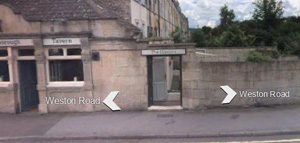 The previous occurrence was reported in the Chronicle and the photo we received shows the same wooden box that was ordered to be removed because it was an obstruction on the road. It is still an obstruction in the road. We haven't used the latest photo here because the picture in the Chronicle shows it clearly. We note the pub complaint that keeping the waste inside creates hygiene and operational issues, but when the pub has a garden with an opening to the street (see our picture) there is obviously somewhere to keep the bin box within the pub's footprint without keeping the waste inside or obstructing the road, and there is an easy route to the street without going through the pub when it is due to be collected.
- We conclude that FixMyStreet is more a PR exercise rather than a useful facility and we have suggested to our informant that because there is already a precedent for having the bin box removed from the highway, they should now report it to Highways and Enforcement. The council needs to be seen to be consistent in its handling of two identical complaints two years apart.
- Waterworks Cottage - Last updated 15 August 2021.
- When Application 20/04067/FUL was placed on the Planning Committee agenda, we commented that we were disappointed that the brief provided by the planning officer omitted some relevant considerations. We pointed out that the cottage is recognised as a Non-designated Heritage Assets and this is a cottage on the edge of open countryside that was only built because it was needed to support the nearby waterworks, so its large garden was part of the transition from urban to undeveloped. We were therefore a bit surprised to read in the meeting minutes which are now available (as is the Chronicle article on the result) that at least one Member thought that the area was already quite well developed. We recalled that there was a similar situation in Lambridge some time ago where an application was refused for reasons which included overdevelopment and on appeal the Planning Inspector emphasised that the transition from Urban to Rural needed to be treated as a key feature of the location and the appeal was rejected with the need to preserve the transition quoted as one of the reasons. It seems likely that an appeal against the refusal of this application would reach a similar outcome.
- We also pointed out that he NPPF specifically excludes residential gardens from the definition of Previously Developed Land and although the protection of such gardens has been watered down from the original 2012 version (which unequivocally forbade developments on residential gardens) it still states in Section 70 that planning authorities should "resist inappropriate development of residential gardens, for example where development would cause harm to the local area" and this is a local area adjoining countryside and an AONB. Also Section 122 requires planning decisions to take into account "the desirability of maintaining an area’s prevailing character and setting (including residential gardens)", which is relevant, whether or not the application site is in a Conservation Area. The comment made in the meeting that it would be preferable in this location than in the green belt clearly suggests that the person who made it has never read the green belt legislation, which provides strict constraints on what is permissible.
- The application was refused for four reasons, though these were laid out in only three paragraphs. They are overdevelopment of the site, inappropriate design for the location, adverse impact on the landscape, and loss of biodiversity. Despite several objections (no longer visible once the Decision Notice is issued) that neither the applicant nor highways can assume access to the site via a private road, this hasn't been mentioned.
- HMOs - Last updated 15 August 2021.
- The council is going out to consultation on a suggested change that the current limit of 25% HMOs in a 100 metre radius should be changed to no more than 10%. There is a Chronicle article which points out that this is too little too late. From our point of view it is an improvement, but it is still not good enough. The statistics we have looked at indicates that far from spreading the incidence of new HMOs wider, it has mainly served to extend the boundaries of the existing areas of concentration. 100 metres is far too short a distance to prevent the gradual spread of the edge of a saturated area. It doesn't solve a problem by making the affected area bigger. Nor does it help when the Planning Committee grant a permission that the policy indicates they should refuse.
- We also believe that the focus on HMOs as buildings leaves the real problem of a disproportionate number of HMO residents in a location untouched. A family home with three bedrooms can frequently be converted to accommodate seven or eight short term rental occupants. What is needed is a much bigger focus on maintaining the diversity of areas of population, and this used as a reason for refusing the enlargement of existing HMOs and also the reason for refusing new PBSAs in areas which have a high student presence already.
- The council is currently considering tweaks to the current planning policies, and a change from counting multi-occupancy buildings to counting the residents of such buildings is an essential alteration to ensure a balanced population in Bath. There is also an obvious mismatch between student accommodation in HMOs being exempt from paying Council Tax and student accommodation in PBSAs being exempt from Business Rates, and the apparent use of HMSOs and PBSAa for non-student use where spare capacity exists. To cover that mismatch there needs to be a new policy introduced that ensures that any premises whether it be a HMO or a PBSA (which currently pays no council tax or business rates because it supports education) loses that exemption status if it also provides accommodation for non-students at any time.
- Cleveland Pools - Last updated 8 August 2021.
- In the printed copy of the Chronicle this week is an article on the Cleveland Pools restoration, which hasn't appeared on the Chronicle's on-line website so far. It coincides with the progress report which the Cleveland Pools Trust emailed to us, which adds a bit more detail to the Chronicle article.
- The printed article focuses on the "big push" being made to secure the final £400,000 needed to see the project to completion and gives a printed link to the donations page. This link will take those interested directly to the donation screen, to save typing the complicated looking link.
- The article reports that the fundraising team are getting involved in key events in the local area, and our e-mailed brief describes the recent one where the Trust entered the Bath Boules tournament which has now grown to a 3-day event in Queen Square involving 64 teams, and the Trust team got as far as the semi-finals. Also mentioned in both the Chronicle article and our brief is the "Making a Splash" exhibition in the Holburne Museum from 24 August to 5 September including exhibits of swimwear from the early knitted costumes to the latest Olympics swim technology. Our brief includes the snippet not printed in the Chronicle, that for those taking their children along there is a children's competition too.
- Finally, the Cleveland Pools Trust has updated its time-lapse film of the work in progress, now showing what has been done by 22 August.
- The coronavirus pandemic has delayed the completion from the original date of last March and has added to the costs, hence the fundraising initiative. The Trustees are now hoping to have the work on the pools completed and to be open to the public by the summer of 2022.
- World Heritage - Last updated 1 August 2021.
- After our piece last week, it was interesting to read in this week's Chronicle that Cllr Kumar is also concerned about the possible loss of World Heritage because the planning policies still regard the Rec as a development opportunity, and the similarities with the Liverpool stadium are a concern. It is a valid concern, because other councillors who should know better argue against him.
- Cllr Hughes points out that less than 2% of the consultation responses said that the policy on the Rec should be deleted. Realistically that is irrelevant, because the policy says that the development is subject to the resolution of legal issues, and they are already resolved ruling out the development. Our item on 25th April 2021 below explained exactly why the council cannot possibly grant permission for a new stadium without being taken straight to the High Court to have the permission quashed, then potentially ending up in court again, charged with offences under the Charities Act for attempting to prevent the Trustees from carrying out their obligations to deliver the Objects of the Charity. The problem is that until the policy is removed by the partial update of the Local Plan it continues to give false hope to those who assume that the law of the land can be safely ignored. The council taxpayers deserve better than have their taxes squandered on court costs and damages.
- Cllr Ball also appears to be retrofitting his beliefs to past events. He claims that the Planning Inspector's role was to ensure that proposals in the council’s plan did not harm the city’s World Heritage Status, when the real check was that the council's plan included a policy to protect the World Heritage Status from harm. The difference is significant.
- Tarquin McDonald of Bath Rugby has referred to consulting stakeholders yet has carefully avoided mentioning the Charity Commission, who have a Tribunal Order that apart from the area currently leased to Bath Rugby the remainder of the Rec must be retained as an open space, or Bath and North East Somerset council (or its successors in title) who as Custodian Trustee under the Public Trustee Act 1906 is legally barred from taking any action which would prevent the Trustees from delivering their obligations to comply with the Objects of the Charity, or the Trustees themselves who are obliged to keep the land outside the area leased to Bath Rugby as an open space for public use, including the area where the East Stand is erected which must be returned to an open space for 3 consecutive months of each year.
- The legal issues have all been clarified: the courts have ruled that there is no prospect of erecting a stadium on the Rec. Retaining the existing policy makes no sense at all.
- On a happier note, a new World Heritage inscription has been announced (and published in the Chronicle) for "Great Spas of Europe" which covers 11 sites, one of which is Bath. There are no geographic boundary details published yet, and it is very likely to be a much smaller area in Bath than the current city-wide inscription, so the original inscription remains important and needs to be retained. If the new inscription increases the potential footfall in the Roman Baths, perhaps the council might consider reviewing the current prices which attracted adverse comments in the press recently, on the basis that lower prices multiplied by more visitors might result in more income.
- More Contempt for Industrial Heritage - Last updated 1 August 2021.
- When the Western Riverside development was being "sold" to the residents of Bath, one of the benefits was to be that the bridge carrying the gas mains over the river from the gasworks would be repurposed as a pedestrian and cyclist bridge. Anyone who has cycled over the Windsor Bridge alongside its busy traffic would welcome a quieter route alongside the vehicle carrying bridge, and pedestrians would appreciate the fresher air. So to discover that the old promise has now been quietly forgotten and the council is currently discussing demolishing both bridges is not going to be popular. If they are sound enough to carry the weight of the existing gas pipes, they are bound to be sound enough to carry the weight of cyclists and pedestrians, and a new tarmac surface will cost less than a demolition contract.
- Is Bath Next? - Last updated 25 July 2021.
- The first European World Heritage Site to lose its World Heritage Inscription was Dresden Elbe Valley. It was inscribed in 2004 as a cultural landscape: "The Dresden Elbe Valley is an outstanding cultural landscape, an ensemble that integrates the celebrated baroque setting and suburban garden city into an artistic whole within the river valley." In 2006 it was placed on the list of World Heritage in Danger because of the planned Waldschlösschen Bridge. UNESCO offered alternatives to the State Party, but the four-lane bridge in the heart of the cultural landscape was built anyway, and in June 2009 the UNESCO World Heritage Committee deleted Dresden from UNESCO's World Heritage List.
- The latest casualty of contempt to the World Heritage Convention that State Parties undertake to honour is Liverpool. The Liverpool Maritime Mercantile City was inscribed as a World Heritage Site in 2004 for being "a major centre generating innovative technologies and methods in dock construction and port management in the 18th, 19th and early 20th centuries" and "an outstanding example of a world mercantile port city, which represents the early development of global trading and cultural connections throughout the British Empire". At the time of inscription, the World Heritage Committee requested that the height of any new construction in the property should not exceed that of structures in the immediate surroundings; the character of any new construction should respect the qualities of the historic area, and new construction at the Pier Head should not dominate, but complement the historic Pier Head buildings. Initially this was heeded and UNESCO noted after the early developments that: "No significant loss of historical authenticity has occurred, as the physical evidence of the City and its great past remain prominent and visible, and in some cases has been enhanced." However, later plans were a cause for concern and UNESCO noted that "The impact on the setting of the property of further new development on obsolete dockland is a fundamental consideration." That new development was the proposed construction of Liverpool Waters, a massive redevelopment of the historic docklands north of the city centre. The World Heritage Committee placed Liverpool on its list of World Heritage in Danger in 2012. Despite this warning sign, the development went ahead, and as a result in June 2021 the UNESCO World Heritage Committee deleted Liverpool Maritime Mercantile City from UNESCO's World Heritage List. The BBC reported it on 22 July 2021. The city's mayor described the decision as "incomprehensible", which contrasts rather sharply with a UNESCO observation that the city had been warned of its potential deletion from the list for many years. The City Mayor has suggested appealing the decision, but UNESCO regard DCMS as the State Party not the City of Liverpool, and DCMS is not likely to have much sympathy with a Local Planning Authority that flouts the World Heritage Convention he is bound by.
- So what similarities are there with Bath? UNESCO's first real concern was expressed in a letter in February 2008 to the DCMS Architecture and Historic Environment Division just after DCMS had decided not to call in the Western Riverside Development for a Public Inquiry. It reminded DCMS that from UNESCO's viewpoint the development was outside the part of the site containing Roman Archaeology, Georgian town planning or Georgian architecture but it could have an adverse impact on the visual integrity of the World Heritage Site. The State Party was reminded that "Bath’s grandiose neo-classical Palladian crescents, terraces and squares spread out over the surrounding hills and set in its green valley, are a demonstration par excellence of the integration of architecture, urban design and landscape setting, and the deliberate creation of a beautiful city" and "the architects who followed were working over the course of a century, with no master plan or single patron, did not prevent them from contriving to relate each individual development to those around it and to the wider landscape, creating a city that is harmonious and logical, in concord with its natural environment and extremely beautiful" and "Although Bath gained greatest importance in Roman and Georgian times, the city nevertheless reflects continuous development over two millennia with the spectacular mediaeval Abbey Church sat beside the Roman temple and baths, in the heart of the 18th century and modern day city".
- This led to a UNESCO Mission to Bath in November 2008, which consisted of site visits and a programme of interviews, one of which was with Watchdog from which they took away our superimposed images of the vertical elevations of the Western Riverside proposals on the key views across the World Heritage Site. The mission concluded that "the realization of the first phase of the Western Riverside project will not have a negative impact on the Outstanding Universal Value and integrity of the City of Bath. The mission however recommends that consideration be given to adapting the second and third phases in terms of a re-division of mass and heights of the buildings by an international architectural competition, which could give a new impact to the appearance of the project". The mission team also emphasized the necessity for the first phase to already cover the infrastructural needs, such as kindergarten, meeting and multifunctional rooms for the inhabitants, etc. As an aside in the Mission Report, it was noted that the Dyson Academy had been withdrawn just before the Mission so was not examined in detail, but it was noted that had it been a live proposal it would not have been acceptable from a heritage perspective. That perhaps is the message that the councillors who overrode the case officer's recommendation to refuse might take heed of.
- At the end of the Mission Report came the advice "The mission reminds the State Party to respect Paragraph 172 of the Operational Guidelines and to inform the World Heritage Committee of any development projects foreseen to take place within the World Heritage property, and of the cumulative adverse impact of smaller-scale projects on the property’s Universal Value and integrity". That reminder fell on stony ground. Royal View on the Western Riverside still makes passers-by wonder how such an unconventional looking building ever got planning permission in Bath. The approved plans for the Bath Press building were never brought to the notice of the World Heritage Committee as requested. The former Labour Exchange, a listed building featured in the television broadcasts of "The Forgotten Blitz" and the Premier Inn on the opposite side of the road had may guests who had seen the broadcasts and wanted to view the only surviving "make do and mend" repaired building in the country still in use in its wartime repaired state, from their upstairs windows. The council's utter contempt for the Act that is supposed to protect listed buildings, ignored in order to build yet another student accommodation block, has not yet attracted UNESCO's attention but if there is ever a follow-up Mission to Bath the resulting abomination will stick out like a sore thumb.
- Looking at the similarities, the UNESCO World Heritage Committee didn't like the Dresden bridge, they didn't like the Liverpool Waters project, and they didn't like Phases 2 and 3 of the Western Riverside after the less controversial first phase which they wanted to see enhanced by some infrastructure. Dresden, Liverpool and Bath carried on with their schemes which UNESCO objected to, regardless. Dresden and Liverpool have lost their World Heritage inscriptions. Since the Mission visit Bath has promoted building heights above the Georgian "human scale", apparently based on the characteristics of the criticised Western Riverside Phases 2 and 3, and also modern styles (particularly for some PBSAs) that grate against the more classical neighbouring buildings (and in the case of the Holburne, attached to a classical host building) rather than "relate each individual development to those around it and to the wider landscape". It is also worth noting that from some of the press coverage it was approving the Liverpool plans for a football stadium that finally tipped the UNESCO decision, which is something those promoting a stadium on the Rec might bear in mind. A World Heritage Inscription, once lost, is lost forever.
- Bath Rugby - Last updated 18 July 2021.
- One of our members has pointed out that the Flood Risk Assessment in the latest application 21/02311/FUL is the same one submitted for 15/05235/FUL and therefore contains the same misleading information. The area occupied by Bath Rugby is stated as being in Flood Zone 3a.
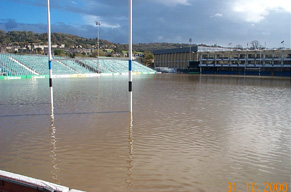 However the Government website providing flood risk information shows that that entire area of the Rec is in Flood Zone 3b for fluvial flooding and most of the pitch area is also in Flood Zone 3b for pluvial flooding.
- Our member remembers the 2000 flood and says that the initial flood of the rugby pitch was from rainwater run-off and this picture shows the result of that, but remembers that the river level soon rose to add river water to the original rainwater.
- The council expects the flood risk assessment to consider all sources of flooding and the Bath Rugby assessment looks at only fluvial flooding, hence the comment in the Bath Rugby for October 2000 indicating that the measured height (at Bathford Gauging Station which is about 3 miles upriver from the Rec) of 19.32m AOD is less than the critical level of 19.5m AOD beside the Rugby ground. Real life on the Rec was a bit different.
- This does suggest that permanent structures should not be permitted in what is clearly defined as active flood plain which has restrictions on what it can be used for. If planning permission for 21/02311/FUL is considered appropriate it needs to be with a Condition that the permitted structures are not permanent and must be demolished on or before the expiry date of the lease held by Bath Rugby.
- Avon Studios, Midland Road - Last updated 11 July 2021.
- This site had planning permission granted for "Erection of eight townhouses and six apartments" in 2013 but none were built. Three years later an application for a PBSA with 115 bed spaces was submitted and later withdrawn, replaced in 2017 with an application for a PBSA with 94 bed spaces and 14 residential studios. It looks as though the 94 bed spaces are unprofitable, hence this application to make the student accommodation dual purpose for students and/or Serviced Apartments.
- We looked at this approach on 13 June when Twerton Mill tried it (see below), and concluded that planning policies required the refusal that was delivered. We expect the Avon Studios attempt to be refused for the same reasons.
- Bath Rugby - Last updated 4 July 2021.
- Two weeks ago we reported that B&NES had not indicated what they intend to do about Bath Rugby claiming that they can't get their contractor to take down the East Stand. This week the Chronicle reported that a course of action is available,
- The article suggests that the council is deciding whether it would be expedient to take enforcement action. We don't think there is a choice if Bath Rugby don't take the East Stand down as required.
- On 30 July 2015, the Upper Tribunal of the Tax and Chancery Chamber, after hearing Case [2015] UKUT 0420 (TCC) issued its Decision. That placed Bath and North East Somerset Council in the role of "Custodian Trustee" of the land conveyed to the council in 1956 (otherwise known as Bath Recreation Ground). That ensured that the council could not be held liable to the actions of the Trustees appointed to administer the charitable land, but only provided the Custodian Trustee had not concurred with any breach of trust.
- If the council does not pursue enforcement action when appropriate, it prevents the Trustees from delivering the expectation of the Charity Commission that the land occupied by the East Stand must be open land for three consecutive months of each year. Thus although the Town and Country Planning Act shows that enforcement action is discretionary, the special legal circumstances controlling a Custodian Trustee removes the discretionary element for that particular piece of land since the use of such discretion creates a breach of trust.
- Bath Rugby - Last updated 20 June 2021.
- It is interesting to see that Bath Rugby raised a planning application to retain the East Stand in place in 2020, (which the council permitted despite the objects of the charity insisting that it must be removed) and now in 2021 is claiming that their contractor is unable to dismantle the stand. That approach suggests a realisation that if they ask then they risk the council saying "No" whereas if they just ignore the obligation they might get away with it. Understandably the council doesn't like being put in that position, but so far there is no indication of what they will do about it.
- If a Breach Of Conditions Notice is issued, we can advise that after 21 days the Town and Country Planning Act authorises:
The local planning authority may —
(a) enter the land and take the steps; and
(b) recover from the person who is then the owner of the land any expenses reasonably incurred by them in doing so.
Thus the council should have no financial bar to taking action. From Bath Rugby's point of view, they claim that the Arena Group is in breach of contract, so they should be able to reclaim from the Arena Group any charges the council passes on to Bath Rugby. - It is actually even more complicated, because the annual removal of the East Stand is part of the objects of the charity, and the Trustees are obliged to deliver the objects of the charity, or else they can by disciplined by the Charity Commission (though we haven't investigated the Act under which the Trustees operate so we don't know the full scope of the disciplines available). It is also relevant that the objects of the charity require the East Stand to be removed for a period of 3 consecutive months, which would control the date when the Trustees can allow the stand to be re-erected if the removal is delayed.
- We have looked at the East Stand, and although it is big and sturdy it is just a set of components forming a frame with seats attached. If Arena Group are not interested in treating a legal obligation as a priority, then there will be several scaffolding companies who would be prepared to tender for the removal task, and if Bath Rugby can't get the stand removed by their contractor then the council should get together with the Trustees to invite, then evaluate, those tenders and choose the successful company. It is also worth asking whether if Arena Group claim they haven't got enough skilled staff and are unable to dismantle their stand when it is a commitment they have known about for a long time, then can they be trusted to recruit sufficient skilled staff in time to reassemble it for the next season (no sooner than 3 months after it was removed)?
- Former King Edwards School - Last updated 20 June 2021.
- Under the anonymising description of "10 Broad Street", planning permission has been granted (with Conditions) to turn the listed building from a school to a hotel. Another planning application raised on the same date seeks approval to vary conditions attached to 13/02136/REN, although as that permission expired in 2018 we can't see how altering the conditions on an obsolete permission can have any useful effect.
- We hope that the new permission granted might actually be acted upon this time and isn't just a device for extending the owner's land-banking policy that has already lasted 24 years.
- Twerton Mill - Last updated 13 June 2021.
- The planning application for re-purposing part of the Twerton Mill development, built after being given planning permission as a Purpose Built Student Accommodation development, with the aim of creating a temporary "aparthotel", has been refused permission. That decision was made a month ago and it has taken until now for the Chronicle to report it.
- The reasons for refusal are straightforward: planning policies require such a use to be subject to a test for suitability of the site, and an impact assessment to be provided for locations outside the town centre. In the absence of these, the proposal had to be refused. There was an additional reason for refusal: the PBSA was permitted with only five parking spaces and the alternative use applied for requires 26 on-site spaces to meet planning policies. Recent appeals to the Planning Inspectorate by other applicants have revealed that the appeal decisions have been based on the Inspector's (false) belief that there are insufficient PBSA beds for the expected number of students and more need to be provided, so this sound decision to retain for students the accommodation built for students is presenting the applicants with a logical disadvantage if the applicants are thinking of appealing it.
- Some of the comments in the Chronicle article uncover a rather different can of worms. Apart from the council finally recognising that their attempts to ban students from bringing cars to Bath wasn't working (and there was a High Court ruling in 2015 which states that attempts to do so are unlawful), there is an admission by the owners of Twerton Mill that they had advertised and let to non-students in the past and AirBNB rooms are currently being advertised. There will be a few students from overseas who stay in Bath for the whole of the duration of their courses so outside of term time they will therefore experience some accommodation let to non-students who will live temporarily alongside them. There will be some students (and possibly their parents) who chose a PBSA because it was assumed to be only for students.
- PBSAs do not pay Business Rates because of a Government policy that educational accommodation should be exempt. Anyone letting to students pays nothing towards Council Tax if it is a HMO, and pays nothing towards Business Rates if it is a PBSA. Therefore any PBSA that accommodates non-students is operating a business that is not exempt from Business Rates (in the same way that an HMO is liable to Council Tax if it houses non-students). The Government Grant to councils did once fund the lack of income from student accommodation, but that changed some years ago and now every non-paying property represents a hole in the council's income. Twerton Mill, and various other PBSA that accommodates non-students needs to choose whether they pay Business Rates or whether they stop accommodating non-students. Perhaps the council should use its Enforcement powers to get all AirBNB (or similar) advertising for PBSA accommodation removed or properly paid for by registering for Business Rates. The applicants for future PBSA need to recognise that they can't ever use it for anything other than student accommodation without losing their exemption, and they have to decide whether they can attract enough students in the current over-supply scenario to make it worth building at all.
- Planning Appeal about 19/04909/FUL - Last updated 6 June 2021.
- It is interesting to see that there is a support comment from a resident of Charters claiming the proposed development "is in perfect harmony with the surrounding buildings in Prospect Place". Prospect Place is over a mile from the appeal site and cannot be seen from it. Should we assume that the comment is something originally used on another development site and re-used without reading it through? If so, does the person named as making the comment know it has been reused?
- The Tufa Field (yet again) - Last updated 30 May 2021.
- In our update of 9 May we warned that the intention to not develop the tufa field could not be guaranteed while the last planning activity was a controversial decision by the planning committee which disqualified a Member from voting on it because of a temporary loss of an on-line link and approved the council's own planning application by just one vote. We pointed out that unless the Planning Committee reconsidered its decision and refused the application, the development could still go ahead unless the decision was overruled by a Judicial Review, perhaps based on the following argument.
- The other part of the controversy is that the field is a designated Site of Nature Conservation Interest, a quality that is supposed to legally protect the site rather than be used as an excuse to try to move its features somewhere else. Finally, slow-worms are a protected species under the Wildlife and Countryside Act. Yet that fact was omitted from the Ecologist's report even though the report was clearly against any development and requested further consultation if the decision would differ from the advice given. However the 10 pages of Ecologist report (which focussed mainly on bats and invertebrates and doesn't mention slow-worms which are protected lizards) was condensed to 3 lines in the Committee Report so the Planning Committee was inadequately briefed. Whoever then authorised the slow-worm habitat to be mowed under the guise of "preliminary ecological works" has clearly contravened that law. The whitewash report that found "no evidence" of the death of slow worms despite the photograph published in the Chronicle, brought the entire council into disrepute.
- Despite all of the above, the Chronicle has now published the news that Richard Samuel, cabinet member for economic development and resources, confirmed that a smaller development was still under consideration, arguing that it would cost the council around £750,000 if the scrapped plans for housing on Tufa Field were nor pursued. It is not clear whether he has spent the money already and was looking for a return on the investment (in which case he should resign his Cabinet post because it is not suitable for a gambler), or whether this was just a rough guess at a profit and nothing has actually been lost and he is just using an arbitrary number to obtain support for his position. What we do read is that the same Cllr Samuel agreed to a community transfer of the Mission Theatre which would cost the council £1,500,000 in lost rent (a decision which is luckily being called in), so he doesn't seem to have properly grasped the "economic" aspect of his role.
- Bath Fashion Museum - Last updated 23 May 2021.
- There are concerns over the possibility that the Bath Fashion Museum (previously known as the Museum of Costume) which has been given notice to quit the Assembly Rooms and as the Bath Echo reports, it might be homeless for up to 5 years while a new location is sought. We are aware that the dual ticket for the Roman Baths and the Fashion Museum is popular with tourists and encourages them to travel through some interesting parts of Bath getting from one to the other, so the closure of the Fashion Museum is going to have a heritage disadvantage as well as a loss in council revenue.
- We wonder if in the short term while a new permanent location is found, there might be some scope for a reduced number of exhibits to be displayed in the Archway Project premises? The Archway building works have been completed so the Project might be open to an approach about what to include inside. In the longer term, we hope that the collection can be housed in a building owned by the council, because the experience learned from the Assembly Rooms location is that a lease is not a guarantee of long-term security.
- Museum Of Bath At Work - Last updated 16 May 2021.
- Although we have no direct connection with the Museum Of Bath At Work, we do support the preservation of Bath's industrial heritage (hence our presence at the Industrial Heritage Day events in the past) and we appreciate the existence of a museum which features Bath's industrial heritage and we recognise that it occupies a listed building which was originally Bath's "Real Tennis Court" building, and it has kept the building in use and in good repair.
- Officially it is a registered charity, known to the Charity Commission as "Charity number: 800297; BATH INDUSTRIAL HERITAGE TRUST LIMITED", and it was originally publicly known as the Camden Works Museum before being renamed The Museum of Bath At Work. Almost all the staff are volunteers, with just one paid permanent staff member, the curator.
- We have been sent a copy of an email that has been sent to those on the museum's address list, which explains that the curator has so far been funded by a benefactor but that source of funding has now ceased, and the Trustees are hoping to fund the curator (called the Director in the email) by increasing the number of Friends of the Museum of Bath at Work. We are happy to give that message a wider circulation with this website item. If anybody wants to become a Friend the link to the application form is in the copy of the email, and to save all the typing we have reproduced the link here.
- The Tufa Field - Last updated 9 May 2021.
- It was good to read in the Chronicle that the new Council Leader is against the plan to build homes on the Tufa Field ("Land to the rear of 89 to 123 Englishcombe Lane" on the planning website) and has declared that the land will not be sold off for development.
- However, the Planning Committee decided to "Delegate to Permit" and therefore it could be permitted at any time on the Case Officer's ensuing delegation. Also, until a planning decision is issued with a time limit the application never times out. Thus the saving of the Tufa Field can never be a permanent decision until the application is brought back to the Planning Committee, and they make al alternative decision to refuse it. Whilst we don't doubt Cllr Guy's sincerity in saying that the plans have been scrapped, the "Delegate to Permit" decision will remain indefinitely unless the Committee which made that decision is prepared to reconsider the planning application and reverse that decision. The job is currently only half done, Cllr Guy.
- The Archway Project - Last updated 2 May 2021.
- We have received a newsletter from the Project announcing that the construction works on the site have been completed and work has started on what exhibits, furniture and resources should go into the Clore Learning Centre and the World Heritage Centre. The World Heritage Centre is due to open next to the Roman Baths later in the year and illustrations to feature in it will largely be those created by Natsko who took part in a Question and Answer session in April.
- The Rec - Last updated 25 April 2021.
- There was an article in the Chronicle about revised plans for the use of the Rec by Bath Rugby, followed a couple of days later by a scaled down item. Both attempt to give credence to a new stadium on the Rec, amended to remove the under-pitch car park. However, Watchdog has been keeping a detailed watch over the various claims, counter-claims and court hearings and has obtained copies of all the Judgments to study so that we know exactly what was decided rather than believing the various claims made. So we know that Bath Rugby has already applied for leave to appeal the decision on the 1922 Covenant and has had that application refused. That is guidance that an appeal is highly unlikely to succeed; it does not prevent an appeal being made, but it does indicate that such an appeal will be almost certainly be unsuccessful. The historical documents enabled us to assemble the following contribution to the council's consultation on the Core Strategy and Placemaking Plan review.
The High Court in 2002 considered all the evidence and ruled that the Recreation Ground is a charitable trust and has been since 1956, and is subject to the covenants of 1922 and the covenants in the 1956 Conveyance. The court noted that the amateur rugby club obtained a lease in 1995 and noted that the change from amateur to professional put that lease outside the scope of the covenants, but made no ruling about the lease because that issue was outside the scope of the case as raised. It also noted that the Sports and Leisure Centre was given permission and erected in 1974 despite the covenants which should have prevented it. As a charitable trust, the Rec was placed under the control of Trustees.
The Charity Commission raised an initial Objects of the Charity, and that was followed by a review of the lease in 2007 where the Commission decided it would be expedient to recognise the 1995 lease and the temporary extensions to the leased area for the temporary stand because to do otherwise would involve the council in considerable legal expense as it was argued in court. This led to some updates as the Commission tried to get to grips with how the Charity was managed. When "The Commission directs that ... BANES demonstrate that it has discharged its responsibilities as charity trustee in respect of any decision relating to the current and future uses of the Rec and the resolution of issues arising from the Rec’s current occupants" remained unresolved the Commission tried to tighten up how the Charity was overseen, and to take the Charity out of direct B&NES control.
One of these amendments, to allow the Trustees to arrange a land swap if it was to the benefit of the Charity, was challenged by the land's neighbours. This led to a hearing in 2013 where the Charity Tribunal considered that the Commission had the right under the current legislation, and allowed mechanisms including a land swap option as tools that might help resolve the mismatch between what the covenants required and what had actually happened.
Local residents mounted an appeal against those findings, and the appeal hearing took place before the First-Tier Tribunal (Charity) under the power given in the Charities Act 2011, in 2014. The appellants did not get all they asked for, but the Order which was the outcome did clarify a number of ambiguities in the original hearing summary. These were:
* Bath and North East Somerset Council was identified as the "Custodian Trustee" of the land conveyed to the council in 1956. This is a specific role defined in the Public Trustee Act 1906 that identifies the council as the permanent holder of the Trust land but without the authority to manage it and thus unable to be held liable for the action of the Trustees committing a breach of trust unless the Custodian Trustee has concurred with the breach of trust.
* Apart from the Custodian Trustee which is a permanent role, the Trustees in place at the time of the Order remain as managing Trustees until the end of their appointment and thereafter a group of managing Trustees will replace them. All Trustees must have a fixed term of 3 years, and members of the council cannot be nominated as Trustees. The Trustees may make rules and regulations for the administration and management of the charity, which must be consistent with the provisions of the existing trusts and this scheme. This requires the Trustees to pursue the objective of the Charity without obligations to pursue the policies or directions of the council or any other body.
* Bath Rugby is limited to the area identified by the 1995 lease which can never be extended in time, and the Trustees cannot allow it to extend in area beyond the boundary in the lease, except that for 9 consecutive months in every 12 months a specified area can be used for a temporary stand. For the other 3 months the area used by the temporary stand must be returned to the Trustees in a condition that allows the Trustees to allocate it to other uses provided it remains an open space.
* Land swaps are limited to all or part of the land covered by the 1995 lease (which is effectively the land currently occupied by Bath Rugby and not the additional land Bath Rugby uses for the additional East Stand), and if any swaps take place they must lapse no later than the expiry date of the 1995 lease.
* The Sports and Leisure Centre can remain as an asset of the Charity until the end of the building's useful life, but it must then be returned to being open land. A replacement building will not be permitted.
* The Object of the Charity, which the Trustees must uphold is defined as:
"The objects of the charity are the provision, with or without charge, of land in or near Bath, including but not limited to the Bath Recreation Ground, for use as outdoor recreational facilities for the benefit of the public at large and in particular for use for games and sports of all kinds, tournaments, fetes, shows, exhibitions, displays, amusements, entertainments or other activities of a like character and the maintenance, equipment or lay out as the trustees shall think fit of such land and always provided that
(i) the charity shall not show any undue preference to or in favour of any particular game or sport or any particular person, club, body or organisation, and
(ii) the charity shall not use the Bath Recreation Ground otherwise than as an open space".In 2020 Bath Rugby applied to the High Court for relief from the 1922 covenant. This was dismissed, having identified around 150 addresses that even with the strictest possible interpretation of the 1922 Covenant have the right to see the Covenant properly enforced:- High Court Decision 2020 EWHC 2662 (dated 13 October 2020). Bath Rugby then applied for Leave to Appeal, and this was refused on the grounds that an an appeal would have a vanishingly small chance of success:- High Court Decision 2020 EWHC 2856 (dated 28 October 2020).
This long saga of court hearings and rulings has reached a point where Bath Rugby can only use that part of the Rec defined in the 1995 lease, and is limited by the duration of the lease and the area defined within it plus the use of a specific additional area for only 9 consecutive months of each year. The managing Trustees of the Charity must deliver the Object of the Charity, which among other things requires all land not covered by the 1995 lease to remain an open space, and the council as Custodian Trustee is barred from taking any action (such as granting any planning permission that would undermine the Object of the Charity) that would enable the managing Trustees to commit a breach of trust.
Under those circumstances, there is no prospect of erecting a stadium on the Rec. The unique legal issues have all been clarified. The Charity Commission, the managing Trustees, and any of the 150 addresses enabled by the 1922 covenant to see it upheld, all have a right to seek a judicial review to quash any planning permission for a stadium on the Rec. It may be that the Charity Commission could also seek damages from the council under the Charities Act, but we haven't explored that legislation.
- After all the above legal hearings, the position is effectively water-tight. The Trustees must uphold the Objects of the Charity regardless of any personally held preferences, and the council cannot legally undermine the obligations of the Trustees by granting planning permissions for constructions on the Rec outside the current footprint of the area leased to Bath Rugby.
- Cedar Park Care Centre - Last updated 18 April 2021.
- According to the Chronicle, despite a local objector asking the Committee to be consistent with previous decisions in rejecting what is an entirely inappropriate scheme, plus a clear reminder from the Ward Councillor that the new plans had failed to meaningfully address the previous reasons for refusal of the previous applications, the Planning Committee ignored them and voted to approve the planning application.
- We gave our views in our 28 March 2021 update, and this latest decision is also likely to be regarded as irrational if it is once again challenged in the High Court.
- Footnote. The draft minutes of the meeting are now available. Given the amount of detailed reasons for refusal made during the public consultation period and the reasons for refusing the previous applications, the paltry level of consideration given to them in the minuted discussion and the unanimous vote to approve suggests that the decision had already been made before the meeting started. Also, as we noted previously, despite the Committee Report claiming that all responses are available to be read on the planning website, nobody can read them now that the decision has been made.
- The Tufa Field - Last updated 4 April 2021.
- There has been some recent news in the Chronicle on this subject, not all of it entirely accurate, so we have had a look at what has been claimed and what is and is not possible.
- In this week's Chronicle was an item on the consequences of losing a connection during the discussion of a planning application, which results in the Member being unable to vote despite managing to re-connect in time to do so. This was something we commented on in our 6 September 2020 update (see below) where we identified an urgent need to decide on a proper protocol for such interruptions. This did not happen, yet it would be a simple modification to the rules to call a 10 minute "comfort break" to allow time for a lost connection to be restored if a connection is lost. That way there would be no loss of the conversation and the temporarily disconnected person could still vote. Not every application is as controversial as the Tufa Field, but Members (particularly those living in remoter areas) should not be held hostage by poor connections if attending virtual meetings.
- We looked at the planning decision that was made, and the decision was "Delegate to Permit" and to date the actual planning permission has not yet been issued, so the Case Officer has the right to return the application to the Committee for a new discussion and vote. There are two reasons for doing that. The first is that Natural England (who has a legal right to ask the Secretary of State to call in the decision once made) required the decision to be based on the council's Ecologist view of the Habitat Regulations Assessment, and that very clearly cast doubts on the viability of transferring the habitat elsewhere, particularly when the current location is a Site of Special Scientific Interest, a designation which is supposed to protect it. That did not get proper consideration by the Committee. The second is that there is a clear mismatch between the policy declaration of "an ecological and nature emergency" and the outcome of the Planning Meeting which treated it as irrelevant. It is fairly certain that if the Case Officer uses the delegation to permit to issue the planning permission, the apparent cavalier attitude of the Committee to stated council policy is likely to result in either a call-in request from Natural England or a "irrational" judgement if anybody takes that planning permission to a judicial review. An article in January recognised nearly 4,000 signatures on a petition to save the tufa field, and at the time of writing this that number had grown to over 5,500. It would only take one of those to feel strongly enough about it to mount a legal challenge and the development, even if eventually approved, would be held up for the timetable dictated by the High Court.
- The Twitter item about Visit Bath - Last updated 4 April 2021.
- We have had our attention drawn to a Twitter item which comments on advice being given by Visit Bath that visitor accommodation is available at the University of Bath. We are aware that not everything on social media is factual so we checked on the Visit Bath website and there is a page entitled "University of Bath Guest Accommodation" where potential guests can apply for a room. Included in the advertisement is the offer of "Plenty of free parking" (thus something actively discouraged for students is readily available for guests) as well as offering Stag and Hen Party accommodation. It is obviously something that has been taken up because there is also a Tripadvisor page entitled "University of Bath Hostel" with reviews that date back as far as October 2016. Elsewhere on the Visit Bath website, rooms are advertised in Green Park House, which also has planning permission as a PBSA.
- This highlights two significant problems. Firstly planning permission for PBSA is given on the basis that they accommodate students and are therefore exempt from business rates, yet some of them (at least, perhaps even most of them behind the scenes) are operating as businesses providing tourist accommodation. Either they need to be registered as businesses and they are allowed to operate as accommodation for the public in general as well as students, or else they must refuse to allow non-students to stay there. They can't be allowed to offer cheap accommodation to visitors to Bath because they have a student exemption to normal running costs, a perk denied to conventional hotels.
- Secondly, planning applications have been readily approved for additional hotel accommodation, to the point where even without the recent coronavirus considerations there are now a lot more hotel beds available than were identified as needed by the most recent assessment of demand. Planning permission for PBSA is given on the basis that it is Purpose Built Student Accommodation, and Visit Bath has a responsibility to hotels and guest houses to promote them and not other accommodation which will deprive them of visitors.
- Visit Bath has an annual tourism contract for Bath & North East Somerset, and using only recognised hotels, guest houses and self-catering accommodation should be a condition for any future renewal of that arrangement. Failing that, perhaps tourist information should be brought back in-house, as it is in many other tourist destinations (and they still have a functioning Tourist Information Office). For a World Heritage Site to have no walk-in Tourist Information is a disgrace.
- Cedar Park Care Centre - Last updated 28 March 2021.
- On the agenda of the Planning Committee are the two planning applications 20/02817/FUL and 20/02818/LBA with a recommendation to approve. Watchdog commented on the previous applications for this site, and that Committee had granted permission only to have that decision quashed by the High Court as irrational decisions, a view subsequently endorsed by the refusal of those applications at a later Committee meeting. We did not comment on these latest applications because when we looked at our bullet points we discovered that every one of them had been adequately covered by the public objections lodged by then.
- The issues raised were largely drawing attention to all the reasons for refusing the previous applications which had not been addressed by the revisions for these later applications. In addition, after the introduction of residents parking in Bear Flat, the demand for parking spaces in the area of the application site now far exceeds the availability, and the shortfall in on-site parking in the applications will create an additional on-street demand which is simply not available. Neither of these issues has been given any realistic weight in a Committee brief that ends with a recommendation to approve. It is also worth noting that the Committee Report includes the same wording we have seen for past Committee briefs: "all responses ... are available for the public to view on the council's planning webpages". Surely the case officers should be aware that once a planning decision has been added to the application file, all the public comments are rendered invisible. If anyone wants to compare the Committee discussion with the public comments in hindsight, this will not be possible.
- Having read the public comments while they are still able to be read, we cannot reconcile the strength of arguments in the Committee brief with the very detailed public objections giving reasons why the applications should be refused. Committee Members should note that the council has already lost a Judicial Review of previous planning decisions for this site, and it was local residents who applied for (and won) the Judicial Review and they still live near the site. If the Committee agrees with the Case Officer's recommendation to approve, a new Judicial Review of that decision is quite possible.
- Hartwells Site - Last updated 28 March 2021.
- The planning Inspector has allowed the appeal against the refusal of 19/01854/OUT, and in the rationale is another example of someone not familiar with Bath assuming that there is a needs for PBSAs despite the universities saying that there isn't and existing PBSAs complaining there are not enough students renting to keep them profitable, which the Inspector dismissed as "unsubstantiated". Attention also focused on the wording of Policy SB15 which includes "but not student accommodation where this would prejudice the achievement of Policy DW1 and B1 in respect of ... housing". It was also noted that the permission granted for the Plumb Centre (see our comment below dated 21 February) was interpreted as evidence of an established need for more PBSAs. Those six Committee Members "actively abstained" have actively created yet more unwelcome developments on the Hartwells site.
- Currently the council is looking to update its policies and perhaps now that Planning Inspectors are using elbow room exceptions as convenient loopholes it is time to delete them. In fact, now that the Core Strategy has stated for long enough that new student accommodation should be on campus it is perhaps time to have a blanket ban on all new PBSAs in the rest of Bath, which is something that appeals then won't be able to get round. It is also a moot point that allowing PBSAs to let to non-students reduces the availability for students (which creates a demand for another PBSA to take up that shortfall) and also allows Business Rates and Council Tax to be chargeable. The operators of PBSAs need to decide which side of that fence they want to be on.
- Fine Cheese Company - Last updated 21 March 2021.
- Included in the planning permissions for the Fine Cheese Company in Walcot Street was a condition we don't remember seeing before. It was a set of applications now given permission for work on the frontage that included the installation of awnings. In our comments on the applications we were reasonably happy with most of the proposals subject to clarification on some sizes, but we objected to the awnings as being out of character for the area and inadequately justified.
- In giving permission for the applications which included permitting the awnings, the Case Officer added the explanation that the awnings were only permitted because the shop needed to display perishable goods in the windows and those goods needed to be shielded from the sun. However, the permission was given with the condition that the awnings were only permitted while the Fine Cheese Company traded from the premises, and when that was no longer the case the awnings had to be removed.
- This looks like a very sensible compromise between local aesthetics and business necessity, and we would like to see similar removal conditions applied to other permissions granted in similar circumstances.
- Victoria Park Golf - Last updated 28 February 2021.
- We commented on the Cabinet virtual meeting on the future of the Victoria Park Approach Course two weeks ago, where it was decided that the council would not proceed with the tender action and to keep the High Common as a public open space in the future. At present, with sporting activities not permitted, the land is being left to nature, with the public free to roam it at will.
- The petition we identified last week attracted over 4,500 signatures by the date of the Cabinet meeting and that encouraged the opinion that the course could be well used if many of those voting to keep the course open used it. The vote not to proceed with the tender action was passed unanimously. Unfortunately, the agreement during the discussion that in future there would be public consultation before entering into any tendering decisions didn't make it through to the minuted decision, which merely recorded:
RESOLVED (unanimously) that the Cabinet agreed with the following decision:
1) That whilst this bid in the report is proceedable, the Cabinet are not satisfied that there are sufficient benefits to commit to a long-term solution and will not be appointing Company A.
2) That the High Common is retained as public open space which should increase the range of informal uses on the site. - As an expedient during the coronavirus restrictions, leaving the land to nature is a sensible thing to do. However the petition (which is still open and now has 4,800 signatures) specifically asked for the Bath Approach Golf Course to be kept open, and the Cabinet decision stopped a long way short of agreeing to that. In the latest Chronicle update the originator of the petition points out that if the area is left to nature for too long it will be almost impossible to convert it back to a golf course. He is proposing a volunteer-run takeover.
- We hope the council seriously considers such an option. After all, they did successfully encourage some of the branch libraries to be operated by volunteers so there is at least one similar precedent.
- King Edward's School, Broad Street - Last updated 28 February 2021.
- In the new applications this week is one submitted as "10 Broad Street" which is the former King Edward's School. The applicant is the same as on the original proposal given permission over 10 years ago and various permission renewal applications since. We haven't looked at the details yet, but we do have to wonder whether there will be any further delay if a new permission is granted. Until now the history of this site has looked like legalised land banking rather than a serious attempt to develop the building. Perhaps this time there needs to be a Condition attached to planning permission, if granted, that the work must be completed by a fixed date or else the site must be passed to the council.
- It is interesting to see that there is also an application 21/00692/VAR which seems entirely pointless when the application it tries to vary time expired in 2016 and is therefore dead beyond resurrection. We wonder how this was passed by the council's validation process.
- Planning Committee discussing the Plumb Centre - Last updated 21 February 2021.
- Having now watched all the debate and voting at the 10th February 2021 Planning Committee meeting, we noticed that the debate about the Plumb Centre application was largely along the lines that the decision by the Planning Inspector to overturn the refusal of the previous application left a very difficult situation. The thought was that even if the latest one was refused, the one permitted by the Planning Appeal could still be built, and neither that one or the one currently being debated was acceptable.
- This is factually correct. Our comment in our 31 January update was along similar lines. We too thought the Appeal reached a wrong conclusion because of an unproven assumption. However we looked at the two applications and came to the conclusion that the reason for the second application was because they didn't really want to build the first one, and the Appeal was really to put pressure on the planning staff to approve the second one. And it worked in that the brief to the Committee recommended permitting it despite the useful floorspaces being reduced.
- It was obvious from the discussion that the Committee consensus was that they hated both, which is why 6 of the 10 Committee Members "actively abstained", recognising to some extent that they were damned if they said "Yes" and damned if they said "No".
- Unfortunately this led to an outcome of an equal split of the remainder, requiring the Chairman to cast a deciding vote, and that vote was to go along with the Case Officer's recommendation, which was to permit. Regrettably, this will almost certainly result in the development which the majority of the Committee thought unacceptable being built. We still hold the view that the one permitted on appeal isn't what the developer wanted, and if the replacement application had been refused it the appealed one would not have been built instead.
- We have been observing the Planning Committee (under its variety of names) for many years. Originally, although the guidelines are clear that the casting vote is a free choice for the Chairman, it was almost an accepted tradition that if the Committee couldn't provide a majority "Yes" vote on the first vote, the Chairman used to make the casting vote a "No". The rationale was that if the answer was "No", the application could be taken to Appeal and thus obtain an independent decision (either in agreement with or overriding the Committee decision), or the applicant could look at the reasons for refusal and make a further application modified accordingly. On the other hand, if the casting vote was "Yes", then half of the Committee would feel disappointed, because the only way of changing a "Yes" decision was in the High Court by Judicial Review, an expensive and labour intensive process. The tradition of following this logic survived for many years. The first deviation from it was when Sally Davis chaired. It has never featured as a logical thing to do since then.
- One point worth noting is that the function of the Planning Committee is to decide whether or not each application on the agenda should be granted permission, and the only outcome that doesn't do that is a decision to defer making a decision. If just one of the Members abstaining had realised that it was the application in front of them was important and had voted "No" instead of abstaining, probably neither of the development possibilities would have gone ahead. Nobody can "actively abstain", because apart from virtue signalling it achieves absolutely nothing that influences the decision that is ultimately made; and the outcome on this occasion was the worst possible decision, as they have all discovered.
- Footnote: We have now noticed a Chronicle article where Cllr McCabe apologised to the Committee for not calling for the previous application to the Committee giving them a chance to discuss how awful the building would look. What a pity his remorse didn't prevent him from using his casting vote to permit the replacement application after the majority of Members made it clear that they were against it.
- Regency Laundry - Last updated 7 February 2021.
- It is interesting to see that the applicants for the Regency Laundry site have asked for a legal opinion on whether the co-living accommodation as part of the scheme is a set of dwellings and therefore needs to be assessed against the requirement to provide affordable housing, or is outside the scope of that requirement and therefore exempt. The Planning Officer has referenced a court decision made on 31 July 2020 to require social housing to be provided.
- The legal opinion is interesting in that it makes an issue of there being no laundry facilities in the private spaces (despite it being fairly typical of bedsits, hence the survival of laundrettes) and therefore all the private units should be considered a single accommodation unit, and makes a comparison between the co-living proposal and PBSAs, which are both "Sui Generis" in planning terms. There is no legal definition of "co-living" but there is a legal difference between PBSAs and an application for co-living that pretends it is not for students. An all-student development is exempt from paying council tax and by council policies cannot provide parking for residents, whereas non-student accommodation is required by council policies to provide on-site parking to a minimum standard and to pay council tax.
- It seems that by describing the proposals as co-living in order to avoid refusal because the area is already socially unbalanced by being saturated with student accommodation the applicants have been caught out by their own cleverness. If it is a single accommodation unit, then it must be for students because no other group of permanent residents would want to share indefinitely the communal facilities with a large number of other residents with nothing particular in common, and under current coronavirus restrictions would be unable to socialise or use shared facilities if anybody else is using them. So it is come clean time. Either this is a development where co-living is for students and is likely to be refused because of social unbalance, or it is not for students and must be refused for inadequate parking provision. Which reason for refusal would the applicants prefer?
- Plumb Centre going to Committee - Last updated 31 January 2021.
- We have been notified that the second Plumb Centre planning application (20/00023/FUL) is due to be considered by the Planning Committee on 10 February. We had a quick look at the Committee expectations and it appears that because the previous refusal was overturned on Appeal the alternative proposal should automatically be given consent. We disagree.
- The inspector's report stated that the student accommodation was necessary because it would allow HMOs to be freed up (see 10 January 2021 item below). The appellant's word was taken on this. It is not borne out by the facts. The previous permissions for PBSAs made similar claims yet have not released a single HMO back into the housing market as family housing, while in the same time window in 2019 the council granted planning permission for an additional 288 HMO bedrooms and in 2020 the council granted planning permission for an additional 179 HMO bedrooms, and the universities have now publicly stated that they had no plans to expand the student intake, and some existing PBSAs (eg 20/04796/FUL) are now complaining they have not attracted sufficient students to be profitable and they need to be free to provide short term lets (without recognising that non-student use makes them liable to pay Business Rates, and to the detriment of existing guest houses and hotels). The reason is very simple: an existing dwelling converted to accommodate students will always be able to be let per room at a lower rent than has to be charged to recover the cost of erecting a brand new building. Also most students regard the freedom that HMOs give compared with the overseen accommodation with restrictive clauses such as not being allowed to bring a car to Bath make PBSAs a last resort destination when all HMO rooms have been taken up. No amount of additional PBSAs will change that preference.
- The Planning Inspector's Appeal report makes no reference to preserving the current uses of the building, recognising only "a trade counter" for the thriving business which was the Plumb Centre and which now trades under the name of Wolseley; and the Genesis Fitness Centre (described as a gymnasium). No thought was given to the destruction of these businesses if the current building is demolished, it was all done by arithmetic, claiming that the replacement building would provide Use Classes B and D without recognising that the existing users would not remain viable to benefit from the new facilities when built. These are real people in danger of losing real jobs, not just numbers on a spreadsheet.
- In addition, when I compare the latest application to the previous one (18/05047/FUL) which was refused for good planning policy reasons and then overturned on Appeal on the basis of false assumptions, the latest one which the Committee has to now consider has considerably less "light industrial" area and less "assembly and leisure" space so this is very definitely not comparing like with like. As every planning application has to be considered on its merits and refusal of these scaled down benefits leaves the one approved on Appeal an advantage in better meeting the current demand for industrial workspace, we hope that the Committee does see the benefit in refusing this application. If the application approved on Appeal was really beneficial to the applicants, they would not have raised a different application. Therefore the possibility that the Appealed design will not be built even if the replacement is refused has to be considered.
- 7 February Footnote: The newly published agenda of the 10 February 2021 planning meeting includes an update on appeal decisions. It is noted that the Plumb Centre Appeal was the only one that was not dismissed. This adds some weight to our opinion that allowing the Appeal was a bad decision based on an erroneous assumption.
- 14 February Footnote: The Planning committee disliked the application before them, but disliked the default of the application allowed by the Planning Inspector even more. 6 of the Committee abstained because they felt that neither was acceptable. That left 2 voting for, and 2 voting against, and the Chairman used his casting vote to support the Case officer's recommendation. So regretfully the application was permitted.
- All Saints Church - Last updated 24 January 2021.
- The planning decision for All Saints Church includes among the Conditions (as Condition 25) a requirement to provide a methodology for recording, dismantling repairing and restoring the Dr Oliver tomb prior to any work commencing to relocate it. It is acceptable to require a methodology for the work, but a FUL planning application cannot be used alone to authorise the work taking place.
- The Dr Oliver tomb is listed (List entry 1396361, Grade II) and the Planning (Listed Buildings and Conservation Areas) Act makes it a criminal offence to damage or destroy a listed building without first obtaining Listed Building consent. This must also be applied for and granted before the methodology can be implemented. The same will apply to any other listed tombs in the churchyard that are subsequently found necessary to be moved or modified: there are 16 tombs and 1 headstone in the churchyard in the listing records.
- Hello 2021 - Last updated 10 January 2021.
- As is customary at the start of a new year, we have provided an overview of our year just ended on our Year Reports page.
- Hello 2021; Goodbye Common Sense? - Last updated 10 January 2021.
- Plumb Centre, Locksbrook Road. Technically this was a decision made on 30 December 2020 but we only heard of it when we read the article in the Chronicle reporting that the council's refusal of the development has been overturned by the Planning Inspector on Appeal. The planning legislation indicates that an appeal should re-evaluate the planning application as determined by the original paperwork, yet this appeal allowed revised drawings (which the public wasn't given the opportunity to comment on) to be considered as part of the Appeal. Apparently the council agreed to this.
- The Inspector has clearly made some irrelevant assumptions. For instance "In the absence of the appeal scheme, the likelihood would be that more of the private rented sector housing would be occupied by students, thereby adding to any overconcentration of HMOs". The universities have publicly stated that they do not expect student numbers to increase, so there is no demand for the rooms in the planning application, and on the opposite side of the river, because of insufficient numbers of students, the Chronicle reports the public's opposition to a proposal to repurpose some of the student accommodation there for visitors to Bath, partly because there is no available parking and the only bus service is designed for university commuting, and partly because the council has already granted permissions for more hotel beds than the city needs and the established tourism industry in Bath is already struggling in the pandemic and shouldn't be exposed to additional competition.
- Friends Meeting House. This decision is also reported in the Chronicle, and we decided to look at the case officer's report. Despite quoting the listed building legislation that seeks to protect listed buildings for harm in excess of the public benefit from the harm, the public benefits listed as justification would all have been delivered without destroying the blind doorway permitted previously under different Government policies and different council planning policies. It does seem that something which is lacking from case officer training is the understanding that planning applicants will be reluctant to amend a design because revising architect's drawings cost money, and that sometimes it will be necessary to refuse an application in order to overcome such reluctance.
- One of the objections (unfortunately no longer visible on the council's planning system but reproduced here for readers) explained how important and how rare the design of the Friends Meeting House is. Thus a design that is unique in the country not just in Bath, is to be destroyed on the grounds that the same damage had been approved previously under rules which no longer apply. Heritage that is destroyed is gone forever, it can't be undone, it can only be replaced by a more visible copy. We can only hope that Toppings has second thoughts about this aspect of the plans.
- Belvoir Castle. This planning application was puzzling from the outset. The skittle alley used to be an asset to the pub. Previous landlords managed to get teams to use it as their home alley which brought in a minimum of 16 customers in on each match day, most of whom would buy more than one drink at the bar. A feature of the game of skittles is that it needs an uninterrupted length of alley between the player and the skittles. This planning permission puts a functioning doorway midway down both long sides, effectively preventing the alley ever being used again for the game it was designed for. Why a publican would destroy a potential income stream for an access to the garden which could have been provided a bit nearer the main pub without harming the listed alley is not explained. It will certainly make the business far less attractive if they want to sell it on.
- In addition, the decision was made by someone who wasn't listed as the case officer, and despite his report quoting the listed building legislation that seeks to protect listed buildings for harm in excess of the public benefit from the harm, the Delegated Report doesn't show any public benefit, and the statement "The proposed development therefore accords with national legislation" is an outright lie; no offsetting public benefit is offered anywhere in that report. If anybody decides to submit this decision to a Judicial Review, that planning permission will almost certainly be quashed with the council ordered to pay the prosecutor's costs. This was a bad decision.
- Wansdyke Business Park - Last updated 20 December 2020.
- According to the Chronicle article, the Planning Committee meeting agreed with the Officer's recommendation to refuse, and although the planning documents list includes the Decision Notice the planning website summary has not yet been updated to show that.
- The Committee Report was quite comprehensive, but it does omit a significant piece of local knowledge: that the Business Park was occupied by thriving businesses who were all given notice to quit (to their dismay). There were many more businesses occupying it than the "bike repair shop and a gym" that Cllr Manda Rigby quotes. They were just the last two businesses to vacate the site. The site might look empty and semi-derelict now, but that scenario has been engineered to make the current planning application look attractive. If this planning application is refused the site could be refurbished a bit to bring the units into a better decorative condition, and it shouldn't then be difficult to fill with businesses provided the rents asked are not unreasonable.
- Other Planning Committee Decisions - Last updated 20 December 2020.
- On the same agenda were two other significant applications:
- The Jubilee Centre on the Lower Bristol Road (20/01794/FUL) which had the Case Officer's recommendation to refuse and the planning website now shows that it was refused on the grounds of flood risk, an incompatible design for the location and an unacceptable landscape proposal.
- The current recycling centre on the Upper Bristol Road was subject to a Reserved Matters application (19/05471/ERES) with a recommendation to permit, and according to the Chronicle article the attempt by one of the Committee Members for a site visit because the pictures are misleading fell on stony ground and planning permission was granted. The picture in the Chronicle might be described as "high density development" by Aequus but it looks more like the now demolished Glasgow tenements than something that fits the Outstanding Universal Value of the World Heritage Site. It also leaves us wondering if they have just approved a future white elephant. In the television news coverage and in the national press have been a number of reports that the Grenfell Tower fire has scared the insurance industry and multi-storey blocks are now being quoted horrific sums for insurance (one television report identified a 2-bedroom flat in a block which didn't have flammable cladding being quoted around £250 a month!). Not much of that has been mentioned in the local press though we did find a June article showing that Bath insurance prices had increased by 24%, and another in November which reports that insurance companies are now fearful of carrying all the risk from insuring flats. If that attitude continues the proposed development might prove to be difficult to sell.
- Listed Shopfronts - Last updated 13 December 2020.
- Bath City Council (as it was then) commissioned a Guidelines document on Bath Shopfronts to advise on the design of new shopfronts in the context of local existing historic shopfronts, and the conservation of traditional shopfront styles as such premises are restored or updated over time. Despite the changes to Local Government as Bath City Council was replaced by Avon County Council and then Bath and North East Somerset Council, the guidelines have not been revoked, though they do seem to have been largely forgotten. That is why we quote from them when we notice signage or fascias being updated in modern materials which would look inappropriate on a listed building, to inform applicants of what the guidelines are.
- We recognise that the Guidelines are advisory, but we are aware that not all applicants know that they exist, so we quote from them in the hope that applicants might find them helpful. We are delighted to see that the Sofa Workshop in Milsom Street noted our comment and replaced their original proposal to cover the existing fascia with a powder coated aluminium tray on which would be mounted acrylic lettering, with an alternative that would have the lettering hand painted on the existing fascia board.
- Milsom Street is one of Bath's "set piece" shopping destinations and we are pleased that the character is being conserved.
- Avon Wildlife Trust - Last updated 6 December 2020.
- The Chronicle has published an interesting follow-up to the decision by the Planning Committee that the tufa field off Englishcombe Lane could be destroyed to allow housing proposed by a developer wholly owned by B&NES to be built. We commented on the voting anomalies that granted that permission in our 6 September update and also on the whitewash investigation of the destruction of the slowworm habitat in our 8 November update.
- It appears that the Avon Wildlife Trust whose sole purpose as a charity appears to be the protection of the local wildlife, has forced the resignation of a Trustee for daring to point out the hypocrisy of the council declaring an ecological emergency and then approving the destruction of a very rare habitat for the sake of a few badly designed residences. Whoever made that decision is the one who should have resigned, because they clearly haven't understood what the Charity Commission expects of the Trust.
- Friends Meeting House - Last updated 29 November 2020.
- In the printed copy of this week's Chronicle, though not online at the time of writing this, is an article describing the intention of Topping and Company to move into the Friends Meeting House, which the article describes (correctly) as "a listed building of significant architectural heritage". Having had a guided tour of the building a few years ago, we can confirm that the interior is every bit as important architecturally as the outside is. Designed as a purpose-built Masonic Lodge, it set out to delight the masons who would use it.
- We therefore imagined that being re-purposed as a book-shop giving the general public access to the interior would allow anybody going to browse the books on offer an opportunity to appreciate the design. Unfortunately, when we took a first look at the drawings it appears that the outside showed the loss of the blind doorway, one of the significant Masonic features ("The way to enlightenment is not obvious"), and the inside would be damaged or the main internal characteristics blocked from sight.
- So we looked at the website of the chosen architects and noted their specialism "re-imagining of historic buildings and sensitive contemporary new design" which is entirely the wrong approach to a listed building of considerable importance in its existing form. Looking at the examples of past work on their website, they look rather like the famous criticism of Prince Charles of "a carbuncle on the face of an old friend". We wonder why Toppings chose such an architect when there are others in Bath who can respect the special qualities of historic buildings.
- Thus we are having to consider our approach carefully. We think a bookshop is a good use of a listed building and Toppings is an established and successful business, but we cannot support the unnecessary destruction of some of the reasons for listing it.
- It is disappointing to see that Historic England don't care about the damage sufficiently to offer a meaningful comment. Under the original description of the "Historic Buildings Establishment and Monuments Commission for England" in the National Heritage Act 1983, Historic England is required by Section 33(1)(c) to "promote the public's enjoyment of, and advance their knowledge of, ancient monuments and historic buildings situated in England and their preservation" and an effectively "No Comment" communication to a planning application to remove some and cover up other important features of a rare example of a purpose-built Masonic Lodge listed building falls a long way short of the expectation in the legislation.
- Bath Quays North - Last updated 29 November 2020.
- When we attended the consultation event for Bath Quays North, we and those others present who were concerned about the looseness of the specification at the time were reassured that the Design Codes for the site would prevent most of the concerns being expressed. Yet the 18th November 2020 Planning Committee decided to approve a variation on the planning permission given to the council as applicants for the site, effectively removing the effectiveness of the Design Codes which had won over those who were concerned about the development. This is very similar to the Southgate development where a Design Code for an acceptable character of the shopfronts in the development was repealed when the first non-compliant shopfront was submitted for a Committee decision.
- Such contempt for promises to the public must undermine the trust the public can have for the probity of the Committee Members.
- Belvoir Castle - Last updated 22 November 2020.
- In July 2020 we reported that the Judicial Review into the decisions to permit planning applications 18/02499/FUL and 18/02500/LBA had reached its verdict and both planning permissions were quashed. In this week's list of new applications are the two applications 18/02499/QUASH and 18/02500/QUASH to reconsider the original applications and provide new decisions.
- What happens remains to be seen, but given that the council conceded to the court that the decision was unlawful and they would not contest judgment, and the court found three separate grounds for quashing the decisions when the developer chose to argue their case, it is difficult to imagine the Planning Committee successfully repeating its earlier errors.
- Alongside this review of historical applications, there is also a new application (20/04017/LBA) which seeks retrospective permission for knocking a doorway from the skittle alley to the garden. We have objected on several grounds, including pointing out that the application attempts to mislead the readers into thinking that the doorway into the garden that is the subject of the application and the doorway into Midland Road put in with planning permission 20 years ago, are the same doorway. They are not; they are in two different walls, and we can find no evidence that there was ever a permitted doorway where the doorway applied for has now been created.
- Slow-worms - Last updated 8 November 2020.
- While not strictly within the Watchdog remit, we are concerned that a planning application for "Land To The Rear Of 89 to 123 Englishcombe Lane" submitted by the council and approved by the council, had a cavalier attitude to legislation intended to protect endangered species. Slow-worms are a protected species under the Wildlife and Countryside Act. Also the site is a designated Site of Nature Conservation Interest.
- Despite this the Chronicle reported about slow-worms slaughtered on land the subject of application 18/01516/REG04. This was followed a month later by a later report of the council response that there was no evidence that "ecological mitigation works have caused the death of the two slow-worms".
- Aside from the complete mismatch between "mass slaughter" and "two deaths", what evidence was the council expecting to find? Slow-worms hide under vegetation and that had been removed Crows, badgers, foxes etc would have cleared out the edible evidence long before the council looked into it.
- We had a read through the planning documentation. First of all, the Ecologist's report was reasonably thorough, covering the loss of the tufa springs, the mitigation measures for bats and their food sources, and badger habitats, but there was no mention anywhere in the report of slow-worms. Given that they are also a protected species this was a serious omission. In consequence, the report to the Planning Committee also failed to mention slow-worms.
- Significantly, despite the Planning Committee approving the application, no Decision Notice has been issued, and that absent document should have included Conditions. We would have expected one of the Conditions to cover an ecology mitigation plan. So why was there "an enormous tractor with a huge plough" allowed anywhere near the field before a planning decision was issued? The public can be forgiven for imagining this was a deliberate choice to forestall any organised protest.
- The Rec - Last updated 1 November 2020.
- The outcome of the court case issues on 13 October 2020 is covered in our 17 October update below. The judge invited submissions on consequential matters on which the parties were unable to agree, and Bath Rugby attempted to minimise their exposure to the Defendants' costs and sought leave to appeal. On 27 October 2020 the judge gave his verdict on these two issues, and ruled that the precedents on cases where covenants have been challenged showed that the losing Claimant should reimburse the Defendants' whole costs; and that the Claimant had put forward four grounds for an appeal and after examining them the judge decided that there is no real prospect of success for any of them. On that basis he refused leave to appeal.
- Bath Rugby could still apply direct to the Appeal Court, but the 27 October analysis of why it was considered unlikely to succeed is a good indication that the Appeal Court, with access to the same precedents is unlikely to reach a different interpretation. It could be an expensive lesson if Bath Rugby do take their case to appeal.
- Cleveland Bridge - Last updated 25 October 2020.
- According to the Chronicle the 21 October Planning Committee gave listed building consent to the repairs to the Cleveland Bridge. From the quotes in the article and the comments that follow it, it is clear that the need for repairs is not disputed, but the type of repair, reinforcing an earlier upgrade to the weight the bridge could carry and narrowing the carriageway, is more controversial.
- What appears to have been overlooked in the past is that Cleveland Bridge is listed Grade II* which puts it in the most important 5% of all listed buildings, so the earlier reinforcement should not have been approved because it was harmful to the character of the bridge. However it was permitted and that allowed the largest lorries to cross the bridge. That in itself does not justify repeating the harmful upgrade. It is also worth noting that just because a bridge could physically carry a weight, it doesn't automatically follow that a lower weight limit cannot be imposed.
- This tacit expectation of continued use of the bridge by the largest lorries brings the into question intention to reduce the width of the carriageway. The existing width is extremely tight according to the Ward Councillor, so a narrower carriageway might make it virtually impossible for two juggernauts (whose width includes the rear view mirrors which protrude further than the vehicle body) to pass each other. The traffic heading towards Cleveland Place frequently queues back from the traffic lights leaving vehicles stationary on the bridge. If the narrower carriageway does prevent two lorries passing each other on the bridge, gridlock will result.
- For these reasons the permission to repair the bridge allows work to start, but it does need some design variations to be considered; it will be too late once the current design is completed and found wanting. Other listed bridges have had weight limits imposed to preserve them so why should Cleveland Bridge be any different?
- Wansdyke Business Park - Last updated 25 October 2020.
- We note that the Consultation Response from Highways includes a recommendation that the applicant should contribute towards the introduction of a Resident's Parking Zone in the area. The residents in that area have already been consulted four times in the past about the introduction of a RPZ and for every one of those four times the majority of residents consulted have said that they don't want one.
- Highways are therefore not in a position to assume that the residents will agree to a RPZ, especially if the reason for asking is for the benefit of a planning applicant rather than the surrounding population. This section of the Highways opinion needs to be revised because planning decisions need to be based on facts not conjecture.
- It is also worth noting that there have been complaints in the press that the original promise by the council when Residents Parking Zones were first proposed that the price of the parking permits would always be pitched at the break-even point of the enforcement costs, and this promise has never been adhered to yet no area which agreed to a RPZ has ever been asked whether they still want to keep it when price rises are to be imposed. Effectively, those who require a permit because they live in a RPZ are being treated as cash cows. Either those with RPZs should be asked if they still want to keep it now that the prices have gone up, or else asking for a fifth time those who previously refused to agree appears to be harassment.
- The Rec - Last updated 17 October 2020.
- There has been a lot of speculation and comment in the Chronicle about the outcome of Bath Rugby's legal challenge to the 1922 Covenant on the Recreation Ground and their subsequent response to it. We researched what the Judge said concerning the 1922 Covenant, and what the Tribunal ruled on the Charity Commission Scheme to establish exactly what the legal position is. It differs somewhat from the claims and assumptions in the Press.
- Taking the Covenant issue first, the case issued by Bath Rugby was under a 1925 Act, and the Judge ruled that the Act was not retrospective, so the position of the 1922 Covenant had to be evaluated according to the legislation at the time it was made. Bath Rugby's CEO is suggesting that they are considering an appeal, but the Judge established that there are legal precedents that confirm that a pre-1925 Covenant is not nullified by a later Act. Thus suggesting an appeal is only a face saving statement and if it is pursued to court the appeal will fail.
- The suggestion is made that only one person is in a position to benefit from the existence of the Covenant. It is true that one person defended the Claim in court, yet the Judge clarified exactly who is and who is not covered by it and there are about 150 addresses documented in the Court papers that meet his definition of "neighbourhood". Bath Rugby made much of their earlier mailshot producing no response, but that is irrelevant; a Court Claim only needs one Defendant, at the time the case is heard.
- Next we looked at the Tribunal's ruling on the Charity. It declared that the Rec is required to be an open space eventually but that the footprint currently occupied by Bath Rugby (including the additional temporary East Stand) is the limit of what is to be allowed to not be an open space for a maximum duration of the remainder of the current lease, with the additional proviso that the East Stand must be removed for three consecutive months each year leaving its footprint an open space. Furthermore, the Freehold of the Rec is held permanently in trust by B&NES (or any future replacements) and the freeholder is barred from influencing the policy of the Trustees; and Bath Recreation Ltd merely deliver the expectations of the Charity Commission's Scheme as modified by the Tribunal. The Tribunal ruled that Bath Recreation Ltd as Trustees could only approve alterations to the status quo (colloquially called a land swap) for the land currently leased to Bath Rugby and only for the duration of the time remaining on the current lease, which cannot be extended. Therefore their authority only goes as far as leasing, not selling, some or all of the land currently leased to Bath Rugby, in exchange for land of equivalent value to the Charity. The Charity Commission Scheme requires that the part of the Rec not leased to Bath Rugby must remain an open space.
- In that scenario, the expectation of building a stadium outside the currently leased footprint, with or without an underground car park, now has three different judgements (including the High Court ruling in 2002) ensuring that it cannot go ahead.
- The new Destructor Bridge - Last updated 11 October 2020.
- The new Destructor Bridge was finally opened to traffic on 7 October 2020 according to the council website. This is only 4 years after it was put in place, and there is no hint of why it was pedestrians only for so long. It will also carry a non-existent bus route. There used to be a bus route serving the Western Riverside, essential for the viability of the Western Riverside it was claimed originally, but so few passengers used it that it was discontinued. It remains to be seen whether that scenario has changed.
- The bridge will carry traffic from the Lower Bristol Road to the Upper Bristol Road, which is the opposite direction to the route with the old bridge in place. The "elephant in the room" is that the old bridge had to be replaced because it would not support the two-way traffic flows through the Western Riverside, hence the one-way arrangement is another oddity.
- Mineral Water Hospital - Last updated 27 September 2020.
- There is an article in the Chronicle reporting on the Planning Committee's discussion on the application for the conversion of the Mineral Water Hospital into a hotel. The minutes of the meeting are not yet available but the outcome, to refuse permission, is in the online planning file.
- We note that the Decision Notices made no comment on the area behind the current building being included in the Historic Buildings list as a Scheduled Ancient Monument. Nevertheless one of the reasons for refusal was the loss of trees and unacceptable development within the garden area, though it would have been a more powerful reason if the Decision Notice had included reference to Placemaking Policy HE1, Section 7b which states "Alterations, extensions or changes of use, or development in their vicinity, will be expected to have no adverse impact on those elements which contribute to their special architectural or historic interest, including their settings". A construction in the preserved space does have a serious adverse impact.
- The other reasons for refusal quoted on the Decision notice also reference the proposed rear extension, noting that it fails to respond to the character of the surrounding townscape and that its size and bulk cause unacceptable harm to the amenity of nearby residential properties.
- The oddity in the Chronicle report of this planning application is the assumption by the case officer that securing an optimum viable use for the building outweighed the impact on neighbours. This was the first planning application lodged for this building, and thus it is too soon to assume that it was optimum and no better application is possible. Furthermore Policy D6 (quoted as one of the reasons for refusal) does not allow "significant harm" to amenities, and many of the nearly 200 objections spelled out exactly what harm would be caused, and there is no doubt that it would be significant because it would be lifestyle changing.
- The word "significant" is open to interpretation, but it is a big stretch of the imagination to believe that more hotel beds, which are already over-provided in central Bath, justify the very significant loss of natural light and garden views for the established nearby residents. Overriding the case officer's recommendation was a very sensible outcome in this instance.
- Twerton Radial Gate - Last updated 20 September 2020.
- Because of the impact on the craft on the river, there are several articles in the Chronicle concerning the failure of the Radial Gate at Twerton (wrongly described as a sluice is a number of them). The key ambiguity is one article describing the failure as a software problem that mistakenly opened the gate wide, and another describing it as a mechanical fault. The fact that it could be corrected by manually closing the gate does suggest that it is a control mechanism problem rather than an engineering problem.
- Anyone who has written software will know that it is impossible to prove the absence of the last bug, so the failing software option is feasible. Anybody who has studied Greenhalgh's original method of controlling the Radial Gate at Pulteney Weir will know that he designed a counterbalanced gate so that there was no inbuilt bias to open or close, and the time and amount of opening was decided by a float measuring the water height and managed by the water flow. Provided there was routine maintenance to ensure that the river silt did not clog the control mechanisms, it was entirely self-controlled. Why that self-controlled gate has now got a mains supply has never been explained. It could however explain why the similar Twerton radial gate is not self-controlled either. Someone has decided that they know better than Greenhalgh how to control the river, and that decision has come back to bite them with a vengeance.
- One thing we do know is that the Environment Agency is really keen on removing the radial gates. When we argued with them that the Pulteney Weir Radial Gate was there for a specific flood relief purpose they replied that it can't be important because there is no evidence of the river silting up as it flows through Bath, and a weir would do just as good a job. That makes as much sense as claiming that there have been no traffic accidents in a street since it was pedestrianised! Of course the river isn't silting up in Bath; that is what the anti-flood scheme still in place was designed to prevent. But outside the flood prevention area there is lots of silt. Near Keynsham there is just half the depth of river than there used to be, primarily because when the Environment Agency was made responsible for the River Avon, one of the first things they did was sell off the dredger that had been maintaining all the river depth to Greenhalgh's design. Certainly the flood plain alongside the river between Bath and Keynsham seems to be flooding more often than it used to.
- Replacing the Radial Gates with weirs remains the Environment Agency's policy (and one that the council appears to support), and we have to wonder how much their failure to properly manage the Radial Gates contributes to that decision. We do think that replacing them with weirs will eventually result in Bath flooding again like it used to, but unfortunately it won't be soon, and therefore the real culprits won't have to carry the can.
- Problems with online meetings - Last updated 6 September 2020.
- The minutes of the Planning Committee meeting held on 26 August are now available, and this reveals the urgent need to decide on a proper protocol for meetings that are subject to communications disruptions.
- The first application to be determined was 18/01516/REG04 (Land to the rear of 89-123 Englishcombe Lane), which was originally declared to be urgent during the July meeting because "there was a large grant for ecological mitigation work associated with the application and the mitigation work had to be carried out during September and October". The reality is that this only matters if planning permission is granted; no mitigation is required if the application is refused. The other unresolved issue is that ecology is being transferred from a site owned by the council (hence the REG04 application) to a site that is privately owned, and the council will have no control over whether the private owner will properly preserve the ecology transferred, unless the destination site is compulsorily purchased to retain council control over its long term future.
- Skip forward to the August meeting, and the minutes note that "Cllr. Eleanor Jackson lost connection to the meeting for part of this item and was therefore unable to vote". The vote was close, in the absence of Cllr Jackson's vote the result was 5 for and 4 against granting permission. Yet earlier in the minutes it is recorded that Cllr Jackson felt that the application should be refused due to poor design, and bearing in mind that the design would not be improved by further discussion in the meeting it is reasonable to assume that her vote would have been against, leaving a split vote and the minutes would then have recorded the Chairman's thoughts in reaching a casting vote decision.
- Some might wonder if a council short of funds would be inclined to give consent just to get the mitigation grant, and disqualifying a vote against would therefore be advantageous. Why else would a vote be taken with one member not taking part when the option was there to defer the vote to the end of the agenda when the discussion could be reprised and a full vote taken? It is worth noting that Cllr Jackson spoke during Agenda Item 2 so the lost connection was short lived and a properly represented vote later would have been possible. It is also worth noting that the application was to permit, though subject to reaching a S106 agreement, and past timescale examples of such agreements suggest that the deadline of October for mitigation funding is unlikely to be met, because planning permission will not be granted to relocate anything from the site until after the S106 document is prepared and agreed. It looks as though corners were cut in the planning committee to ensure that a decision was made quickly, and then Conditions were imposed that wreck the ecological timetable and show that there was time to debate and vote properly. This was not their finest hour.
- It is for these reasons that there needs to be a policy discussed and agreed for the proper procedure to be followed when on-line connections are dropped during a meeting. The need to work online is going to remain for a while yet, and making decisions on the fly is always going to find somebody prepared to suspect a hidden agenda, whatever the eventual outcome. At least if there is an agreed and published policy, the meeting would be able to show that it is following the policy.
- Abandoning Ship? - Last updated 6 September 2020.
- In the summer, after having spent (wasted?) money to move Bath's Tourist Information from a prominent location with enormous footfall in Abbey Churchyard to a virtually invisible location in Terrace Walk, Visit Bath, who operated the facility, decided to close it because it had been consistently losing money. This rather curious description reveals that unlike Tourist Information Offices in almost every visitor destination in the country, someone had decided to run it as a profit centre rather than as a public service. This is a classic outsourcing folly. Whoever made that decision should be ashamed, but they probably are not.
- So now we have a World Heritage Site which, according to a recent UNESCO report is a designation that attracts 4,500,000 visitors a year, has no enquiry point with information on what is worth seeing. What it would cost to keep the information centre open must be a tiny fraction of the spend from so many visitors. A mobile phone app is no substitute for personal opinion, and not everybody has a smartphone in any case.
- Then while researching something else we stumbled on another rather curious decision. Tucked away in an apparently hidden corner of the council website is the news that the council has decided to virtually abandon Bath as a location for council business. The parts of Lewis House that accommodated Planning and Building Control amongst others are exporting the functions to Keynsham instead. The item claims that the ground floor "will continue to deliver public-facing services" which overlooks the services provided to customers by Building Control when they were on the first floor. When most of the developers and architects are not in Keynsham, that omission isn't ideal. Leasing part of Lewis House for university use is also a bit provocative, in a city where many of the permanent residents are already feeling crowded out by the universities and their students. With the recent changes to the way Government funding is distributed to Local Authorities, every student residence and university building makes a bigger hole in the council's budget.
- Dick Lovett’s Mini dealership - Last updated 6 September 2020.
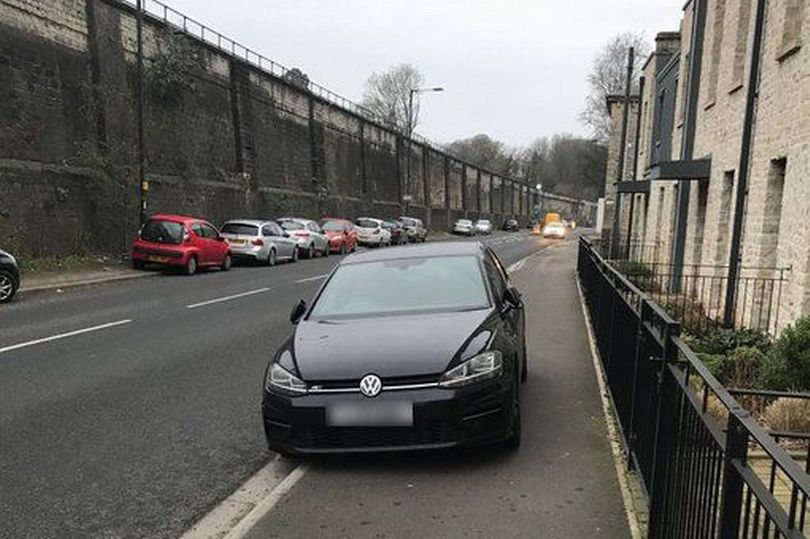 A week before the refusal of the Reserved Matters planning application, this week's new application was submitted, indicating that the applicants expected the outcome they got. It is another submission for this site, which has a similar description. We haven't yet examined the new application to see how different it is from the one refused permission, but we do hope the Case Officer doesn't suggest student parking can be suppressed when High Court Case Law EWHC 4084 (2015) states categorically that it can't.
- In any case, previous attempts to insist that students can't bring a car to Bath have failed. This photograph of the road outside the Twerton Mill site was taken on a quiet day, because usually the area beside the railway has no spare spaces. Nevertheless, even on a quiet day, there are plenty of cars defying the restrictions. Students obviously know the restriction can't be enforced, even if the Council officers don't.
- Jones The Bootmaker - Last updated 30 August 2020.
- The applications for 19 Cheap Street, 19/04327/AR and 19/04347/LBA, were both refused by the Case Officer but unusually only 19/04327/AR was challenged by an appeal. Equally unusually the Appeal Decision was for a split decision, with the vinyl street numbers on the fascias facing Cheap Street and Abbey Churchyard permitted but all the rest of the signage covered by the application dismissed on appeal, despite the Appeal Inspector noting that they had already been installed. This brings some interesting complications for the applicants, because now they have street numbers permitted on the Advertising application but refused on the Listed Building application which they did not appeal, so technically they cannot be installed or left in place without a successful Listed Building application.
- Likewise, because the advertising refused on appeal is already in place, Enforcement should require their removal, but they know that the street number vinyls which technically have insufficient current planning permissions to remain were nevertheless considered acceptable as advertising by the Appeal Inspector, and therefore would be difficult to refuse if a retrospective Listed Building application is submitted for them. Common sense suggests that because the council doesn't charge for listed building applications but has to bear the cost of processing them, it isn't something to be insisted on.
- Our expectation is that Enforcement should insist on the prompt removal of the elements of signage refused by the Planning Inspector, plus the repair of any damage caused by installing them without permission, but to accept that the street number vinyls are "de minimis" harm in the Listed Building scenario and they can remain.
- Lewis House - Last updated 23 August 2020.
- Hidden in the council website is an item on the leasing of the accommodation in Lewis House. It focuses on the two floors to be leased to the University of Bath, but also mentions that the two floors above them are to be marketed as office space. It claims that the ground floor will continue to deliver public-facing services, which isn't quite true because Building Control used to have an area on the first floor where the public could seek advice or submit plans, and where will that be when the University moves in?
- So now we have the only city in B&NES becoming visitor unfriendly, without a Tourist Information facility and without proper council offices. What a way to manage a World Heritage Site. UNESCO will be pleased (- not; see World Heritage below).
- World Heritage - Last updated 2 August 2020.
- We were copied a Press Release, subsequently put online, announcing that UNESCO has published a new report: the first to examine the cultural, environmental and financial benefits to UK life from these diverse UNESCO projects, and their active contribution to the UN Sustainable Development Goals.
- Following the chain of links we found the report itself, and its key finding "Investment in the UK’s UNESCO designations would increase cross-disciplinary work and enhance their contribution to the UK economy and society, and the United Nations Sustainable Development Goals.". However it is over 50 megabytes and is in ZIP format, so anybody wanting to read the full report will have to download it from this link and then unpack it into a readable format.
- The report is UK wide and information about Bath is scattered amongst the text. We noted that the UNESCO designation is a contributory factor in attracting 4.5 million visitors (a number only exceeded by the Lake District and the Jurassic Coast), has contributed to just over £25 Million of Heritage Lottery Funds being granted for Bath projects, and has led to the establishment of the UNESCO Chair in Higher Education Management University of Bath this year. According to the report "Their UNESCO status helps them to unlock research funds and attract additional income and other non-financial resources such as human capital and information access".
- With all these ongoing benefits, we have to wonder why the council repeatedly puts the UNESCO designation at risk. For instance, the UNESCO Monitoring Report on Bath resulted in the World Heritage Committee expressing concern that whilst Phase 1 of the Western Riverside development was acceptable, Phases 2 and 3 were not, and the council was strongly advised to redesign the later phases. Not only did the council ignore this, but it has promoted the design of the phases which they were advised to redesign as acceptable models for planning applications for other developments, spreading the what they have been informed is an undesirable appearance (and this isn't the only example of the council skating on thin ice). Dresden had its World Heritage designation removed for insisting on building a bridge which the World Heritage Committee frowned on, so perhaps the council should start to reflect on the impact of a similar punishment being inflicted on the City of Bath unless they take World Heritage seriously.
- Homebase - Last updated 19 July 2020.
- We were tipped off that there was a closing down sale at Homebase, and that this was reported in a Chronicle article. We were aware of the planning application 20/00259/FUL so we had a look at the documentation, which revealed that the Homebase lease expires on 31August 2020 after which there is an extant planning permission to demolish the building.
- When we looked at the comments lodged on the planning application it was littered with criticisms from council consultees that insufficient information had been provided in some specialisations, and there were also (at the time of writing this) 14 support, 134 objection and 5 neutral public comments on the planning website with a lot of criticism about the design of the proposed replacement which was too tall, too densely packed, too cramped and too lacking in outdoor amenities. Historic England is also critical of its design and massing and recommends improvements.
- This suggests that there will be amendments and replacement drawings and there is no guarantee that the developer and the council decision makers are likely to quickly reach a compromise acceptable to both and capable of gaining planning permission. It looks as though once Homebase has closed its doors for the last time the site will lie derelict for a while. Undesirable though that might be, it is still preferable to granting planning permission to anything the public might consider a disgrace in a central location in the World Heritage site.
- Wansdyke Business Park - Last updated 12 July 2020.
- This planning application has attracted some strong criticisms of the Travel Plan from the Highways Department comparing the claims with the relevant council policies, most of which we agree with. For instance it is unwise for the Travel Plan to quote from a traffic and parking survey which is 9 years old to reach a conclusion that there are no parking issues around the site, when everybody who lives near there can see the reality for themselves: that the area is flooded with commuters parking at no cost rather than paying for parking in the centre; that the introduction of residents parking in Bear Flat has created a new demand from visitors and shoppers who would previously parked in Bear Flat; and that the significant increase in the number of local HMOs in conjunction with parking not being provided at any Purpose Built Student Accommodation has resulted in a very significant demand for student parking during the academic year.
- The Highways report wrongly assumes that "students are prohibited from bringing a car into the City Of Bath" when there is High Court Case Law (EWHC 4084 (2015) is the reference) which established the principle that planning conditions could not restrict the lawful activities of a tenant beyond the boundary of the development in question. This is in addition to our assessment that a restriction on parking on the streets of Bath was unenforceable, when we looked at the law that was extant before the High Court considered the situation and clarified it further.
- World Heritage - Last updated 28 June 2020.
- There is an item in The Chronicle commenting on the arrangements that will be in place when the Roman Baths is once again open to visitors, though with a pre-booking system in place to control the numbers in order to provide proper social distancing.
- Coincidentally we have been provided with a link to a new UNESCO Report which finds value in UNESCO designations as the UK emerges from Covid-19 restrictions. Some of the report covers areas which we are already aware of, such as Heritage Lottery Funding being available for restoration projects (such as the Cleveland Pools we mention below) though were were a little surprised that UNESCO's assessment that over the years this has totalled more than £25Million. The other item that was news to us is that the University Of Bath now has a UNESCO Chair in Higher Education Management. How this fits in with the World Heritage Management Plan, the Roman Baths Archway Project and other similar initiatives is not explained, but this overview provides a Commitment from the Government Heritage Minister to encourage future visits, and also a link to the full report for those interested in the details. We have downloaded the report for our archives.
- Edward Colston's Statue - Last updated 21 June 2020.
- Although Bristol is outside our remit, the fact that both Bath's MP and Bath's Council Leader have been quoted in the Chronicle does bring the issue more local. The fact that Edward Colston's statue was Grade II listed gives it a heritage value too, which we think needs to be more prominent.
- Taking the MP's comment first, ("Bath’s MP Wera Hobhouse has said that having Edward Colston’s statue still standing in Bristol in 2020 was ‘indefensible.’") the Grade II listing brings the statue under the Planning (Listed Buildings and Conservation Areas) Act, and whether it should have been there in 2020 is a decision under the control of the Secretary of State and not the local MP. The role of an elected MP is to uphold the will of Parliament as expressed in the extant legislation, whatever her privately held opinion might be, unless she can command a majority in Parliament in favour of change. In the same vein, the listing entry not only describes the statue, it identifies where it is required to be, so the Mayor of Bristol is also allowed to hold a personal opinion but he has a civic duty to restore the statue to its original place to accord with the listing entry created in accordance with the Act, and he cannot legally move it anywhere else.
- 12 JULY 2020 UPDATE: Deliberate flouting of the listing is a criminal offence which, according to the Act, could attract a custodial sentence. At present, the statue is undergoing restoration, but the speculation in the local news on television is that the graffiti will be left, which is also an offence under the Act.
- The Council Leader's comment ("Councillor Dine Romero said she will bring people together to 'confront this historic evil'") is less definite, seeking a dialogue rather than a stated outcome, but again the legislation must also be heeded too. It is perhaps worth mentioning that judging the past by the standards of the present is not going to change the past. For instance 60 years ago it was perfectly legal to drive on an open road outside a built-up area at 100mph or more, but it isn't today. 120 years ago, the emphasis was on the vast sums of money that Coulson spent on improving the lot of poor Bristolians, and that is why Colston's statue was commissioned. At that time, it had been recognised that the way his money had been earned was perfectly legal during Colston's lifetime, and it is what Colston did with it which stood him apart from other rich businessmen. If every building that Colston had sponsored was demolished now there would be large swathes of derelict land in Bristol, and it is not helpful to pick and choose which parts of Colston's life should justify protests.
- Update 21 June 2020: The statue has been retrieved from the river and is currently undergoing restoration.
- The Rec - Last updated 31 May 2020.
- In the Chronicle is a rather woolly confirmation that the applications to extend the temporary permissions for the East Stand used by Bath Rugby have been given permission for a further two years. This doesn't mean that they can remain in place permanently for the two years as the article claims, because the Rec is covered by a charitable scheme, overseen by the Charity Commission and implemented by the Trustees. The scheme has been under the scrutiny of two levels of Tribunal and the final decision by the Level 1 Tribunal is obligatory. Therefore the Trustees have to ensure delivery of Clause 4(5)(b): "The lease must not permit the tenant use otherwise than as a site for a temporary stand (usually referred to as ‘the east stand’) or playing pitch or access areas and must require the site to be available as open space for use for the purposes of the charity for at least three months in each year. The three months shall be consecutive summer months. The site, including all grass surfaces, shall be made available at the start of the three month period in a condition that is immediately suitable for the playing of sports and the use of the land for leisure purposes." Planning permission is required by the Town and Country Planning legislation, but it does not override other constraints. Therefore despite the planning permission, it only grants permission for the East Stand to remain in place for 9 months of each year for a period of two years.
- 43 Upper Oldfield Park - Last updated 31 May 2020.
- We objected to the first version of 19/04909/FUL which was for a dwelling and garage in part of the garden of the building given planning permission as a result of an appeal against the refusal of 14/04547/FUL. We pointed out that there were several conditions attached to the appeal consent: banning the use of the entrance onto Junction Road; maintaining a root protection fence around the area protecting the roots of the landmark tree in the Norland site next door until the landscaping had been completed; and requiring the landscaping to adhere to the layout defined in 11/05409/COND. When these Conditions were ignored by the Applicant, an Enforcement Notice was raised which required the landscaping to be delivered. We pointed out that because these Conditions were the requirements of the Secretary of State, a Local Planning Authority did not have the authority to override them until they had been delivered in full.
- The original scheme was subsequently amended taking the upper storey off the garage, and we repeated our objection in principle. It therefore comes as a surprise that according to the applicant's latest email the Case Officer agreed to revisions to the proposal; revisions for which we have just been notified we have three weeks to comment on. Of course we will reiterate our objection in principle, but in view of the Government's current Coronavirus advice that those from different households need to maintain "social distancing" of at least 2 metres, the rump of the garden between the flats and the fence marking the proposed development is insufficient for the residents of 14 flats to share, yet it is supposed to be a communal garden. Perhaps in the current climate this unauthorised truncated garden deserves a Health and Safety investigation.
- Bath Quays Bridge - Last updated 17 May 2020.
- The first two parts of the bridge arrived as forecast on 12 May. The Chronicle published photographs of it though they seemed to be more interested in a lack of PPE and social distancing than the bridge itself. The remainder of the bridge should arrive on 19th May.
- The arrival provoked questions about why the contract wasn't let to a British company. The council has explained that they opted for "best value" and as the tender process is going to be Commercial-In-Confidence we will probably never know how that was arrived at. We can say that until 31 December 2020 the UK must follow EU regulations and they include an obligation to give any company in the EU the right to respond to a UK tender invitation, and the UK cannot show a preference for any one or group of EU states while evaluating the tenders submitted.
- Impact of Student Accommodation - Last updated 3 May 2020.
- In this week's Chronicle is a report that the coronavirus could leave the council with a significant budget deficit. This is partly due to the income generating facilities like the Roman Baths being closed as part of the coronavirus lock down, but there will be other consequences if the lack of tourists is looked at from a wider perspective.
- The council's own officers are repeatedly warning the planners that Bath is already over-subscribed for hotel bedrooms, yet more and more hotels which are not needed are applying for and receiving planning permission. The lack of tourists must by threatening the future of many existing hotels and guest houses; and the lack of tourists spending money must be putting a strain of retail and restaurant businesses. The hotels permitted but where work is not yet completed provides an ideal opportunity to land-bank sites, removing any leverage the council might have had to allocate those sites for what is really needed, which is family homes and social housing.
- Watchdog has been concerned for some time about the amount of student bedrooms being approved, because too many areas are becoming socially unbalanced by replacing permanent residents with students. Whilst there is now some legal limitation on converting more domestic properties into HMOs, they are still being approved on the fringes of the excluded areas, and there seems to be no restriction on how much Purpose Built Student Accommodation is permitted, despite the evidence that there is so much already built that rooms applied for as student accommodation are being advertised for holiday lets and "AirBNB" accommodation. The council needs to bear in mind that if they had not been so ready to say "Yes" to student accommodation, they could have had other uses for those sites and received a Council Tax or Business Rate income from them which would have reduced the current deficit. Perhaps this is the time to introduce a policy of refusing all applications for student accommodation, and all applications for further hotels on the grounds that they are now unaffordable to the council budget.
- Virtual Library - Last updated 3 May 2020.
- While looking for other information for this week's website update, we came upon details of how the council's library service is dealing with Covid-19 and their how to install suitable software and how to use it advice from a PC (other devices will be similar). After that the reader can go straight to the lists of publications supported by the library; this is the featured book list.
- Strictly speaking, this is outside the Watchdog remit, but we have members who are considered vulnerable and are being shielded at home and this information might be useful to them.
- Mineral Water Hospital - Last updated 5 April 2020.
- The Chronicle reports that following nearly 100 objections to the Applications to convert the Mineral Water Hospital into a hotel, the design has been modified, reducing the height and appearance of the proposed extension, and reducing the number of rooms from 190 to 167.
- The applicants claim that their alterations produce a design that "enhances the significance of this important Grade II* listed heritage asset". This just proves that they simply do not understand the significance of a II* listing. To qualify for a II* recognition, the Secretary of State has to regard the whole building (not just part of it) as one of the best 5% heritage assets in the country. That is why anything proposed which demolishes any part of the listed structure should be wholly exceptional and only permissible if it provides public benefit which exceeds the loss of heritage. No hotel will meet that criterion. Therefore, as the Bath Preservation Trust point out, if the building is to be converted into a hotel, it must do so within the building as it currently exists.
- Everybody who objected before needs to object again, pointing this out.
- Sydney Gardens - Last updated 22 March 2020.
- The planning applications for Sydney Gardens were given planning permission this week. Although we had recognised that maintenance of the railway structures through Sydney Gardens were the responsibility of Network Rail, and we had agreed with Network Rail that the necessary repairs and maintenance would be delivered as part of the electrification work, we were concerned that when the electrification scheme was postponed the maintenance work appeared to have been postponed with it. For that reason, we had recommended that the council and Network Rail agreed to a programme of maintenance aligned to the completion date for the restoration of Sydney Gardens, as a public benefit to offset the harm to the listed Gardens, as defined in the NPPF.
- In evaluating the planning applications, the Case Officer assessed that the substantial public benefits from the additional features being added to the Gardens more than offset the less than substantial harm to the heritage asset (mainly caused by the encouragement in the Equalities Act to improve accessibility), and therefore the restoration of the railway structures need not be conditioned to obtain public benefit. Although disappointing, we cannot argue against that conclusion, and we are encouraged by the report that discussions between council, Historic England and Network Rail are already taking place on a voluntary basis and will continue.
- More on Student Accommodation - Last updated 15 March 2020.
- Bath City Football Club. The Chronicle reports that the planning application was refused by the Planning Committee. There were the inevitable complaints about the decision, but Twerton is within the World Heritage boundary, and the description of the World Heritage City is that buildings are of a human scale. Seven stories of student accommodation amidst an area which is predominately two or three stories should never have been proposed, and that alone would have been justification for refusal. An environmentally unfriendly pitch and streets unsuited to the transport needs of over 300 additional students are additional nails in the coffin. There were the expected protests that 800 letters of support were not heeded, but it is not a popularity contest, and the planning regulations require decisions to be made purely on planning policy grounds. This was a good decision; if the football club wanted to secure planning permission, it should have proposed a development which could be approved.
- Former Hartwells Site. The Chronicle reports that the planning application was refused, contrary to the Case Officer's recommendation to "Delegate to Permit". Despite the large site being available for development, there was not enough affordable housing proposed, and what there was consisted of apartments when the characteristic of the surrounding area is for properties with private gardens. Even the properties which were not for students were apartments, and the limited parking provided was all in one place so that it would have been a tidy walk in the rain with shopping bags for those living there. The student accommodation produced the usual unproven claim that it would release HMOs back to housing, when those who live near HMOs know that the internals of HMOs have been modified to cram in as many students as possible and are now unsuitable for normal housing. Also, the Core Strategy requires new student accommodation to be provided on campus, not in Newbridge. This looks like a "tick box" development rather than a planned community, and refusing it was a good decision.
- Student Accommodation - Last updated 8 March 2020.
- Although we didn't comment on either of them (there were so many other public comments covering our concerns that we had nothing new to add), both the Bath City Football Club and the Hartwells Site applications include student accommodation, and both Committee Reports include an assumption that an S.106 agreement will ensure that students occupying the accommodation can be banned from bringing a car to Bath.
- As we mentioned last week in the context of the Plumb Centre (see below), the High Court judgment EWHC 4084 (2015) established the principle that Section 106 agreements could not restrict the lawful activities of a tenant beyond the boundary of the development in question, so a "No Car" policy is now worthless because Case Law overrides it. We have therefore brought the Case Law to the attention of the Ward Councillor for Twerton. Effectively the High Court has interpreted the S.106 clause in the legislation that specifically identifies "the site" as being wholly contained within the application boundary. Anything outside the boundary (for instance a "No Car" restriction) is outside the scope of S.106 and cannot be part of a planning agreement or a planning Condition.
- EWHC 4084 was not a Bath court case, it merely exposed the general principle of where a planning application ends. It is perhaps worth noting though that EWHC 4084 resulted in the associated planning permission being quashed because the S.106 document strayed outside the scope of S106.
- Unusual Appeal - Last updated 8 March 2020.
- Jones the Bootmaker has appealed the refusal of advertising consent 19/04327/AR but not the associated listed building application 19/04347/LBA which was also refused. So even if the appeal succeeds, there will be no permission to install the signage on the listed building. From the Appeal Inspector's point of view, both planning refusals ought to be considered together because an appeal against just one is a waste of time. The signs have already been installed, so unless there is an appeal against the listed building refusal before the window of opportunity expires early in June, an enforcement notice can be issued to remove the unauthorised signage.
- Bath Preservation Trust - Last updated 1 March 2020.
- Although she is not leaving her job of Chief Executive of the Bath Preservation Trust until July, Caroline Kay has just announced that she is leaving so that the Trustees have time to arrange a replacement.
- We wish her well in whatever she chooses to do next. We have had an excellent working relationship with her, and hope that her replacement keeps similar lines of communication open.
- Cleveland Bridge - Last updated 1 March 2020.
- The Chronicle reports that the Government has provided the money needed for the Cleveland Bridge repairs out of their "Highways Maintenance" fund. It will ensure that there is no undue delay in starting the repair work.
- However, we doubt that police spot checks will be sufficient to keep over-weight lorries from using the bridge, and although the number using the bridge is significantly reduced, there are still some who have been seen going over the bridge when they shouldn't. When there were traffic restrictions in Combe Down while the stone quarries were stabilised, there were width limits as well as weight limits and these proved successful. Something similar coupled with ANPR cameras to collect the registration numbers of offenders should avoid any risk of a heavy lorry and part of a weakened bridge ending up in the Avon.
- Plumb Centre, Locksbrook Road - Last updated 1 March 2020.
- There have been a lot of support comments for the Genesis Gym in the last week, which emphasise that the gym is a valuable local asset. What all of them overlook is that the gym is currently operating, and if the application is refused it will remain open. However, if the application is approved, the current gym will be closed down and demolished along with the Plumb Centre and there will be a hiatus while the site is cleared, the new construction erected and fitted out so that the gym can be re-opened. We wonder where the enthusiasts for the gym are going to go for their exercise in the months when it doesn't exist? They also seem to have overlooked the fact that the student accommodation will result in students parking their cars in the area: our assessment that a restriction is unenforceable has now been reinforced by Case Law after the High Court judgment EWHC 4084 (2015) established the principle that Section 106 agreements could not restrict the lawful activities of a tenant beyond the boundary of the development in question, so a "No Car" policy is now worthless because Case Law overrides it. Some of the gym users travel a distance and if the planning application succeeds they are likely to find there is nowhere to park when they arrive.
- Fairfield Arms - Last updated 23 February 2020.
- Although we did not specifically object to the planning application we noted that what we would have objected to was amply covered by those 187 objectors who did.
- We are pleased to see that the planning decision recognised the importance of retaining this community asset and refused permission on that and five other grounds for refusal.
- Student Accommodation - Last updated 16 February 2020.
- The public consultation that was mentioned in a Chronicle Item did take place, and the feedback we received is that exhibitors would talk about the plans for the redevelopment of the Regency Laundry building which were on display but they appeared deaf to the criticisms of the scheme from the public. The proposal is to replace it with Purpose Built Student Accommodation, an idea which didn't go down well. It is expected that a planning application will be lodged in a month or so.
- After the exhibition the Chronicle has published another article which makes it clear that the usual lie that a PBSA will alleviate pressure on HMOs came from the developer, when everybody knows that the council has a policy that PBSAs must not provide parking, and that makes HMOs the destination of preference for any student intending to arrive with a car, a cheaper option with a greater luggage carrying capability than public transport. We have been informed (though we haven't checked if it is true) that the PBSAs currently in existence have spare student accommodation which in total exceeds the number proposed for the Regency Cleaners site. If it is true, then the claims that the new development "will provide much needed accommodation" appears to be wishful thinking.
- The Core Strategy is specific that in future the Universities are supposed to provide additional student accommodation on campus. This has been largely ignored by the council and the universities, and the University of Bath even had the brass neck to get planning permission for Wessex Building to be student accommodation, and then after it was built it was converted into offices and the council did nothing about it until it was out of time to enforce changing it back to student accommodation.
- The public comments associated with the Chronicle article are mostly against the proposals. We hope that as many as possible make their feelings known to the council when the planning application is eventually raised. Our recent Neighbourhood Balance item (below) makes our position clear.
- Meanwhile the planning application for the Co-op Scala is our new one for this week, and that also includes student accommodation.
- Neighbourhood balance - Last updated 2 February 2020.
- There have been a couple of Chronicle articles about the proportion of student accommodation in Bath, based on letters submitted. One was last week and another is this week. The gist of both is that there are already more than enough student beds and the council should not approve any more. We recognise that the council is required to make planning decisions in accordance with council policy, but that doesn't mean that they have to approve everything that is applied for.
- The Core Strategy expects universities to provide student accommodation on campus, and this can, if the council wishes, be interpreted as accommodation for students for the duration of their course, and not just for the first year. The council also has a policy of maintaining a balance of population types in any area, so this can be used to refuse more Purpose Built Student Accommodation anywhere in Bath, because the City of Bath now has a greater proportion of students to non-students than any of the places reputed to have a large number of students which we have examined as comparisons; even the Gleaming Spires" of Oxford have a lower percentage of students than Bath has.
- It is also worth debunking a few assumptions. The calculation in the "Government Grant" that councils are reimbursed for the loss of council tax from Student accommodation is no longer applicable, so every student HMO or PBSA is a demand on council services and a loss of council income that a normal residence would generate. The assumed student numbers in the Local plan are dreadfully underestimated. According to the figures quoted on the University of Bath website, just their numbers last year were more than double the estimate of the total student population of both universities in 2020 used to inform the Local Plan; and the best figures we could find for the University of Bath were that in 2017 that university was only a few students short of the total council estimate for 2020. Nevertheless, so much PBSA accommodation has been approved that there are vacant beds to be had. At least one of the PBSA's has advertised AirBNB rooms available.
- The council's assumption is that because the Universities limit the number of cars allowed in, there will not be a need for parking for student cars, yet a car is cheaper than public transport for home to Bath journeys and more luggage can be carried, so whether a car can be used for travel to university is irrelevant. It only needs a comparison to be made during term time and out of term time to assess just how many student cars are taking up residential parking spaces, and the clause in the tenancy agreements that cars will not be brought to Bath is therefore completely ineffective. Finally, once a HMO has been recognised as an HMO, owners are then applying for extensions in order to cram in even more students, and if given consent the house that was once a family residence is modified so that it can never afterwards be a family home and the assumption that PBSAs will release an HMO back to residential use is just a soundbite that will never be delivered.
- Whilst we can show that it is possible with current policies to refuse further student accommodation of any type, we are not optimistic that it will be heeded. After all, the council's estimates of the number of hotel and guest house rooms needed in future had already been exceeded when further hotel accommodation has been given permission, against Departmental advice. It does look as though the planners are afraid to say "No".
- The Rec - Last updated 26 January 2020.
- Court Case. We have been notified that the High Court hearing to decide whether the 1922 Covenant on the Rec which forbade the erection of any building for the purposes of trade or business which could be a nuisance to the neighbourhood is still current and enforceable, originally arranged for 6th February 2020, has been postponed, at least until March but possibly as late as April 2020.
- We wonder whether the Claimant is having second thoughts. Between the court case being threatened and today there have been Tribunal hearings to clarify for the Charity Commission how the charitable land should be handled. This has resulted in a definition of the exact land area that Bath Rugby is allowed to use until the expiry or surrender of the 1995 lease, plus the definition of the size and position of the temporary extension of that area to accommodate the East Stand for nine months of each year with the requirement that for the remaining three consecutive summer months the grass surfaces must be restored in a condition suitable for playing sports or leisure uses. Furthermore the Trustees are required to limit their use of the land swap ability to land defined in the 1995 lease, and lasting for no longer than that lease has left to run. The Trustees must also not show any undue preference for any sport or organisation and not use the Recreation Ground otherwise than as an open space; and they are required to accompany any variation of the 1995 lease (which cannot have its expiry date extended) with a Condition that Bath Rugby Club must "minimise disruption to local residents and to users of the charity's land". This takes the 1922 Covenant a bit further, because "disruption" has a wider scope than just building on the Rec and also covers parking problems, litter and anti-social behaviour. Effectively, the subsequent legal clarifications have rendered irrelevant whether the High Court decides the 1922 Covenant should be nullified or retained. The legal proceedings have also required the Trustees to not allow any structure on the open space of the Rec outside of the 1995 leased area plus the nine-monthly use of a defined additional area for the temporary East Stand.
- Planning Applications. In the new applications this week are applications from Bath Rugby to extend the temporary permissions currently held but due to expire later this year. Some may wonder when a temporary arrangement goes on too long and effectively seems permanent, but our research suggests that there is no suitable alternative under current planning law. Both the 1st Tier and 2nd Tier Tribunals did not express an opinion on whether or not the 1995 lease expiring in May 2070 was appropriately agreed, which leaves the Trustees free to argue in the courts that it was not appropriate and should be nullified, but realistically they are unlikely to do that and lose the income from the lease and also expose the council to a damages claim from the beneficiaries of the lease.
- Planning permissions for building work are permanent, so the council as "Custodian Trustee" under the Public Trustee Act 1906 cannot be a manager of the Trust land but cannot by action or inaction prevent the Trustees from carrying out their duties. Therefore temporary permissions must be given for a stand that has to be removed for three consecutive summer months each year but is allowed to be erected each year for the next 50 years "in association with the lease" if the leaseholder chooses. Similarly, those buildings which were in place when the 1995 lease was agreed are only supposed to remain until the lease expires in 2070, but any additional building work must be given temporary permissions so that the Trustees can return the Rec to an open space at the end of the lease. When the 1906 Act and the 1990 Act are mismatched, temporary permissions are the easiest practical arrangement. We shall examine the renewal requests to make sure they are not outside the areas over which Bath Rugby has a lease or Tribunal agreement to use, but we will not be criticising the temporary nature of the permissions sought.
- Sydney Gardens - Last updated 19 January 2020.
- Our first look at the Sydney Gardens planning applications shows that they are reassuringly similar to the proposals discussed at previous consultation events. However the restoration of the gardens with the aid of lottery funding will not fully recreate the leisure garden character if a number of "visitor attractions" in the form of the views of the railway which Brunel created specially to entertain users of Sydney Gardens continue to show the neglect currently visible.
- We had a verbal agreement with Network Rail that the cast iron pedestrian overbridge would be restored as part of the electrification of the line. Whilst electrification has not yet taken place, the bridge remains a listed structure and as such the current state of neglect cannot be left indefinitely. It is the last Brunel cast iron bridge on the line and it therefore must be maintained in good condition. Technically this should have been classed as maintenance rather than being deferred with the electrification work.
 Likewise, Network Rail have cut back some (but not all: the Beckford Road Bridge is untouched) of the vegetation growing on the listed railway structures as part of their trackside clearance work. However they do not appear to have made any attempt to kill the plants, they are merely pruned, and will regrow. We discovered in the past that a similar cutting back exercise near Bath Spa station encouraged regrowth and until Network Rail complied with our request to kill and remove the Buddleia, its powerful roots continued to damage the structure it was growing from. The same future damage will occur in Sydney Gardens. This picture shows the stump of one of the bushes, left behind after the pruning, and illustrates the damage to the listed stone which the growth has already caused, and there are other similar examples and damaged stone elsewhere in Sydney Gardens. This and other cut back bushes in Sydney Gardens need to be killed, removed and the root damage made good. Network Rail had already agreed to do this work in their Electrification workshops and again these are maintenance issues rather than electrification dependent.
- It is unfortunate that the recent application from Network Rail (19/03211/LBA) was given consent before the recent pruning of the Buddleia took place, because that application would have been an ideal place to add a condition that trackside vegetation on listed structures should be killed and removed rather than being cut back. There are currently no other planning applications from Network Rail where such a condition can now be added, but the current Sydney Gardens applications have been submitted by the council, and it is possible to add a Condition to those applications when given consent, that the council agrees with Network Rail a maintenance programme of vegetation removal and restoration of listed railway structures within Sydney Gardens, to be completed within the timescale of the activities in the applications being given consent. Whilst the work in Sydney Gardens is claimed to be an overall improvement, there are nevertheless some parts of it which under a recent High Court clarification (The Bradford Case) leaves the work in the less than substantial harm category and Paragraph 196 of the NPPF expects some public benefit to be provided to offset it. Maintenance and repair of listed structures is that public benefit.
- Cleveland Bridge - Last updated 12 January 2020.
- Watchdog supported the repairs to the Grade II* listed Cleveland Bridge, but expressed our concern that when the delay between identifying that repairs were needed (apparently the defects were serious) and plans being submitted to carry out the repairs spans a gap of several years, the probability that some of the defects may have got worse needs to be borne in mind. That comment seems to have got us onto the list of those to be kept up to date on developments.
- We have now received a copy of an information notice informing operators of large goods vehicles and coaches that from 3 February 2020 there will be a weight limit of 18 Tonnes on Cleveland Bridge and alternative routes for over-weight vehicles will be indicated by "Diversion" signs. As a policy, making sure that the heaviest lorries (up to 44 tonnes) should not go over the bridge, is sensible. However, it is not uncommon to read of large lorries taking unsuitable routes when following their SatNav, and the Cleveland Bridge will still be shown as a normal route on any SatNav that has not been updated. Therefore we recommend that ANPR cameras are set up to monitor the bridge and any vehicles that do not observe the new weight restriction are pursued. That approach will convince operators that the restrictions must be observed.
- There are mixed feelings about the published weight limit. However when we took into account that the fire station is just south of the bridge and a fire engine full of water would weigh just under 18 tonnes, it does seem sensible to allow the shortest route to Fairfield Park and Larkhall, at least until work on the bridge makes this weight undesirable.
- Website Statistics - Last updated 5 January 2020.
- For the first update of 2020 we have produced our usual "End of year" report of our activities during 2019.
- Like last year we have also examined the continued loss of family homes as they are converted into HMOs. We have also looked into what the planning legislation says and have identified a number of issues arising last year from the council's failure to comply.
- More "Garden Grabbing" - Last updated 8 December 2019.
- On 3 November 2019 (for Application 19/01391/FUL - see below) we pointed out the planning objections to building in the garden of Kennet House. Along similar lines there is a new application 19/04909/FUL this week for another development in a garden, this time at 43 Upper Oldfield Park.
- Aside from the NPPF specifically excluding residential gardens as "previously developed land" or "potential windfall sites", this property is also covered by an Enforcement Notice which attempts to complete a set of condition attached to an Appeal Decision, that nobody should be allowed to live in Number 43 until the landscaping scheme for the shared garden has been delivered, and that the entrance from the site onto Junction Road should not be used. It is also part of the Conditions of the Appeal decision that the root protection area for the protected pine tree should continue to be fenced until the landscape scheme is installed and only arboriculture or landscape works can be approved within it with building, plant or any storage use of the area forbidden, and if that expectation had been met it would have physically prevented the construction of part of this new proposal.
- The Conditions were laid down by the Planning Inspectorate which is part of central Government, so it is a moot point whether a Local Planning Authority can approve anything which undermines or contradicts the requirements of central Government. The fact that the applicant has so far ignored all the Conditions attached to the Appeal decision that Charters could be built does not remove the requirement to deliver them, which is what the Enforcement Notice set out to do. We hope that the planners will refuse this latest application on that basis and ban all future alternative use of the area required to be a shared garden, permanently retained. We would not expect any appeal against such a refusal to be treated favourably by the Planning Inspectorate after their previous decision was treated with such contempt.
- Visitor accommodation - Last updated 1 December 2019.
- Bath is being targeted by an advertising campaign encouraging more Airbnb properties. Meanwhile, Royal National Hospital For Rheumatic Diseases (still known locally as the Mineral Water Hospital) has submitted planning applications to convert the buildings into a 169 bedroom hotel.
- Taking those in order, we have had reports from some living near student HMOs that some have not remained empty during the summer months this year and that the people seen moving in and out during August did not look in the right age group to be students and seemed to have stayed for a week before being replaced by others. The assumption being made is that these are likely to be holiday lets, whether Airbnb or not. Student HMOs are exempt from Council Tax and Holiday Lets are not, so we think that student HMO licences should either ban the use of the building by anyone other than students, or else some arrangement needs to be made for charging Council Tax for those two months when the students are not in residence and the property is available for other uses. The council should look into this as a matter of urgency.
- Watchdog has maintained for some time that Bath is saturated with cafes and restaurants and that each new one that opens is either followed after a relatively short interval by another similar business closing down or the new venture fails. The same problem now seems to be growing in the hotel and guest house sector. Airbnb use must take trade away from existing Bed and Breakfast and Self Catering properties in Bath, and hotels will soon be vying for the insufficient number of visitors compared to the number of available bedrooms. The council's Case Officer looking at the planning application for Bath College's Allen Building noted that other hotel developments previously approved and in some cases now taking guests would satisfy the forecast growth in tourist bed requirements at least until 2025. Despite the Allen Building already having permission (from Application 17/01588/FUL) for conversion into offices for which there was a "pressing need", the planning committee approved the demolition and replacement of the Allen Building by a 198-bedroom hotel which they were advised would all be surplus to requirements. Now add the plans for the 169 bedrooms proposed for "The Min" and if approved the total supply will exceed the 2025 demand by almost 50% and even the 2030 forecast demand will be considerably exceeded. Hotels and Bed and Breakfast properties which fail as a result will produce quite a shortfall in business rates.
- Facadism - Last updated 17 November 2019.
- The publication of the book "The Creeping Plague Of Ghastly Facadism" (ISBN 099574016X for those wishing to buy a copy) by The Gentle Author on 31 October 2019 is the culmination of an on-line blog followed by lecture events. It is primarily a gallery of the most notorious examples of facadism (often referred to in the architectural press as "Deathmasking") in the Spitalfields area of London. After its publication, the BBC and various architectural websites have picked out samples from the 122 page book, and some of them echo planning decisions and surviving facades in Bath.
- We have put some of the Gentle Author photos alongside Bath examples in a Facadism section of our Public Realm web page.
- The Bath Rugby Plans - Last updated 10 November 2019.
- The Chronicle reports that a Residents Association has issues with the quality of the information provided by the Stadium for Bath team. In reply, the applicants state: "It is our intention that all Pulteney Estate residents are informed with factual information so that they may make informed decisions regarding the project."
- Perhaps they would like to start the factual information by quoting the expectations of the Tribunal looking into (and endorsing) the Scheme proposed by the Charity Commission. It said:
Trustees shall ensure that the land made available under any agreement with Bath Rugby for the site of the East Stand and for any other use that restricts free public access to, or the use of, any part of the Recreation Ground as open space, shall not exceed in surface size the maximum extent of any grant that has been approved by the Commission for the erection of the East Stand on a temporary basis since 2002 (which the Upper Tribunal clarified as 1042 square metres). All such land shall be returned to open space and made available to the Charity for its own purposes for a least three consecutive months in the summer of each year in a condition that permits the playing of other sports for the full three month period.
This was further clarified by the Charity Commission:
The objects of the charity are the provision, with or without charge, of land in or near Bath, including but not limited to the Bath Recreation Ground, for use as outdoor recreational facilities for the benefit of the public at large and in particular for use for games and sports of all kinds, tournaments, fetes, shows, exhibitions, displays, amusements, entertainments or other activities of a like character and the maintenance, equipment or lay out as the trustees shall think fit of such land and always provided that
(i) the charity shall not show any undue preference to or in favour of any particular game or sport or any particular person, club, body or organisation, and
(ii) the charity shall not use the Bath Recreation Ground otherwise than as an open space. - In summary, the Rugby Club is restricted to the use of the area defined in the 1995 lease plus temporary use of 1042 square metres where the East Stand can be erected for nine consecutive months of a year, a concession that has temporary planning permission from 15/05237/FUL which expires on 30 May 2020. The Trustees are forbidden by the objects of the Charity to allow any construction on any other part of the Bath Recreation Ground, because that must be retained as an open space.
- That is factual information, all in the public domain. It remains to be seen whether Stadium for Bath do inform the Pulteney Estate residents of it.
- Planning Application Updates - Last updated 3 November 2019.
- There are a couple of new submission documents on existing open planning applications which merit further comment:
- Land North Of Kennet House (19/01391/FUL). Historic England have commented on the revisions to the original plans, pointing out that their advice to the earlier submission has not been followed up. Their advice was to consider whether any type of new dwelling could be erected on this site without adverse consequences. In the absence of such considerations the advice has now been turned into a specific objection, and the use of the word "object" gives them the legal right to ask the Secretary of State to call in the application for ministerial consideration if the planning committee is inclined to give consent.
- The Chivers House Site (18/03797/FUL). In March 2019 the planning application was considered by the then Development Management Committee, and despite detailed objections (quoting reasons from planning policy documentation) from Planning Policy, Economic Development, Housing, Highways, Urban Design, Landscape, Arboriculture, and Conservation, alongside specific advice from the Viability Assessor that some level of affordable housing is viable, and a specific warning from Historic England that "Landmark" buildings in the Western Riverside development were intended to be exceptional and not a yardstick for other developments and therefore the potential impact of the views of this development on the wider area of the World Heritage Site and Conservation area needs to be given great weight, the Committee ignored all this advice and recommended approval for the flimsy reasons the Minutes record.
- A new drawing has been lodged in the last week addressing the minimum viable affordable housing criticism but nothing else. It is not clear whether the new drawing should allow additional comments. The website page says the comment period is closed, but the Customer Charter says that the public are allowed 14 days for additional comments. Our "Make Comment" link on the Full Set page still gives access to the comment form for those who want to comment.
- The fact that despite insisting that affordable housing could not be provided it became possible once the council consultant challenged it, does raise some doubts about whether other claims can be taken at face value, and whether some of the original DMC Members might have given too much weight to the applicants claims and too little to their own council specialists. Eight specialist Council Departments specifically objected to the plans and none focused on affordable housing, which shows that there are significant planning policy reasons to refuse still not addressed. We think that because no planning decision has been issued yet, it would be sensible for the entire planning application to be re-considered by the new Planning Committee set up since the Local Elections.
- More False Reporting of the Rec Plans - Last updated 27 October 2019.
- In a new Chronicle article it is claimed that "the ownership is still being disputed" when the question was cleared up long ago. In 2002, an Appeal in the High Court recognised that when the Rec was purchased in 1953 by the (then) Bath council, the terms of the sale made it clear that the Rec was intended to be charitable land protected by covenants accepted as part of the transfer of ownership, and it recognised the lease of 17 October 1933 allowed the use of 3.7 acres at the western end of the Rec as a football ground for amateur matches. That ownership transferred to Avon County Council and then to Bath and North East Somerset Council.
- On 24 April 2014, the First Tier Tribunal (Charity) cherry-picked a bit on what it thought was important in the 2002 Judgment but stopped short of arguing against it, and officially defined the council as "Custodian Trustee" under the Public Trustee Act 1906 of the land transferred to the council in 1956. This makes the council the permanent holder of the Trust land but without the authority to manage it. That role goes to the Trustee arrangement set up by the Charity Commission, with no Trustee able to serve more than two consecutive 3-year terms. This original ruling was further clarified by the Upper Tribunal (Tax And Chancery Chamber) on 18 May 2015 which increased the amount of additional land that can be occupied by the temporary East Stand by 6 square metres and required the East Stand space to be reverted to open land for three consecutive months in the summer. All this is in the public domain; we found it with internet searches, and the Chronicle could have done the same.
- Also in the documentation we found is the ability of the Trustees to arrange a land swap, but only for the land described in the lease of 1995 which was to allow the professional Bath Rugby to continue to occupy the pitch and buildings previously used by the amateur rugby team. The objective of the potential swap (which isn't compulsory but if it takes place it will expire on the end date of the 1995 lease) was to allow the option of other open land to be made available to the public to compensate for the business use of the west end of the Rec, because the 1995 lease would otherwise have to be declared as in breach of the Trust objects and the covenants on the Rec that it shall not be used other than an open space.
- One thing is abundantly clear: the Trustees are barred by the Charity Commission supported by the 2014 Court Order, from agreeing to any building or construction on the land outside of the 3.7 acres allowed in the original transfer of the Rec because the objects of the charity forbid it. Likewise, planning permission for any such building or construction cannot be granted by the council without the council being in breach of Trust and therefore in breach of two separate Court Orders. Legally, the idea of a stadium on the Rec is a dead duck because the series of legal rulings ensure that a Judicial Review will quash any planning permission, yet it continues to be promoted.
- Homebase Site Consultation - Last updated 20 October 2019.
- As a result of a planning application (which resulted in a decision that an EIA was not required because it dismissed the flood risk on old information despite the Environment Agency updating the 100-year level, and which did not check how the proposals would impact on the Outstanding Universal Value of the World Heritage Site) it is apparent that over-high buildings of the type that the UNESCO Mission to Bath was vehemently opposed to are expected to be proposed (the World Heritage Site is supposed to consist of buildings of "human scale"). It looks as though the residences are predominately one and two bedroom apartments, of which there is already an over-supply because Crest Nicholson changed their Western Riverside plans and what would have been a terrace of houses and gardens is now a block of apartments, now almost finished. What Bath is left short of is 3-bedroom houses with gardens, for families. The public reaction has been largely unfavourable.
- The site owner, reported to be Guild Living, has not reassured anybody when their spokesperson refers to "any future redevelopment" rather than the scheme being shown to the public, and then "aspiring to deliver a unique retirement community" (our emphases) in buildings that are too tall to be attractive to those old enough to retire. The elderly are wary of living in anything higher than ground or first floor because of the fears of being trapped upstairs in the event of a power cut disabling the lifts or a fire below them leaving them out of reach of the available fire service ladder. We looked up Guild Living in the Companies Register and it is described as "Activities of other holding companies not elsewhere classified", it has existed for less than a year and has just one Director. It looks like it might be a public front for another business.
- It is also worth noting that the Hinton Garage site was given planning permission for a very similar retirement scheme (which they called "Assisted Living"), the garage was demolished and the land has remained derelict ever since. In conjunction with the verdict of the Judicial Review of the extension of the Cedar Park Care Home which has accompanying evidence which showed that currently there is a small over-supply of beds; whether they are called care, assisted living or retirement does nothing to change the public impression that there is no requirement for the facilities about to be exhibited and something else will be built instead or the site will just be land banked in the expectation that it could be sold on for a profit at a later date.
- If Homebase has chosen not to renew the lease, it doesn't alter the fact that this is a serviceable building with a fair sized car park, and the site could be easily reused for another retail operation. Our view is that nothing should be demolished until a planning permission is granted for a change of use and a specific replacement design is approved.
- Bath Rugby - Last updated 13 October 2019.
- We were curious about how the planning application, for Bath Rugby's request for a decision on whether an Environmental Impact Statement was necessary for a development on the Rec, fitted in with the reported feedback on their exhibition which made it clear that there would be an impact, thus leaving open the question about why bother to ask when the answer was already known?
- Then we wondered what the Scheme for the charity Bath Recreation Ground said the objectives of the charity were, so we obtained a copy of the Scheme. We summarised that research in an item on our The Rec page. In a nutshell the Trustees are obliged to keep every part of the Rec as open land apart from the areas occupied by the Bath Sports and Leisure Centre and the area leased to Bath Rugby in 1995, and they can be sued if they commit a breach of that trust. Then we looked at the obligations of the council as "Custodian Trustee" and discovered that they were immune from being sued unless they condoned the breach of Trust, which would be obvious if they give planning permission for anything built on what should be open land. The planning legislation treats Local Authorities as a single unit, so the Custodian Trustee is guilty of condoning a breach of trust if the Planning Committee or any staff using delegated authority grant planning permission for a development on land required to be kept as open land.
- Thus Bath Rugby is entitled to ask for planning permission, but the council will be in breach of trust if the response is yes.
- Clean Air Zone Consultation - Last updated 29 September 2019.
- Although not strictly part of Watchdog's remit, the Clean Air Zone does indirectly have an impact on Bath's heritage by the probability that non-compliant vehicles may try to avoid the charging areas and thus divert unsuitable vehicles through residential Conservation Areas unsuited to such traffic.
- When we saw the Chronicle article which indicated that a further consultation has been set up, and we failed to find this in the "List of Consultations" on the council website, we searched for where the consultation is reported to save readers the trouble.
- The Chronicle article and the council website both show a map which includes the alterations to the zone as a result of the earlier public consultation, so there might be new points to make on what is or is not amended. One point that stands out to us is that the Sainsbury's supermarket in Green Park is inside the zone as is Waitrose, but Morrison's is outside it. We wonder if the council could be accused of unfair business practice because the statistics show that the London Road does have high levels of NO2 and could justifiably be part of the zone.
- Bath Rugby - Last updated 29 September 2019.
- A decision on the planning application 19/03133/SCOPE has been made, and the decision is that an Environmental Impact Assessment is required as part of any future planning application for a stadium on the Rec. For those interested, the Decision Notice explains not only that an EIA is required, but also what it must cover, and provides in an Appendix the consultation responses that led to this level of detailing. We have no reservations about the decision; it was obvious that anything built on the Rec would have a significant Environmental Impact that would need to be properly assessed.
- However, when we read the report in the Appendices from the Environment Agency (who own the Radial Gate; the council only manages it) we were horrified by the statement "This could for example result in the radial gate being removed". Whether this is the personal view of Mark Willitts who commented on this planning application, or the formal position of the Environment Agency, is not clear. What is relevant is that exactly how the Radial Gate contributes to the effectiveness of the Bath Flood Defence Scheme as designed by Frank Greenhalgh, is explained clearly in his document "Bath Flood Prevention Scheme" which was lodged in the Bath Reference Library. The sluice gate is a balanced mechanism actuated by floats which are controlled by the upstream water level, and provided the flotation chambers are kept clear of silt there is little to go wrong; no electrical or hydraulic mechanisms are necessary, leaving so little to go wrong that the suggestion that it is coming to the end of its life looks difficult to justify.
- Nevertheless, this ignorance of what the Radial Gate is for has a long history, because in 2000 there was a suggestion that it should be replaced by a weir and the Bristol Avon Local Flood Defence Committee commissioned a hydraulic study from Bristol University and this resulted in consultants Lewin Fryer in conjunction with the Environment Agency issuing "The Hydrolab Report (Project 2281)" in March 2003. That report concluded that if the current Sluice Gate were ever removed an alternative sluicing mechanism would have to be installed otherwise the flood protection provided upstream of the Radial Gate would be lost. When the Environment Agency was part of the study that reached the conclusion that a sluice was essential, it is disappointing that they now appear to be taking the opposite point of view, without any proper research. We can only suggest that either of the documents in italics in this section are made essential reading, both for the Environment Agency staff, and for Turley who wrote the EIA assessment in the planning application and falsely described the Radial Gate as "installed in the 1970s to assist with flood management but no longer fulfils that role", when it is an essential part of that role as the Hydrolab Report proves.
- Recreation Ground - Last updated 22 September 2019.
- We remember that when the plans were prepared for the Western Riverside we mocked up pictures of the impact that the development would have on the views, and we discussed these with the UNESCO World Heritage Monitoring Team when they visited Bath, and they asked to take a copy of our main overview away with them to supplement their report. So we know how powerful such mock-ups can be; they don't have to be architecturally detailed provided the heights, location footprints and visual impacts are completely accurate.
- This is why, when we were sent a file of visual impacts of the proposed stadium and they looked accurate to the information made public so far, we recognised their importance in informing the ordinary public who might have difficulty in assessing the visual impact of planning application drawings.
- It was accompanied by a note asking if we could give some publicity to the fact that there is a campaign to challenge the scheme being run by a handful of people (who can be contacted via that website) and who are desperately underfunded and under-resourced and who have next to no knowledge of how to leverage social media. We can't help with the social media issue because Watchdog has no presence there either, but we are happy to draw attention to their Crowdfunding scheme which is gathering funds to set up a legal challenge.
- The crowdfunding page is https://www.crowdjustice.com/case/save-our-recreation-ground, and it has already passed the validation sum milestone, so all sums now offered will be recorded on the website.
- Jews Lane Old Bakery - Last updated 15 September 2019.
- One of the planning permissions granted this week was for the development of the Old Bakery site. We wonder about the legality of requiring no parking on site for students, which rules out disabled students and therefore is an offence against the Equalities Act.
- The planning permission included the proven unenforceable condition that students will not bring cars within 1km of the site because their tenancy agreement says so and the management team will do checks during office working hours, detecting absolutely nothing because students won't be using a motorised vehicle during those hours in any case. Those who live near students already know that car use is almost always after normal office hours.
- Even in the unlikely case that a student is detected using a vehicle during office hours, having a clause in an agreement and being able to enforce it are two very different things. We debunked the effectiveness of this clause in the Tenancy Agreement in July 2018 and nothing has changed since.
- A Welcome Survivor - Last updated 01 September 2019.
 According to the Campaign for Real Ale (usually abbreviated to CAMRA), 18 pubs a week were closing on average in 2018. When one of those pubs was The Grapes in Westgate Street, its future looked in doubt, and Watchdog had concerns over what might happen to the decorative Jacobean ceiling (dating to 1683 according to the Historic England description) on the first floor if the building was converted to other uses. Despite it having some protection from its Grade II* listing, the original proposal was that the first floor would have included the ceiling as part of a 5-bedroom HMO which would have put it beyond public view and at the mercy of the HMO residents.
- Luckily, the HMO accommodation was never created, and a later planning application included the first floor as part of the pub to be reopened, with hotel rooms above. The intention is that the public should be able to view the first floor accommodation as part of the Public House function.
- It did reopen as a pub in August, with a gallery of photographs on the Chronicle website. Closing as a pub, and re-opening as a pub under new management is good news at a time when nation-wide the loss of pubs has slowed a bit but still continues.
- Southgate Plaques - Last updated 18 August 2019.
- We attended the unveiling of the plaque remembering Winnie Troutt at the beginning of July. We understand that Guy Henderson, the Southgate Shopping Centre Manager, has been pleased with the public reaction to it and has welcomed a suggestion for another plaque, this time to Stothert and Pitt (who had a business premises in Newark Street before moving to their building in Lower Bristol Road), to be installed in an appropriate location.
- If it is eventually installed, we will add it to our Bouquet entry. For now, we have been provided with a mock-up of the expected design, which is currently being shown to companies who might make it in metal. We think some readers might be interested in it.
- Update: We have been informed that the wording will be cast in upper and lower case, so that the style matches the Winnie Troutt plaque. We haven't yet been provided with a revised mock-up.
- Belvoir Castle - Last updated 11 August 2019.
- We have been informed that the High Court has accepted an application that a Judicial Review of the consents to replacing the listed skittles alley behind the Belvoir Castle with residential accommodation, is appropriate. Watchdog was astonished that the planning consents were given after we had pointed out the legislation protecting listed buildings defines the skittles alley as part of the listing, that there is visible evidence of past flood events of significant depth, and that the design of the proposed development is a fire risk not acceptable under building regulations, whilst the waste collection methods are a health and safety hazard. It is also worth noting that very few of the councillors who made the decisions about to be reviewed are in the new Planning Committee set up after the recent Local Elections.
- The council has indicated that it would not oppose a decision to quash the planning consents (18/02499/FUL and 18/02500/LBA) but they cannot speak for the applicants who might want a full hearing (at their own expense). We have no information yet on what their view will be, but we can't imagine they will win if our concerns about the high risk of flooding, fire risks and health and safety hazards are included in the court papers.
- Flood Risk Assessments - Last updated 4 August 2019.
- The news on TV of flash floods in the north of England seems to have awakened memories of the last occurrence in Bath in 1968 when torrential rain overnight ran off the hillsides and overwhelmed the drains lower down the hills causing flash floods. Although this eventually swelled the river and spread the flood, which resulted in the council commissioning Greenhalgh's flood protection scheme, those who lived through the flash flood were adamant that some of the city streets flooded first and then the river overflowed.
- The juxtaposition of the national flood news and our article on Elizabeth Park seems to have brought attention to the Environment Agency's Flood Zone Map of the area which was was created a few years ago. Our article on Elizabeth Park with our photos and those pictures that followed in the Chronicle where one clearly shows that the land has been sculpted to flood progressively whereas the Flood Zone Map shows it all at the same high risk flood level, led to the suggestion that the Environment Agency's data is now out of date.
- We looked at the area generally, and discovered that the requirement to minimise the flood risk to the new properties being built had resulted in raised ground levels on much of the Western Riverside which as a consequence no longer reflected the flood risks as identified by the Environment Agency.
- However, when we examined other planning applications adjacent to the river there were some other glaring differences between the indicated Flood Zone and the real risk. In particular, the application for 1-3 Brunel Square had a flood risk assessment which showed the appropriate section of the Environment Agency map and used that to claim that the development was in an area where "the majority of the site is within Flood Zone 1". The EA map does show that, but the area identified as Flood Zone 1 is that part of the station area where the ramp up to the platform level car park used to be. That was demolished some years ago. A view of the area now shows that there are steps down from Dorchester Street to the vaults 1-3 Brunel Square and yet there is a Flood Zone 2 area which includes Dorchester Street and the railway station forecourt. It is not possible to go downwards from a Flood Zone 2 location and thus improve the flood risk! It is also worth noting that Brunel's diaries reveal that the construction of Bath Spa railway station was delayed because the site was flooded when work was due to start, so there is documentary evidence that the vaults on which the station and tracks are supported have their footings in ground likely to flood.
- Some developers will not be familiar with a location and others might happily quote the Environment Agency Map knowing that it gave a better assessment than the location genuinely merits now. Given that there is visible evidence that the EA maps are out of date in some places (particularly where the raised ground level of the Western Riverside now acts as a dam between water running off the southern slopes and the river where it previously ended up; and also where other developments have changed earlier land contours), some checking of accuracy needs to take place. Whilst ideally the Flood Zone Map should be updated to reflect changes since they were published, the more practical approach would be for those handling planning applications to go along to the site and make their own judgement about whether the EA flood risk assessment is still valid.
- Western Riverside - Last updated 28 July 2019.
 In the printed copy of the Chronicle was an article on some of the public art in the newly completed Elizabeth Park, but we couldn't find it online. We did find an earlier article informing of the date of the opening of the park. Crest Nicholson invited us to attend, and we went along.
- The opening of the park was to be marked by a series of events during the afternoon and evening. After the guided tour and presentations we have covered in our illustrated write-up of that time in our Elizabeth Park piece on the Western Riverside web page, there were musical acts and later in the day a film projected onto a screen with rows of seats facing it for those who wanted to watch it. We stayed for almost 2 hours, but it was still too light then for the film to start so we don't know what was shown.
- Although not part of the Crest Nicholson event, we chatted to the representative of Designability, a charity based at the RUH in Bath who have created the Wizzybug, which is described in detail on their website. Designability have crowdfunded enough to make a small stock of Wizzybugs which are then loaned at no cost to those with disabled youngsters (target age range 18 months to 5 years) who need them. They had an example there (see picture) which those interested could study (and operate if they wanted to). There are very few motorised mobility aids for the very young, particularly aids that are easily adjustable as the child grows, so despite it being outside our remit, we are giving it and the charity a small plug here.
- Bath Rugby Club Scoping Application - Last updated 21 July 2019.
- Although the public cannot comment on Scoping Applications, they are available on-line for the public to read, and therefore we can examine the documents and comment on their contents on this website.
- The Designated Heritage Assets is incomplete, because there are two additional Scheduled Monuments: the Sawclose, and the Assembly Rooms (which is also a listed building but the Scheduled Monument designation was added as a wartime expedient to secure Government funding for bomb damage repairs). The assets scoped out should not list the Old Police Station (because it has dining tables in the street which will have a view of the proposed stadium), nor the Guildhall Market (which has glazed doors giving views equivalent to Newmarket Row).
- The other oddity in the scope is the removal of the Radial Gate. The purpose of the Radial Gate is to reduce the risk of flooding upstream from the location, whereas the function of the weir alongside it is to reduce the risk of flooding downstream. Therefore, removing the Radial Gate and replacing it with a weir will provide greater flow capacity downstream, but increase the flood risk upstream, threatening the properties in part of the Forester Road estate and along St John's Road, which is contrary to Paragraph 163 of the NPPF. The Environment Agency, who own the Radial Gate, ought to know how the Radial Gate functions; if not, then they haven't sufficiently understood Greenhalgh's design.
- The Covenants On The Rec - Last updated 21 July 2019.
- Following our mention last week of the associated leaflet we were contacted over the comment in it "Lawyers for Bath Rugby and a mystery off-shore company want rid of these restrictive covenants" indicating that the leaseholder, his agents and the current Trustees cannot legally apply to have covenants removed.
- We looked back at the High Court hearing in 2002, and it is clear that the Judge considered the 1922 and 1956 Covenants were voluntarily entered into when the then council could have challenged them at the time it took possession of the land, and consequently it was ruled that the land defined as The Recreation Ground is a charitable trust and the Covenants are binding in perpetuity on the owner, the Local Authority, currently known as B&NES, the Claimant in that court case.
- It looks to us as an unqualified observer that if the High Court so ruled, then only the Local Authority can challenge it as an Appeal, and a lesser Court cannot overturn it.
- Planning Committee - Last updated 7 July 2019.
- On 3 July, among the applications being discussed by the Committee were the Cedar Care Homes applications which had been before the Committee of the previous council and had been given consent. Those decisions were subsequently reviewed by the High Court which quashed the decisions as irrational. Consequently, the applications were before the current Planning Committee to consider the original applications as modified by a Viability Review and a small number of revised drawings. As before, the Case Officer had recommended refusal.
- The Viability Report was almost certainly prepared in response to the High Court's observation that there had been no evidence that the viability concerns originally put forward by the council were valid. The applicant's report was subsequently analysed by consultants employed by the council, and criticised by a further assessment by Thrings Solicitors. The council's review was hampered by the applicant withholding key information with which to properly assess viability, so only a broad comment was possible, pointing out a current over-supply of beds would reduce to a small under-supply by 2022. What none of these reports mentioned though it is a significant fact, is that even if there is a forecast under-supply there is no specific requirement for the additions to be provided in this particular listed building.
- The committee refused the applications, identifying the scale, design and location of the development being unacceptable, and the consequential adverse impact on the landscape setting also being contrary to planning policies.
- Winnie Troutt - Last updated 7 July 2019.
- We received an e-mail of thanks for our Bouquet on this subject, and an invitation to attend the formal unveiling of the plaque on 3 July. The unveiling was done by a former Bath Councillor, Patrick Anketell-Jones. Those who read the Western Daily Press on the following Saturday will have seen a lengthy illustrated article on it, but unfortunately we cannot find it on-line.
- Although we took a camera along for some photographs (two of which we have now appended to our bouquet), we were pleased to see Richard Wyatt there recording the event for his Bath Newseum website, which also includes a video clip.
- Bath Postal Museum - Last updated 7 July 2019.
- The Bath Postal Museum moved into the basement of the Head Post Office building, a building that was opened on the corner of New Bond Street in 1927. The co-location made sense at the time the museum moved in. Unfortunately, the Post Office function has been moved upstairs in W H Smith in Union Street. We were not happy about the decision to move the Post Office into a pedestrianised street (see our 21 April 2019 comment below), but it has gone ahead regardless. The Bath Postal Museum is a separate organisation and it has not moved. The Post Office's memorial plaques commemorating the deaths of local postmen in WW1 and WW2 will move into the Postal Museum, to be formally re-dedicated in a few week's time.
- The message from the Bath Postal Museum is that they have not moved with the Post Office, and visitors continue to be welcomed.
- Roseberry Road - Last updated 23 June 2019.
- We were critical of the plans for the Roseberry Road site, but the planning application was given consent. Since then we have watched the development as work progressed, and we haven't changed our minds about the appearance of the street frontage.
- However, one of our members went along to the unveiling of the memorial on the river side of the development, and reported back that the developers had funded the memorial and that the new building at the back of the site and overlooking the memorial garden (now named "Mary's Walk") was more attractive than the streetside buildings.
- We still think the development could have looked more in keeping with historic Bath, but we do applaud the developers for finding a space to commemorate the wartime victims of the location, and for generously funding the memorial.
- Bath Victorian Spa Quarter - Last updated 23 June 2019.
- We received an e-mail from the Roman Baths Archway Project announcing the launch of a website that tells the story of the former spa buildings in Swallow Street. As they explain "While the buildings have had an interesting and varied history, we believe it is the stories and personal experiences that make this project truly come to life", hence their approach with the assistance of Bath Spa University students: "We have pooled together stories from first-hand accounts like the Victorian Spa's visitor books, newspapers, and oral histories, and presented them as an interactive and multi-sensory timeline".
- The website starts modestly, but it offers opportunities for public comment, so it is clearly intended to grow over time.
- Fashion Museum - Last updated 16 June 2019.
- A statement on the council website which gave the basic facts led us to another Chronicle item that explains why the National Trust has given the council notice that they are invoking a Break Clause in the lease for the Assembly Rooms. The council is now looking for a new home for the Fashion Museum (formerly the Museum Of Costume). Neither article considers the loss of council income if the museum has a spell where it is not open to the public. It is also important to remember that many tickets are a combined ticket for the Roman Baths and the Fashion Museum so any new location needs to be close enough for that combined ticket offer to remain feasible.
- We do wonder whether the National Trust has misjudged the situation. Many of those who visit the Fashion Museum do so because they have the combined ticket, and while there they also look at the areas of the Assembly Rooms that are not part of the Museum. Despite the apparent attractiveness of what is described as an "immersive experience" the Assembly Rooms are a bit out of the way, and without the draw of the Fashion Museum on a combined ticket, the footfall might not be as high as the National Trust imagine; and many of those who do make the effort are likely to be NT members with a membership card that allows entry without payment.
- Land fronting Kennet House - Last updated 9 June 2019.
- Each week we look at a set of planning applications to keep up to date with the latest consultation responses. This week we noticed that 19/01391/FUL has a response from Historic England which analyses the impact of the proposed development and specifically uses the word "object" in its evaluation. This is a significant assessment, because the use of the word "object" gives Historic England the legal right to ask the Secretary of State to call in the decision for his own determination if the Local Planning Authority ignores the stated objection and is inclined to grant permission. This planning application now looks dead in the water.
- Winnie Troutt - Last updated 26 May 2019.
- We have move this item to our Bouquets page with additional and larger photographs.
- The New Council - Last updated 12 May 2019.
- It is early days for the consequences of the recent Local Elections results that gave the Lib Dems an overall majority on the B&NES council to be revealed, but there is a Chronicle item on "7 things to expect from the new Lib Dem council" for those who would like a "heads up" on what might follow. What the priorities will be and which of these will be delivered and in what form remains to be seen.
- Watchdog is non-political and is concerned only on preserving the heritage within the World Heritage Site, so we have read the "7 Things" purely on that basis. The only heading we are initially concerned with is the reliance on social media sessions for input about how the council is run. The elderly probably have more dependencies on how the council is run than the average resident, yet they are the least likely to have a social media presence. This needs to be borne in mind as policies are developed.
- Bath City Farm - Last updated 5 May 2019.
- Watchdog as an organisation has not openly supported Bath City Farm other than recognising that it is a well liked community facility which is free for the public to visit. However, we do recognise that some Watchdog members do support it as individuals.
- That is why we gave some publicity to the fact that the Farm has been vandalised and they are now fundraising to repair the damage and provide some precautions against it happening again.
- The latest Chronicle news item reports that the Farm is delighted with the support given so far, and the article has retained the link to the fundraising page in case others might wish to help. It also repeats the wish that anybody with helpful information should inform the police.
- We are happy to bring the Farm's desires to a wider audience through this website.
- People Don't Do Their Homework - Last updated 28 April 2019.
- The Chronicle reports that the Bath Preservation Trust has come under fire from people who preferred showing their ignorance to the electorate to finding out the facts. Georgian properties lose more heat from draughts through badly fitting sash windows than they lose through the relatively small areas of glass, and the BPT has published a booklet on how to make such properties energy efficient without adversely affecting the appearance. Why did none of the critics ask the BPT before delivering incorrect assumptions to their audience?
- There are methods of draught proofing windows that are effective yet invisible; and well designed secondary glazing doesn't have the double reflection problems that conventional double glazing does. Also, there are solar panels that look just like welsh slate and replacing slates with these doesn't ruin the appearance of a listed building like the more commonly seen panels above the roof surface. As for why we can't have solar streets - why not read the World Heritage Management Plan? If you want to be elected to the job of looking after a World Heritage Site, then you have to comply with the rules that Central Government signed up to protect. Similarly, Heritage is a concept enshrined in Acts of Parliament, and describing heritage as a constructed concept is not going to repeal that legislation (which is different in England than it is in Scotland, so Edinburgh is not a valid comparison). The Chronicle article does name names of the candidates, so if anybody wants to know if their potential candidates are the ones who don't know what they are talking about, it is easy to find out.
- On a similar though retrospective line, there is a Chronicle article on the Bath Blitz. It doesn't make any specific reference to the Old Labour Exchange, but that building does fit into the category of people not doing their homework. The building was listed because it was the last "make do and mend" repaired building in the country (not just in Bath) that was still fit for use in its wartime repaired state. If the people in the planning committee who were deciding on what happened to the building had taken the trouble to ask why the BBC programme "The Forgotten Blitz" brought so many visitors to the adjacent Premier Inn to admire the resourcefulness and skill of those who kept the stump of the original building in use in difficult times, they would have discovered a class of tourists fascinated by how the repairs had managed to last so long and wishing to photograph it from the upper windows of the hotel. Instead, the people too lazy to find out if their assumptions that only the exterior walls were of interest were correct, voted instead to replace a unique wartime relic with student accommodation, and thus replace a charity doing valuable work with the disadvantaged with a shop that very few are interested in. Did anybody vote for the Committee Members with the expectation that they would seek to destroy unique heritage, after having evicted a charity contrary to the Equalities Act?
- Planning Oddities - Last updated 21 April 2019.
- This week's planning decisions have revealed some significant planning anomalies:
- W H Smith was granted permission for new signage, except that the signs granted permission have implications that typical business signs do not. W H Smith was given permission to add "POST OFFICE" to its front elevation. The case officer has recognised that this is part of a series of merging Post Offices with W H Smith shops, but hasn't taken the next step of examining the implications of moving the Post Office from a building specifically designed for a Post Office with a private loading yard for handling valuable letters and parcels, into a high street shop in a pedestrianised street without a suitable vehicle-usable rear access. We recommended on 17 February (see below) that Highways should be asked for their comment, and since then it has been suggested to us that the Police might have a crime prevention concern too.
- The snag is that Use Class A1 not only covers a retail establishment but also Post Office services, so there won't be another planning application for moving the services of the Main Post Office into another building in an unsuitable location and with inadequate security arrangements for valuable items posted. This really should have been given a wider consultation before the decision was made. Even though logically it should be the Post Office that is responsible for not thinking through the local implications of its "one size fits all" relocation policy, it is very possible that in the event of a successful theft the press would blame the planning system that did not concern itself about the local risks of theft when granting permission.
- The Belvoir Castle decisions are a clear example of procedural failures. After the DMC granted "Delegate to Permit" permissions the planning applications were reopened for public comments and some members of the public did supply further comments. This meant that procedurally the decisions had to be returned to the DMC to discuss and evaluate the points newly raised, and then either repeat the decision made before or make a different one. That did not happen, and the officer delegated to permit made no mention of the new points either. Thus the additional comments made were overtly disregarded. We understand that one of the Local Councillors (who does not sit on the DMC) is currently exploring whether these procedural shortfalls require the Secretary Of State to call in the decisions for his own determination because the Local Authority did not correctly deal with them.
- As Others See Us - Last updated 14 April 2019.
- We had a report this week from a member who was walking through Bath on Thursday morning and was stopped by a visitor who was checking that Terrace Walk was where she thought it was, because she wanted to get the tour bus there. Our member was heading that way anyway so walked with the visitor, chatting.
- The visitor said she was from Australia and had arrived in Bath by train having spent time in Edinburgh and York. Unfortunately her impressions of Bath were not good. In making her way to her accommodation at the Green Park student block she was shocked to see the number of young people (who did not look like homeless people) drinking on the streets, and she was having to avoid the pools of vomit everywhere. As she was travelling alone she did not feel safe and was really disappointed that Bath as she had experienced it did not match the image given in publicity. [Visit Bath please note].
 On Terrace Walk (and the surrounding area) there were a large number of rubbish bags which had been and were in the process of being ripped open by seagulls, and food and litter strewn all over the place. Gullproof bags weren't used and some of it looked like commercial waste. She could not understand why the city was allowed to be like this. Our member provided this photograph; some of the ripped bags and scattered contents were just outside the newly relocated Tourist Information centre, which is probably the worst possible place to make a tourist feel that Bath values them. We were provided with a second photograph which we haven't used, of similar gull damage to rubbish in Pierrepont Place. That picture shows rubbish that is more obviously commercial waste.
- Our member discovered that the visitor had an interest in Jane Austen so she was recommended a visit to the Jane Austen Centre (which she knew about) and then the Fashion Museum. Jane Austen would have enjoyed promenading during her stay in Bath so a visit to Sydney Gardens was also suggested because it was likely to have been somewhere where Jane Austen would have walked. The final recommendation before they parted company was to join one or more of the Mayor's Guides walks because they would show her more of the real parts of the city that the tour buses did not reach.
- Our member ended their report with: "She was a lovely lady and I felt totally ashamed that someone who had come from the other side of the world had such a bad image of the city".
- We couldn't have put it better ourselves. It does seem that Edinburgh and York gave the Australian tourist a much better impression than Bath did, and that is something the new council after the elections on 2 May should examine as a priority. We also wonder how the Green Park student block can provide rented accommodation for tourists and still claim to be exempt from Business Rates. This too needs investigating.
- Bath Recreation Ground - Last updated 31 March 2019.
- The recent planning application 19/00860/REM from Bath Rugby shows the club's contempt for the legal position that the council is responsible for maintaining the Rec as an open space favouring no particular sport. It is not surprising therefore that a number of objections have already been lodged pointing out that if it is not restored to an open space it is the council, not Bath Rugby or the company currently acting as trustees, who will be financially liable for any court fines for failing to deliver the covenants that were intended to preserve the out of season views across the World Heritage Site.
- Keeping a Dog and Barking Oneself - Last updated 24 March 2019.
- The planning application for the Chivers House site (18/03797/FUL) went before the Development Management Committee on 13 March 2019. The main pre-meeting brief included noting a discrepancy between the developer's insistence that if affordable housing was included the development would not be viable, and the independent viability assessor's estimate that having discussed with the Applicant's Agent the original estimate of 23 units of viable affordable housing had been downgraded to 17 units. We wonder at the description "independent" if the Applicant can influence the outcome, but nevertheless the lower number was still a Policy CP9 discrepancy (though the Minutes describe it as a benefit!). Alongside this, Planning Policy pointed out that the development did not meet Policies B1, B3, B5, ED2B, CP5 and ST7; Economic Development reported that the loss of an Employment Site that is in high demand cannot be justified in economic development terms; Housing objected because Policy CP9 requires 29 affordable dwellings; Highways objected because Policies ST2 and ST7 were not met; Urban Design objected on the grounds of poor quality public realm, the buildings are too high for the location, and too bulky, and in the wrong materials; Landscape objected on the grounds that the communal amenity space was insufficient, and the surfaces were neither safe nor legible nor designed for anything other than cars: Arboriculture considered that the retained tree would be at risk and no attempt had been made to improve the green infrastructure; Historic England warned of the adverse effect the height and scale would have on the World Heritage Site (which they say should carry great weight) and views into and across the Conservation Area, so that they concluded there was potential for harm to the wider historic environment.
- The Applicant made a late offer of 17 shared ownership units, and the Case Officer raised an update to the pre-meeting brief withdrawing the objection that there was no affordable housing, but warned "However, it is considered that the multiple and significant remaining conflicts with the development plan, including its poor design, lack of parking and impacts on the local character as well as the World Heritage Site and Conservation area, weigh heavily against the proposal".
- The minutes of the meeting reveal that the shortcomings were mostly ignored, and the Chronicle article includes a few things that were not minuted. That article points out that Cllr Crossley compared it against student accommodation (which was completely irrelevant) rather than heeding the advice of the council officials and statutory consultees, and sufficient of the DMC then followed his lead and voted to approve, hence our title for this piece. A similar thing happened to the application for Cedar Care home and the High Court quashed the planning decision with just over £34,000 in costs against the council after the Judge was particularly scathing about decisions being made on personal opinion rather than published policy. A B&NES statement after that High Court decision promised "we will be undertaking further training with members in the light of the judge's comments".
- That went well didn't it? The Chivers House decision looks equally irrational and therefore similarly vulnerable to a Judicial Review. However, Section 97 of the Town and Country Planning Act allows a Local Planning Authority to revoke a permission given, making reference to the development Plan and other material considerations that the DMC clearly didn't consider; but how much easier would it be to just bring the application back to the next DMC meeting and re-assess it before a decision is actually issued, or even the meeting afterwards which would be after the Local Elections and the Committee membership might be different.
- Clean Air Zone - Last updated 10 March 2019.
- Watchdog is only following the Clean Air Zone consultation from a heritage point of view. Bath stone is limestone and it is therefore susceptible to acid rain, and it is NO2 and CO2 that contribute to the likelihood of rain becoming acidic. Therefore the potential spread of damage because of rat runs around the proposed Clean Air Zone is something we have been concerned about, because the majority of rat runs would have been longer in distance and time than the more direct routes being avoided.
- The results of the Cabinet meeting are now summarised on the council website. There are some changes to the scheme as offered for public consultation. The most significant one is the decision that with additional traffic management at Queen Square the zone could be amended to a Class C CAZ so that it will not matter if private cars are compliant or not, they will not be charged to enter the zone.
- That decision by the Cabinet will be welcomed by many, but we have two residual concerns. The first is that the additional traffic management in Queen Square is likely to raise the pollution levels around Queen Square's Grade I listed buildings in order to reduce the pollution levels in Gay Street which has Grade II listed buildings. We therefore want to see this impact monitored and measured. The second concern is that although the spectre of rat-running through residential areas north and south of the river to avoid CAZ charges is considerably reduced by the exemption of private cars from the charges for entering the CAZ, there will still be some rat-running of LGVs and vans (and perhaps an occasional HGV) through residential streets which are not suitable for such an increase in larger traffic. As well as locally increased pollution from such traffic, there is also likely to be some minor damage such as broken wing mirrors or minor scrapes to residents' cars parked along these roads. A width and weight limit control of such streets needs to be considered.
- 21st Century Sack of Bath - Last updated 24 February 2019.
- We have started to assemble a "rogues gallery" of council planning decisions which are contrary to national legislation or guidance and/or contrary to local plans and policies. We will add to this gradually, but for this first bite at it we have identified all the reasons why the current demolitions on the Newark Works site are unauthorised. Unfortunately, the Secretary of State who is ultimately responsible according to the legislation, ignores reports of Local Authority law-breaking and is as much use as a chocolate fireguard.
- We will gradually add to the Sack Of Bath page.
- A pat on the back - Last updated 24 February 2019.
 We have in the past raised Enforcement cases where unauthorised work has been carried out and the outcomes vary. So it is only right that when Enforcement persuade the offending business to raise a planning application to cover the work already done, and then the criticisms of the drawings supplied were also accepted and better replacements were offered, we acknowledge it. Well done Betfred!
- Enforcement closed the complaint 17/00545/ADVERT when the advertisement application was given consent, but we waited until it had been installed. With hand painted lettering on new real timber, it now does credit to the listed building.
- Post Office - Last updated 17 February 2019.
- The recent planning applications for the W H Smith premises in Union Street were for the addition of Post Office signage to the building. We have commented on the applications just as signs on a listed building because that is our remit.
- But we do suggest that Highways has a good look at the implied Post Office use and the practicalities of getting what might be high value parcels away from a pedestrian street providing opportunities for opportunist thieves, towards parked transport where the choice appears to be either carrying them to Stall Street, Cheap Street or Upper Borough Walls, none of which are suitable for parking a lorry, or else loading from the back door of W H Smith onto Parsonage Lane, a very narrow medieval street which would be totally blocked to other traffic by any stationary lorry.
- The original Main Post Office building has an integral loading bay (and a bus stop immediately outside for customers) which cannot be replicated for the W H Smith alternative.
- Planning Policies - Last updated 17 February 2019.
- The planning decision made this week was to refuse the application to construct a terrace of HMOs in the grounds of 43 Upper Oldfield Park. It was interesting to note that the reasons for refusal, comprehensive as they were, nevertheless focused almost entirely on Local Authority policies. This does call into question why the references to national policies, particularly the observation made in the Watchdog objections, that the location of the application is contrary to the Government guidelines in the NPPF that garden grabbing is not acceptable, and also to the extant Conditions applying to the entire plot which accommodates the building now referred to as "Charters" which included fencing off the Root Protection Zone of the pine tree until the approved landscaping has been completed, did not form part of the reasons. Furthermore, the council's Arboriculturalist was concerned about the impact of the development on root damage to the pine tree and also had concerns about things dropping from the canopy, and this did not appear in the reasons for refusal either.
- The applicant has a history of appealing many decisions to refuse, or else raising a new almost identical application, and it would have been useful to have a complete set of refusal reasons in the Decision Notice so that separate communication of additions to the Planning Inspector in the event of an appeal would not have been necessary.
- Maid of the Bridge - Last updated 10 February 2019.
- Watchdog took an active interest in the restoration of Victoria Bridge, and watched as it was dismantled, and then later we watched as it was reassembled with some slight modifications to the supports to the roadway, because modern stress analysis replaced Dredge's trial and error modelling approach and that showed that under some weather conditions Dredge had stresses on the metalwork that could be avoided. It is interesting to note that Dredge described it as a taper chain suspension bridge but by today's techniques it is recognised as a double cantilever.
- Because the bridge as re-erected wasn't identical to the one removed, there was some wrought iron "hangers" left over. We were party to the early discussions about how the iron could be re-used, and saw the early sketches of "Maid of the Bridge" (a neat pun about the sculpted figure of a maid which would be literally made from the left-over parts of the original bridge).
- The sculpture itself was officially unveiled last November, but the latest Chronicle article this week is based on an interview with Anna Gillespie, the sculptor who had the original idea. We are posting the link because it is interesting to read the sculptor's description of her work, and for those who are outside Bath and read this have an article with a photo of the sculpture being lifted into position.
- Christmas presents - Last updated 20 January 2019.
- Rather belatedly we have caught up with the good news that two projects in Bath have benefited from the Heritage Lottery Fund's December 2018 allocations.
- The Chronicle reported on 17 December that a £2.7 million grant had been awarded to Bath's Sydney Gardens to go towards restoring the park to its former glory.
- The Chronicle reported on 19 December that the Cleveland Pools Trust have been awarded £4.7 Million towards the restoration of the Pools and their return to public bathing.
- These are not gifts, but awards that can be claimed against expenditure towards achieving the aims as expressed in the separate applications. Nevertheless, provided the projects adhere to the aims they put forward, they will be able to claim their expenses back, up to the limit of the awards.
- Annual Report for 2018 - Last updated 6 January 2019.
- As has been our custom at the start of each calendar year, we have once again prepared a report of the statistics for 2018.
- East of Bath Park and Ride - Last updated 6 January 2019.
- Over the Christmas break there was a Chronicle article on an alternative suggestion for an east of Bath park and ride. Two things were particularly noticeable in that article.
- The first is that "Campaigners were delighted this week to receive assurances from across the political spectrum that the meadows would be protected"; a statement which would be more encouraging if such an undertaking had not previously been made in 1994, only for it to have been conveniently forgotten just after the following Local Elections. Even the 1994 undertaking was just re-iterating the condition that accompanied the planning permission for the construction of the Batheaston Bypass that sought to ensure that no future developments would be approved along the route of the bypass "to compromise the integrity of an oxbow lake and wildlife reserve specifically constructed as mitigating environmental features". The wildlife now occupying the area of Bathampton Meadows previously targeted as a park and ride location is in a foraging area for the Greater Horseshoe bat, which ought to give the location legal protection, but that too was conveniently forgotten. It remains to be seen whether the current assurances survive long after the 2019 Local Elections.
- The second is that the alternative suggestion of using one carriageway of the Batheaston Bypass would provide 100 parking spaces. The full length of a carriageway would accommodate far more than that, which leaves the question of who opted for just 100 herringbone spaces, and why?
- An odd mismatch - Last updated 2 December 2018.
- We note that there is a letter from the Secretary of State's Casework Unit on the file of 18/02499/FUL (The Belvoir Castle, 32.33 Victoria Buildings) stating that the application does not involve issues of more than local importance justifying the Secretary of State's intervention. For a typical FUL application, that would be a reasonable response to make.
- However we notice that there is no similar letter on the associated 18/02500/LBA. This omission could be significant, because a LBA application identifies a planning application that covers a property on the Listed Buildings Register which makes that application of national importance, and being located near the middle of a World Heritage Site, it is potentially of international importance. A recent High Court ruling now requires the Secretary of State to give specific detailed reasons why anything of more than local importance should not be called in so we will watch with some interest whether that legal obligation is met for the LBA.
- Have the rules changed? - Last updated 2 December 2018.
- When a planning application is received for a listed building, it was part of the arrangement that the LBA and the FUL and/or AR associated with it should be considered together. This was part of the revised instructions when Conservation Officers ceased to determine the LBAs and Case Officers became responsible for all delegated planning decisions. We have not been advised that this has changed.
- Yet during this week, we received notification that the AR for 8 Brunel Square (18/04571/AR) had been given consent on condition that work does not proceed until the associated LBA has been determined. At the end of this week we discovered that the LBA for that address had just been through validation and was now open for public comment. Until now, the LBA had always been evaluated before the other associated applications, so that a consistent set of responses could be given. Because it hasn't happened this time, we have to point out that the decision on the AR cannot be used to pre-suppose an outcome on the LBA which is evaluated under different legislation. It will be interesting to see whether the English Heritage objection to illuminated signage in this location, which they made at the time 12/03608/LBA (also granted permission this week despite that objection) will be echoed by Historic England against the latest LBA.
- Herman Miller Building - Last updated 25 November 2018.
- We commented on the Pets At Home planning application pointing out that the reason why the building was listed was because it was a very early example of the Mero roof structure. Therefore the proposal to blacken the glass and thus reduce the visibility of the Mero installation would harm the significance of the listed building. We also pointed out that darkening the glass on just one section would remove the external uniformity of the building.
- Behind the scenes, Pets At Home e-mailed us to see if we would change our mind, and we pointed out in reply that with some rearrangement of the products inside and an improvement in the ventilation, neither the sunshine nor the heat would be a problem.
- It all went quiet for a long time and then consent was given this week with a Delegated Report that failed to even mention that there had been an objection lodged. It claimed that the planning application proposals "would be an acceptable alteration/addition to the listed building that would preserve the significance of the designated Heritage asset". It won't, as will be obvious when the alterations are made, which is why we have replicated our planning objection in the link at the beginning of this item after it disappeared from the council's planning file. It will save us doing an "I told you so" comment later on.
- Post Office Move - Last updated 18 November 2018.
- The Chronicle has published an article headed "Everything you need to know ..." about the proposed move of the Post Office from its current location in Northgate Street to W.H.Smith in Union Street. However, it says there is a public consultation, but it doesn't say how the public can contribute to it (it isn't listed as a consultation on the council website), nor does it say where the consultation documentation can be found.
- Our concern is how a post office, originally described as the "Main Post Office", and occupying a building specifically designed for the main post office can function adequately as an add-on to an existing business.
- The current arrangement has a bus stop outside, and taxis can drop off those with limited mobility on the kerb outside. The Union Street premises is in a pedestrianised street, so there are no nearby bus stops and no opportunities for taxis to deposit passengers by the door. It therefore does not meet the Equalities Act for Accessibility. That Act specifically identifies as an offence any changes that reduce an existing level of Accessibility. Moving from a building that has street level services to the first floor of W.H.Smith is not a like-for-like change.
- The existing premises has a courtyard for vehicles within the building footprint so that vans can collect parcels and mailbags as required. There are no similar facilities in Union Street and no explanation of how parcels and registered letters can get from the counter staff to the road vehicles which will carry them away. The only possible vehicular route is Parsonage Lane which is very narrow and would be completely blocked by any vehicle that stopped to load.
- Our members who use the Moorland Road post office which used to be in its own building but now occupies an area in McColl's, report that at Christmas time there are so many people queuing to post cards abroad and parcels to all destinations that at least a third of the goods in the shop are virtually inaccessible to those who want to shop in the Convenience Store that accommodates the post office. Similar problems will arise in W.H.Smith, with the additional complication that Smiths doesn't have a vehicular road outside.
- This looks very much like an convenient excuse to get the Main Post Office out of Northgate Street so that something more profitable can move in, and the peripheral damage to the public that use the current facilities is being ignored. No wonder there is no useful way of commenting on the proposals
- Litter Picking - Last updated 14 October 2018.
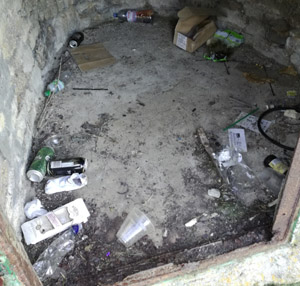 We were sent a set of photographs by a public spirited citizen who was taking the Skyline Walk and was appalled by the sight of the litter in Sham Castle; so much so that he went back the next day with a rubbish sack and a camera and took before and after photographs, of the litter present and then absent after he had picked it up. His message was that historic places like Sham Castle should be treated with more respect by the people who had left their rubbish.
- We agree with that view, but we also think that this unsung hero should have some proper recognition for his initiative so we have awarded him a bouquet page.
- On a more serious note, apart from the litter issue we have serious concerns that an area with a live electrical installation was left open to the general public. This looks like a Health And Safety hazard. There is a door just visible in the third row of photographs on the bouquet page, but the frame it would close against looks very badly corroded. If it no longer allows the door to be secured in the closed position, then repairs are needed urgently.
- Mopeds versus Maintenance - Last updated 7 October 2018.
- The Chronicle was silent about the irrational behaviour of the Development Management Committee (see below) but it did feature another council initiative, the purchase of some electric mopeds. The Chronicle article was largely a quote from the council's own website announcement. The council calls the intended users Civil Enforcement Officers, but the Chronicle prefers to call them Ambassadors, and the average man in the street still calls them Traffic Wardens.
- Leaving aside the obvious question of why use mopeds which require all Civil Enforcement Officers to hold a driving licence when electric bicycles are similarly pollution free and do not require a licence, we have to wonder about the financial implications, because the council is quoting a discounted price of £2500 per electric moped and a quick look around the electric models advertised for sale shows a wide range of brand new mopeds costing less than that at full list price.
- We therefore wonder what the economic benefit is. By definition, a moped is limited to 50cc and 30mph, and typically they achieve over 100mpg and don't clock up a high mileage so they have a relatively long life. While accepting that they do create some pollution from the exhaust pipe, the amount per mile is insignificant compared with any other motorised vehicle on the road, and the trade-in value of the used mopeds is relatively low. We concluded that this wasn't a decision made for financial reasons, but a "green credentials" vanity policy. If the £7500 is readily available, it could be better spent dealing with the destructive weeds growing from the stonework of some council owned listed buildings.
- Development Management Committee - Last updated 30 September 2018.
- The meeting of 26 September 2018 was a clear indication that over half of the Committee members either hadn't read the papers or had no idea of the planning guidance and underlying legislation. Yet the Government expectation of planning committees is that they understand the planning policies and legislative obligations against which planning applications are to be evaluated. The DMC made decisions which fell far short of these expectations. It is not the first time either: the council declined the offer to revoke the planning permission for demolitions at Foxhill despite Curo agreeing not to pursue that plan, and thus had the decision quashed by the High Court on the ground that the decision was contrary to the Equalities Act; and then had the planning permission for Cedar Park Care Centre quashed by the High Court because the decision to permit was irrational. For a council short of money, this has totalled a very large sum squandered in legal costs.
- Belvoir Castle. It is disappointing therefore to see that by a narrow majority the applications for the Belvoir Castle were approved. The discussion focussed on the need to keep the pub, almost to the exclusion of any other policy concerns. However, the marketing data for the Belvoir Castle shows trading figures which demonstrate that the pub is operating profitably in its current configuration and thus the argument that the pub needs planning permission to survive is completely irrational. Nevertheless, over half of the voting members of the Committee appeared to be persuaded by that false claim.
- Thus, the Committee did not accept the case officer's recommendation to refuse. This means that the fact that by the applicant's own documentation the development cannot comply with Policy H7 or the Equalities Act (or the building regulations based on it) was considered irrelevant. The fact that the bin stores cannot get the bins to the street because each store has to first navigate a flight of stairs was ignored. The fact that the residential floor level is over a metre and a half above the ground level of the only exit to the street and therefore in the event of a flash flood (as occurred in 1968) nobody outside could get in and nobody inside could get out was not considered important. The fact that the ecological survey examined only the skittle alley and did not cover the other areas of the pub subject to building work, and only covered the summer despite bats having different winter and summer habitats and thus fails to comply with Statutory Instrument 490/2010 (The Conservation of Habitats and Species Regulations) and therefore make the granting of permission without a compliant survey unlawful. The Committee Brief identified that Policies CP6, HE1, D6, D7, ST7 are not met, but none of these were considered important enough to be discussed. Attention was drawn to the July 2018 re-issue of the National Planning Policy Framework which encouraged decision makers to give more weight to the views of those most affected by the proposed development, but this requirement went unheeded.
- The fact that permitting the Listed Building Application despite clear evidence that it fails to conform to the expectations of Sections 16, 66 and 72 of the Planning (Listed Buildings and Conservation Areas) Act makes the decision unlawful, because although the Committee was free to discuss whether the Planning Application considered under the Town and Country Planning Act would result in the survival of the pub, the Planning (Listed Buildings and Conservation Areas) Act is only concerned with the fabric of the listed assets, and the total demolition of an entire section of the listed building structure (the skittle alley) is a "substantial harm" not a "less than substantial harm" as was assumed. Therefore the Listed Building Application could not have been approved, and certainly couldn't have been approved based on the argument that it might save the pub (which didn't need saving). It is a moot point how the loss of a currently attractive outdoor space laid to grass by building the proposed accommodation on top of it can ever improve the pub's trade from which its profits are derived. It is also worth noting that the planning applications have already scared off one skittles team who played there in 2017 and won't play there in 2018.
- This leaves three relatively cheap ways out of this irrational decision:
• Section 23 of the Planning (Listed Buildings and Conservation Areas) Act allows a Local Planning Authority to revoke a decision.
• Historic England can use its automatic right to refer the decision to the Secretary of State with a view to having the DMC decision revoked on the grounds of substantial harm to a listed asset. Their advice that the views of conservation advisers should be sought resulted in the Senior Conservation Officer providing a detailed outright veto of the plans, a veto which the planning committee did not heed.
• The Environment Agency can use its automatic right to refer the decision to the Secretary of State with a view to having the DMC decision revoked on the grounds of an unacceptable evaluation of the Exception Test. The fact that the elevated platform on which the Western Riverside is being built acts as a dam for water run-off affecting the application site is also relevant because it invalidates the flooding model currently in use. - Then there is the expensive route of a Judicial Review. It is understood that the local residents are already actively exploring that option, and will be instructing a solicitor with planning expertise in the next few days.
- Jews Lane. The Town and Country Planning Act makes it clear that making false statements in a planning application are a criminal offence. When the local Ward Councillor who lives very near the development site asked for a site visit because the transport statement looked inaccurate, the DMC refused to defer for a site visit. If it is subsequently shown that the transport statement was inaccurate, that decision not to defer could be interpreted in any claim against the council as proof of the council condoning an illegal act.
- We also notice that the transport statement maintains the fiction that a rule in a tenancy agreement is enforceable and the Committee brief included a draft Condition requiring compliance with it. We have examined and debunked the assumption that it is enforceable in our item "Student Cars - Last updated 15 July 2018" below.
- 20mph Zones - Last updated 16 September 2018.
- When Bath's 20mph zones were being proposed in 2014 and were open to public consultation, we pointed out: "the council has a policy to de-clutter the streets. Yet 20mph speed limits require not only signs at all entry and exit points but also repeater signs at many locations between, thus adding clutter. How can the council embark on a course of action which completely opposes existing council policy, without re-visiting that policy? Additional clutter and World Heritage are not ideal companions." Although we didn't say so at the time (it was outside our remit) there were Government and other credible statistics available then which indicated that introducing 20mph zones would probably increase the incidence of serious injury and fatality accidents. The council at the time went ahead regardless.
- This week, the failure of 20mph zones to improve road safety has been exposed to the national press by responses to Freedom of Information Requests (see typical articles in The Telegraph, The Sun and by a motoring pressure group). B&NES is one of several councils to admit that the rate of people killed or seriously injured went up in more than half of the new zones, but say that it would be too expensive to remove the 20mph signage. Perhaps so, but a request to the police not to set speed traps on roads which the council now recognises as wrongly limited to 20mph might allow drivers to watch the road ahead more than their speedometer and improve the accident rates at very little cost.
- HMOs - Last updated 9 September 2018.
- On the council website is an announcement on the changes to the national regulations for HMO licensing, and the council's thoughts on how it might be further extended in Bath City.
- There appears to be an overlap with other permitted uses when the proposal "to extend the scope of licensing to cover HMOs which house three or four people in two or more separate households in Bath City" would also encompass the situation where a couple let a spare room to a lodger, or even two rooms to two lodgers (the maximum permitted by the tax regulations). We hope that when the plans are published as a policy, that a suitable exclusion clause is added so that owner occupiers who take in lodgers are not classed as residents of an HMO. This is important, because those properties which became HMOs before the HMO Use Class C4 was introduced did not have to retrospectively apply for a different Use Class, so there is no easy way to identify which properties are older HMOs to be caught within the scope of the council's extension of the revised regulations, and which properties are owner occupied dwellings with lodgers, which ought to fall outside the scope.
- Belvoir Castle - Last updated 19 August 2018.
- After our objection to the proposed development of the Belvoir Castle, which would replace the Grade II listed skittle alley with 10 apartments, we have had some supplementary information provided to us. The first reported that because the Western Riverside is being built on an elevated platform, the lowest point of the road beside the skittle alley is just a few metres north of the end of the current skittle alley, and every direction from there is uphill. There are just two standard sized kerbside drains to take any rainwater away. Thus in the event of torrential rain similar to that downpour producing the flood in 1968, water that overwhelms the two drains will quickly rise to the road level outside the only exit from the proposed development. This confirms our expectation of floodwater preventing those inside the development being able to leave when such a flooding event recurs. We also notice that one of the other objections confirms that the skittle alley did flood, confirming our assertion.
- Archway Project - Last updated 12 August 2018.
- We have had a progress report from the Archway Project, informing us that they are preparing a new set of videos on archaeological excavations. They are not available yet, but later they will provide updates on the Roman Baths social media channels and their website. We are publishing the website link here for those who want to keep an eye on it themselves.
- National Planning Policy Framework - Last updated 5 August 2018.
- An updated version of the NPPF was issued on 24 July 2018, and with it came a reminder of the associated Planning Practice Guidance, and an overview of the main updated content. Taking this last item first, the advice is "The new rules will also make it easier for councils to challenge poor quality and unattractive development and give communities a greater voice about how developments should look and feel." This indicates that greater weight should be given to local comments on developments that directly affect them, and if the council does that then the NPPF will support that approach. Of those where Watchdog has taken a particular interest, the most obvious candidates for heeding local concerns are The Rising Sun in Lymore Avenue where the residents opposite the proposed development are very concerned about its impact on them; and the development replacing the skittle alley in the garden of the Belvoir Castle with dwellings which will have a serious impact on the amenity of Park View residents. For proposals which are not in line with what local communities want, the framework "ensures councils have the confidence and tools to refuse permission for developments that do not prioritise design quality and do not complement its surroundings".
- In the revised NPPF we discover "Existing open space, sports and recreational buildings and land, including playing fields, should not be built on unless ... an assessment has been undertaken which has clearly shown the open space, buildings or land to be surplus to requirements" and in the Planning Practice Guidance we read "The World Heritage Committee Operational Guidelines ask governments to inform it at an early stage of proposals that may affect the Outstanding Universal Value of the Site and before making any decisions that would be difficult to reverse, so that the Committee may assist in seeking appropriate solutions to ensure that the Outstanding Universal Value is fully preserved. Therefore, it would be very helpful if planning authorities could consult Historic England (for cultural Sites) or Natural England (for natural Sites) and Department for Digital, Culture, Media and Sport at an early stage and preferably pre-application." These constraints should have been heeded, but there is no indication that they were.
- Bath Rugby persists in presenting its plans for building on open space which is not just any open space but an open space that was deemed to be charitable open land by the High Court (Bath and North East Somerset Council v HM Attorney General [2002]) which recognised not only the charitable status but also the applicability of the covenants in the 1922 Conveyance and also the later 1956 Covenant that recognised the Lease dated the 17th day of October 1933 so long as the Bath Football Club shall remain their lessees under the said Lease, and included the condition "The Corporation will not use the Recreation Ground otherwise than as an open space." The Charity Commission notes "The Rec was registered as a charity in November 2002. BANES is the trustee of the Charity and delegates authority to manage the Charity to a Trust Board." Although changes in Trustees have taken place since, with the conclusion of the First Tier Tribunal in 2016 about who the Charity Commission should recognise as the official Trustees, it does not supersede the High Court ruling that the council is the owner of the charitable land and is bound by the covenants associated with that land, and carries the ultimate responsibility for what the Trustees do in the name of the council. If the Trustees grant Bath Rugby a larger footprint, the council ought to refuse it according to the NPPF definition of "existing open space" or else the council can be sued for not upholding the 1956 Covenant.
- In addition, the World Heritage Committee Operational Guidelines require the Government (represented by DCMS) to be alerted at an early stage of decisions that would be difficult to reverse, and there is no indication that in the case of the Rec the council or DCMS is complying with that obligation. We have been tipped off that some local residents have short-circuited this inaction by going straight to UNESCO's UK agent, ICOMOS UK with details of the latest Bath Rugby scheme.
- Rugby Stadium - Last updated 22 July 2018.
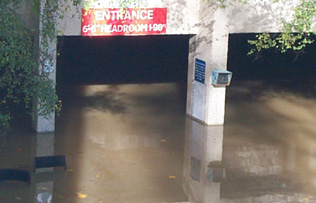 It is interesting to note that the on-line Chronicle has featured two articles on the proposed new rugby stadium, one in favour and one against, both written by the same person, thus positioning the media right on the fence between them.
- There is also a third article on the idea of raising the pitch and having car parking beneath "similar to parking under the leisure centre". The Leisure centre floods (see picture), as the Rec does (it is described as Zone 3b, Active Floodplain), and a silt floor left after such an occurrence will take a lot of cleaning up. Then there is the proposal to remove the Radial Gate "because Bath hasn't flooded since it was put in" (a concept which makes as much sense as Highways choosing to remove a set of traffic lights because there haven't been any accidents there since they were put in) and there will be more flood events if the radial gate is removed. We have seen the document by a former Bristol Avon Local Flood Defence Committee member which was ignored during the council's Strategic Flood Risk considerations, and that explains exactly why the radial gate has reduced the flood risk, We also note that under the Water Resources Act 1991, it is the National Rivers Authority that has the final decision on whether the Radial Gate can be removed, not the council. The same Act also leaves the final decision on the proposed new bridge in the remit of the NRA.
- The problem with raising the pitch is that there has to be a supporting structure constructed beneath it, and that supporting structure will occupy space that would otherwise have been occupied by flood water. So raising the pitch automatically reduces the water storage capacity on the Rec and increases the risk of flooding elsewhere. Furthermore, an underground surface strong enough to support parked cars is unlikely to have the soak-away characteristics of the land which currently forms the Rec. The NPPF requires "safeguarding land from development that is required for current and future flood management. We would expect the Environment Agency to veto any idea of developments on an active flood plain which increase to potential flood risk elsewhere.
- One of the public comments on the proposal to raise the pitch asks why, if it can be done on the Rec, it couldn't be done on the Lambridge pitch instead, thus flood proofing the playing surface and creating the east of Bath Park and Ride beneath it. It is a very good question.
- Planning Oddities - Last updated 22 July 2018.
- Three weeks ago there was a planning application for advertising to be mounted on 1-3 James Street West. The previous (refused permission) application for this site was accompanied by the necessary Listed Building planning application, and they both appeared on the list of new applications at the same time. This latest advertising application arrived without an associated Listed Building planning application despite it being necessary, and after waiting three weeks there is still no sign of it. We trust that the Case Officer will not determine the advertising application until the Listed Building one has been submitted and the public have had an opportunity to comment on it.
- This week's new applications list includes one for 43 Upper Oldfield Park, applying to build "5 residential units for student or healthcare worker accommodation" in the garden of the main house. There are two major anomalies here: the first is that because the application to sign off the Condition requiring the landscaping to be delivered before the main house is occupied was withdrawn, there is an Enforcement Notice on the main house requiring the landscaping approved with the approval of the main house to be delivered, and it can't be and also have the 5 residential units built on part of the site for landscaping so the minimum required is an approved planning application to amend the landscaping drawing ahead of this latest application being determined; The second is that student accommodation can be applied for without a parking provision, but healthcare workers may be required to work shifts and travel to or from work outside the hours when public transport is available so they will require a parking provision, and thus the two potential uses are mutually exclusive.
- Student Cars - Last updated 15 July 2018.
- There is an interesting article in the printed Chronicle this week, though it wasn't on-line then and it is now. In essence it warns students about a ban on bringing cars to the city, and expects a termination clause in tenancy agreements to be sufficient to enforce it. It will be interesting to see how that works in practice.
- Some students will bring a car. For many of them, it is a far cheaper home to university journey than by public transport, and it allows them to carry rather more than is possible in a suitcase on wheels. For some of them who take employment during term times to offset some of their tuition fees, it allows them to get back to their Bath accommodation after working later than the buses in Bath do serving the area where they live. However, there are more students than available HMO rooms so some of them will inevitably be renting Purpose Built Student Accommodation, and almost all of these have a clause forbidding the use of a car.
- This leads to an interesting scenario. There isn't much the PBSA business can do other than go to court if they terminate a tenancy and the student refuses to leave and becomes a squatter. There are some mandatory conditions where a court will automatically grant a Possession Order, such as a rented house being sold with vacant possession and the tenant after being served notice doesn't cooperate with the hand-over date. But terminating a lease just to leave a room vacant or available for somebody else is an application for a Discretionary Possession Order, and the judge decides whether or not to grant it.
- One consideration is that virtually all the PBSAs threaten to make a student homeless if they bring a car, so there is a serious shortage of car friendly lets, and if a student is forced to use a PBSA because that is the only vacant option to homelessness, is he or she signing the agreement under duress? If so, does it make the "no car" condition an unfair contract term, and therefore unenforceable? If one judge decides it is an unfair contract term, then the others are likely to adopt the same position thereafter.
- The other consideration is that if the use of a car allows the student to take up the offer of evening employment, would a judge consider issuing a Discretionary Possession Order, making the student both homeless and unemployed (because employee records normally need a residential address)? We suspect that few judges would think it a valid outcome for somebody parking a roadworthy vehicle in a legal parking space.
- Finally, there are a number of PBSAs providing cluster flats, where several students share a group of rooms. A Discretionary Possession Order is for a unit of accommodation not a person, so would a judge put several students out of their accommodation just because one of them has a car? We suspect not.
- The council places the onus on PBSA management for enforcing their "car free" policy that they insist goes into each S106 Agreement (because there are minutes of a council meeting stating that position). That PBSA management has to pay a court fee for applying for each Discretionary Possession Order, whether it is granted or not. Are they more likely to risk their money gambling on a judge granting the Order, or turn a blind eye to the car condition being ignored? The row of student cars parked along the Lower Bristol Road suggests the latter. If the council tries to enforce the S106 clause and the PBSA management responds by applying to the court for a Discretionary Possession Order and the judge doesn't think it is justified, what can the council do then?
- Also, Residents Parking Zones don't fix the problem, because there are specific hours of Residents Parking enforcement and outside of those hours it is unrestricted parking. So how many student cars are parked overnight in Residents Parking areas and moved in the morning to a Park and Ride which is free parking if the student doesn't pay to ride into Bath? A student with a car won't normally use the car to go to university because of the restricted parking on campus, and will normally have a bus season ticket which is valid for all buses apart from the Park and Ride services, so any Park and Ride site is usable provided any bus other than a Park and Ride service is used from there; and Bath Spa University buses go right past the Newbridge Park and Ride.
- Termination clauses sound like a powerful weapon until the improbability of them being effective is examined.
- North Parade - Last updated 1 July 2018.
- Among the decisions made last week was one giving permission for Abbey Hotel in the bit of North Parade by "Bog Island" to add a mobile bar to the 12 tables and 48 chairs in front of the hotel. It was disappointing to read that the rather crude looking mobile bar was considered to not harm the setting of a Grade II* listed building, despite it being positioned right in front of the entrance and Historic England expressing their concern about the extent of street furniture and clutter in the area and recommending published advice which should be read before determining the application.
- It is also sad to see that despite The Bath Society having taken the Government to both the High Court and the Court of Appeal to establish the legal principle that protecting listed buildings and conservation areas should be the primary consideration when evaluating planning applications affecting them, the relevant sections of the Act are just quoted with no apparent thought given to their significance.
- The other shortfall is in the council's policy of encouraging street furniture in almost any location where it is requested. Residents of Bath are therefore discovering more and more parts of the public highway which are no longer available for pedestrians to use. Perhaps the time has come where use of the public highway by businesses must be rented not given away, and the additional trading area should be part of the Business Rates calculation, so that the public have some form of return for their inconvenience.
- Foxhill Outline Planning Decision - Last updated 24 June 2018.
- Hot on the heels of the High Court Judgment that the planning permission for Cedar Care Home should be quashed (see below) comes this week's Chronicle report that the outline planning decision to permit demolitions on the Foxhill Estate granted to Curo in July 2017 should similarly be quashed.
- The Foxhill planning decision was even more finally balanced than the Cedar Homes one, because the Committee vote was tied, and planning permission was granted by the Chair's casting vote.
- Watchdog has observed the planning process for over ten years. The casting vote system has been in existence for the whole of that time, and whilst the rules say that the Chair's casting vote can be used as the councillor sees fit, by convention prior to this current Committee the casting vote has always been used to vote against an application. We have even attended a meeting where there was a tied vote with the Chair's normal vote being for an application, where his casting vote was against it. This was explained at the time by the simple logic that if the vote was tied there are equal arguments for and against, and if the casting vote were to be for the application then only a court case can undo it, whereas if the application is refused then the applicant can re-submit the application having taken into account the comments of the Committee and such a replacement application can be determined on its merits.
- The current Chair doesn't follow that convention, arguing that the rules do not indicate any presumption on which way the casting vote should be cast; this isn't the only application where the casting vote was for rather than against. However it is the most expensive occasion because it left the council spending a significant sum of money (council tax money that could have been spent on something more advantageous) trying unsuccessfully to defend that one vote which normal convention would not have made in the way it was.
- It is also worth noting that two out of two High Court challenges of DMC decisions have seen the council lose, which indicates that extant legislation and planning policies carry more weight than personal preferences or prejudices in the courts when assessing the validity of council decisions. Those who believe in the future that the council has made a wrong decision will be emboldened by that.
- Royal View - Last updated 17 June 2018.
- Among the decisions made this week was permission for the signage for the café to be installed in the ground floor of "Royal View". We noticed from the Case Officer's report that nobody commented on this application, either for or against. We are not surprised by that. The building was given permission despite the constraints in the Western Riverside SPD that should have led to its refusal. We did try to tell the architects that when we were consulted about the plans, but they wouldn't listen, and apparently those who later voted to permit didn't take any notice of the SPD either.
- Since construction was completed, the comments overheard on Victoria Bridge vary from puzzlement about how the building got permission, to outright horror that it is totally alien to the character of Bath. We have heard many nicknames too, and perhaps "Wedding Cake" is the most complimentary of some rather critical descriptions. Watchdog came to the conclusion that nothing anybody could do to the building (apart from demolition) would make it less (or more) of an eyesore than it currently is, and didn't bother to comment. We wish the successful applicants well in their enterprise, but their café isn't ideally placed for casual passing trade.
- Cedar Care Home - Last updated 10 June 2018.
- We noticed an article in the Chronicle that "the planning permission" (it is not stated whether it is 17/01542/FUL or 17/01543/LBA or both) granted for an extension to Cedar Care Home had been challenged in the High Court, and the High Court had quashed the permission. Quashing a permission is not the same as refusal, it merely resets the situation to what it was before the decision was made. Thus the DMC has to re-list the applications on a future agenda and reach a decision once again. They will be guided in that process by the full text of the High Court Judgment. They might also ponder over why the applications had been the subject of "third party requests" (note the plural) to DCLG for the Secretary of State to call in both applications. This was doomed to failure, because the SofS never calls in anything unless it gets headlines in the national daily press and makes him look bad, but perhaps the High Court Judgment might make his gatekeeper ponder on whether sending out his standard refusal letter without mentioning the fact to the SofS is always a good idea, particularly when there are multiple requests on one subject.
- We looked back on the minutes of the relevant meeting and they make it obvious that no heed had been paid to the Case Officer's report. Earlier applications (15/04344/FUL and 15/04345/LBA) were refused on the grounds of over-development of the site and wrong materials for a listed building. One of the DMC members then submitted a written comment against the replacement applications that claimed (amongst other things) that "the application addresses the points raised in the first refusal". How an even bigger addition to the host building using the same rejected materials addresses the overdevelopment of the site is not explained, but the fact that a DMC member can be so blind to the information in front of him does suggest that rather than the "training" suggested by "a B&NES council spokeswoman", he should be replaced by somebody else, one who can read and understand planning applications (or even the meeting brief which stated that "the differences between the previously refused and current scheme are very marginal and do not improve the overall quality of the design, scale or use of materials").
- The incompatibility in the planning application between the Placemaking Plan requiring more outdoor amenity space when more beds are provided, and the development which removed some of the existing outdoor amenity space in order to construct the extensions which would house additional beds, was noted by the Case Officer but not by anybody minuted in the DMC meeting. It was also notable that no differences between the consideration of the two applications had been discussed, yet the FUL application had to be assessed against the guidance in the Town and Country Planning Act and the LBA application against the Planning (Listed Buildings and Conservation Areas) Act. The Case Officer's report identified the significant differences, yet nobody is minuted as taking any heed of the listed building observations.
- We trust that before the applications are re-considered, the training proposed by the council will have taken place, and the suitability of the current membership will have been reviewed. The six DMC members who voted to permit despite the adopted planning policies indicating refusal, and the eight who voted to damage the listed building despite the guidance in the Act which is supposed to protect it, have wasted a substantial amount of council taxpayers money.
- Footnote: While looking at the DMC meeting minutes from September 2017, we noticed that the next item on the agenda also had a Case Officer's well-argued reason for refusal based on planning policies and a specifically relevant SPD, and again the DMC don't appear to have read the meeting brief when they overrode the recommendation to refuse. It wasn't a good meeting.
- The Allen Building - Last updated 10 June 2018.
- A week ago we reported that the Allen Building of the City of Bath College already has an extant planning permission 17/01588/FUL for conversion to offices within the existing structure, which is scarcely mentioned in the Officer's brief yet that reuse could be delivered quickly and it contributes to the target for office accommodation in the North Quays Development Plan. We also reported that the fact that reusing an existing building which already has the appropriate planning permission is far more sustainable than demolition, site clearance and new construction, was not recognised in the Case Officer's report either. In addition we noted that five of the council's specialist Departments, one statutory consultee and seven recognised and respected local organisations were firmly against granting planning permission, yet the Case Officer recommended "Delegate to permit", causing us to comment that a more striking case of keeping a pack of dogs but barking yourself is difficult to imagine.
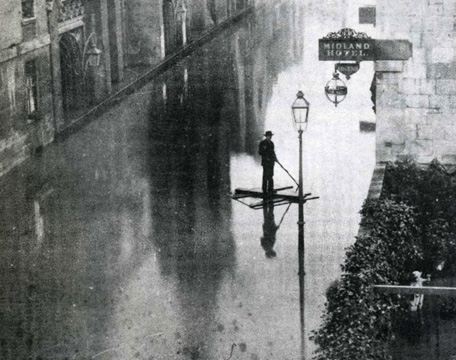 We disputed the accuracy of the flood risk assessment with this picture which shows that the area has badly flooded in the past. We also know that the builders on the Old Labour Exchange site were surprised that they found (and preserved) the slow flow of an underground river through the original basement when they built the student accommodation above it, showing that their water level is only about two metres below the pavement level. This rather invalidates the claim of "no springs or other issues in the immediately surrounding area" in the Allen Building Flood Risk Assessment. Reality is more telling than any modelling results.
- The minutes of the DMC meeting of 6 June are not available yet and we didn't attend the meeting, so we were pleased to read the Chronicle Summary which reported that the DMC overrode the Case Officer's recommendation and voted to refuse planning permission. We support that decision and consider it very safe: there are more than enough valid points in the seven objections from local organisations plus those of the council specialists to successfully fight any appeal against a refusal. It will be interesting to read the DMC minutes when available to see whether any of the Watchdog comments featured in the decision making.
- An interesting aside is the observation in the Chronicle report that the Allen Building was "previously owned by Bath College". We checked, and discovered that the extant permission for offices was granted to Bath College, yet the application to demolish it to build a hotel was submitted by Dominvs Project Company 8 Ltd. It looks as though Bath College applied for a planning permission with no intention of delivering the offices, merely to inflate the price they could ask for the site; and they sold it to a development company who had no intention of delivering the offices either. This rather reinforces our suspicion that the hotel design had been carefully arranged so that with minimal alterations it could be used as Purpose Built Student Accommodation. There are a number of competing hotels in the area which might make it difficult to attract an operator for what the DNC described as an ugly looking building, and there is a very good financial return from a PBSA.
- Argyle Street - Last updated 27 May 2018.
- It was unexpected that the false statement in the planning application 18/01417/FUL (that the building listed as Grade II when the Historic England records show that the entire terrace from Laura Place to Pulteney Bridge is Grade II*) was not noticed, despite Watchdog's objection pointing it out and planning legislation warning it is a criminal offence to mislead in a planning application. It is also significant that nowhere in the planning application does the size of the proposed "umbrellas" get stated, yet without any indication whether they are tiny or huge (and the "Location" drawing, if correctly to scale, indicates that they are each 2 metres across), planning permission was considered unnecessary; and this despite their presence being recorded in every future photograph of the Grade I Pulteney Bridge, which must be one of the most photographed views for tourists.
- It is one of the quirks of the planning system that if they had been placed in the grounds of No.17 they would have required Listed Building consent but because the public can walk past this location the impact on listed assets is not considered. A device for the benefit of a few cafe customers appears to take precedence over the memorable views of thousands of tourists. Bath deserved better.
- Milsom Street - Last updated 27 May 2018.
- It was disappointing to note that despite quoting from the objections of both Bath Heritage Watchdog and Bath Preservation Trust to 18/01022/REG03, more weight was given to the opinion of bba architects & planners who quote correctly the text of Policy CR3 and then fail to note the associated explanatory text "Enhancing Bath's central shopping area, to maintain its competitiveness, diverse offer and reputation for independent and niche retailing" and "Local Plan policies protect the centres from changes of use" and then think it through. Firstly they note that HAY was the business that vacated the shop, but make no connection with the HAY shop still trading next door. The obvious assumption is that the business wants to trade in the street but at a lower cost. Then they assume that a bowed shop-front is a disincentive to retail use, yet there are nearby bowed shop-fronts (in Old Bond Street for example) which disproves this. They still regard 39 Milsom Street (3 doors along) as a bank when it has planning permission granted 2 years earlier to operate as a restaurant, and certainly the close proximity of another restaurant will prevent No.36 from making "a positive contribution to the vitality, viability and diversity of the centre". The existence of a bus queue immediately outside the property will not enhance the view of A3 customers either.
- They also point out that there are four other properties in Milsom Street and several in Milsom Place which are similarly currently vacant and unwanted. Clearly there are other influences at work that prevent these vacant premises being let; and also inhibit similar applications to turn them all into A3 use.
- The clue is perhaps the rent of "£90,000 per annum exclusive subject to upward only rent reviews". To this figure must be added staff costs (including pension provisions), Business Rates (an unstated but unlikely to be small sum) and all other operating costs. This suggests that unless the renter has a high profit margin, there won't be enough income to service all the outgoings. The fact that Jamie Oliver's famous name wasn't sufficient to make Jamie's Italian viable in this location does lend some weight to the Watchdog view that Bath has reached its saturation level for A3 uses.
- Time will tell whether the availability of A3 use will make this property attractive without a more realistic expectation of the rent for what is just a long, thin shop. £690 per square metre per annum is a lot to find.
- Mixed Views on Universities - Last updated 20 May 2018.
- There are mixed messages in the press about the value of the University presence in Bath. On the one hand there are councillors who think the University of Bath has been the salvation of Bath despite the University paying only a peppercorn a year for rent of the site it occupies. On the other hand, other councillors are concerned at the impact of the student accommodation on the council finances.
- This last point has only recently become true. The Government Grant to councils originally included a calculation that increased the payment to offset the loss of Council Tax that could not be collected from student accommodations. This worked while the full grant was paid out, but recent years have seen the amount that was paid by the Government reduced gradually, and finally the funding basis for B&NES was changed completely. The consequence is that student HMOs and Purpose Built Student Accommodation now provide no council income at all.
- There are a couple of elephants in the room associated with the salvation of Bath view. There are two universities and a college in Bath, which account for a higher percentage of the population than even the "dreaming spires" of Oxford accommodate. In order to house this already large and always increasing proportion of the population, offices, factories and other locations that could provide employment and therefore business rates are being demolished to provide accommodation for students, which under the more recent Government policies make them financial parasites. The knock-on effect is that many dwellings that could house families and pay Council Tax are unaffordable to such families who thus have to live outside Bath, but are profitable as HMOs; and places of employment for the reducing number of permanent residents are now increasingly outside the city, adding to the volume of commuters and subtracting their spending power. Meanwhile, a number of Bath traders see a significant proportion of their customer base disappear each summer, and some of them do not survive until the students return for the Autumn Term.
- Furthermore, the Leader of the Council informs the press that the council doesn't want any more student accommodation except on campus, a preference that is included (but not currently enforced) in the Core Strategy, but he doesn't seem to have taken any steps to ensure that the Development Management Committee use that policy to refuse applications for additional PBSAs unless they are on campus. Meanwhile, those who make their profits from providing PBSAs suggest that universities couldn't afford such developments, completely overlooking the fact that if they make a profit from PBSAs then so would universities.
- With the council's newly acquired financial penalties of a large student population, it is imperative that the university-council relationship is reworked as soon as possible. Step one should be an assumption of zero growth in the university intake unless accommodation for the increase is provided on campus, sufficient for the entire duration of the university courses. That is the only way that the council's targets for places of employment and affordable residences nearby can be delivered.
- Pollution in Bath - Last updated 13 May 2018.
- The council website section covering this subject has recently been updated with additional public consultation events, and a newsletter which includes updates to the clean air zone boundary. Although not obviously connected with heritage, the pollutants created by vehicle emissions can contribute to acid rain, and Bath stone is a carbonate that is susceptible to acid. We therefore have more than a passing interest in the scheme.
- Nevertheless, there are some reservations about the criteria being used to judge what is a "higher-emission" vehicle. Whilst recognising that there has to be a starting point, the reliance on Euro standards is flawed. There are vehicles which were engineered to meet the standards for the Euro test but cannot achieve similar results under normal driving conditions; and there are vehicles which were first registered before the Euro test came into force and therefore were never tested against the standard which they would have comfortably met had they been tested. The first category will get an exemption they do not deserve, and the latter group will be penalised when they don't deserve it. The final unfair category is "Vehicles within the disabled passenger vehicle tax class" which are effectively the vehicles obtained through the Motability scheme, yet disabled passengers have a personal Blue Badge which can be displayed in any vehicle used for their transport. This discriminates between the disabled who are registered keepers of a vehicle and those who who are normally passengers rather than drivers.
- The other oddity is that the press (and the 2016 annual survey) emphasise that London Road is one of the most polluted roads in Bath yet it is almost entirely outside the Clean Air Zone. This means that deliveries to Morrisons are outside the zone, yet Sainsbury's in Green Park Station, although on the edge of the zone, cannot be accessed from any direction without entering the zone. There has to be an argument about unfair competition as a result of these arrangements.
- The council is encouraging feedback on the scheme, and have now published an e-mail address for such communications.
- World Heritage Day - Last updated 22 April 2018.
 World heritage Day 2018 was be on Sunday 22nd April in Royal Victoria Park. One of our members went along and afterwards sent us some photographs and a short report. This photo shows that the event was well attended.
- The Ermine Street Guard demonstrated weaponry and military manoeuvres which will have looked mostly familiar to those who had seen them in previous years, though the archery demonstration was new and the trebuchet had been set to a lower power to suit this year's ammunition melons which represented the rocks which would have been used in battle. There were also a number of stalls (out of shot) providing information and things to do.
- Zizzi's Appeal - Last updated 25 March 2018.
- There was an interesting observation in the document describing why the appeal against the 17/04521/AR refusal was dismissed. The applicant had indicated that the planters seen on site were what was going to be remaining on the site, not the ones in the submitted plan. The Appeal Inspector noted that those on site were more subdued than the ones refused planning permission, but nevertheless he had to deal with the submitted plans which showed what he considered were unacceptable planters.
- Others thinking of appealing planning refusals should note that an appeal is against the planning decision, not what could have been submitted instead; and that the Appeal Inspector will deal only with the drawings submitted to the planning process, regardless of any variations subsequently introduced into the appeal process.
- Loss Of Shops - Last updated 18 March 2018.
- This week's new applications contains another clutch of proposals to convert buildings into cafes and restaurants. However Bath seems to be saturated in such eating establishments, to the extent that each new business appears to be followed a relatively short time later by an existing similar business closing down. Cafe's and restaurants are now competing for a fairly static number of customers.
- Whilst that in itself doesn't give grounds for refusing the applications, there should perhaps be warnings given to applicants requesting pre-application advice that the saturation point exists and they may be opening a short-lived business.
- From the council's perspective, the gradual erosion of shops could have an impact on the number of visitors looking for cafes and restaurants, and the loss of a shop needs to be taken more seriously than it has in the past.
- Pickford's Site - Last updated 11 March 2018.
- We notice that the S106 Agreement still retains the "Motor Car Condition", which our research suggests is unenforceable. If a student does not comply with the Condition but nevertheless refuses to vacate the accommodation, the only way of forcing the student to leave is by a County Court Judgment. Our enquiries to the Clerk of Court revealed that such an application would be classed as a Discretionary Possession Order, and although the decision on whether or not to issue an Eviction Notice is at the discretion of the judge hearing the case, it was considered very unlikely that a student who is up to date with the rent due and has not committed a parking offence with the choice of parking space would be viewed by a judge to have committed an offence heinous enough to be made homeless.
- University of Bath - Last updated 18 February 2018.
- Following the article in the Chronicle informing that Councillors are questioning the peppercorn rent that the University pays for the land it occupies and the subsequent discussion on how Wessex House could be built for student occupancy but then reused as offices without planning permission (application 99/00365/FUL for Change of use of levels 6-9 Wessex House from residential accommodation to offices was withdrawn and was never resubmitted), the University of Bath applied for a Certificate of Lawful Use (17/06221/CLEU).
- We examined the relevant legislation and the documentation submitted, and discovered that whilst the University is a charity and is totally exempt from council tax for student accommodation, it is required to pay 20% of the assessed Business Rates for office accommodation. The Financial Statements for 2009-2010 and 2011-2012 showed no such Business Rates payments. Therefore we argued that the application as submitted did not prove the business use of the former student accommodation for 10 years.
- The case officer took a different view, concluding that as the Financial Statement 1999-2000 reported the conversion as completed in 2000 then there was more than 10 years of evidence and the current use was lawful. Clearly, failing to pay the Treasury its dues is not significant in planning decisions.
- Our real concern though is the statements in the Delegated Report "planning permission was not and is not required for changes of use of University buildings" and "changes to the use of buildings located within a university campus are not considered to require planning permission given that universities are considered to constitute a single planning unit". This is in direct conflict with the Core Strategy "the strategy seeks, in accordance with saved Local Plan Policy GDS.1/11, the development of about 2,000 study bedrooms and 45,000 sq.m of academic space at the Claverton Campus" and the Placemaking Plan "Development on campus should contribute to the full spectrum of the University's needs, including academic space, all the accommodation space that is needed for the growth in the intake of first years from 2011 and a major share of the accommodation space that is needed for their subsequent years of study".
- If the University has Permitted Development Rights to change the use of any building on campus, then the Core Strategy and the Placemaking Plan are undeliverable because any student accommodation could be altered into offices and classrooms once built. Either the Case Officer is wrong or the Full Council which endorsed the policies are wrong. This cannot be allowed to fester, and a meeting of the Full Council needs to discuss and agree and then publicise which viewpoint is to take precedence.
- Bath North Quays - Last updated 11 February 2018.
- The letter in the Chronicle commenting on the lack of affordable housing in the North Quays development raises an interesting point: How can the council have a target of 30% affordable housing and then sit back and do nothing when it is claimed that it would cost too much to provide them. The obvious conclusion is that either the preferred developer is not able to meet the constraint that is council policy, or that the design put forward is wrong. Any outline planning application that does not accommodate the 30% target should be refused outright. Another developer or another design is required.
- Any sign that the council has a policy it can't be bothered to enforce will lead to a series of other developments requiring affordable housing going to appeal using the argument of victimisation. Bath deserves much better than that.
- Marks and Spencer - Last updated 4 February 2018.
- As an aside to the permission now granted to the M&S planning application, we notice that Metro Bank is so similar to Metrobank that a breach of trademark dispute is likely to follow.
- Norland College - Last updated 14 January 2018.
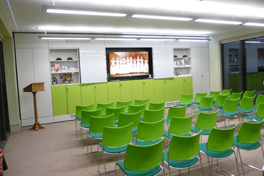 Although the conversion work is not quite complete, the Oldfield Park building which was the former 6th Form House associated with Hayesfield School is now Norland College, and the Principal invited local residents to an open evening to hear a potted summary of the 125 years Norlands had been in existence, apologies for the time it took to get the building work done, and the plans for the future now that this building supplements the York Place building which will remain in use. As we have members living in the area who went along, we had first hand assurances that unlike the other universities, the College will run its Degree course with no plans to increase its intake of students, which will stay at its current level.
- After the introductory speech, those attending were free to explore the building and talk to the staff. Those who used the building when it was part of Hayesfield School noted that the internal structure was virtually unchanged (though nicely redecorated and furnished, see picture), and the new extensions connected seamlessly to the original building.
- Student HMOs - Last updated 10 December 2017.
- As a secondary investigation, we did examine the Government's calculation for rectifying the loss of council tax from student HMOs. It is wrapped up in the Government Grant calculation identifying the loss of Council Tax income based on the number of student households as notified by the council, assessed at Band D rates. These notional losses are added back into the Government Grant calculation which deducts the potential Council Tax income on the assumption that all properties are occupied and paying their due. While the Government was paying the full residue of the entire sum needed by Local Government, this was a fairish calculation provided the council's figures are supplied accurately (only fairish because student HMOs might be larger properties than Band D). Recently, the Government has been arbitrarily reducing the Government Grant by a percentage of what was calculated as actually needed, and every such reduction leaves B&NES failing to get sufficient credit for student-occupied properties where they cannot collect Council Tax. This is in addition to the stresses on funding services; stresses which would have applied had there been no students in Bath. Yet there are a lot of students in Bath, and each student-occupied property not paying Council Tax is now a contributory cause of the reduced services caused by the reduced budget.
- Bath Libraries - Last updated 26 November 2017.
- The Chronicle article has some interesting conflicting views. The mobile library was saved only because of the combined opposition by Labour and Liberal Democrat councillors which forced the Cabinet to preserve the mobile library service, yet the council leader claims the council have listened to the people rather than being forced to listen to the other councillors. The people won't get asked about the principle of shedding the branch libraries until after the decision was made not to fund them: the council website already describes them as "community libraries". This is another "consultation" over a decision that has already been made. The forecast savings of £200,000 are of a minor scale best described as rounding errors in the types of sums in the council's spreadsheet, and they will take nearly 18 months to show because they are offset by a £275,000 bribe to make the decision look even vaguely acceptable.
- One thing that appears to have been overlooked is that the branch libraries are mostly wheelchair friendly in that the books and staff are at street level. Forcing such users to get to a main library and then navigate to an upper floor is certainly not within the spirit of the Equalities Act, and a judge might decide it is not within the letter of the Act either. If the Save Bath Libraries campaigners carry out their threat to seek a judicial review, the council's legal costs will eat up all the claimed savings and more. This doesn't look like something that has been thought through.
- Pickfords Site - Last updated 19 November 2017.
- We mentioned on 5 November that the Committee overruled the Case Officer on the original application with very detailed objections (about the height, bulk, massing and external appearance failing to comply with the then draft of the Placemaking Plan; and that the loss of the industrial business would have an unacceptable impact on the local economy, again failing to comply with the then draft of the Placemaking Plan). We said that these are reasons which must still apply because the alterations between the original refused application and the current one are minor and inconsequential, and the adopted Placemaking Plan is very similar to the draft.
- The excuses mentioned in the Chronicle for not repeating the refusal were tenuous, and came nowhere near overcoming the loss of industrial business nor the height and bulk, and the alterations to the appearance were minimal, and yet the objection that it failed to comply with Placemaking policies was never reviewed in detail. We also notice that a late objection from a site neighbour was omitted from the Update Report despite it being received three days before the update was written. This was a Development Management Committee which appeared to be trying to avoid the cost of an Appeal hearing, and hoped to do so by approving something that really didn't deserve to be approved in the form presented.
- Wansdyke Business Centre - Last updated 12 November 2017.
- One of our members who lives near this location informed us that the two appeals against the council's refusal of permission to replace the Wansdyke Business Centre with a mixed use site (16/02749/FUL and 17/00955/FUL) were dismissed. Armed with that news we found a Chronicle article reporting it.
- The dismissal for the earlier application was more substantial than that for the second application. The Appeal Inspector noted that the planning policies that formed the basis of the council decisions had now been superseded by the more recent Placemaking Plan and the appeals were evaluated against the most recent policies. The developments were favoured by some of the new policies and opposed by others, which left the Appeal Inspector reaching a balance between conflicting policies. That balance came ultimately to the conclusion that the reasons for approving the appeals were outweighed by the reasons for dismissing them.
- It was disappointing to see that although the Appeal Inspector noted the local residents' concerns about the inability to enforce the S106 constraint that students occupying the proposed accommodation could not bring a car, and the expected resultant demands on the already limited parking in the area, he still believed that the S106 constraint had weight and was enforceable and as such it formed part of the appeal evaluation. None of the permanent residents believe it.
- Bath Cricket Club - Last updated 22 October 2017.
- It was no surprise to read in the Chronicle that the developer wishing to build student flats on the Cricket Club car park claims that student flats are "the only viable alternative". It is part of the role of developers to try make planners doubt their grasp of regulations in order to influence planning decisions in their favour. It does not make the claim true, and our research confirmed that it isn't true.
- We looked at the Environment Agency's website and their advice is very clear that student accommodation (along with dwelling houses, drinking establishments, nightclubs and hotels) is not permitted on flood zone 3 land without complete compliance with the NPPF advice on such applications. The fact that there are wardens to look after the students makes no difference, as the Environment Agency has already carefully spelled out to another developer attempting similar accommodation elsewhere in Bath. It is clear though that the claim that there are no other viable alternatives is false. The Environment Agency website also conveniently listed what would be permitted: "Buildings used for shops; financial, professional and other services; restaurants, cafes and hot food takeaways; offices; general industry, storage and distribution; non-residential institutions not included in the 'More Vulnerable' class; and assembly and leisure such as amenity open space, nature conservation and biodiversity, outdoor sports and recreation and essential facilities such as changing rooms". Thus the gym and cricket school might still be possible if the student accommodation element is withdrawn.
- We also note that in the event of a flood (which might last several days) all 142 students could be accommodated by the University of Bath, which suggests that sufficient spare accommodation is already available elsewhere and perhaps this development is not as essential as the developer claims; and profitability for the Cricket Club is not part of the NPPF description of the Exception Test.
- Obituary - Last updated 8 October 2017.
 We were saddened to read the obituary to Major Anthony Crombie in the Chronicle. The article hints at "landmark case law", which he referred to as ensuring that the Government recognised the need to comply with its own legislation passed by Parliament. So certain was he that he was right that he refused to accept the first verdict against him, and he won on appeal. That established "The Hammercrest Verdict" into case law, requiring planning decisions to give precedence to preserving or enhancing Conservation Areas and Listed Buildings over perceived benefits from proposed developments. This success was instrumental in him being nominated for the MBE he was subsequently awarded. (Our picture of Major Crombie with his MBE was taken from the Order of Service for his funeral).
- Tony, as we knew him, was a leading light in The Bath Society, and we met him regularly in the Bath Society Meeting Room in Green Park Station along with others from heritage backgrounds to discuss the issues each was interested in and the actions they were taking. This allowed exchanges of views and suggestions and advice, to the benefit of all.
- These meeting ceased when the Bath Society Meeting Room could no longer be used, but Tony's wise advice lives on: "Research meticulously, prepare thoroughly for what would follow, and if the matter is likely to be over an extended period then don't expose all your weapons in the early stages".
- We particularly remember Tony's generosity in allowing the Bath Society Meeting Room to be used by others. Of particular help to Watchdog was his support for our links with the Architectural School of the University of Notre Dame in Indiana, USA. Students of classical architecture were allocated projects designing areas of Bath for modern functionality in Georgian architectural styles. Their projects were presented every two years from 2009 to 2015 and covered the Western Riverside, Kingsmead, Manvers Street and Narrow Quay. Tony allowed the Bath Society Meeting Room to be used free of charge for public exhibitions of the first two of these when the output was brought to Bath. If the Bath Society had retained the use of the Meeting Room after 2012 we are sure he would have hosted the other two as well.
- Rest in peace, Tony. We were privileged to have known you.
- The Rec - Last updated 1 October 2017.
- There was an interesting letter in the Chronicle this week where the writer fears losing a famous view if Bath Rugby build a new stadium. We think he has a point. Bath is a World Heritage Site and many visitors arrive for a complete experience, not just a look at some Georgian buildings and a wander round the Roman Baths. Scenery is every bit as valuable as the bits the council promotes, and the Mayor's Guides confirm that the view the letter draws attention to is very popular with the tourists. It was also featured in the City Trail booklet which has not been actively promoted for some time.
- For years the Rec has hosted rugby matches, and the number of spectators has always been more dependent on the results on the pitch than the quality of facilities used by the spectators, so the letter writer has a sound basis for hoping that Bath Rugby could continue on the Rec as it currently does. What he doesn't emphasise is that with a season of limited duration and home and away matches played in that time, there are not many days when a match is played on the Rec. He could then have made a telling point that a stadium built and in use for a handful of days a year would ruin a popular view every single day.
- It is perhaps also worth mentioning that the High Court, in its 2002 Judgment made it clear that the council is ultimately responsible for the Recreation Ground which it holds in trust, and the observation of the Covenants which applied to it on the date that the responsibility started, and that while the Charity Commission might have established that it will deal with the Trustees, the High Court's position that the Trustees are agents of the council and thus the council bears the responsibility for the actions of the Trustees, remains unchanged.
- Former Herman Miller Building, Locksbrook Road - Last updated 24 September 2017.
- This week we noted that planning permission had been granted for Planning Application 17/02033/FUL. The Delegated Report contains an odd contradiction. The damage to the listed building caused by the rooftop addition is acknowledged: "the pavilion continues to harm the significance of this designated heritage asset by virtue of its bulk and its high profile position on the riverside elevation which is considered damaging to the clean simple roof line of the building. This harm is considered to be 'less than substantial harm' in NPPF terms but harm nonetheless." The justification for this harm was that it brings the listed building back into active use.
- The problem with this conclusion is that earlier in the report the principle of this educational use was not for discussion because "the use of the building by Bath School of Art & Design for academic purposes has commenced" so it had already been brought into use.
- Our comments at the public consultation, repeated in our comments on the planning application, made it clear that a roof top extension was a vanity project because there was ample space to put the functions it contained in an extension that did not destroy the original listed plan form. We remain unconvinced that "from a functional perspective a roof top extension is the most logical and feasible option" had really been thought through. There was no public benefit from harming the listed building with a rooftop extension in an incompatible style when options existed for providing the same facilities without such harm. Bath deserved better.
- Mineral Water Hospital - Last updated 10 September 2017.
- Last week we reported on the attempt to by the Bath Preservation Trust to have the Mineral Water Hospital declared an Asset of Community Value under the Localism Act 2011 and the outcome that it had been turned down by the council. The Chronicle reported that the BPT has urged the council to bring forward a development brief for the site as a matter of urgency. We support this initiative.
- The latest news is that the Mineral Water Hospital has been sold to Winchester-based Versant Developers & Homes, and it is important that the buyers are made aware of the constraints they will be under (it is both a Grade II* Listed Building and a Scheduled Ancient Monument) before they start to make plans for what to do with it. The council needs to prepare a development brief quickly to ward off inappropriate planning applications and potential appeal processes..
- Green Park Station - Last updated 3 September 2017.
- In our comment on the planning application for the anti-pigeon netting in the Train Shed of Green Park Station, we pointed out that the proximity of the netting to the hot flue of the Pizza Pod would be a fire hazard. The drawings were not updated after that comment was submitted, and as a result the drawings forming part of the planning permission granted, which showed the netting installed above the current location of this flue, and the interior of the Train Shed with the Pizza Pod not in place, are now legally part of the implementation. We had reported the unauthorised structure to Enforcement, so perhaps something will now be done to pursue 16/00303/UNDEV which is currently awaiting investigation.
- Right and Left Hand Mismatch - Last updated 20 August 2017.
- Amid all the local press reports on how polluted the Bath air is and the expressed desire for it to become cleaner, we have the very recent introduction of speed management tables at intervals along Lower Oldfield Park, thus ensuring that vehicles slow down for the humps and speed up between them, which is the style of driving that creates the maximum amount of exhaust pollution for any given distance. One local member queried whether the right hand knew what the left hand is doing, hence our title for this paragraph.
- Public Consultation - Last updated 20 August 2017.
- Visitors to the consultation would have seen an outline of the suggested development in the grounds of the new flats at 43 Upper Oldfield Park, some elevation sketches, and a page of explanatory notes (of the 11 residential units containing 18 beds) to take away. These would be in place of the landscape plans (rotated so that south is at the bottom) provided to the Planning Inspector dealing with the Appeal for 43 Upper Oldfield Park. These links provide to readers all the information that was made available to those who did attend.
- The stated aim of the event was to listen to the public's comments, so that the designs could be amended in the hope of creating a planning application more likely to be supported by those interested enough to comment on it. Thus the information in the links above must be regarded as a first draft rather than final intentions.
- Our quick straw poll of the local residents afterwards reveals that the development would be in a dangerous place on a busy road which already has a bad reputation for minor accidents. There is an expectation that the construction phase will be chaotic regarding the impact on traffic flow, and risky in terms of additional accidents if there is any vehicular access to the site once built.
- Dorchester Street Telephone Boxes - Last updated 6 August 2017.
- We raised an Enforcement Case because planning application 06/02656/LBA had a Condition that no work should commence (on removing the station ramp) until the eventual location of the listed telephone boxes was decided. Application 08/04795/COND positioned all 5 in a row in what is now known as Brunel Square, and this was approved on 2 November 2009. Four were initially installed in a row outside The Graze and remained there for a while, after which they have been moved several times, adorned with advertising, decorated with flowers (having removed the windows) and one has been repainted. In short, these listed telephone boxes have been mightily abused.
- Normally when an Enforcement Case is raised, one of three things happened: it could be ignored (as our initial complaint that they had been moved from The Graze was), or it gets registered but ultimately we are told that action will not be taken, or else it gets registered and pursued. On this occasion though, we got a Case Number for our second Enforcement complaint, that the boxes were being "officially" vandalised, and that resulted in a reply that a legal opinion was being sought. Later we received an update that Historic England had advised that once the boxes were removed from their original address, they were no longer listed, which is a strange reason because the address where they were first moved to continued to be the original Dorchester Street, and they were then illegally moved to where they currently are (and all we asked is for them to be put back). Historic England have said that because they are moved items, they would ask the Secretary of State to delist them. The council has asked the site manager of Southgate to keep them on site somewhere because the public has an affection for them, which is interesting because as far as we can discover they never formally ceased to be the property of BT.
- The Watchdog archives reveal that English Heritage (as they were then) were realistic in recognising that they had to be removed in order to construct Debenhams, and were content with the plan to reinstall them opposite their original position in what was eventually renamed Brunel Square. Nowhere in their comments was there any warning that moving them from one side of the road to the other would lose them their listing. So this looks like an arbitrary decision by Historic England, because the listed building legislation does not cover this situation; it does not say anything about whether or not moving a listed item from one side of the road to the other is a significant event. The corollary to this is that the full set of listing entries cover a number of items that could reasonably be moved such as historic gates, huts and other telephone boxes. So now, for consistency, Historic England has to continue its arbitrary policy and delist any of these that are removed from their original address, so gates sent away for repair will lose their listing and therefore need not be replaced. The whole policy is a new can of worms unless Historic England rapidly rethink it.
- The clue to what led Historic England to make the delisting decision is their reported verdict that "having considered the change in location as well as the lack of visual relationship with any listed buildings in their current location, Historic England have confirmed that they do not consider the kiosks to be listable in their current position". It is patently obvious from that statement that they were not shown the supporting evidence from our Enforcement case. Our enforcement case was that they were required to be moved to their new position outside the Grade II listed vaults beside the Grade II* listed Bath Spa Railway Station, and we provided the link to a drawing from 08/04795/COND showing the exact position in support of this. They were illegally moved afterwards (ie without permission from an essential Listed Building Application) and their illegal new position is not what Historic England should be commenting on; they should be considering the appropriateness of continuing the listing entry in respect of where they should legally be sited. Somebody has either deliberately misled Historic England, or else somebody has mischievously allowed Historic England to pursue a false assumption. If it is now too late to reverse the wrong decision to delist the telephone boxes, Historic England should now insist that they are placed in the position identified in 08/04795/COND and then create a new entry for them in that position.
- The other unanswered question is who decided that our simple request ("Can you put the phone boxes back please") ought to be attacked with a sledgehammer approach of seeking legal advice (and no doubt guiding the advice behind the scenes), because this is not something that Enforcement would do under their own initiative when they had the simple alternative of telling us it would not be expedient to enforce. Someone clearly has a vision for Brunel Square that doesn't include the telephone boxes and didn't want anything left to chance. The sad thing is that Historic England went along with it and introduced their own interpretation of the legislation which now puts a significant number of listed items around the country at risk of suffering unintended consequences from what would until now have been reasonable maintenance activities.
- Enforcements - Last updated 23 July 2017.
- We have recently notified Enforcement of several instances where changes have been made that should have had planning permissions beforehand but none were applied for. Enforcement have responded with case references (see our Enforcements page) that were not all in the categories we expected from the details we had provided. In the past, we have simply let Enforcement know and they have changed it. However this time we received the comment "The complaint will be investigated as reported regardless of the description" without an explanation of why Enforcement have not co-operated this time. We have therefore noted on the Enforcements page those where we believe the allocated case number has used the wrong category, so that those who want to monitor specific types of case have more accurate information.
- Bathampton Meadows Park & Ride - Last updated 16 July 2017.
- The front page headline on the latest issue of the Chronicle announced that the proposed Park and Ride on Bathampton Meadows would no longer be pursued. Watchdog is happy that common sense has finally prevailed, and that the various reports that the council has been party to that showed that a Bathampton facility would not have any measurable effect on the traffic volume entering Bath from the east nor the pollution levels along the route, have finally been given some credence.
- The Chronicle online has helpfully provided a timeline of how the current decision came about. Unfortunately, it doesn't go back far enough. In 2004 there was a study, jointly commissioned by the Government Office for the South West (who represented the Secretary of State) and B&NES Council, entitled the Bristol Bath to South Coast Study. Amongst the investigations this study covered was the question of whether Bathampton Meadows was a suitable site for a Park and Ride. It came to the firm conclusion that it was not. The report, and therefore that decision, was adopted by B&NES.
- The 2009 planning applications to expand the Lansdown, Newbridge and Odd Down Park and Rides also proposed a new Bathampton facility, and despite all the Government guidelines intended to protect Green Belts, World Heritage Sites and locations subject to flooding, planning permission for the Bathampton proposal was granted with only three members of the planning committee voting against it. That decision influenced the ensuing local elections, such that the Liberal Democrats promised not to build that Park & Ride if they took control of the council, and they were elected in sufficient numbers to honour their promise, and so the extant permission time expired. But the Conservatives regained control of the council in 2015, and putting the Bathampton Meadows back on the table won them no friends.
- So we cannot criticise the decision now made to abandon the plans, only wonder why it took so long to do so and why so much money was squandered on a scheme that twelve years earlier in a study part-funded by the council, the council had formally recognised that the site was unsuitable.
- K6 Phone Boxes - Last updated 11 June 2017.
- On 28 May we reported that we have been allocated an Enforcement Case Number for the unauthorised works to the listed K6 phone boxes that ought to be in Brunel Square and we have updated our Enforcements page accordingly. We were awaiting further developments. We were not expecting the further developments to be yet more abuse, so we have sent a photograph taken last week to Enforcement showing the council's Parks Department adding vegetation to one of the boxes. This is intended to bring to the council's attention that unauthorised works are still going on.
- HMO Consultation - Last updated 28 May 2017.
- Part of our comments on the council's consultation on HMOs looked at the Article 4 Direction and its effectiveness, This particular Direction removes Permitted Development rights to convert a residential property into an HMO, thus ensuring that every such conversion in areas that meet specific criteria has to be preceded by a planning permission. Effectively, it is a legal instrument to amend extant legislation, and as such it gives the council additional control over HMOs.
- What it doesn't do is place any legal obligation on the council to recognise the reason why the Article 4 Direction was considered necessary; to accept that some areas of Bath have reached or exceeded saturation level as far as the number of students are concerned. That is because the planning legislation is based on properties, not population. However, HMOs typically house 6-8 adults compared to 2-4 adults in a corresponding residential property and from a straw poll of residents in the Oldfield Park area it is not just the number of properties devoted to HMOs that unsettles them (by limiting the opportunities for families to move in with the social benefits of friends for resident children and car sharing for school runs) but also the impact on local traders when a significant proportion of footfalls go home at the ends of term.
- There is no excuse for ignoring the impact of student populations on the demographics of an area. It is noteworthy that in the case of the Wansdyke Business Centre (17/00955/FUL), not only are the two local councillors against it because it will make the local imbalance of population groups even worse (contrary to policy CP10), and the Parks Department considers the student units will be affected by shading (from the tree canopy in the SNCI designated green corridor) that is likely to minimise natural light levels in these units, but also the University of Bath states "The extent of student occupation in Oldfield Park is detrimental to the public image of higher education and inappropriate for a residential neighbourhood" and "The University would not seek to secure this property to accommodate its students" Effectively the University which would have been the prime user of the proposed student accommodation has recognised it would be bad PR for the University and therefore they have expressed no interest in it.
- K6 Phone Boxes - Last updated 23 April 2017.
- The red K6 Telephone Boxes that used to stand in Dorchester Street before the Southgate Shopping Centre was built, are supposed to be erected as a group of five (as described in the Listed Building description) in the environs of Bath Spa Station. We raised an Enforcement case when they were moved elsewhere, and since then one of them has been partially repainted in yellow without listed building consent. So far, we have not been allocated an Enforcement Case Number, so we have reminded Enforcement that a number is still awaited, and that we expect all the phone boxes to be returned to the station precinct and arranged in the correct sequence.
- Cleveland Pools - Last updated 16 April 2017.
- We were pleased to see that the Development Management Committee granted permission for the restoration of the country's only surviving Georgian Lido. We did note that there were concerns expressed by the nearby residents, but we have difficulty reconciling their concerns about increased road traffic with the plans put forward by the Trustees.
- The Trustees have already secured permission for a river landing stage, which should provide a route for construction materials initially, and visitors eventually. The streets around the entrance to the site are part of an established Residents Parking Zone, so very few Bath residents will attempt to arrive by car, and any that do will only do so once and discover that they need a suitable permit.
- The Trustees have undertaken to keep the local residents informed, and hopefully that process will reassure them that the concerns voiced so far are somewhat exaggerated.
- South Quays Planning Applications - Last updated 9 April 2017.
- On 5 April 2017, the Development Management Committee granted permission to 16/04819/REG13 which included the demolition of buildings curtilage listed with the Newark Works.
- We checked with the National Planning Casework Unit whether they were aware of the threat to listed buildings from this application. They replied that they had received and noted the application 16/04818/EREG03 but had no record of any notification of 16/04819/REG13. We have their e-mail stating this.
- The council is the owner of the land, is the applicant for the works covered by 16/04819/REG13, and has taken it upon itself to determine this application without reference to the Secretary of State. This is therefore an unlawful decision, having failed to comply with Section 82 of the Planning (Listed Buildings and Conservation Areas) Act 1990.
- We therefore expect "The Commission" as described in the Act (Currently Historic England) to ask the Secretary of State to call in this unlawful decision for his own determination. We also expect the Secretary of State to overturn the decision because the planning authority did not have special regard (as defined in the High Court Case Law from the "Hammercrest" appeal) to the desirability of preserving a listed building or its setting, and did not heed paragraph 132 of the NPPF which required great weight to be given to the asset's conservation, in a World Heritage Site where such assets are of the highest significance.
- We recognise that the council had already ignored EU directives on competition in designing offices specifically for BMT (which BMT confirmed by pulling out after the roofline was altered), but now that BMT have withdrawn from the scheme the council has no excuse for unlawfully ignoring the extant UK legislation to conserve listed buildings. Luckily the council can revoke their consent under Section 23 of the Planning (Listed Buildings and Conservation Areas) Act 1990, and if they do this quickly enough it would save the expense of a public inquiry.
- Former Hinton Garage - Last updated 9 April 2017.
- We reminded the Development Management Committee that the Planning Code of Conduct states: Your role is to make planning decisions openly, impartially, with sound judgement and for justifiable reasons and asked that the draft minutes should be amended to include the justifiable reasons before the draft minutes were signed off as a true record.
- We acknowledged that within the rules the Chair was entitled to vote again and to vote whichever way she thought appropriate, but pointed out that there was a long history of the casting vote being used either to refuse an application or to defer a decision for further information. That is why we were asking for a minuted explanation of why the long-established convention was considered inappropriate on this occasion. We were told that there was no legal obligation to provide such an explanation, and it would not be provided.
- It is true that there is no legal obligation. However, by deliberately withholding that explanation rather than explaining it "openly", it does leave open to speculation the reason why it was decided best to withhold it.
- Coal Wagon - Last updated 2 April 2017.
- On 1 April 2017, the coal wagon discovered in one of the sealed off vaults under the platform of Bath Spa Station was installed in the Museum of Bath At Work and unveiled amid speeches by the key players who had ensured its restoration. Watchdog was invited along, and we took photographs (some of which are on our News Summary page). The restorers had retained as much of the original material as possible, which included the engraving "GWR" which could be traced with the fingers but unfortunately wasn't clearly visible in the photographs we took.
- South Quays Bridge - Last updated 12 March 2017.
- As expected from the overstated public benefits and the understated heritage harm in the Committee Brief, the council has permitted it own application, rather than admit it needed improvement.
- The design of the bridge was chosen on the basis of the design of the span before any consideration was given to how it would impact on the heritage or the flood protection scheme, thus creating a square pegs and round holes mismatch. The people who understand heritage (Urban Design, Conservation Officers, Heritage England etc) were all very clear that there would be better solutions that did not demand the demolition of the landmark arches, but the Committee considered itself more knowledgeable than the experts (offered as the most charitable of the possibilities).
- Bath deserved better.
- South Quays - Last updated 12 March 2017.
- The "Bath Quays South" development has also attracted the attention of the national press. In an article in the Sunday Times dated 12 March (which we can't reproduce verbatim for copyright reasons) and Headed "Threat to Bath's heritage status" it highlights the large development of office blocks and flats as a likely trigger for UNESCO to send another Mission to Bath, as they did in 2008. Historic England consider this a real risk. Their planning director believes that it is not too late for the local authority to avert a potential threat. A quote from the Bath Preservation Trust emphasises that economic growth is important but it should not be pursued "at any price". The council has said that planning applications would be refused if there was "Identifiable harm" to the city's heritage. The article draws a comparison with Dresden in Germany, which recently lost its World Heritage Site designation because of inappropriate development.
- We remain sceptical about the council's claim, because the decision on what is identifiable harm rests with the council, and as can be seen with the decision on the bridge above, there is no recognition of identifiable harm if the council decides it wants something. A similar example is a more modest planning application for the building on the corner of Union Street and Cheap Street, right in the Georgian heart of Bath, where despite the clauses in the legislation intended to protect listed buildings and conservation areas requiring "special attention" to be paid to protecting or enhancing the character (and this was clarified in court as being of primary importance) the council has reissued a considerably weaker guidance than the earlier Shopfronts Guide, and the Development Management Committee regarded this guidance as having supremacy over the extant legislation; and therefore inappropriate "bus stop" style signs will now adorn a prime shop front.
- A Heritage Organ - Last updated 5 March 2017.
- Although much of this website is concerned with architectural heritage because that tends to be what is current from week to week, we do take an interest in heritage in a broader sense, hence our industrial research presented to the public at each of the Industrial Heritage Days that have been held. So when some of our members were chatting to the organist at St. Mary the Virgin at the bottom of Bathwick Hill, we discovered that the organ was historic and important, and it was in dire need of restoration.
- Our subsequent researches revealed that in September 1814 the foundation stone was laid on land donated by the Pulteney family for a church designed by John Pinch, dedicating the church to St Paul. Yet before the construction had advanced much the church was being referred to as "St. Mary the Virgin" and it was under that name that it was dedicated when the building was completed.
- The original organ, by Gray of London (and reputed to have done duty as a temporary instrument in Westminster Abbey) was replaced in 1878 by one built by Father Henry Willis, a famous organ builder, responsible for such famous instruments as St Paul's in London as well as Canterbury, Durham, Winchester, Lincoln, and Exeter cathedrals among numerous others.
- The organ in St. Mary's is the only example in the city of the work of Father Henry Willis. The musical tradition of the church dates back to the late 1800s, and the organ is currently to this specification for those interested in the details.
- The organ was last overhauled in 1980, but it really needs a full restoration now to replace the parts (especially the leathers) that are failing. The church is currently mounting a series of organ recitals (there was one last Thursday and the next is on 12th April) to raise some money.
- We encourage those who enjoy organ music to go along and contribute their entrance charge to the fund raising. Everything helps. But our member who is knowledgeable about pipe organs thinks that ideally the church also needs a benefactor or two to contribute larger sums towards what will be a substantial cost for a full restoration.
- Update: The item above elicited an informative response from another organ enthusiast who provided some additional information on the Gray & Davidson instrument that was removed from St Mary's in 1878.
- After its removal, it was transferred to a United Reform Church in Salisbury, where it remained in use until the 1970s. It was then taken to Germany, and it is now in the Staatsliches Institut für Musickforschung, Berlin where it was fully restored by E F Walcker in 1986. It can be seen and played at this music museum (which translates as "State Institute of Music Research").
- Kingsmead Square - Last updated 5 March 2017.
- Among the permissions granted this week was the one for tables and chairs in Kingsmead Square. The application ensures that there is room for the fruit and vegetable stall, but it does wrongly assume that it is a permanent fixture, and it isn't.
- Those with local knowledge will have seen the stall brought to site each day and assembled in position and stocked. The reverse happens at the end of trading with the stock removed then the stall dismantled and taken away. From the drawing submitted showing the locations of the tables and chairs, this looks problematic for the stall holder unless the tables and chairs in front of the stall are removed for the durations of the arrival and departure times of the stall.
- Green Park Red Wheel - Last updated 29 January 2017.
 There is an article on the award and installation of the Green Park Red Wheel in the Issue 125 (Winter 2016) edition of the Transport Digest.
- For copyright reasons we cannot reproduce the article itself, but we are happy to give the magazine a mention so that readers who want to read it know which edition to look for.
- Batheaston Park & Ride - Last updated 22 January 2017.
- In a triumph of pointless dogma over common sense, a report has been prepared asking the Cabinet to choose between Sites B and F, both of which are on Bathampton Meadows. There does not appear to be an option for the Cabinet to refuse both, despite neither being able to show that they will reduce traffic into Bath, largely because a lot of that traffic doesn't stop in Bath and thus wouldn't use a Park and Ride! This is perhaps arguable in Court as maladministration. As most of the Cabinet don't live in Bath, they are not likely to challenge the inadequate report in front of them. Perhaps they should unearth the earlier Council promise that nothing would in future compromise the wildlife reserve specially constructed alongside the Batheaston Bypass as mitigating environmental features to offset the damage caused by the Bypass. Both the sites proposed are part of that reserve which is supposed to be inviolate.
- The locations chosen are both in Green Belt land, both in the de facto buffer zone of the approach to the World Heritage Site and both are essential winter feeding grounds for Rhinolophus ferrumequinum, the Greater Horseshoe Bat. The Greater Horseshoe Bat is unique in the local bat population in that it is the only one that doesn't properly hibernate; in milder weather feeding daily, and even in the coldest weather it will feed at dusk every few days. As a consequence, it needs to feed throughout the year and in winter food is scarce. Whilst the council may be able to design lighting that they claim (falsely, because the impact of car headlamps is never included) to be compliant with the legal obligation to maintain in 'favourable condition' the bat conservation objectives, they cannot claim that the removal of a significant foraging area during winter scarcity is favourable to the bats. A Bristol University study described it as the rarest mammal in Britain and advised that protection of nursery roosts and prey populations is essential. Thus both of these sites are ecologically unsuitable.
- For car parking on Green Belt land, it has to be shown that there is no better alternative. The report writers cannot claim that there is no better alternative because their tacit assumption is that every vehicle destined for the east of Bath Park and Ride comes from the east, whereas much of the traffic actually heads into Bath from the Motorway Junction 18 and there is land in that location that could accommodate a Park and Ride without encroaching on Green Belt or spoiling the views from an AONB. Thus there is a better alternative and that should rule out the intrusion into the Green Belt. However, that doesn't support the dogma that the Bathampton Meadows WILL be used regardless of the level of opposition, a dogma which has ensured that an up-to-date traffic analysis has not been conducted. The figures currently being used assume that the MOD is still occupying four large sites and employing some 5,000 daily commuters into Bath.
- Anyone using a bus into Bath from the east will be aware that there are some places where heavy lorries alongside the bus lane that leave enough room for traffic to progress in the opposite direction, make the bus lane too restricted for a bus to pass the lorry. Unless the Park and Ride buses are narrower than normal, a faster ride into Bath cannot be guaranteed. Nor can the claims to reduce pollution along that road be considered significant.
- It is perhaps worth noting that so far the determination to deliver a Park and Ride on Bathampton Meadows has cost in excess of a million pounds, and if the Council had not squandered that money they would not now be seeking to move the Central Library to save some of it.
- Trams - Last updated 8 January 2017.
- We were sent a discussion document on the possibility of trams being re-introduced to Bath. Whilst there are examples of tram systems successfully operating elsewhere (mostly overseas), no account seems to have been taken of the rather unusual characteristics of Bath.
- The examples of the trams that operated in Bath showed trams that had less seating capacity than a modern double-decker bus. Even so, because central Bath is built on vaults raising the road levels above the underlying natural ground level by an amount that varies between 3 metres and 7 metres depending on location, and because these vaults are over 200 years old and designed to carry the weight of a loaded horse drawn wagon, some of the tramway routes had to be strengthened by steel props. The council installed such supports under part of Stall Street and around "Bog Island" because they owned the vaults in those locations. Legally, every vault belongs to the owner or tenant of the building incorporating the vault, so every additional strengthening has to be the responsibility of a population of mostly private vault owners and few of them are likely to want their vaults wrecked historically for the benefit of a tram line above. Without all the additional strengthening, larger trams to give the carrying capacity forecast would be out of the question, because any damage to a vault underneath would be the responsibility of its owner to repair and many of these would need Listed Building Consent with the delays associated with the planning process preventing the tram route from being used in the interim. To change that needs an Act of Parliament. Smaller trams, to be compatible with the existing vaults beneath, would require more trams and therefore more drivers to provide the required carrying capacity, and that would not bring the expected economies of scale.
- Similarly, the electric wires cannot be attached to the buildings, because the older properties in Bath have most of their structural strength in the Party Walls and the building front is a low stress infill, not designed to be pulled towards the street. That is why the original Bath tramway had the wires supported by roadside poles and not the architecture. It has to be borne in mind that the poles and wires had all been removed before the Act protecting listed buildings was introduced, so the visual impact is an issue now whilst it wasn't before.
- Finally shopping habits have changed since the Bath trams ceased to operate in 1936. Instead of a myriad of small shops each collecting from local wholesalers, we now have centralised bulk stocks and large multi-drop delivery vehicles. Vehicles on pneumatic tyres can steer round them as they unload; trams can only go where their rails take them, and if an articulated lorry is in the way, those services would have to wait. Road closures for Utility repairs could also halt affected routes for the duration of their works.
- We are sceptical about the practicalities in respect of Bath.
- Foxhill Estate - Last updated 11 December 2016.
- Having attended some of the public consultation sessions at Foxhill, Watchdog is aware that the local reaction to the new development on the former MOD land (now called Mulberry Park) was much more welcoming than the Curo plans for the existing estate. Now that an outline application for the existing estate has been submitted (16/05219/EOUT) it has become clear that the loss of social housing let at below market rates is not being offset by similar numbers of properties at similar rents for those displaced. The Chronicle reports that the council are aware of this and object to it. Hopefully they will insist on like for like replacements for any affordable housing demolished, because Curo is a housing association and it needs to behave like one.
 Green Park Station - Last updated 4 December 2016.
- The Green Park Station Red Wheel plaque was installed on the front of the station on Monday 28th November and formally unveiled the next day.
- This photo shows it in its final position.
- Steam Crane - Last updated 27 November 2016.
- Those who have been watching the gradual restoration of the Stothert and Pitt steam crane at the "Homebase" end of the Western Riverside development may have noticed that little progress has been made recently. We have been in touch with the restorers and they assure us that they have all the necessary materials to complete the job and they do intend to finish the restoration, but they do need good weather on the days when the manpower is also available. Unfortunately, a dry spell with biting cold winds immediately after a very wet spell has forced the current pause in activity.
- Enforcements - Last updated 27 November 2016.
- We are grateful for the tip-off that unauthorised works have taken place on two listed buildings, in Quiet Street and York Buildings. The Enforcement complaints we subsequently raised have now been allocated Case Numbers and we have logged them on our Enforcements page.
- Former Labour Exchange - Last updated 13 November 2016.
- We made no secret of our dislike for the planning application, arguing that the real value of the former Labour Exchange was the survival of the last still usable "Make Do And Mend" repaired building in Bath (and as far as we have been able to establish, in England too) and the ability to see just what was possible with limited materials and manpower. Despite this historic survival, planning permission was granted, and work started.
- The Chronicle now reports that the external work has been completed and the scaffolding has been removed. As we expected, the new construction doesn't sit comfortably within the historic facade which is very obviously now a deathmask. The responsibility for this rests with the council who should have followed the expectations in the Planning (Listed Buildings and Conservation Areas) Act that they would refuse permission, and not Iesis who built what they were wrongly given permission for.
- Onega Place - Last updated 9 October 2016.
- On 6th October 2016, Watchdog went along to the public consultation event for the redevelopment of the Onega Place site on Upper Bristol Road. The site is bordered to the east by Victoria Bridge Road and to the north by Upper Bristol Road, with the River Avon towpath to the south. The current occupants are the Halfords workshops. The site is allocated for residential redevelopment in the Council's Housing Land Supply Report.
- The proposed scheme is for the demolition of the present industrial buildings to make way for a new residential development comprising 49 apartments and a ground floor café unit together with associated landscaping and public realm improvements.
- The exhibition was of the emerging proposals and was advertised to those living and working in the area for their feedback, before preparing a planning application for submission later this year. We met and discussed the plans with the developer, the development consultant, and the architect, as well as the PR company who issued the invitation.
- We were pleased to see a development of residences rather than student accommodation; and the inclusion of a cafe on the towpath was a nice touch. We left feedback on improving the design and expressed our concerns about the loss of employment for the Halfords employees.
 Industrial Heritage Event - Last updated 25 September 2016.
- The Saturday 24th September event was well attended (see picture) and there were two exhibitors who came along for the first time.
- Even the regular exhibitors had new material on show, so any visitors who had attended the previous events had something to look at that they had not seen before.
- On this occasion there were no other competing events and the weather stayed fine, so there was a steady flow of visitors this time rather than the groupings before and after the other events (or the showers).
- The organiser reported that he had received requests for another future event and he would start investigating the options for 2017. Whilst the Twerton Football Club premises was convenient for display space and for parking on Away match days, it isn't cheap and the "help yourself" refreshments were no real substitute for a manned bar, so there is a value for money consideration.
- Sydney Gardens - Last updated 21 August 2016.
- We went along to the original consultation on 2 June and fed in a number of suggestions. Having subsequently examined the Stage One Masterplan and having recognised that a number of our suggestions are now incorporated, we decided to allow the scheme to proceed to a lottery bid without further input. Whilst we are clear in our own minds what we would like to see in the gardens, we cannot predict what the Heritage Lottery Fund will deem important. We have to trust that the exhibitors have a better grasp of that scenario than we have.
- Cleveland Pools - Last updated 7 August 2016.
- After our item on Cleveland Pools on 24 July, the Cleveland Pools Trust has been in touch to thank us for our continued support and to ask us to clarify that the Heritage Lottery Fund regulations are based on reaching milestone points set by the HLF, and that although the HLF have awarded a maximum sum, it will be paid in stages and only if specified milestones are reached. The Trust appointed a Project Team that met the skill set required by the HLF and that released some initial money, but the next milestone is their public appeal.
- The Trust has to show public financial support of at least £600,000 by a date in November to secure the next milestone payment, and we have been asked to clarify that "near enough" isn't good enough. If there is any shortfall at all in the fundraising appeal (either not enough money, or enough money but not by the milestone date) the HLF money will dry up completely.
- On that basis, we make no apology for repeating the link to their current fundraising appeal which is doing well but still has a way to go in order to meet the release milestone for the next grant from the Heritage Lottery Fund.
- The Colonnades - Last updated 31 July 2016.
- The Development Management Committee met on 27th July, and that agenda included the two applications for the Colonnades.
- Watchdog reminds Committee Members that before each meeting our web page Next DCC is updated to give easy reference to our comments on the planning applications on the agenda. In this particular case our detailed research and analysis extended to seven pages, which was abbreviated in the Committee Brief to 13 one-line bullet points, omitting our Health and Safety concerns and quoting two of them wrongly. "Lack of clarity within the submission" does not really convey the problem that there are contradictions between the drawings, and whatever is built cannot possibly comply with the standard Condition that states that the development must be only in accordance with the specified (but inconsistent) drawings. "Impact on the spring in Parade Gardens" is the wrong way round. The spring exists within the development red-lined area and is positioned to create havoc with part of the proposed electrical installation, yet the plans before the Committee make no mention of it. Blocking a spring simply diverts it somewhere else, and that unpredictable new location could be somewhere even more damaging. We assume that not all of the Committee Members read our full comments because by a majority of six votes to four the Committee agreed to permit the application without allowing for a deferral and further investigation, and thus they have voted for a development that cannot be built to comply only with the drawings as approved. The old proverb "More haste, less speed" comes to mind.
- If any of the Committee Members were early risers and tuned into BBC Radio Bristol that morning, they would have heard a spokesman for the Bath Small Business Focus Group saying how worried he was about the impact on the businesses in Grand Parade and Bath Guildhall Market that would result from extended works in the area, and asking for more details on construction methods before a decision is made. He also said that none of his museum or restaurant contacts had expressed any interest at all in an underground location close to a river that poses some risks of flooding. They would also have heard from a spokesman from the Abbey Residents Association suggesting that until the council has more detailed information on how the development work which would be taking place alongside other major projects at the Abbey and the Roman Baths, would affect the residents in the area, and how the operation of the facilities once opened would have noise, waste and other potential adverse impacts controlled to protect residents, then any planning decision would be premature. The Chronicle report shows that there was an attempt to defer a decision to give time for such concerns to be explored but it failed to get the necessary support This poses the question of why the majority thought that they knew all that they needed to know when there were so many unanswered questions.
- Whilst we recognise that the Committee permission was subject to a substantial number of Conditions requiring details of various parts of the development to be separately defined and approved, the normal public planning consultation facilities do not operate on Conditions, and therefore the council cannot fulfil its obligations to allow those affected to make their representations on the details once submitted. Committee Members should have recognised that Conditions are normally signed off at Case Officer level. Members have approved a development where the very public visible appearance will be approved without them or the public having any further say in what it will finally look like. Bath deserved better.
- We Offer Congratulations - Last updated 24 July 2016.
- To the Council's Parks Department for Green Flag Awards for five parks and green spaces. One or two of the national awards might be earned by paying special attention to particular locations, but earning five indicates a standard of care applied widely, and the Parks Department should be proud of its success. We recognise that there is another unsung party to these awards, and that is the public who use them and keep them award winning by looking after the facilities and disposing of their litter responsibly. They too get our congratulations.
- To the Cleveland Pools Trust for getting on the Open Palace Programme and thus attracting visitors from around the world to view the site and the restoration plans. This opportunity for publicity and word of mouth advertising can only bring benefits, from visitors interested in the restoration progress, and from those who follow the restoration with the intention of using the Pools once they are opened to the public.
- Sydney Gardens - Last updated 5 June 2016.
- On 2nd June there was a public exhibition in Sydney Gardens which we only found out about a few days beforehand so we couldn't advertise it as part of the last update. It should have been better advertised.
- That said, we did manage to go along. It was a preliminary to developing an application for Heritage Lottery funding for restoration and improvements to the gardens. The public were presented with a range of ideas with the emphasis that these were only ideas and not proposals. The object of the consultation was to gauge public opinion on what would be popular and what would be unpopular. There was also scope for the public to put in their own ideas to supplement those already on display. To that end, the public were offered red "No" and green "Yes" stickers for simple responses and Post-it notes for ideas and qualified comments. All seemed to be well used. There were also people supporting the exhibition who were able to explain, clarify and discuss what was being presented. They encouraged new thoughts to be committed to Post-it notes.
- We noted that the area around the railway was not mentioned in any of the lists of ideas. Until Network Rail finalise their designs for the electrification of the line through the gardens, it was thought best not to make assumptions about what might be possible in that area.
- Among the more popular ideas were the provision of better play facilities for youngsters and a maze of a similar style to that by Pulteney Weir. An area for more formal "keep fit" activities for adults got a mixed reception, with some strongly in favour and some expressing concern that too much organised activity would harm the tranquillity which the gardens currently offer. Drinking fountains for people and for dogs, and free public toilets were popular suggestions, as was the inclusion of a cafeteria. One thing that was proposed in the new ideas from the public is the banning of cycling, amid fears that playing children and moving cycles invited accidents. The gardens are not so big that cyclists can't be expected to dismount and walk through.
- Among the less popular ideas was almost total public veto on the demolition of the Victorian ladies toilet. Although fenced off and now difficult to view behind the overgrowing plants, they clearly are still held dear and the desire for restoration rather than removal was strong. The idea of a formally planted orchard fell on stony ground too, because if there is one thing the gardens are not short of, it is trees. The idea of a wildflower area got some support.
- The retention of the tennis courts by Sydney House was strongly argued as essential, whilst the suggestion of additional entrances to the gardens and the widening of some of the existing ones was widely rejected. The removal of the gate between gardens and canal towpath was universally vetoed, and the suggestion of an additional gate with ramped access for wheelchair and pram transfers between canal and gardens got a very mixed reception.
- We were assured that the consultation material and the results of the consultation would be published (we were not told where, but we assume it will be somewhere on the council website. Provided we are informed when that happens we will report where to find it.
- Brunel Square - Last updated 29 May 2016.
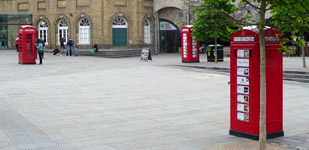 We were tipped off by a member that the red telephone boxes in Brunel Square were being placed on a low loader which then drove off. A bit of detective work afterwards found two by the goods entrance to Southgate bearing advertisements for businesses in Brunel Square, and three scattered around Brunel Square rather than in a row as they previously had been, with one of them bearing no advertisements, the feature which identified it as the one that previously had been by the goods entrance to Southgate. We have since been provided with the photo which shows clearly how widely the three in Brunel Square are now scattered. These are listed "K6" telephone boxes, so we investigated further.
- The listing text identified them as "Five K6 Telephone Boxes outside Bath British Rail Station" and further clarified that they were of two different types: "Central kiosk by W Macfarlane, Saracen Foundry (Glasgow), remainder Carron, (Falkirk) Stirlingshire". So the obligation is not just to have all five in one place outside the station, but to place them in a specific sequence.
- We dug further. The listed building consent for the work to create Brunel Square required: "No work shall commence on the items specified below until full details are submitted to and approved in writing by the Local Planning Authority:
j) The re-erection of the 5 telephone kiosks". - Strictly speaking, until there was a written agreement about where all five would be placed (and only four have been installed in Brunel Square so far), the work to the listed buildings should have been held back. Perhaps, as this did not happen, we can look forward to Brunel's ramp being reconstructed?
- On a more serious note, we have raised an Enforcement Case to attempt to get all five reinstated in a row, as the listing text requires.
- The Lansdown Bomb - Last updated 15 May 2016.
- This site has a complicated planning history, with a planning application raised in 2013 which was refused, with this refusal appealed, plus a similar but not identical planning application submitted in 2015 which is still under consideration. The appeal for the 2013 application was allowed in February 2015 subject to conditions which were accepted as met to the extent that development could commence, in a decision dated November 2015. We assume therefore that the work on site preparation is based on the 2013 application, and the intention for the construction phase is to build the scheme described in the 2015 applications if these are approved.
- So we looked carefully at the 2013 documentation and found a sentence in the archaeological survey "The upper tennis court was constructed in the 1960s, apparently on the site of a World War Two bomb crater". In the Ground Survey Report that formed part of the application to have the Conditions signed off we find that "The Screening against the Zetica regional bomb risk map (Avon) indicates the site to be in an area where the bomb risk is high", yet the condition ("No development shall take place until a site investigation of the nature and extent of contamination has been carried out in accordance with a methodology which has previously been submitted to and approved in writing") was signed off sufficient for the work to start without any mitigation measures being set out and agreed. Those mitigation measures should have detected the bomb in a safe manner. The act of physically unearthing it could have caused an explosion and the fact that it didn't is fortuitous.
- Now that the bomb has been removed and destroyed in a controlled explosion, we hope that a "Lessons Learned" investigation takes place. This might not be the last unexploded bomb buried in land which might be developed in future.
- Green Park Station - Last updated 1 May 2016.
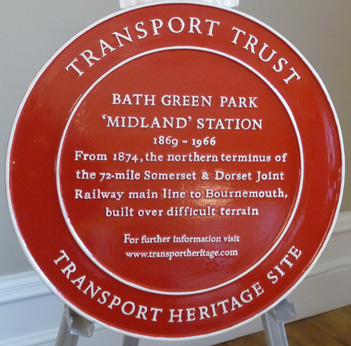 Like Bath Spa Station which was honoured with a Red Wheel by the Transport Trust in 2013, Green Park Station has now been similarly honoured.
- The Green Park Station Red Wheel plaque was formally unveiled at a ceremony in the meeting room in the Green Park Station building. Watchdog is grateful to Cllr Neil Butters for the invitation to attend the ceremony, allowing us to take this photograph and to include a summary of this event with additional pictures on our website.
- The unveiling ceremony took place ahead of the installation of the plaque, so we hope to supplement that summary with further details once the plaque is installed on the station building.
- Industrial Heritage Event - Last updated 10 April 2016.
 The event was well attended (our picture is just a sample of those attending), and we noted among those who came the Mayor of Bath, the Leader of the Council and at least one other councillor who spoke to us. Those exhibiting had a lot of public interest and the consensus was that they would like another such event in about six months, so we will keep in touch with the organisers and bring to you the date when one is chosen.
- We did take the opportunity to chat to the other exhibitors. Some were there just to provide some informative history, which included ourselves, the Sweetland Organ display and the Bath Blitz exhibits along with several others. Other exhibitors like the Cleveland Pools Trust and the Kennet and Avon Canal Trust were raising awareness in the hope of encouraging volunteers and donations.
- The Mineral Water Hospital facilities are facing relocation to the Combe Park site, and that will entail the closure of their museum unless another home for it can be found. The museum currently uses the Mineral Water Hospital's former Chapel and is not a NHS feature, purely a volunteer operated visitor destination (open Monday and Wednesday from 10am to noon, and Fridays from 2pm to 4pm) and despite the extensive range of exhibits and the fact that the National Mineral Water Hospital was the first ever hospital to take patients from anywhere in the country (hence the "National" in their original name), and the fact that it pioneered a number of medical and surgical treatments we take for granted today, there is no room for it at Combe Park and the volunteers are seeking some more constructive assistance. Their wish list includes somebody to develop a website for them (bearing in mind they have almost no money) so that if the physical exhibits can't be shown then at least they could survive as a virtual museum; but better still, somebody who will provide them with a permanent exhibition space so that they can carry on as they are. It occurs to us that if the NHS facilities leave the current buildings then there will be a new use for the listed buildings, and a condition for any change of use could be the inclusion of a hospital history space (Planning officers conducting Pre-application Assistance please note). There was such a condition attached to a planning application in Combe Down to ensure that there was public access to local quarrying information, so there is a precedent for such an approach. There is much more to Bath's history than Roman and Georgian architecture and we are happy to raise awareness of other history that Bath should be proud of. If there are any readers of this item who can assist the museum, then we have contact details (which we don't want to put online in case it attracts spam phone calls) and if anybody wishing to assist contacts us using the email links on our Contact Us page we will be happy to pass on the details.
- "A"-Boards - Last updated 21 February 2016.
- After we reported in January that the council intended to crack down on unauthorised advertising, we have been observing the central area now and again for any indications that this policy is making a difference. There does seem to have been a reduction in the number of banners attached to railings, and this is welcomed.
- We have previously criticised the "road blocks" made up of "A"-Boards in Union Street advertising businesses in Northumberland Place and The Corridor, and there does not seem to have been any reduction in the number of these. We also remember that the inclusion of hanging signs in The Corridor as part of its refurbishment was controversial because there is no historical basis for such signs; and the planning permission for these (in Application 12/05083/LBA) was based on the promise in the planning documentation to "remove A frame signs to improve the visual identity of The Corridor".
- That promise has not been honoured. On Wednesday when we looked, there were 11 "A"-Boards along The Corridor footway and a twelfth visible but out of the way having been placed on the doorstep of a unit, in addition to the usual clutter at the Union Street entrance. What a pity that the Decision Notice accepted the promise in the planning documentation in good faith and did not include a Condition requiring the removal of "A"-Boards once the hanging signs were installed.
- American University Studies - Last updated 14 February 2016.
- Watchdog has always supported the Architectural School of the University of Notre Dame in Indiana, providing photographs, local knowledge, and other information that may be requested as well as supporting any presentations that are subsequently made in Bath (like the Kingsmead designs presented in May 2015).
- However, we have received an e-mail from the course Professor explaining that there will be no similar presentation in Bath in 2016. He explains: "I was preparing another 'Bath campaign' with my new students, but changed my focus around October, when a proposal I made for a Refugee Housing development in Greece received attention in the press. Because of the urgency of the crisis in the Aegean, I was compelled to ask my students this time around to help produce a masterplan and designs for the refugee project instead. The team will present the refugee proposal at a conference in the Vatican this June".
- When we searched we did find references to articles in the architectural press from last September when the world's architects had been issued with a challenge, asking why architects were not more involved in the migration crisis, and inviting them to offer a solution to those countries suffering from an influx of refugees exceeding their ability to accommodate them. We also found articles which revealed that as well as the Notre Dame design other architects responding to the migration crisis include charities such as Habitat for Humanity, Article 25 and Urbana de Exteriores. Unfortunately these articles are only available to registered readers so we can't provide links. We also found a short article that that anybody can read which appeared in the Church Times, covering the Notre Dame ideas.
- For those who are interested in the details, we were provided with an explanatory booklet, currently being considered by the UN, the UN High Commissioner for Refugees, the EU, and the Greek Government. The booklet came with the advice: "I attach a brochure that illustrates and describes the project. Please feel free to share with anyone who is interested". We are sharing it with our readers with a caution that because of the number of illustrations it contains it could take a while to download for anybody with a slow internet connection; and a text only version is also provided for such readers.
- Former Labour Exchange - Last updated 24 January 2016.
- After our mention of the former Labour Exchange last week (see "Deathmasking" below), we had our attention drawn to the Chronicle article on the building. We were reminded that the entire building was listed, not just the façade, and that what is about to take place destroys the last untouched "Make Do And Mend" wartime repaired building that was still fit for use some 70 years afterwards. As such it was unique in Britain, and now - as it was put to us - the last remaining dodo is about to be killed. Like the dodo, only pictures will remain, to the regret of those who will later wish otherwise.
- In the article the emphasis is entirely on the frontage, which shows how little the council which permitted its destruction knew about it, because the wartime cobbled-together roof was also a unique survivor of what remained possible when there were severe shortages of materials and craftsmen, as was the patch on the corner. That the council did not value the building has been obvious ever since the abortive proposal to turn it into a "Wet House" was mooted. The blitz survivors will never forgive the destruction of their unofficial war memorial; and we have been told the name of the person they blame, but we will not quote it here.
- Deathmasking - Last updated 17 January 2016.
- Deathmasking is a derogatory term used in architectural circles for the process more properly known as façade retention. Façade retention, done properly, retains the entire façade and outer shell of a building and modifies the inside, so that externally it still looks like the historic structure. It is still undesirable to do this to a historic building, but where it is necessary it can leave something that fits properly into the street scene. A successful retention can be seen in Bath Street, where the exterior of the former Royal Baths now forms part of an internal space which was initially "The Colonnades Shopping Centre" then "British Home Stores" and now "Primark" with each new occupant placing their own character on the interior but leaving the outside virtually unchanged.
- Where façade retention becomes a "deathmask" is when the exterior appearance does change, and the retention of the façade is an uncharacteristic token gesture on a building that fails to retain the character of the original. We have in the past pointed out that the treatment of the former Labour Exchange in James Street West on the corner of Milk Street is in the worst possible taste because the retained façade will be dwarfed by a glass and steel structure emerging from within it and towering above it.
- Last week, the Development Management Committee failed to understand how façade retention is supposed to work, and has approved a development of the Bath Press Site where the new structures will again tower over the façade in an uncharacteristic design. Our informant from that meeting told us that instead of looking at whether the application is appropriate for a Locally Important Building (and this designation cannot be disputed because its picture adorns the front of the council's draft Locally Important Buildings Policy document) the Committee members became obsessed with the clock in the façade. There were issues of traffic, parking, impact on nearby listed buildings, conflicts with policies retained as part of the Core Strategy, Clauses in the Planning Acts and associated Case Law, and headlines in the Chronicle expressing concern about dwindling stocks of commercial premises which should have been discussed by the Committee; every one of these subjects more important than whether the clock would keep time (nice though that would be). On the sidelines, the new premises the Bath Police moved to is within the red line defining Crest Nicholson's Western Riverside Outline Planning Permission, so the security of tenure for the police is doubtful and the Bath Press site would have been a more practical relocation, but it would have had to have been designed with the parking of the specialist vehicles the police use in mind. Unfortunately such joined up thinking is scarce.
- Whether the Committee isn't minded to take its role seriously or whether they are simply inadequately trained is not obvious, but performances like this and the earlier decisions on the Upper Oldfield Park flats contrary to planning Case Law suggest that it isn't currently fit for purpose.
- Unauthorised Advertising - Last updated 17 January 2016.
- We were pleased to read in the Chronicle that the council is to crack down on unauthorised roadside advertisements. Whilst the article places emphasis on roadside banners, it should also cover unauthorised A-Boards and cycles used as advertisements. Likewise, although the emphasis is on the control provided in the Town and Country Planning Act, the restrictions in Section 28 of the Town Police Clauses Act are also relevant.
- If anybody wishes to follow the link to the Government Guide, then the one printed in the article does not work: use this one instead.
- Fracking - Last updated 13 December 2015.
- On the website of Ben Howlett, Bath's MP, is a report of confirmation from the Minister at the Department of Energy & Climate Change that Bath and the surrounding area including the Mendips will not be subject to any fracking activity in the future. This appears to be good news, though the reason for this assurance (that there is believed to be no shale gas to be found) rather than a commitment to preserve Bath's hot springs for posterity, doesn't offer the same degree of permanence.
- As with any Ministerial statement, the choice of words needs to be studied. Bath and the surrounding area is free from shale gas exploration we are told. However, shale gas is not the only reason for fracking; in the USA it is also a technique used for oil extraction. Currently the Government is not actively pursuing fracking for oil, but that doesn't mean that it won't at some future time. So we went looking round the Ministry website for information on oil, and we found a map "Onshore Oil and Gas Activity" which shows locations for future assessment, and the area between Trowbridge and Westbury shows there. We think that location is too close to Bath for comfort. Perhaps Bath's MP could seek reassurance that such a location is to be deleted from the list of possible licences.
- A-Boards - Last updated 29 November 2015.
- Following our piece on A-Boards last week where we identified some locations where the council policy was not obeyed and not enforced we were provided with some additional photographs. The number of pictures made it impractical to continue to report them on this page, so we have created a Rogues Gallery on our Public Realm page to put them all together.
- Meanwhile, we were also informed of Statutory Instrument 783/2007 which is entitled The Town and Country Planning (Control of Advertisements) (England) Regulations 2007. It is a complex document, but having examined all the clauses about what does and does not require advertising consent, we came to the conclusion that although the council has an informative document on advertising and has prepared a policy for the acceptable number, size and position of A-Boards, it doesn't remove the obligation within the Statutory Instrument whereby any business which wants to deploy an A-Board must first obtain Advertising Consent to do so. The council will then look at the number, size and position applied for and decide whether the adopted policy indicates approval. Without that express permission, A-boards become an offence under Section 28 of the Town Police Clauses Act 1847 which despite its apparent age is still current and has relatively recent updates via the Criminal Justice Act 1982 and the Police and Criminal Evidence Act 1984. Section 28 of the Act makes the placing of A-Boards (amongst other things) on the footway a criminal offence punishable by a fine of up to £1000 or by up to 14 days in prison.
- Sawclose - Last updated 1 November 2015.
- Although many planning permissions are granted with Conditions requiring an exploration of the site's archaeology, it is very rare for the results of that to be made public. It is common to find that there is an application to sign off the Condition, but mostly those findings are submitted to the council on physical media such as a CD and therefore the public never see it.
- The exploration of the Sawclose is therefore wholly exceptional in that the archaeologists placed an invitation on their website inviting the public along on 31 October to see their dig in progress. The response surprised them: they had anticipated a couple of dozen visitors yet by the time we left, still with an hour to go, nearly 100 people had been in. We have put on our News Summary page an outline of what was there to be seen. What we couldn't do is recreate the very interesting presentation that was given at intervals during the open period, though we have hopefully reproduced some of the key points.
- While there we were saddened to notice that the little Weigh House is now just a pile of stones. It wasn't in the way, because the plans as approved show that location as just an empty space, and so in our comments on the planning applications we recommended that it be retained as a symbol of the earlier use of the Sawclose (even if it didn't have a public use, it could have been used to store overnight the tables and chairs which will inevitably clutter up the area in due course), but neither the developers nor the planning committee gave it a second thought, and now it is gone. Also gone is the historic doorway that was installed in the modern Clinic building. The archaeologists would have been very interested in it as a possible clue to what used to be on the site, but the Clinic building and its anachronistic doorway had long gone by the time they started work. The only crumb of good news is that the stone from the demolished boundary wall and Weigh House was taken away for reuse as building stone rather than being smashed into hardcore as so often happens.
- This item is therefore a tribute to Cotswold Archaeology for considering the public and making the arrangements for access to the site and then fielding the wide variety of questions asked of them. It wasn't a widely advertised event yet it got a surprisingly good response, which shows that there is a lot of public interest in what is under the visible surface of Bath. It would be wonderful if other explorations were to be similarly exposed to the public.
- Oldfield Park Development - Last updated 4 October 2015.
- We have now seen the draft minutes, which reveal that of the ten potential members of the Committee, only nine were present, and one of those left the meeting before the debate and vote because Oldfield Park's councillor declared a disqualifying interest.
- No mention was made in the minutes about the harm done to the Conservation area (which has a legal emphasis) and the motion was supported by the grounds of "much needed housing" (which doesn't have a legal emphasis). Other than that we know that the debate was just "a short discussion" though there is no indication of what was discussed, after which eight councillors voted to bring the whole planning process into disrepute, and created a precedent for unauthorised developments that could come back to haunt them. Historic England had asked that the application be determined in accordance with National and local policy guidance. It wasn't. Bath deserved better.
- Oldfield Park Development - Last updated 27 September 2015.
- We pointed out last week that everything the Liberal Democrat Council did before the election concerning this development was based on avoiding the harm that the building (erected without planning permission) does to the Conservation Area. Since the Local Elections, the enthusiasm from the now Conservative Council to uphold that legislation in respect of this development has not been evident. As we said last week "We cannot understand how the council can now reach a diametrically opposing view: the legislation is unchanged and the relevant Supplementary Planning Document remains in force". When they are available we will read the minutes of the planning meeting with interest to see how this shift in position was justified. One local person said to us, tongue in cheek, that when the Development Control Committee was renamed the Development Management Committee, the attempts to properly control disappeared.
- It is the same Local Planning Authority as far as the outside world is concerned, and the legislation remains unchanged. The Enforcement decision followed by the completely different stance reflected in the latest decision has been published world-wide by the Chronicle, and its readers can be forgiven for assuming that the council is completely muddled (particularly when most other councils have a different Local Election timetable to B&NES so they won't be aware of the change in administration). That said, we do hope that is because of a difference in people rather than party politics: people can be educated but politics tends to be less adaptable.
- Park and Ride Consultation - Last updated 20 September 2015.
- There appears to have been very little new research into needs, capacities and volumes, yet the closure of the MOD sites and the employment opportunities they provided will have made a significant difference to the travel profile from the east. The demolition of other office accommodation, to be replaced with mostly student accommodation with conditions banning the use of a car, should also have been factored in. Finally, reference is still being made to a new station which no longer features in Network Rail's plans, so all assessments of desirability based on such a station are now skewed.
- The other factor that has not apparently been considered before preparing the inappropriate short-list is the impact of illumination (both vehicle lights and car park illumination) on wildlife. In winter it gets dark mid-afternoon so at some times of the year a park and ride will be servicing an after-dark rush hour. These sites have always been dark, so to now illuminate them will have an adverse effect not only on protected species but also on other species they currently feed on.
- The initial reaction is that reliance on previous studies of potential Park and Ride sites (paid for from council taxes), which effectively dismissed all three sites as unsuitable, without reworking the usage profiles, renders the short-list now being consulted on totally unscientific. Some members have described the consultation as a farcical waste of money. That is perhaps an extreme view, but it can certainly be criticised as unprofessional.
- Industrial Heritage Day - Last updated 13 September 2015.
- Watchdog was just one of the organisations who exhibited at the Industrial Heritage Day on Saturday 12 September 2015 at the Bath City Football Club, and we added new items to our already extensive range of exhibits. The Mayor of Bath came along and spoke to every exhibitor, which was very much appreciated.
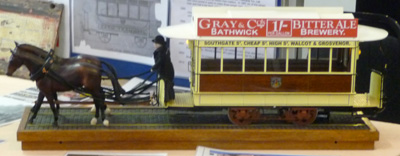 The surprise exhibitor was Ipswitch Transport Museum which brought a section of timber from one of Bath's original horse-drawn trams and a model of the tram as it would have looked (pictured). These trams were in use from 1885 to 1894, and the remains of one of the original Bath trams has been discovered in Ely. The Ipswitch Transport Museum plans to restore it, and we have exchanged contact details with the museum to assist with their restoration research.
- Given that the date of this Industrial Heritage Day, chosen half a year earlier, was then found to clash with Bath City FC playing at Home, the University of Bath's Open Day and the parade that formed part of the Jane Austen Festival, we were agreeably surprised at how many people came to see what was on display and to discuss the exhibits with the exhibitors. All this was despite the press release not appearing in print, only online. Clearly there is a lot of public interest in Bath's industrial heritage, which suggests that it should perhaps feature more prominently in Bath's tourism publicity.
- The Chronicle reported the day as a "huge success", which was our view too. We have been informed that so many of the visitors asked for another similar event that there are now provisional plans for a repeat. No date has been chosen yet, but we understand that April 2016 has been suggested. We will publicise the date once decided.
- Former Labour Exchange - Last updated 2 August 2015.
- We received a note on the subject of this development and we thought initially that we should just reproduce it here as public feedback to the decision makers; an expression of the level of concern that this development has raised. It said:
-
Those who lived through those terrible nights when Bath was bombed have long regarded the survival of the old Labour Exchange as the unofficial memorial to those who were killed and a reminder to those who survived of how lucky they were. It also stood as a tribute to the ingenuity of the workmen who managed to salvage the wrecked building in the face of severe shortages of materials and bring it back into use. This was why it was eventually listed.
That B&NES couldn't respect the building as one cherished by Bathonians is disgraceful. That they couldn't wait until all the wartime survivors had died before finishing off what Hitler failed to achieve is truly heartless. For the council to then proclaim its part in the desecration of this war memorial in gaudy signs plastered on the front of it is really rubbing salt in the wounds.
 When we noted the words "proclaim its part" we went along to have a look. There are two large signs now installed on the front, one of which shows the pictured admission of participation. Illustrations of the proposed development on these signs show the red front door in the facade, except that between these signs that red door has now been painted black, and the windows are blocked off and painted in the same funereal colour.
- There are extant planning permissions for this building but none of the plans approved included these alterations. It remains a Grade II listed building and any alterations like these which change the character of the building must have listed building consent. None has been applied for, and certainly none has been granted. Digging deeper we found that the extant permissions included several Conditions that said that approvals for various detailed things must be secured "prior to the commencement of development" and these have not been secured so no work at all should have taken place to date. Unauthorised work to a listed building is a criminal offence and by putting its name on signs that are unauthorised, the council is now party to that offence. We have raised an Enforcement case accordingly.
- Taking a more tangential look at this development there are several adverse comments in the Chronicle about the use of this site for yet more student accommodation, and an article announcing the launch of a campaign to say enough is enough and student numbers (now approaching a quarter of the population of Bath even without counting the 5,000 City of Bath College or the 240 Norland students) should in future be capped.
- Fracking - Last updated 26 July 2015.
- Originally the Government announced that Areas of Outstanding Natural Beauty, World Heritage Sites and Sites of Special Scientific Interest would be protected areas as far as fracking was concerned. It looked as though this would protect the sources of the hot springs. However, the draft regulations have been now published, with a press release, and this makes it clear that such areas are not wholly exempt, they are just restricted down to 1200 metres and fracking is permitted below that depth anywhere in the country. In order for the hot springs to be warmed to the temperature at which they emerge from the ground, it is likely that they have some part of their route below that depth, and therefore there could be a significant risk of disrupting the flow or contamination of the water on its way to Bath. The current assumption is that it takes the hot springs a considerable number of years to traverse from source in the Mendips to its emergence in Bath, so if such disruption or contamination occurs it will not be evident quickly, and by the time it is evident it will be irreversible. This draft legislation as written is therefore a direct threat to Bath's historic waters because it removes the opportunity to refuse planning permission, even for World Heritage Sites. We have traced an on-line petition. Whilst the council and Bath's MP can make authoritative comment on the draft legislation (and it is imperative that they do so), the ordinary citizen only has the petition route to making their feelings known, which is why we are providing a direct link to the petition website.
- RIP Charlie Ware - Last updated 26 July 2015.
- We have moved our obituary for Charlie Ware placed here last week to a new page on our recreated original campaign website for Churchill House because it was too big to leave on this "Headlines" page. We have not only placed the link to the Chronicle article on that new page, we have also added the link to the article printed in the Western Daily Press on 15 July after it was brought to our attention.
- River Avon Options Study - Last updated 21 June 2015.
- On Thursday 11 June we attended the public consultation at the Guildhall. The study had examined two locations: Pulteney Weir and the Twerton sluice gates. There were experts on hand to describe and discuss the exhibits on display.
- Three options had been put forward as possibilities for the Pulteney Weir location with visitors invited to discuss the pros and cons of each. At Twerton, there was only one fundamental design with minor variants. The council in conjunction with the Environment Agency had provided feedback forms and a "ballot box" style container for them once completed, so that comments could be submitted privately and anonymously if desired.
- Update: We were told that the exhibition material will soon be put on-line on the council website and that public feedback could be sent to the e-mail address on that page. Last week the exhibition material was not there, but it has been made available since then and this link will retrieve it for you. we hope that readers who could not attend the public consultation will examine it and make your views known. The exhibitors are hoping for as many opinions as possible.
- American University Designs - Last updated 31 May 2015.
- For those who could not attended the events on 22nd May in Bath Royal Literary and Scientific Institute (BRLSI) in Queen Square, we have put together an outline of the presentation. As time permits we will supplement this with an overview of the spoken commentary that went with the slides on display.
- American University Designs - Last updated 24 May 2015.
- Those who attended the events on 22nd May in Bath Royal Literary and Scientific Institute (BRLSI) in Queen Square to hear the speakers from the University of Notre Dame and to view the drawings prepared by the architecture students were treated to talks which focused more on the rationale behind the designs than the designs themselves. This drew on published research into the geography of neighbourhoods, and the various components which in combination give a measure of the sustainability of any given development, with some interesting conclusions relevant to Bath.
- Professor Richard Economakis of Notre Dame concentrated on the principles of good urban design and how that was embodied in the student projects for the Western Riverside in 2009, Kingsmead and Green Park in 2011, Manvers Street in 2013 and the latest project for what he called Narrow Quay which roughly equates to the area referred to by the council as North Quays. Dr. Christopher Miller of Judson University, Illinois took a more academic approach, examining the science behind good building design and the indicators to commercial viability which guided his Masters Thesis when he was a student at Notre Dame, a thesis which covered a hypothetical development he called Market Bridge that Bathonians would recognise as the Walcot Street Cattle Market area.
- Also on display for those who wished to browse through it was a newly published book "Durability In Construction", already on sale in the USA and soon to become on sale in UK book shops. A booklet "Graduate Studio Masterplan Proposals for the Restitution and Improvement of Bath's Historic Urban Fabric" was donated to those present who could make good use of it.
- Oldfield Park Development - Last updated 3 May 2015.
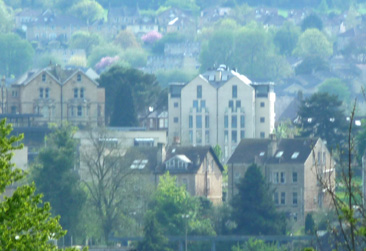 Watchdog has not taken an active part in this planning activity, but has kept in touch with the local activity group fighting the development, and they informed us that the Development Control Committee meeting of 29 April 2015 voted to enforce the removal of the Oldfield Park flats. The minutes of the meeting are not yet available but the Chronicle reports the enforcement decision, though it mostly focuses on the developer's viewpoint on the decision. However there are anomalies between the Chronicle's report of the developer's claims and what appears in other documentation. For instance, the press statement claims that the council insisted on a steel frame for the building; the documents submitted with the planning application state that it was the developer's insurers who insisted on the steel frame; the brief to the DCC states that the drawings submitted to Development Control differed from those in the planning permission, suggesting that the developer had decided before any question of a steel frame could have been raised by the council that what was going to be built was not what had been given permission. We also note that the drawing submitted in the retrospective planning application (which was refused) differs from the appearance in our photograph (taken from Victoria Park), and the brief for the enforcement agenda item states that "the deviations are substantial".
- The decision to enforce was also reported on the local TV news, with ITV interviewing the Chairman of the DCC who made it clear that building something unauthorised is entirely at the developer's own risk and the developer had been made aware of this yet carried on with the construction.
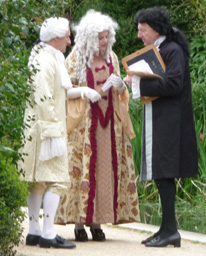 World Heritage Day - Last updated 19 April 2015.
- We went along to the World Heritage Day event on Sunday 19 April in Prior Park Gardens. The weather could have been kinder because there was a chilly wind blowing, but the ground was dry and firm, even off the prepared paths. There was period music both performed live on period instruments and from recordings for the dancing displays, a selection of period costumes for children to dress up in, and people wandering around in period costume (see picture) explaining the history. There were stands featuring other heritage activities too, and the Cleveland Pools one was attracting a lot of attention (aided no doubt by a prime location near the refreshments cabin!).
- For those who were interested in the work in progress in the splendid gardens, there were well-informed guides explaining what there was to see, and what the eventual aims were.
- Everywhere we looked, people were enjoying the day out. The organisers are to be congratulated. The only minor drawback was that being Sunday, the buses to and from Prior Park were infrequent.
- Shop Signs - Last updated 29 March 2015.
- One of the things we would like to see on listed buildings is the business name hand-painted on the fascia, and if we comment on applications for new signage we always recommend this approach. Unfortunately not all businesses want to do this and permission is sometimes given to mounted lettering.
 While the business trades in that premises this can look attractive, but problems are left behind if the business ceases trading or relocates. The picture here is part of the fascia of the building that LUSH occupied until they relocated. We emphasise that LUSH is just a recent example not a business we have any particular issue with, and we wish them well in their new premises. However because their name is clearly readable in the photo despite the lettering being removed, we cannot avoid identifying them.
- This was a shop on a corner and there are three other fascia panels apart from the one photographed which are in a similar condition. All the fascia panels which previously bore their mounted lettering now look like well-used pincushions.
- If permission is given in future to mounted lettering, it would be useful if it was accompanied by a condition requiring the fascia to be restored if the lettering is removed. This is not a good residual look for any building.
- Newark Works - Last updated 22 March 2015.
- Among the decision noted this week was the one labelled "Bayer Building" to mislead the casual reader into not noticing that it has an impact on the Newark Works too. If the Secretary of State read the heritage statement, then the only reference to the Newark Works is "listed facade" when it is very clear in the definition in the planning legislation that there is no such thing as a listed facade, only complete buildings and other structures in its curtilage; and when the applicant is the council, there is no excuse for not knowing that. The Newark Works has its own listing entry, completely independent of the Bayer Building.
- We made specific reference to this misleading description in Watchdog's strong objection, yet the SofS response makes no reference to our comment. We have to assume therefore that the SofS was not sent that document.
- As the SofS gave permission for "The Bayer Building" we now expect to see a REG13 application for the works to the curtilage of the Newark Works so that the council is not open to accusations of maladministration, because false or misleading descriptions in a planning application are unlawful, and the SofS cannot be seen to approve an unlawful application.
- We also have to question why the SofS made no mention of the issues raised by Watchdog. Can it be that the SofS did not receive all the relevant documents? When the on-line planning system started to show a separate tab for Comments rather than list them among the document set, we queried whether there was a risk that the comments might not be seen by the SofS and were assured that procedures would be amended to ensure that did not happen. The evidence suggests otherwise.
- As Others See Us - Last updated 22 March 2015.
- We were sent a cutting from one of last week's national daily newspapers criticising the Gypsy and Traveller Site nearing completion beside the Lower Bristol Road. For copyright reasons we cannot reproduce the article itself (and it is not on-line and therefore in the public domain), but we can report the main gist.
- Their main criticism was the cost, labelling it "Britain's most expensive", and the fact that it had been built on Green Belt land hadn't gone unnoticed either. Implicit in the photographs which accompanied the piece is the evidence of the demand, as shown in the photo of the earlier illegal camp, far exceeding the supply in the form of the number of new residential units, though this inadequacy was not featured in the text, merely hinted.
- If an ordinary resident had applied to build on Green Belt land it would have been refused on the grounds that the land should remain open space, so the council has not applied the legislation when selecting the location and then granting themselves permission to develop it. That criticism is fully justified.
- The cost is high, but it was offset by a substantial Government grant such that the connection between the full cost and the description of "a cash-strapped council" is unjustified. However if the "Britain's most expensive" description is true, then it does leave an unanswered question of why something with a more typical cost wasn't the objective. The mismatch of supply and demand is rather more worrying, and the outcome, given the provision of two caravan parking spaces beside each residential unit, could be one family in the unit and two others living in caravans parked in the spaces beside it.
- This development is just beside the normal road route into the World Heritage Site from the west, and the impression this site will give to tourists arriving from that direction needs to be monitored and controlled.
- Industrial Heritage Day - Last updated 8 March 2015.
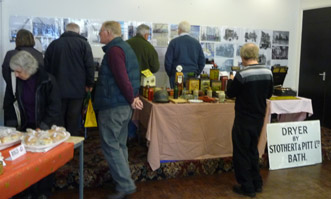 Watchdog was just one of the organisations who exhibited at the Industrial Heritage Day on Saturday 7 March 2015 at the Bath City Football Club, and we were agreeably surprised at how many people came to see what was on display, with plenty for them to see and discuss with the exhibitors. There was no official count of how many came through the door but it was several hundred according to the organisers; and this despite the press release not appearing in print. Clearly there is a lot of public interest in Bath's industrial heritage, which suggests that it should perhaps feature more prominently in Bath's tourism publicity.
- We have been informed that there will be another similar event in the future. No date has been indicated yet.
- Breaking News - Last updated 3 March 2015.
- By a strange coincidence, one of the new planning applications this week was a listed building application for 1-3 James Street West, the little bomb-scarred building between Milk Street and Kingsmead North.
- On Monday 9th March at 10am on the "Yesterday" channel (Freeview Channel 19) there is another repeat broadcast of "The Forgotten Blitz", a joint BBC Bristol and Bath Blitz Memorial Project production. If you haven't seen it, it is worth watching or recording to watch later. One of the locations featured in the programme is that very building, including a discussion led by Nick Knowles on its significance.
- We contacted the Bath Blitz Memorial Project and we were informed that they had brought the building to the attention of English Heritage who subsequently listed it as a rare surviving example of the wartime "Make do and mend" approach to keeping going regardless of the destruction around and the shortage of materials. In other words the importance of the building is its character exactly as it is now. We were also informed that so many of the guests at the adjacent Premier Inn took an interest in the building that the Bath Blitz Memorial Project prepared and donated an Interpretation Panel for the hotel to display.
- It is believed that some of the guests, having seen the broadcast of "The Forgotten Blitz" or having seen the articles on the programme in the Guardian, the Daily Mail or the Radio Times, came to Bath especially to see it; and while the Genesis Project occupied the building and offered furniture for sale, it gave the visitors a chance to see inside the building in its original 1930s livery as well.
- It is difficult to imagine a more effective advertisement for Bath than an oft-repeated BBC documentary; it is the type of publicity that money can't buy. Yet the council wants to destroy the character of the building for the sake of a few more student flats which their own adopted Core Strategy rules against. The council owns the building, the council evicted the Genesis Project from it, the council appointed a preferred developer, and the council has included a significant sum in the recent budget to fund the destruction; all this while hiding the planning application origins behind the preferred developer so that the council avoids asking the Secretary of State for permission to ruin a listed building. Once its character is ruined, the people who arrive to see it and find it ruined will moan on the various Social Media services that they travelled all that way only to find that Bath couldn't care less about the heritage except the parts they can charge an arm and a leg to see. Did nobody in the council think this through? Mud sticks!
- Our thanks to the member who brought the TV broadcast to our attention; and to the Bath Blitz Memorial Project for explaining the historical background.
- The February DCC - Last updated 15 February 2015.
- There were some substantial planning applications before the committee, and a quick summary of the outcome is:
MOD Warminster Road approved; MOD Foxhill (now called Mulberry Park) was also approved. The area beneath Grand Parade called The Colonnades in the planning application (which might cause confusion for those who remember the short-lived Colonnades Shopping Centre in Bath Street) was refused; as was Pinesgate. - The Mulberry Park decision on the outline application came after the applicants reduced the height of the controversial 6-story blocks to four stories and thus made the layout and height profile more acceptable, a view also taken by the Committee Members. The detailed styling of the individual buildings will be applied for separately, and the illustration in the news item should not be taken as an example of what was approved. Watchdog did attend the public consultations and we pointed out that part of the site was too far from the proposed bus services for the elderly or infirm to carry shopping, but this was ignored. The bus route provision is to be subject to separate review under Condition so hopefully this will result in those living in this part of the site being less likely to rely on car usage.
- By contrast, the decision to approve the Warminster Road plans remains a mystery. The Application Form applied for 189 dwellings and the drawings showed 204 dwellings, meaning that the application is inconsistent and fails to comply with planning law so it should automatically have been refused. The Committee Report places considerable weight on a threat that the existing buildings could be retained and converted to residential, despite the Government guidance that each planning application should be stand-alone (and despite the fact that the conversion as described is not possible as permitted development). The ten members of the Committee who voted to approve this have therefore condoned an unlawful application and a brief contrary to the extant guidance: perhaps they will explain why they did this given their role is to make decisions strictly on planning grounds. It now remains an outstanding question of how many will be built, and whether the council will enforce the applied-for 189.
- One of our members found the news that the council has been awarded a New Homes Bonus allocation; and speculated that because so much potential residential development land had been given permission for student accommodation, perhaps any plan for dwellings had to be approved to safeguard the money. Given the reservations that English Heritage had about the harm to important views, it remains to be seen whether the Secretary of State will be asked to call in this decision. It will also be interesting to see whether when the development goes ahead it becomes Bath's latest nomination for the Carbuncle Cup. (The Chancellor's Building at the University of Bath had the dubious honour of a place on the short-list last year, which isn't what is expected of a World Heritage Site).
- Of the ones refused, the Pinesgate design was contrary to some policies in the newly adopted Core Strategy, and yet half the Committee wanted to approve it: perhaps they should read the strategy that was adopted.
- The Colonnades one was very sensibly refused, but despite the decision to protect the iconic views of Pulteney Bridge the council says it is still committed to the idea. The most shocking thing in that article is not the stubbornness of refusing to accept that from the outset such a development was a bad idea, but the news that nearly £4 Million of council funds has been allocated in the draft budget to convert the Colonnades, yet the benefits were to go to commercial enterprise. The expenditure of council tax should be for the benefit of the public not to provide a subsidy for business, and we hope the auditors question this budget entry very closely.
- Victoria Bridge - Last updated 18 January 2015.
- Although it had been possible for some days beforehand to cross the newly restored Grade II* listed bridge designed by James Dredge, there was an official opening ceremony conducted on Thursday 15 January 2015. Amid speeches describing the restoration and acknowledgements of the contribution of the key people that ensured its success, there was a ribbon cutting ceremony which was filmed by the BBC for their "Points West" news item that evening.
 Three pairs of scissors wielded by two of James Dredge's descendants, Nigel Bridewell (left) and Stuart Dredge (second from right), and by Martin Veal (Chairman of the Council, centre) simultaneously cut the ceremonial ribbon watched by the Mayor, Cherry Beath (second left) , and Paul Crossley, the Leader of the Council (far right). Crest Nicholson hosted the reception which followed.
- At that reception, Paul Crossley introduced local artist Anna Gillespie who has been appointed to reprocess the iron from the bridge that was not in a fit state to be reused in the restoration, and will use it to create a sculpture to be named "Maid Of The Bridge", to be installed near the bridge once completed.
- One residual anomaly is that the temporary girder bridge which kept the pedestrian route available during the restoration and has now been removed because the restored bridge is fully opened, is still the subject of planning applications which are still "Pending Consideration".
The rock band "Muse" recorded their album "Origin of Symmetry" in Real World Studio in Wiltshire and in St Mary the Virgin, Bathwick in 2001. Matt Bellamy always wanted a real church organ on the track "Megalomania".
Their online record shows: As we drove back through Bath, Matthew's saying "there must be a church with an organ - look, there's a church! let's stop there, I'll bet they've got an organ." So we drew into this church about 7 o'clock one evening, walked straight into the church and there was a guy playing the organ. Matthew went straight up to him and said, "can I have a go?" And the guy says "certainly". Matthew sat down and started playing this huge church organ, in St Mary's church in Bath, right in the centre of Bath.
The vicar of the church insisted on seeing the lyrics to the song before allowing them to record the organ. Although none had yet been written for the song, Bellamy proceeded to write out some "positive", "nice" lyrics for him and he allowed them to record the song.