



Western Riverside News
Quick Finder (Sections on this page)
| Latest concerns [18/5/08] | Earlier concerns [30/3/08] |
| A legal minefield [3/2/08] | The DCC Meeting [27/11/07] |
| The Public Meeting [13/9/07] | The Scheme |
| What you can do | Western Riverside Images |
| World Heritage Committee | The BMW Garage Scheme |
| The June Can Of Worms [27/6/10] | The April 2010 Update |
| The July 2010 DCC Brief [4/7/10] | The July 2010 DCC Meeting [11/7/10] |
| Elizabeth Park [26/7/2019] |
Elizabeth Park
Background
The original outline permission indicated that an area beside the river which would provide flood compensation would be landscaped as a public open space. Crest Nicholson's consultations since then have identified a preferred name; as their statement to the press explained: "Bath is blessed with a great variety of public parks and open spaces named after Queens – such as Victoria, Alice and Alexandria – so it was logical to name the new leisure area Elizabeth Park". That said, the name was popular with nearby residents and the general public.
The next stage was to include things that the public would enjoy, because a park without some reason to go there isn't going to be well used. This led to what is best regarded as public artwork, plus what is described as the Elizabeth Park Fitness Area, which provides simple strength and balance equipment suitable for a very wide range of ages.
The Opening
The opening ceremony was on 26 July 2019, and Watchdog was invited. We went along for the start time, which proved to be educational. The early arrivers were given a walk around the public artwork, and at each there was an explanation of what it is, and for the opening event the artists took it in turn to describe the background to their piece, and how they had interpreted their brief.
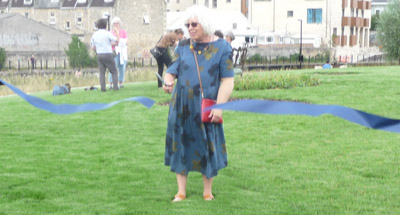 This was then followed by a short speech by Crest Nicholson's first buying customer, who put an option on a property "on plan" (ie, before it was built), purchased it when it was finished, and saw BT's first fibre broadband service for the Western Riverside installed in it.
She then cut a ceremonial ribbon to declare Elizabeth Park open (see picture).
The Artworks
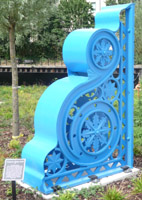
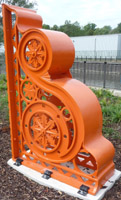 We were pleased to see that Crest Nicholson had fulfilled their promise to preserve the decorative scrolls from the Destructor Bridge when it was removed in 2015. They were installed beside the path nearest to the river, some distance apart. Each had an informative plaque that explained where they had come from and added:
These cast iron, decorative scrolls have been repaired, preserved and reinstalled as colourful waymarkers with which to remember the industrial heritage of Bath Riverside and to act as signposts along the river
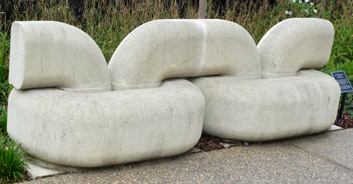
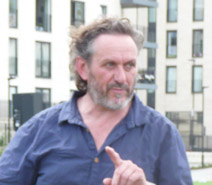
 Further along the riverside path was what its informative plaque called Chain Link Bench. Its creator, Sam Flintham (left) explained that he had studied stone carving at Bath College and had been surprised and delighted to have received the commission for this work. He explained that he was inspired by the industrial heritage of the Riverside site and his chain showed links, each as a constituent of a composite entity, mirroring the connection between the past and the present.
He admitted that he would have ideally liked more time to create it, but he was satisfied with the finished product. The size isn't obvious from the picture, but it would seat 6 or 7 adults. We sat on it. It was comfortable enough to use as a seat.
Phenologist: One who studies recurring natural phenomena, such as animal migration, especially as influenced by climatic conditions.
 Away
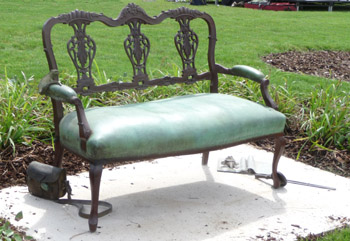
from the path, on a small concrete island in the grass was Jenyns' Seat. Reverend Leonard Jenyns was a naturalist, phenologist and lifelong friend of Charles Darwin. He came to the Bath area in 1852.
Away
from the path, on a small concrete island in the grass was Jenyns' Seat. Reverend Leonard Jenyns was a naturalist, phenologist and lifelong friend of Charles Darwin. He came to the Bath area in 1852.
 Jenyns' Seat is the work of Patrick Haines who was there to explain his very detailed work. He explained that he had visualised a seat where Jenyns might have sat talking to his friend, Charles Darwin. Jenyns was the original choice for the second voyage of HMS Beagle, but he turned it down and recommended Darwin instead
At Darwin's end is a lizard on the arm, there is a beetle crawling up the back leg, and there is a colourful beetle emerging from Darwin's leather ammunition pouch on the ground.
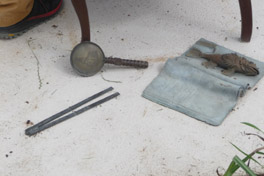 At Jenyns' end there is a pair of dividers on the seat, a magnifying glass leaning against the front leg shows Charlcombe Church (where Jenyns was the vicar), there is a ruler on the ground just in front of a specimen fish on a book in which are written notes about it. The seat and arms look as though upholstered in the fashion of the time.
It isn't as inviting as a seat as it looks though, nor does the pouch feel like leather or the paper feel like paper, because everything there is made of bronze. A lady from the Bath Royal Literary and Scientific Institution (BRLSI) sat on the seat and gave a short talk on the Jenyns collection in BRLSI, and we tried the seat later and found it reasonably comfortable provided we didn't lean back to use the back rest.
If the artist's work looks familiar, it is because he also crafted the Herschel seats looking towards Victoria Bridge.
The 7 July 2010 DCC Meeting
On the morning of the meeting, BBC Radio Bristol did interviews with Watchdog and the Bath Preservation Trust, followed by a public phone-in. Their initial slant was to suspect objectors of NIMBYism and objections to affordable housing, but gradually they got the idea that the resistance was because people genuinely cared about Bath, and the World Heritage Site really was at risk because of the scale being unsuitable. A number of callers shared the view that affordable housing was desperately needed, but that was no excuse for making it downright ugly. We have made a recording of the broadcast, but it is far too big to put on-line.
Just before the meeting, an update brief was issued. This was placed on-line but it was well hidden by providing it with a Background Papers reference rather than a Report one. We have not analysed the update brief to the same degree as the main one because it is unlikely that many of the DCC Members had time to study it before the meeting, and most of the content was presented to Members by the Case Officer during the session.
A comparison between the English Heritage comments as written, and the brief and plans before the Committee, does indicate a mismatch of expectations though. English Heritage clearly expect what they call "the object buildings" (ie the 8 and 9 storey blocks) to be dealt with separately; yet they are part of the outline application, and are included in any decision made.
The Officer's presentation started with an outline of what had been happening behind the scenes since the November 2007 decision of the DCC to support the development. Time had been spent on negotiating an S106 agreement and the set of conditions that would accompany any planning permission, and this was now nearing completion. He reminded the Members of the objectives of the development: to have a contemporary design that complements the World Heritage Site; to have a high density urban design based on quality architecture that met sustainability targets and provided affordable housing; to open up the riverside, provide new infrastructure and bridges; facilities for public transport users and cyclists; and the provision of a community school. He reminded the members of the improvements in height and layout in 2007 that allowed Members to recommend approval. He reminded Members that what they were considering at this meeting were amendments to the 2007 plans, and what he wanted Members to do was reaffirm their support for the scheme in the light of the latest amendments, because Crest Nicholson wanted to start work soon.
He went on to explain the changes since 2007 and the reasons for them. He explained that originally a grant for affordable housing had been offered by English Partnerships, but English Partnerships had now been the subject of a Government reorganisation and grants for affordable housing were now the remit for the Homes and Communities Agency or HCA for short. When the HCA examined the plans, they had concerns about the undercroft parking, which like Southgate was designed as a single large area with separate buildings located above. The HCA had worried that if they supported one part of the development, they were committing themselves to the whole area covered by the common car park, and this might not be value for money in Government terms. So this was the driver for the redesign, and the plans presented to the Committee now show underground parking associated with individual buildings giving more flexibility for construction a section at a time, the relocation from between the taller blocks of the "mews" style terraces which now have street level parking, and a redesign of the mix provided in Phase 1 with greater emphasis on housing in the form of town houses rather than flats and an increase in the proportion of affordable housing. Additional units offset the reduction in housing units caused by having a greater number of larger units.
The Ecology Report implies that the badgers are no longer using the (previously identified) embankment setts. It makes no reference to searching for new setts. We have been informed (we believe reliably) that the badgers have built new setts within the Phase 1 area and they still forage along the embankment.
He continued that originally the former railway embankment was to be left as undeveloped land because it was occupied by badgers. But now the Council Ecologist and Natural England concluded that no badgers now use it, so the embankment is to be removed and the land used for parking and a service area for the scheme and also Victoria Buildings, plus a few extra units of housing. The other major change was the reduced height for the buildings by Norfolk Crescent.
Members were shown diagrams of the main changes, with an explanation that the areas of change make the scheme more viable and unlock HCA support. He added that English Heritage are supporting the changes, which they do not consider have a significance outside the Western Riverside site; that CABE are supporting the changes and like the fact that the basic design principles are maintained; and that the Environment Agency acknowledge that the public spaces provide flood storage. Other minor bits and pieces can be dealt with by officers if the Committee delegates to officers to approve.
We have our doubts that this arrangement would be successful. The latest information from the EC is that the B&NES case is still very much a live investigation. Also, given that the arrangement of the Western Riverside main highways are predicated on the declared requirements of the Bath Transport Package for which Government funding is sought, and the creation of flood storage is to be used thereafter as public open spaces, we believe that the scheme still falls foul of the EC interpretation of public works.
So we expect the Homes and Communities Agency to maintain its position of a year ago that it will not consider, even in outline, any investment approach for the Bath Western Riverside Project until this infringement issue is resolved.
Attention was drawn to the migration of particular items from the S106 agreement to Conditions. This was to meet European Court of Justice rules that public works have to go through public procurement procedures. So instead of the original expectation that the public works would be delivered as part of the development, the S106 agreement would be for cash sums leaving the council to arrange to do the works having placed contracts through public procurement exercises.
He reminded Members of the letter from John Betty appended to the Update Report, in which he advised that the Office of Government Commerce believed that the European Commission was inclined to close its proceedings against the UK with these changed measures in place.
Members were then invited to seek any clarifications they wanted. Cllr Brian Webber asked whether the potential for a seagull problem had been considered, and he was assured that control measures would be part of the details of the package. Cllr Darracott asked if the site boundary is still as it was, particularly north of the river. He was assured that the boundary of the outline was unchanged, or else the changes now proposed could not be simple amendments. He was assured that whilst in the current economic climate the Waste Management Site was remaining for the foreseeable future the council's aspiration that it be relocated and that part of the site used for housing remains. The changes to the detailed plans are just part of the outline site, and its boundary is within the outline. Cllr Beath asked whether the family housing would have 2-3 bedrooms. She was assured that the affordable housing covered a spectrum of 2 to 5 bedrooms and the designs were flexible to leave the options open in case the HCA money did not survive the coming spending review.
Then the members of the public who had requested to speak were invited to address the Committee.
There were some interesting procedural anomalies during this section. Watchdog had liaised with the Bath Preservation Trust and the Bath Society to jointly make the best use of the short time available, which was shown on the Speakers List as "To share 6 minutes". Except that at the meeting, we did not share 6 minutes, we were allocated exactly 2 minutes each, which made a nonsense of the Bath Society using less than its share to give Watchdog an additional 15 seconds. Then when the Watchdog Chairman started to speak, he was interrupted by requests from the top table for somebody else to turn off their microphone, while the allocated time continued to tick away. It looked like a deliberate attempt to cut the Watchdog presentation short, because surely after all the DCC meetings held to date, such a shambles could not be accidental. Were they afraid we might say something the Members might take heed of?
The Bath Preservation Trust objected to both applications. Whilst it was evident that Bath needs more housing, it is not best achieved by a long public silence followed by an unseemly scramble. The design of the social housing risks it becoming the ghetto of the future. There are inconsistencies which make the masterplan incompatible with Phase 1. There is too much reliance on conditions which will lead to a lack of control over the final outcome. The concerns of UNESCO should be taken into account, and they have not been. Similarly, English Heritage have asked for a formal review mechanism, and that has been ignored. The decision now should be to defer a decision until the conditions can be put to the Committee for consideration.
The Bath Society said it was important that the S106 conditions should be put to the Committee, and only then should the Committee make a decision if it wants to see planning permission granted. The speaker pointed out that the Bath Society did make a comment, but all the effort of preparing it was wasted because it was not mentioned in the Committee brief. Finally, he reminded Members of the comments by CABE that this was failed post-war housing which would be a frightening and oppressive place.
Watchdog attempted to speak, but was thwarted (see box above right) and only read out about half of it. So we have put our comments on-line for anyone who would like to see all of what we intended to say.
Crest Nicholson spoke in favour. They explained that after a period of economic uncertainty Crest have bounced back after being restructured. All the necessary consultations with the council, HCA, CABE and the Environment Agency have resulted in a viable scheme with a lot of public infrastructure to be procured by B&NES. The Committee should take comfort from the fact that what was now proposed was regarded by HCA as a priority scheme.
Cllr Gazzard spoke as the Cabinet Member for Development and Major Projects (another bending of the published procedure because it should be Ward Councillors who speak at this point!). He pointed out that it was important to bring housing to the city, that there was a shortage of key worker accommodation, and that it was essential to approve the plans to show that Bath wants this. A lot of people have worked very hard on this and work needs to start soon.
Members were then invited to speak. Cllr Curran moved a motion to approve (as he had done in 2007), pointing out that the three major differences between these amendments and the 2007 plans were understood; that the UNESCO visit was just the latest observation on a scheme that has had more scrutiny than any that he could remember, and it was important not to lose this opportunity to redevelop because it was sorely needed. He did not see the need for the final S106 agreement to come before the Committee provided the previous arrangement for it to be referred to Group Leaders and the Chair continued.
The Officer then reminded the Committee that in 2007 they were happy for him to consult with the Committee Chair and Group Spokesmen and he hoped the Committee would feel the same. He thought that bringing the entire decision back to the Committee would be interpreted as a negative act, particularly when the HCA would be likely to favour schemes ready to go rather than ones with a larger degree of uncertainty. Cllr Currran indicated his acceptance of a clause in his proposed motion to that effect.
Cllr Darracott seconded the motion. He assured the Committee that he was as enthusiastic about the scheme as he was before. He was happy with the riverside plans, the flood protection which would be a pretty public space. He said that even the historic parts of the city show the occasional unusual addition, and Feilden Clegg Bradley have used an imaginative modern vernacular in the context of what is around the site, and the scheme speaks for itself. He thought the site needed either proper and accurate pastiche or something unashamedly modern. And it was better to use brownfield land than to build on the Green Belt.
Cllr Beath had some sympathy with objectors but nevertheless there was a need for regeneration in the city. She welcomed the changes like the improved river frontage and pragmatically thought the scheme should proceed. She would vote for, and did not see the need for it to be brought back to Committee when all the agreements were in place.
(When have we heard that before? - Oh yes, about the Busometer!)
Cllr Webber thought that as this was a new quarter in Bath, it was appropriate that it should have a new character. He thought that when people see it, they will like it.
At the show of hands, the motions - to delegate to officers to approve - were passed unanimously.
Corollary
The whole Western Riverside item took just an hour and a half. That doesn't seem very long for something that is likely to affect the whole future of Bath.
 How many of the Members who voted for these plans will be prepared to stand in front of the Western Riverside (if it is ever built) and say "I am proud to have voted for this"?
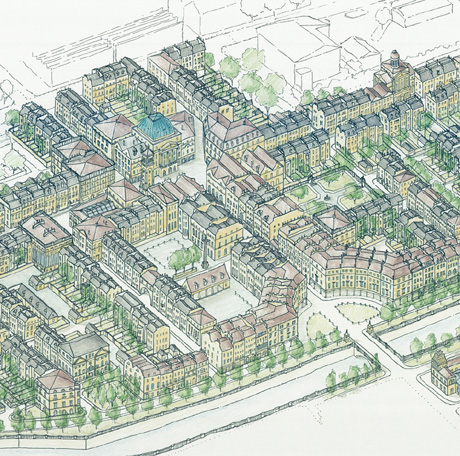 The question is particularly pertinent when architectural students from an American University can design something so much better: a masterplan that has more residents, more public and civic buildings and more on-site parking plus the acceptance by heritage organisations that it does genuinely complement the World Heritage Site.
And those images will always be around for people to say "if only ...". They must have influenced UNESCO's recommendation that the design of the Western Riverside should be open to international competition.
UNESCO and the World Heritage Committee are still expecting the State Party to produce alternate plans for the Western Riverside, and the evidence from Dresden, St Petersburg and Seville is that their patience wears thin. If they despair of Bath, do these councillors at the DCC really want to go down in history as the ones that arranged the demise of Bath as a World Heritage Site? Bear in mind that the tourist's view of a destination that is no longer recognised for its heritage is likely to be far worse than the idea of visiting somewhere that has never been especially recognised.
Then there is the Office of Government Commerce assuring Bath that the European Commission will not pursue the Crest Nicholson agreement. When was the last time a Government Department told the unvarnished Truth? What we do know is that such EC investigations are never hurried and they never pre-empt their final decision, and the British Government through the agency of the HCA cannot be seen to give money to a scheme that might later be declared unlawful. Promises and indications might be regarded as encouraging, but no final decisions will be made until the case is finally closed.
Like everybody else, we can only wait and watch what happens next. But we are not optimistic it will be "Happy ever after".
The July 2010 DCC Brief
Three pages of the Officer's Brief were a direct quote from the minutes of the November 2007 DCC meeting. Whilst this ploy insulates the Case Officer from the opinions expressed in the extract, it is disingenuous in that there are inaccuracies and misrepresentations in those minutes, which are not subsequently brought to the Committee's attention:
- Quote: The revised proposal had been reduced in height in many areas and was now in line with the newly adopted Local Plan and SPD. Consider this: The SPD sets a limit on the number of storeys, not the number of visible storeys. All the buildings quoted as 6 storeys in the application but which have an underground car park are 7 storeys by the criteria in the SPD. The three riverside buildings are overtly greater than 6 storeys. As the planning application is to be considered as a set of drawings, then that set of drawings does not comply with the SPD.
- Quote: The new scheme was in line with relevant plans and policies. Consider this: As shown above, it conflicts with the SPD.
- Quote: This left the option open for the 3 riverside buildings to be dealt with together and offers the potential for better balance to the scheme. Consider this: The expression "better balance" is meaningless. Also the potential is very limited. By granting planning consent to the outline application, the footprint, location and number of storeys in these buildings becomes fixed. The only scope then is for the design and materials of the elevations and the internal layout to be varied. But the DCC were being misled into thinking that there would be a lot more flexibility than that. The revision to the Detailed application removes the 8-storey building from the 2007 status of "outline" and it is back as a specific part of that phase. Granting permission for Phase 1A specifically gives permission to the 8-storey block beside the Victoria Bridge.
- Quote: The Senior Professional - Major Projects ... concluded that ... the proposals would not ... impact on the essential qualities of the Bath World Heritage Site. Consider this: Cllr Curran no doubt sincerely believed that, but ICOMOS-UK had already stated the opposite when they commented on the planning applications; and it is ICOMOS-UK and UNESCO and not local councillors who have the final say on what is or is not acceptable at this location in the World Heritage Site. The DCC in ignoring the advice of ICOMOS-UK were directly responsible for the UNESCO Mission being sent to Bath, and that Mission unambiguously ruled that the plans for the Western Riverside must be changed if they are to be compatible with the World Heritage Site.
- Quote: He referred to the derelict condition of the site for a number of years, and to the status of the City as a World Heritage Site which was awarded when the site was in poor condition. Consider this: UNESCO have always taken the view that undeveloped land is no bar to World Heritage status but once development starts, what is being built has to fit in with the Outstanding Universal Values of the World Heritage Site. So Dresden only lost its World Heritage status when they started to build an unsuitable bridge, and Seville is likely to be put on the "At Risk" list having given permission for an oversized bank building, until construction starts. Bath is likely to be treated the same as Seville.
As far as the opinions expressed by the Case Officer in the remainder of the report are concerned, there are again some inaccuracies and omissions.
- Quote: The site layout proposals incorporated into the Outline Application have been further amended in order to replicate the changes made in the Detailed application. Consider this: Only some of them have. There are now discrepancies between the various drawings in the Outline Application.
- Quote: The extent of the Detailed application site remains unchanged. Consider this: The red lined area is the same, but some Detailed application buildings now overlap the area and construction works granted planning permission as 07/00449/FUL, whereas previously they did not. One or the other must be an enforcement issue if both are pursued.
- Quote: The HCA wished to ... reduce the degree to which an approval of the initial phase dictated the form and layout of subsequent phases. Consider this: The SPD requires a standard form and layout across the phases, so one or the other of the HCA requirements or the SPD requirements will remain unsatisfied.
- Quote: The scheme remains generally in accordance with the spatial provisions incorporated in the Council's BWR Supplementary Planning Document (SPD). Consider this: The spatial provisions are only a small part of the SPD. Other SPD requirements are not met, such as "A fundamental consideration for any proposal will be its compatibility with Bath as a World Heritage Site." (remember the World Heritage Committee asked for "reduced density and volume of the ensemble, so as not to impact on the Outstanding Universal Value of the property" and this has not been provided) and "It is important that the massing of groups of buildings respects human scale and does not result in the perception that the development comprises large, solid, coarse-grained blocks" (the typical human scale of Bath is three storeys plus attic storey above pavement level; and large solid blocks are exactly what is proposed, see our photo montage page, still relevant because of the Officer's view that the proposed development is "broadly of the same character").
- Quote: The proposed Development Agreement would be in breach of European Procurement rules. ... This change has been designed to be EC compliant. Consider this: This is wishful thinking. The full text of the Rouanne judgement by the European Court of Justice makes it clear that any local or central government contract with a commercial organisation designed to provide public benefit from a development has to be tendered through the EU Journal. The public benefit is partly the S106 agreement but also partly from the offer of Homes and Communities Agency funding for affordable housing, and partly by the admission by the Case Officer that "the rapid transport link is to be funded to a significant extent by the Bath Western Riverside development". Our information is that a defence of the Government's position along the lines proposed by the Case Officer has already been made to the EC, and it has been rejected. The indications are that sooner or later, the Western Riverside scheme will have to be offered as an EC wide tender exercise, unless the entire development is without funding agreements, subsidies, or public facility benefits.
- Quote: Any failure to implement the residential development of the BWR at the level anticipated in the Local Plan and SPD may mean that land for additional dwellings could have to be provided elsewhere in the Bath area. Consider this: This is very carefully worded and the use of "could" conveniently leaves the option of this not being true. It is somewhat disingenuous though, in that it is designed to frighten the DCC into agreeing the plans in case something worse happens. But the Government's housing targets for the area, taken into account in 2007, have been scrapped, and the Local Plan requires "About 450 - 600 dwellings during the Plan period" on the Western Riverside, which is not a difficult number to achieve. It certainly doesn't justify approving the plans as presented, even if the understandable desire is to exceed the numbers in the Local Plan.
- Quote: UNESCO has no formal status within the UK Planning system. Consider this: This is true, but only to a limited extent. Since November 2007, PPS5 has been brought into effect, and applies to all planning decisions made after 1 April 2010. Included in the advice provided is the requirement "the heritage assets themselves should have been assessed using appropriate expertise". UNESCO designate World Heritage Sites, so their opinion is the appropriate expertise. Other guidance is "There should be a presumption in favour of the conservation of designated heritage assets and the more significant the designated heritage asset, the greater the presumption in favour of its conservation should be. Significance can be harmed or lost through alteration or destruction of the heritage asset or development within its setting." World Heritage Sites belong to the world's population, and UNESCO protect the interests of the world's population. They have already identified the harm that would be caused by this development within its setting. Local Planning authorities are advised "Substantial harm to or loss of designated heritage assets of the highest significance, including ... World Heritage Sites, should be wholly exceptional". UNESCO have advised that the 2007 plans for the Western Riverside, which are virtually unaltered in this 2010 update, do cause substantial harm.
- Quote: Surprisingly few responses have been received, particularly in comparison with the large number of objections received previously. Consider this: The number of new comments is small. But our straw poll of Watchdog members showed a couple of commonly held views. Either: the current and previous designs were considered so similar that their original objection could stand, particularly when the original application was only amended rather than being withdrawn and resubmitted; or the DCC showed themselves so devoid of sound judgement last time, despite the public comments showing how unacceptable the plans were, that there was no point in wasting time writing in again, when the expectation was that they would rubber stamp their previous decision to avoid the risk (and cost) of an appeal.
- Quote: For the most part, material Planning Considerations in this case have not changed since the Committee's assessment in November 2007. Consider this: The words "the most part" cover a multitude of sins by avoiding an obligation to give a complete answer. PPS5 has been introduced and should now be taken into account. Yet it is not mentioned. Similarly, no mention is made of Circular 07/09, which requires local planning authorities to place due weight upon the need to protect all aspects of the Outstanding Universal Value of a World Heritage Site when planning decisions are made. The omission of this information leaves the Committee potentially unaware of the recently published guidelines.
- Quote: The current form of the development is the only practicable means of delivering the number of residential units on this site which are indicated in the Council's own Local Plan. Consider this: This is disingenuous. The figures in the local plan are "About 450 - 600 dwellings during the Plan period" on the Western Riverside, and the current form of the development cannot by any stretch of the imagination be the only way to achieve that number on a 44 acre site. Nowhere in the Local plan does the number of dwellings shown in the outline application appear. Also, the University of Notre Dame demonstrated in 2009 that the use of more traditional terrace and block designs could achieve slightly more residences on the Western Riverside than the current applications along with a small number of civic and public buildings. This contradicts the "only practical means" claim, even if the numbers in the current plans (rather than in the Local Plan) may be considered desirable. UNESCO was so convinced that other options were possible that they recommended an international architectural competition.
There is an interesting "Catch 22" for the DCC to consider. PPS5 says " Where the application will lead to substantial harm to or total loss of significance [to a World Heritage Site] local planning authorities should refuse consent unless it can be demonstrated that: the substantial harm to or loss of significance is necessary in order to deliver substantial public benefits that outweigh that harm or loss." If the DCC does not refuse consent, they are admitting that the scheme delivers substantial public benefits, which is all the evidence the EU need to demonstrate that the contract does not comply with EU Public Procurement Directives.
If the DCC Members actually read and understand the policies in their Local Plan, and the Government guidance we have identified above, they will discover that a number of the policies give a clear indication that permission should be refused. But we predict that the likelihood of that happening is on a par with porcine aviation. We plan to attend the DCC and see what happens.
The June 2010 Can Of Worms
Planning application 07/02879/EFUL for the enabling works on the Western Riverside site was granted planning permission on 22 June 2010. The Officer's report states "Whilst permission has not yet been granted for the scheme as a whole, the proposals are at a very advanced stage, and are likely to be permitted this summer". There are two things wrong with this. A case officer is not supposed to gamble on the outcome of a planning decision not yet made; and if it is claimed that this is not a gamble, then he has predetermined a future decision, which is equally unacceptable. Secondly, the permission was granted for the drawings submitted in 2007, which are out of date and incompatible with "the scheme as a whole".
We think "the scheme as a whole" consists of the newly permitted Enabling Works (07/02879/EFUL), the Site Outline (06/01733/EOUT), the Phase 1 application (06/04013/EOUT), the Access Road (07/02117/FUL) and the Victoria Buildings footpath (07/00449/FUL). All but the Site Outline and Phase 1 have by now been granted planning permission. On the periphery of the scheme is the Transport Package which states that the BRT route is to run along the former railway embankment, which thus fails to connect with the access road, and which bisects a small terrace of buildings to be erected in Phase 1.
Starting with the enabling works, particular drawings are specifically identified in the enabling works decision notice "In order to clarify the scope of this permission" and these drawings show the original footprints of the buildings before the update of 06/04013/EFUL changed the layout. There are accessibility requirements for gas mains, sewers, drains and water mains, so that if leaks develop at any time in the future it is possible to access the site of the leak to repair it. Electricity services do not leak in the same way, but the requirement for access to repair faults still applies. Agreement would have been reached with the service providers that the routes in the enabling works were acceptable to them. So the Service providers will want to review any agreements in place if the buildings above their services are going to be in different positions, yet the routes of the services and the locations of the buildings above them are part of "the scope of the permission" and any changes required by service suppliers or the developer will invalidate the enabling works which are now specifically scoped to the superseded site plans.
But it doesn't stop there. A terrace of buildings in the Outline and Phase 1 plans occupies part of the car park associated with the Victoria Buildings footpath permission, and that permission includes a garden boundary wall which continues part way through this newly proposed row of buildings. The Access Road permission included footpaths which are to be omitted or blocked by trees in other plans, and depending on which plans you look at Victoria Bridge Road can be in different positions. Planning applications are supposed to be determined independently of other applications, so such incompatibilities are within the rules. But the outcome does show the folly of making planning decisions as token gestures in advance of firm and final plans. We also notice that the locations, the presence or absence of some buildings varies depending on which drawings within the outline application you look at. Not all that should have been updated have been. As planning permissions are granted for a set of drawings, these mutually exclusive drawings would invalidate any permission granted on the current set.
New documents have been lodged against both the outline application and the Phase 1 application. Included in these is a flood risk "Sequential Test" document, which uses as part of its justification the Regional Spatial Strategy targets that have been abandoned by the new Government, and in part the SPD which was written before PPS25 (which mandated the sequential test) came into force, and in any case that SPD rules out planning permission for tall buildings. If the Environment Agency believe that they have been misled by the Sequential Test report, they have a right to demand a Public Inquiry, and unless the Sequential Test document is rewritten to reflect the current guidelines, they should do just that.
Finally our wildlife spies report that the claim that badgers only forage on the railway embankment from a sett off-site is not true. So the Ecology Report, which appears to have monitored the originally identified setts rather than search for new ones within the application boundary, is inaccurate and needs to be corrected to reflect the facts.
It will be interesting to see whether these facts are part of the report to the DCC when they debate the latest amendments, if indeed they do in the timescale being predicted. We don't think that the document set can be made consistent in that "this summer" timescale, particularly when the rerouting of site services relative to the new layout requires the revised agreement of the service owners, which they can't lodge against a planning application that is already determined.
Granting permission for two (or more) mutually incompatible designs invalidates them. So unless the documents and permissions are all consistent, Enforcement will be placed in an impossible position. The whole document set is in disarray and not in a fit state for a decision to be made; and it will not be acceptable for the DCC to be mindful to approve and delegate to officers to resolve, because then they won't have a clue what might eventually be documented in their name. Besides, no officer has the power to revoke a permission already granted, nor to raise variation applications. So such a delegation would be an abdication of the Committee's responsibilities, and it would not solve the problems caused by the permissions already granted in any case.
The critique of the outline application submitted by ICOMOS-UK is as valid today as it was when it was written, because the recent update made no real changes apart from a few tweaks for Phase 1. It was that critique that let to UNESCO sending a Mission to Bath, and the Mission Report led the World Heritage Committee asking the State Party (normally DCMS) to produce alternative plans for the Western Riverside. And what will happen if DCMS reports to the World Heritage Committee in February 2011 a solution for the Western Riverside that either does not reflect the wishes of the World Heritage Committee or differs from the plans embodied in planning applications, is anybody's guess. As a minimum, we would expect UNESCO to treat it as a failure of stewardship. The recently introduced PPS5 makes it clear that the current plans for cramped brutalist blocks on the Western Riverside should be a dead duck. UNESCO will expect no less.
The April 2010 Update
In April 2010, a large number of updates were lodged against the two planning applications that were considered by the DCC in October 2007 (see The DCC Meeting below). Despite the DCC being mindful to permit, no planning permission documents were subsequently issued, so it is possible to subsequently amend the applications, even though we consider the scale of the amendments (the whole site outline 06/01733/EOUT has around 50 new documents, the detailed Phase 1 application 06/04013/EFUL has about 80) is an excessive amount for an amendment and new applications would have been preferable.
Our first impressions of the whole site outline is that there are two main differences from the original. The BRT Route that had run along the old LMS rail route has been displaced northwards, and to the east end of the site the embankment has been removed completely. Across the site this BRT route is not dedicated, and the documentation shows these roads shared by other buses and general vehicular traffic. The west of the site is otherwise virtually the same, but to the east, the layout of the buildings, and the heights of some of them have been altered. These changes are the main thrust of the amendment to the Phase 1 application.
Layout
We have created the picture below based on the information from two of the submitted drawings. In the planning application, heights have been quoted above mean sea level, but we have converted these into how high they would be compared with the surface of the river towpath alongside Norfolk Crescent, which gives a much more realistic impression of how it will look to the local observer. These heights are shown in red on a selected sample of the building images.
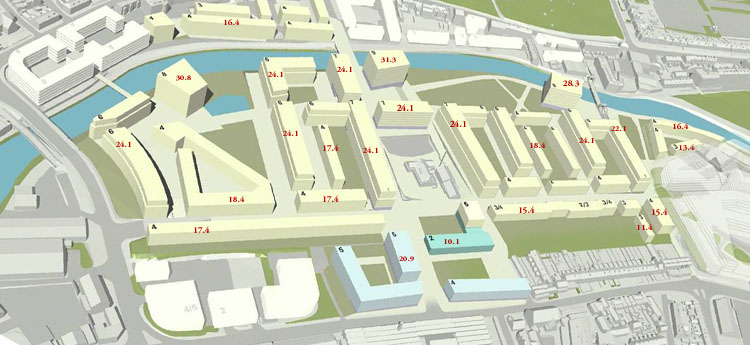
We have shown the heights in metres, but for those who prefer imperial units, 30 metres is about 100 feet. The black numbers on the buildings are the number of storeys. Note that these are not always a standard height: by our calculations, one storey can vary between 11ft 5in to 14ft 8in (16ft 7in for the school) depending on which building it is, in the same way that part of Southgate is 4 storeys but is the same height as the 6 storey Carpenter House. The Western Riverside SPD specifies a maximum height of 6 storeys (though it does not specify any height for a storey), so all the 7, 8 and 9 storey buildings fail to meet the council's planning constraints for the site.
Buildings
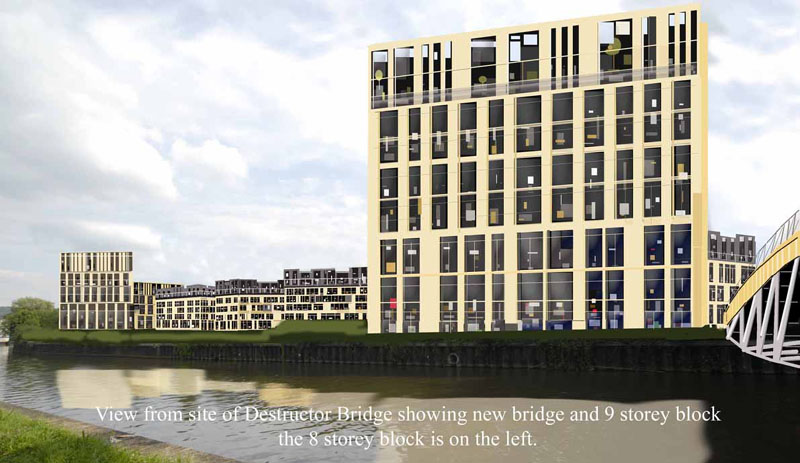
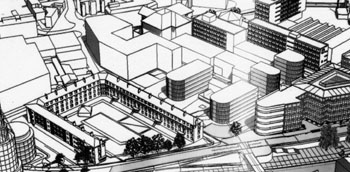
The heritage descriptions of Bath all emphasise "the human scale" of Bath (and also the limited palette of materials), and the picture below, our artist's impression of the view across the river by the Destructor Bridge, shows how this development fails to meet that objective.
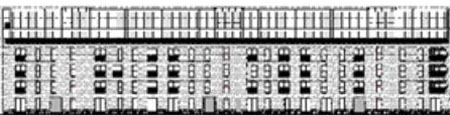 We have based the above picture on some line drawings that indicated the style proposed. On the right is a block clearly showing the double height roof area. These double height roofs were criticised by English Heritage when originally proposed, and the revisions put before the DCC in 2007 made them all single height. But now the double height ones are back! This sketch is a representation of the long block along Victoria Bridge Road. By our calculations this is 22.1m (or 72ft 6in) above the surface of the river towpath.
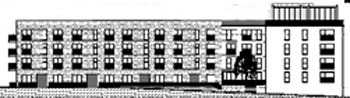 The next picture on the right is the four storey block to the south of the one above. to our eyes it is an identically styled building except for the roof and the balconies sticking out the end. We calculate the height of the lower or left hand side as 18.4m (or 60ft 4in) above the surface of the river towpath. This is more realistic as a "human scale" building, but the design fails to reflect the "Golden Ratio" that typifies Bath: this is 1960s styling, and cheap mass-produced 1960s at that.
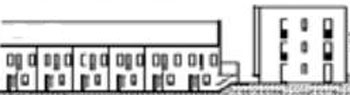 Finally the sketch on the right is the "Affordable Housing" section towards the Lower Bristol Road end of Victoria Bridge Road. The houses as sketched are not ideal, but could be improved by better spacing of the windows and some attention to detail in visually breaking up the expanse of roof. But the buildings are in the right scale and proportions, and are the least objectionable proposals for the site. We calculate the height of the houses as 11.4m (or 37ft 5in) above the surface of the river towpath. However, when placed alongside the flats to be built next to them whose height we calculate as as 15.4m (or 50ft 6in) above the surface of the river towpath, the overall impression given is that Snow Hill is being replicated on the Western Riverside.
Other issues
Nowhere in any of the documentation could we find any real consideration of the World Heritage Site. What makes the concept of World Heritage exceptional is that World Heritage Sites belong to all the peoples of the world, irrespective of the territory on which they are located. So the peoples of the world, as represented by the World Heritage Committee, and not Bath's residents and council, should be the arbiters of what is acceptable. And in the discussion on Bath at the meeting of the World Heritage Committee in Seville last year, they indicated that Phase 1 could be made acceptable. The Committee required the State Party [ie the British Government] to "submit to the World Heritage Centre and ICOMOS, for review, a revised plan showing that all necessary social facilities have been included in the first Phase of the Bath Western Riverside project". But this revised Phase 1 contains just housing, when "social facilities" would include doctors, dentists, hairdressers, shops, community facilities, cafes and pubs. What is more, the plans have not been submitted to the World Heritage Centre and ICOMOS (we checked!) but only to the council's planning office.
The World Heritage Committee also required "the State Party to submit to the World Heritage Centre and ICOMOS, for review, a time-bound revised plan for the second and third phases of the Bath Western Riverside project, including revised density and volume of the ensemble, so as not to impact on the Outstanding Universal Value of the property, its integrity and on important views to and from the property". The UNESCO Mission to Bath went a step further and asked for "reduced density and volume of the ensemble, so as not to impact on the Outstanding Universal Value of the property, its integrity and on important views to and from the property, and so as not to add a new barrier within the Northern and Southern parts of the City (as it currently is in the proposal the mission reviewed). The development of those two phases should be submitted to an international architectural competition".
But apart from a few minor, almost cosmetic, changes to the proposals for Phases 2 and 3 the plans as seen by the Mission remain unsatisfactory from a World Heritage perspective as shown by the World Heritage Committee's judgements. This should be sufficient to secure refusal according to the Local Plan which shows:
POLICY BH.1 Development which would harm the qualities which justified the inscription of Bath as a World Heritage Site or which harm the setting of the World Heritage Site will not be permitted. This is reinforced by the newly introduced PPS5 which says:
HE7.2 In considering the impact of a proposal on any heritage asset, local planning authorities should take into account the particular nature of the significance of the heritage asset and the value that it holds for this and future generations.
At the DCC for the previous Western Riverside applications, the council has argued that the rules should not be applied "for the greater good", ignoring the fact that there is no greater good for the world at large. PPS5 does offer some guidance in this area:
HE7.5 Local planning authorities should take into account the desirability of new development making a positive contribution to the character and local distinctiveness of the historic environment. The consideration of design should include scale, height, massing, alignment, materials and use.
It is clear to us that given the World Heritage Committee criticism, no claim can be made that the virtually unchanged plans for Phases 2 and 3 offer "a positive contribution". The scale, height and massing also exceed the maxima quoted in the Western Riverside SPD. We would not be surprised if the council pretends that it does make a positive contribution though, so we return to PPS5 for a further piece of guidance:
HE9.2 Where the application will lead to substantial harm to or total loss of significance local planning authorities should refuse consent unless it can be demonstrated that: (i) the substantial harm to or loss of significance is necessary in order to deliver substantial public benefits that outweigh that harm or loss;.
And it is here that we point out that the designs of the University of Notre Dame for the Western Riverside were in keeping with the World Heritage Site, and provided as many dwellings as the Crest Nicholson plans, so the council cannot pretend that the plans in front of them are the only option and therefore must be approved for the greater good. Therefore the damage to the World Heritage Site cannot be justified on the grounds that it is necessary in order to deliver public benefits when other solutions are demonstrably possible. It could be for that reason the recommendation by the Mission was for an international competition.
We have already notified ICOMOS and the World Heritage group at UNESCO that there are revisions to the planning applications that are incompatible with the recommendations of the World Heritage Committee, and we would expect that Committee to review the situation at its next meeting. By failing to inform ICOMOS and UNESCO of the revised plans ahead of them being entered into the planning process, B&NES has again broken the terms of the World Heritage Convention on behalf of the UK Government.
Legal minefield
Meanwhile following on from our earlier report, we have checked with the European Commission, and they have not yet seen satisfactory evidence that the contract between B&NES and Crest Nicholson complies with Directive 2004/18/EC which was enshrined in UK law as "The Public Contracts Regulations 2006": Statutory Instrument 2006, Number 5. The European Commission continues to investigate, but ultimately will hold the UK Government responsible for any infringement. We would expect the UK Government to then hold the local council responsible under the UK Statutory Instrument. The EC never moves quickly in such cases, but the problem is not going to go away.
It appears that the Public Contracts Regulations make provision for any competitors of Crest Nicholson to sue the council for lost opportunities for profit if the EC eventually rule that the contract is illegal. This could be very expensive.
The outgoing Labour Government turned a blind eye to the occasions when B&NES failed to adhere to the regulations creating problems for Central Government. It remains to be seen whether the new coalition will be similarly relaxed, or whether it will take exception to such failures.
Goodbye Gasometers
[19/9/09] Watchdog got in touch with various organisations to establish their position regarding the demolitions.
• English Heritage believed that the principle of demolishing them had been established as part of the Western Riverside development, but were surprised that they were being demolished now when the Western Riverside planning permission has not been granted and therefore a condition of an archaeological survey of the structures was not in force.
• The Planning Officers were unaware that this work was to take place now, but pointed out that unlisted structures that are not in a Conservation Area do not need planning permission for demolition, so that even if they had known in advance, the council had no powers to prevent demolition.
• Wales and West Utilities who are carrying out the work gave us an explanation: "The works are necessary for safety reasons and follow a number of discussions with the HSE concerning the structures. The holders have been decommissioned for a number of years and because of their condition, the most responsible solution is their removal." In response to our enquiry about whether an archaeological survey had been conducted before work started they said "I am not aware that a survey such as you have described has been carried out, or is necessary for these works to have proceeded. Unfortunately the work cannot be suspended due to its advanced stage. Doing so would leave the structures in an extremely vulnerable and unsafe condition, particularly in the event of bad weather. The site remains a 'live' operational gas installation and our primary concern is the health and safety of our workforce and the public who may be in the vicinity of the holders. Works are planned to be completed by the end of this week."
We regret that work started without an archaeological survey, but we cannot argue with the position that the work would be unsafe to halt part way through. We will pursue with Wales and West Utilities whether they have any historical information or drawings, which would at least preserve the records of what was there, even if we couldn't preserve the structures themselves.
[6/9/09] On 1st September, work started on demolishing the gasometers on the Western Riverside site. Whilst this action was always in the plans, the fact that there was no announcement before the work started is to be regretted.
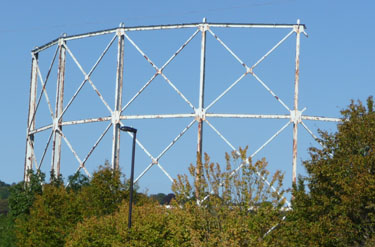 The news was published in the Chronicle after the work started, but that new report carried some misleading information. It said "A third, smaller, tower will remain for the time because it is still being used." The one still being used is one of the larger ones.
The larger gasometer being cut up (we don't think the word dismantled used in the Chronicle is an accurate description) has for some unknown reason been left with a third of its structure still in place (see picture). We have no particular concerns about this structure. The original one in that location was destroyed by a 250Kg bomb at 23:28 on 25 April 1942 and a replacement was built. The other large gasometer, the one still in use, is also a wartime reconstruction.
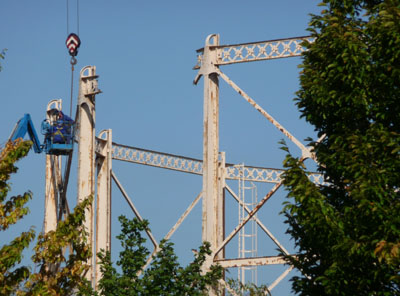 But the smaller one was particularly important, because it was the only one that survived the wartime bombing. The former Bath Gas and Coke Company was one of the first gasworks in Britain: it opened in the final years of the Georgian period, though it was considerably extended by the Victorians, and the small gasometer was the oldest surviving structure on the site.
The Victorian Society believed it was one of the oldest surviving gasometers in the country, and would have liked to have seen it carefully dismantled so that it could be re-erected somewhere else, such as in an industrial museum. With a bit of notice, such a future might have been arranged.
However, look at the picture on the left. It is not being dismantled, it is being chopped up with a cutting torch. Such an approach not only removes it from the Bath skyline it has graced for the last century and a half, it makes sure that nobody else can rescue it for posterity either. What happened to the condition on the Western Riverside that all archaeology should be carefully documented before it was removed?
So we wonder: Who told the Chronicle that the small one was being left? And who told them that the gasometers were being dismantled? Because neither was true.
European Commission infringement Proceedings
[6/9/09] This is what we have learned:
Article 226
"If the Commission considers that a Member State has failed to fulfil an obligation under this Treaty, it shall deliver a reasoned opinion on the matter after giving the State concerned the opportunity to submit its observations.
If the State concerned does not comply with the opinion within the period laid down by the Commission, the latter may bring the matter before the Court of Justice." [EU Lexicon]
According to the Office of Government Commerce, Article 226 procedures progress through stages.
Letter of formal Notice: This offers the Member State an opportunity to respond to an allegation that it is in breach of Community law.
Reasoned Opinion: The Commission formally advises a Member State that it is in breach of its Treaty obligations and describes the rectifying action. The Member State is required to comply with its EC obligations - not only to reply to the reasoned opinion - within a given time limit.
Referral to ECJ: If the Member State fails to comply with a reasoned opinion within the prescribed period, the Commission will apply to the ECJ for a ruling that the Member State is in breach of the Treaty. The ECJ can impose penalties.
The European Commission, on 25/6/2009, decided to initiate infringement proceedings against the UK Government. These proceedings are pursuant to Article 226 of the EC Treaty, and a Letter of Formal Notice has been sent to the UK Government.
Article 226 proceedings are the means by which the European Community ensures that Member States observe the obligations they have undertaken (see box right). In this case, the obligations to be enforced are public procurement rules, so it looks to us that the formal complaint procedures have now been initiated in respect of the B&NES contract with Crest Nicholson, which we anticipated would happen, see "EU Procurement Rules" in the box below right. This is a major development with a significant potential impact, yet we have been unable to find any reference to the Letter of Formal Notice on the B&NES website.
We checked what the Homes and Communities Agency (the successor to English Partnerships, who had promised Government funding for the Western Riverside) thought of this action being taken by the EC. We now know that the Homes and Communities Agency has already let Crest Nicholson and B&NES know that it will not consider, even in outline, any investment approach for the Bath Western Riverside Project until this infringement issue is resolved.
So clearly B&NES (or at least, some senior officers in B&NES) do know the serious situation they are in, they are just keeping it quiet. And yet the council are still using the Western Riverside development as part of justification for the BRT! That argument is now dead.
As a final observation, we have discovered that the Office of Government Commerce is planning legislation to give those disadvantaged by contracts in breach of EU Procurement rules the right to seek damages from the authority that let the offending contract. The timetable is to enact the legislation by the end of 2009. We have been unable to establish whether the legislation would backdate those rights.
UNESCO Mission to Bath
EU Procurement Rules
A year ago, we warned that the European Commission was investigating various council contracts which they thought did not comply with procurement directives (see our early alert and the subsequent developments).
We have just learned from the York local press that the EC's first formal complaint under this series of investigations concerns a development in the City of York. The complaint was made to the British Government rather than to York council
We believe that eventually a similar complaint will be made regarding Bath council's contract with Crest Nicholson, but we have been unable to obtain an indicative timescale.
As the agenda for the 33rd World Heritage Committee meeting in Seville passed the time when the report of the mission to Bath was discussed, the contents of the Mission report started to emerge. The Chronicle was first, with some comments from others placed on-line, which was somewhat speculative, hotly followed by BBC Radio Bristol with an on-air interview with the Council Leader and a Watchdog spokesman, eventually followed by another Chronicle item revealing the full text of the paper presented at Seville. And that, finally, allows a proper analysis of what was said.
It does not guarantee that the World Heritage Committee will agree with everything it says: it is, after all, a report to the Committee for the Committee to discuss and decide what it wants to do. The Committee's decision will be published later. It is reasonable to assume that the Committee will accept many if not all of the recommendations, but they have the ability to strengthen or weaken any of them, so we have to wait until the decision is published before we know exactly what it is.
It is important to understand that UNESCO reports are always expressed in diplomatic terms, and the approach taken with any difficulties affecting World Heritage Sites is to try to find a negotiated solution. So anybody reading it expecting to find dire threats of removal of World Heritage status is going to be disappointed. It remains as the final sanction, and nobody should doubt UNESCO's will to use it if they exhaust other options, but there will be a lot of discussion and negotiation before a decision is reached that there is no other alternative. Bath needs to take its warning from what happened to Dresden (see box below right), yet recognise that it took three years to reach that conclusion.
Dresden Loses World Heritage Status
 In 2004 Dresden was made a World Heritage Site. In 2006, it announced its intention to build this bridge over the River Elbe.
After three years of negotiation during which UNESCO tried to persuade Dresden to opt for a tunnel or a different design of bridge that would be in keeping with the Outstanding Universal Value of its surroundings without success, the meeting in Seville has announced that Dresden will be deleted from the list of World Heritage Sites.
In the New York Times is an interesting article from early June blaming the problem on the German Government rather than on Dresden.
The State Party
The report refers to the State Party. That is DCMS, the Department for Culture Media and Sport. DCMS was required to report on the state of conservation of each World Heritage Site in Britain, which they routinely do once a year, usually on or around the 1st February. Exceptionally this year, they had to respond to the report of the findings of the Mission to Bath (and also the Mission to Edinburgh). According to the paper presented to Seville the State Party indicated that it was not possible under the United Kingdom planning scheme to withhold final approval if all other stages of the planning procedure had been completed.
This statement, made at the time that Hazel Blears was in charge, is not true. Section 77 of the Town and Country Planning Act allows the Secretary of State to call in any planning application where permission has not been granted for the Secretary of State's determination, and in the case of the Western Riverside permission has not been granted, the council has only signalled its intention to grant permission if an acceptable agreement is reached, so it could still be called in for a Public Inquiry and that Inquiry could still decide that planning permission should be refused. Then there is Section 97 of the Town and Country Planning Act which allows the Local Planning Authority to revoke any planning permission granted where the development is not yet completed, halting work at that point but not requiring any work completed by that time to be undone, and Section 100 gives the Secretary of State the same powers. So the State Party has lied to UNESCO, and it remains to be seen whether the new Secretary of State will allow the lie to persist
The Mission indicated that the first phase should not be stopped (though they said it does need to be changed), but we have to question whether that view was reached on the basis of the false advice from the State Party that it couldn't be stopped.
Mission Recommendations
Reading through the Mission report, there are a few oddities: the claim that similar heights to the 8-storey buildings can be found in the historic quarters of Bath leaves us wondering where, apart from the rear of the Paragon as seen from Walcot Street, which is atypical; the claim that new buildings will not have more impact than the gasometers, when the gasometers are transparent giving views of the trees and hills through them and buildings are solid; the claim that there will be boat commuting to the city centre when there is no current plans for them to land when they arrive.
There are parts of the report that paint a healthy picture, and we agree with their findings. The main properties like the Roman Baths and Royal Crescent are indeed well maintained and properly promoted, and there has been some progress towards reducing visual clutter around the city. In other places, the Mission has been in no position to see through the spin: the fact that those making the planning decision cared not what the visual effect of the Holburne extension would have on the views from Sydney Gardens, and the fact that the council's own figures that show that the Transport Plan would have a negligible effect on pollution levels.
Hence the Mission concluded that current state of the property (by which they mean the World Heritage Site) is in a good overall state of conservation. And it is on the whole, though some buildings such as the Cornmarket have been neglected for too long, and the council's refusal to implement their Local Plan policy for Locally Important Buildings puts other structures at risk. However it is the future plans that cause the Mission some concern.
In the case of the Western Riverside, Phase 1 is thought to lack the necessary social facilities. This suggest to us that there is an expectation that the New Urbanist concept of neighbourhoods (which we have reproduced on our Notre Dame page) will be expected to be followed for the Western Riverside. The current plans for Phase 1 do not comply though, so despite the Mission having no great concern about the position and size of Phase 1, they are concerned about the scope; effectively the Mission is demanding changes before planning permission is granted.
As far as the Western Riverside Phase 2 and Phase 3 plans are concerned, the Mission for all its diplomatic language, leaves no doubt that as currently presented they do have a serious impact on the Outstanding Universal Value; so much so that they urge an urgent re-think, perhaps through an international architectural competition (which might remove the need for an EC investigation into the Western Riverside procurement process). This view is entirely consistent with the comments made by ICOMOS-UK when the outline planning application was being discussed, that it fell far short of expectations for a World Heritage Site. If the World Heritage Committee endorse this recommendation, then they they are effectively asking for significant revisions that they will approve or veto before anything is submitted into the planning process. The World Heritage Convention requires this level of consultation for all major developments, but until now B&NES has ignored the requirement. UNESCO are unlikely to allow them to do so in future.
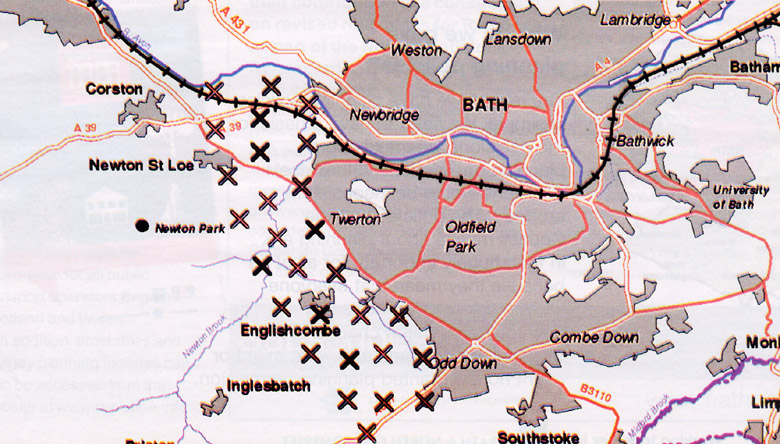 The requirement to enhance the protection of the surrounding landscape to prevent adverse impact is open to interpretation. It may be asking for a formal buffer zone to be declared right around the city boundary, but it could equally be asking that the existing legislation covering the protection of the Green Belt should be strictly enforced. Either way, we believe this is a very clear indication that the Mission does not approve of the Park and Ride plans, nor the regional Spatial Strategy for building houses on a very large swathe of Green Belt along the South West boundary of the World Heritage Site (see picture, right).
The final recommendation sounds innocent enough but packs a real punch. It asks for a reinforced, integrated and homogeneous interpretation for all the attributes of the Outstanding Universal Values.
 Reinforced
indicates that World Heritage control should be backed by legislation which cannot be ignored during the planning process. Integrated means social and employment facilities should complement dwelling provision and that everything should operate to common standards laid down in the World Heritage Management Plan, so what is acceptable near the Royal Crescent shouldn't be different to what happens in Locksbrook or Twerton. Homogeneous means that everything should look as though it belongs in Bath, so glass palaces like the Dyson Academy or the office block towers shown in the Cullinan plans (pictured right) will not be acceptable. In short, supplementary Planning Documents should enforce style guides, which should enforce "Bathness". The Mission clearly want to see Bath move away from "High Street Anywhere" shopfronts and "It stands out so I want an award" architects. The Notre Dame exhibition showed that neither are necessary.
Reinforced
indicates that World Heritage control should be backed by legislation which cannot be ignored during the planning process. Integrated means social and employment facilities should complement dwelling provision and that everything should operate to common standards laid down in the World Heritage Management Plan, so what is acceptable near the Royal Crescent shouldn't be different to what happens in Locksbrook or Twerton. Homogeneous means that everything should look as though it belongs in Bath, so glass palaces like the Dyson Academy or the office block towers shown in the Cullinan plans (pictured right) will not be acceptable. In short, supplementary Planning Documents should enforce style guides, which should enforce "Bathness". The Mission clearly want to see Bath move away from "High Street Anywhere" shopfronts and "It stands out so I want an award" architects. The Notre Dame exhibition showed that neither are necessary.
The Future
Make no mistake, unless the World Heritage Committee dismisses the Mission's recommendations, which is highly unlikely, they will be looking to Britain to honour the World Heritage Convention it signed up to and promised to follow. This means having a World Heritage Management Plan which has more authority than any council "Vision", proper compliance with the requirement that any major development should be submitted to the World Heritage Committee before any planning decision is reached, and proper control over the setting and appearance of the World Heritage Site. In a nutshell, Bath is no longer trusted to look after its heritage without UNESCO keeping a close eye on it.
The reaction by DCMS and B&NES to this very polite but rather damning report will determine what happens next. Both have to take it seriously and try to reach an acceptable agreement with UNESCO if Bath is to avoid being added to the "In Danger" list in future. One thing is certain: the Major Developments team can no longer be allowed the free rein they have been given in the past.
UNESCO Mission to Edinburgh
Although there is no information on what the report from the UNESCO Mission to Bath said, the recent article in The Scotsman about the report by the Mission to Edinburgh offers an important insight. It must be remembered that the same members from UNESCO and ICOMOS went to both Edinburgh and Bath. We have also looked back through the archives of The Scotsman to see what was reported about Caltongate last November while the mission was in progress, and there are a number of parallels with Bath.
In November, UNESCO's European Heritage chief said that the move to allow a developer to lead the masterplanning, instead of the local authority, was highly unusual in a World Heritage site and that "It's very puzzling that the council did not lead the original masterplanning process. Had this happened, we believe many of the tensions over Caltongate could have been avoided and the proposed development would have looked a lot different". For Bath's Western Riverside, the council allowed the developer to create the Outline Planning Application, which the council referred to as a masterplan. But ICOMOS-UK disagreed. In their comments on the outline application, their statement We consider that any development of the Western Riverside should be based on a detailed Master Plan and an analysis of Bath’s spatial planning, skyline and significant views makes it clear that the masterplanning process had not been conducted properly in Bath either.
In the Edinburgh report, UNESCO ask for the total redesign of a huge part of the development. We believe that a similar demand will be made on Bath.
In the Edinburgh report, UNESCO state that there is a need for clear policies in relation to height controls within the world heritage property. The Western Riverside has a Supplementary Planning Document which set the ceiling on the development at six storeys (which we consider to be ambiguous because it doesn't say how tall the storeys can be), but then it ignored its own policy and approved a number of blocks consisting of a parking storey and six residential floors above, which even a child could add up and make seven. Bearing in mind that the Southgate shopping development of four storeys (counting from the pavement; we will ignore the underground car park for now) completely dwarfs the four storey Georgian buildings along Southgate, control based on the number of storeys is insufficient in any case. The Outstanding Universal Value of Bath includes the appreciation of a human scale for the buildings, and that was not at all in evidence in the designs for the Western Riverside.
In another article in The Scotsman, in response to the criticism of Caltongate, Scottish finance secretary John Swinney insisted the government would respect the views of UNESCO's world's heritage committee when it rules on major developments in Edinburgh next month – saying the body had a fundamental part to play in the planning process. It is perhaps only a matter of time before DCMS are forced into a similar admission about the Western Riverside. Then perhaps the Major Projects personnel might negotiate with the World Heritage Committee to establish appropriate solutions to ensure that the outstanding universal value of the property is fully preserved, something the World Heritage Operational Guidelines, which the British Government committed to implement, require.
Finally, according to The Scotsman: UNESCO's report [on Caltongate] will also recommend the creation of a buffer zone around the current world heritage site. Like Edinburgh, Bath currently lacks a formal buffer zone, but the Mission were under the impression that the Green Belt around Bath was sacrosanct and therefore no formal buffer needed to be declared. Watchdog has already informed the World Heritage Committee that the council has approved Park and Ride facilities on the land that the Mission thought would be open green space for all time, and we fully expect that Committee when it meets in Seville to insist on a formally defined and inviolate buffer zone around Bath.
So whilst the above is speculation, it is considered likely that the disapproval expressed over the development plans for Edinburgh, and the actions proposed to force those plans to be revised to take World Heritage properly into account, will be very similar to the outcome as far as Bath is concerned.
BMW Garage
 [9/8/09] This was the first application on the DCC Agenda for 5th August. From the outset it was obvious that there were problems with the audio system and the acoustics of the room. This reached a point that when Members complained that they could not hear what was being said, and the Chairman adjourned the meeting while these problems were sorted out. The delay was some 15 minutes.
The presentation on the BFI Waste systems was given by an unnamed Council officer. We were told that the site is in the area classed as the Western Riverside and that location was earmarked for a landmark building. We were then shown drawings of the surrounding area indicating layout height and massing which appeared to be the old original and superseded proposals. These were used to justify the height and bulk of the proposals by showing that at 4 storeys it would be dwarfed by the massive blocks behind it. This would clearly mislead the Committee, because the latest drawings have a terrace of low houses with gardens where the massive blocks were shown. (Sheer incompetence, or deliberate lies? We leave you to make up your own mind!). We were told the car transporters would access the site of the Windsor Bridge Road, virtually at the point the BRT is to cross it and a controlled barrier is to be put in. We were informed that there had been new drawings and the flats reduced from 10 to 7. (Those "new" drawings were dated February 2009, so how old was the brief that the Council Officer was reading from? And why was there no mention of UNESCO's expectations of a redesign of that part of the Western Riverside? Was it omitted because the report was older than the news from UNESCO? We have seen some shoddy Case Officer reports during our activities, but this one was truly dreadful!). We were also informed that the design and materials were meant to be different. (Meant by whom, we wonder? Until the applicant asked the council for advice, a perfectly acceptable low-key structure was being put forward).
Public speeches were made on behalf of the Bath Society, when the UNESCO wording about the second and third phases was brought to the Committee's attention; and then Watchdog, when the discrepancies between the Western Riverside SPD and the design presented were brought to the Committee's attention. We also let the committee know we had noticed that this application and one for an access road approved recently under delegated authority were both enablers for the BRT route across the Western Riverside which would be discussed further down the agenda.
Cllr Curran started the debate. He picked up on the transport issues such as the BRT entry and exit points, and agreed the design was not acceptable.
Cllr Coombes also said the design was not appropriate and could not understand why anyone would want to stick two storeys of housing on top of a car showroom.
Cllr Jackson was referring to Waterside Court (refused permission by the council yet granted permission on appeal), and not the new and still under construction Charlton Court.
Cllr Jackson said the student block was appalling and could not be used as justification. She said that the materials were wrong and timber cladding should never be used. She agreed with Cllr Curran about the transport arrangements.
These three were the only exponents of common sense.
The debate on the other side of the argument started with the view that this application has been lying around for too long and needed to be dealt with (yet the only recent documents on the planning application were from the Environmental Health Officer and his objections and his recommendations for further research into noise hazards were completely ignored so he could have been ignored weeks earlier, or else he could have been heeded and a decision made later when new results were available; there had to be a political motive behind the precise timing of 5th August). Some of the more notable quotes were:
Cllr Willcox: "Yes the design is not good but I do not see that as a reason to refuse".
Cllr Bull: "Not the best of designs but after all you have got the student block along the road and other car showrooms so given that it will fit in. Anyway it is not trying to be a landmark building". (Did he not remember that both the SPD and the presenting officer said it was a landmark building?)
Cllr Webber "It seems a reasonable compromise". (Compromise between what and what, we wonder?)
Not one person who spoke was in favour of the design and yet despite this, despite the fact it is in a prominent location in the World Heritage Site, despite the knowledge that it is to be constructed of materials that don't conform to the SPD (so those who slaved over writing the Western Riverside SPD and getting it approved now know that they wasted their time) and despite the fact that UNESCO have already expressed concerns over the massing of the Western Riverside, planning permission was granted by 7 votes to 5.
Does anybody believe in coincidences, when exactly the same voting pattern appeared at the end of the subsequent BRT debate? The same BRT that would share the entrance construction works from the Windsor Bridge Road and take advantage of the lowered soil levels that this application would provide? Cynical? What us?
[2/8/09] The report to the DCC was written by a remotely located consultant case officer rather than by one of the council's permanent staff - and it shows. The report to committee has errors, omissions and a determination to recommend to permit that cannot actually be justified by the documents he is supposed to have read. We are fully aware that those who select and pay for a consultant choose the consultant who will give the "right" answer. Therefore a recommendation to permit can be assumed to be a chosen outcome. So it is no coincidence that this application is on the same agenda as the discussion of the BRT. The DCC members are intended to be gullible enough to believe that 7 dwellings on top of a car showroom means the BRT must go though the Western Riverside.
The case officer makes numerous references to the Western Riverside SPD. He uses it to justify the height as equivalent to 5 storeys on the grounds that there would be perhaps a taller building next to it, but omits to notice that the outline design for the Western Riverside shows the adjacent building to be 3 storeys plus attic terrace immediately outside the boundary wall, and that they will be completely dwarfed by this development and the end of the terrace will be starved of sunlight by this tall building immediately to the south. Yet the report says the council is encouraging high development on the adjoining land. 2/10, more homework required!
What the report doesn't mention from the Western Riverside SPD is the residential design codes. In there we read:
• Top floors must be treated as a proper roof form - for example a mansard. The report is happy with a flat steel roof.
• Large expanses of surface car parking will not be permitted. Yet all parking is surface.
• Replicate the existing contextual forms of terraces. This is a tower block.
• No direct access for vehicles from street. Access is provided from both Windsor Bridge Road and Lower Bristol Road.
• Unacceptable materials [includes] Timber ply panels, Sheet or profile metal, Reconstituted Bath Stone. All present!
• Location restriction: Natural or white painted timber boarding, only at river edge. This location is as far from the river as it can get.
On these variations from the SPD, there should only be a recommendation to refuse, particularly when a large number of revised drawings were submitted after the SPD was written, so it should have been taken into account.
But by far the biggest lie in the report concerns the issue of noise. The report says: The Environmental Health Officer objects on the basis that the site is not suitable and has stated verbally that there are concerns that the site may fall within category `D' where planning permission should normally be refused. Wrong! The Environmental health officer wrote his concerns down, and we can read them on the planning file. We read:
I have spoken to the noise consultant who carried out the noise assessment for this site and explained my reservations regarding the noise assessment which can be summarised as follows:-
• That the 24 hour noise survey was undertaken at a location within the site which would not give results which were truly representative of the noise levels at the facades of the new dwellings (i.e further away from the carriageway than the dwellings will be, and possibly partly screened) and therefore that the Noise Exposure Category was possibly understated.
• The location of the new workshops and wash facilities are adjacent to another site zoned for residential development and therefore the noise from activities undertaken need to be assessed with any future residential development on that adjoining site in mind
I share the concerns expressed by David Carter in his response to the original consultation regarding residential use of this site, which is adjacent to one of the District's busiest and noisiest junctions, in terms of Road Traffic Noise.
The public Health implication of allowing a residential development on this site are unacceptable if it falls into NEC D and not in accordance with the guidance in PPG 24.
Newly published Government research acknowledges the proven link with chronic exposure to road high levels of road traffic noise and heart disease.
Faced with the admission from the applicant's noise experts that their noise readings cannot be trusted, and the knowledge (if he had bothered to look it up) that the workshops would be at the bottom of a (very short) garden behind a row of terraced houses, the proper answer would be to ask for more accurate noise level assessments before making any recommendation. The alternative is to recommend to refuse, on the grounds that the measurements taken are an underestimate and PPG24 says that for Noise Exposure Category C, Planning permission should not normally be granted. Those who know the location know that this is alongside a busy congested junction controlled by traffic lights. So the noise is not just passing traffic noise, it is traffic normally waiting then pulling away from stationary, which is louder and more strident than average.
The best advice is another quote from the Environmental Health Officer: I note that the master plan describes the use of this site as mixed use. That is not to say that it should be a mixed use which includes a residential element.
We agree. We have no real concerns about a motor vehicle sales and maintenance facility on the site, but believe that planning permission should be refused for any residential element in this location, or any living accommodation built above where vehicles containing highly inflammable petrol might be placed, no matter how small that quantity is. We hope the DCC have the sense to refuse this application in its current form.
We don't know how much the consultant case officer was paid for this report, but for such poor quality it is probably too much.
[26/4/09] After lying dormant for nearly two years, some new drawings have appeared on the planning application for the BMW Garage on the corner of Lower Bristol Road and Windsor Bridge Road. Application 06/00274/FUL has been updated, and according to the correspondence the revised drawings are based on discussions with Urban and Rural Planning which have been passed on to the planning department.
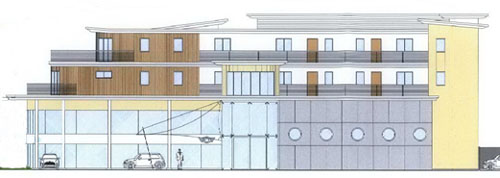 PPS1 is very clear: Design which is inappropriate in its context, or which fails to take the opportunities available for improving the character and quality of an area and the way it functions, should not be accepted. Even by the standards of the Western Riverside, which was so wrong for Bath that it provoked a visit by a Mission from UNESCO and ICOMOS who were both concerned about the World Heritage Site, this design is spectacularly inappropriate.
PPS1 also says: Local planning authorities should not attempt to impose architectural styles or particular tastes. Yet all the fashionable "must haves" are all here in one form or another, with render, zinc, steel, glass, a quirky roofline and timber cladding all contributing to a design which has no references to the palette of Bath. These materials cannot be said to align with the local vernacular or the surrounding buildings. Even alongside the brutalist designs of the Western Riverside, this design and the choice of materials will look dramatically wrong.
We cannot blame the applicants for following advice which they think could lead to a planning decision, but they have been very wrongly advised. We also believe that placing residences above an industry that features volatile liquids and compressed gasses will be very difficult to justify in Building Regulation and Health and Safety terms, and it may be necessary ultimately to dispense with the dwellings. Ironically, this would mean reverting to the plans prepared in 2003, before the applicants made the mistake of heeding the council's advice.
A final quote from PPS1: Community involvement is vitally important to planning and the achievement of sustainable development. Watchdog feels that the intervention of Urban and Rural Planning, imposing their aspirations onto a location which is highly visible from many locations around the World Heritage Site, has removed any opportunity for community involvement. The PPS1 advice is: Effective community involvement requires an approach which ... enables communities to put forward ideas and suggestions and participate in developing proposals and options. It is not sufficient to invite them to simply comment once these have been worked-up. However, commenting on the fully worked-up proposals is the only option provided.
Watchdog therefore considers that existence of these plans, and the part that Urban and Rural Planning played in developing them despite the guidance provided by PPS1, needs to be brought to the urgent attention of the UNESCO Mission. Meanwhile, we urge the only community involvement that is now available, objecting to these plans, either online or in writing to the Planning Department. This proposal in its current form is contrary to policies BH1, BH2, BH5, D2 and D4 of the Local Plan, and conflicts with guidance contained in PPS1 and PPG15 and should therefore be refused.
Planning News
[21/12/08] On 17th December 2008, the Development Control Committee was given a verbal update. They were told that that S106 negotiations are continuing but are proving difficult in the current financial climate.
And the current climate is certainly difficult. According to The Times, on the day that this update was given to the DCC, Crest Nicholson have agreed to a restructuring plans whereby its creditors take over 90% of the company in return for halving the outstanding debt from £1 Billion to £500 Million. It has also been noted by the Financial Times that in the current difficult financial climate, HBOS were more prepared to lend money for mortgages than the other banks, so that now agreement has been reached for the merger of HBOS and Lloyds TSB, funds for purchasing the houses and flats already on the market will probably dry up still further.
Sunday Times
6th July 2008
"The Housebuilder Crest Nicholson has appointed a specialist team at accountants Deloitte to advise on a potential financial restructuring ahead of crunch discussions with its lending banks and shareholders. The Deloitte team specialises in working with distressed businesses.
[14/9/08] On 10th September 2008, the Development Control Committee was given a verbal update. They were told that negotiations still ongoing but still not yet at a point where consent can be granted. They were also told that the outlook is still positive despite the current economic situation, and Crest Nicholson remain buoyant.
We interpret "buoyant" as optimistic, since they are feeling the financial effects of the credit crunch as the box on the right shows.
Something else that might affect the financial viability of this development was spotted in the press. The Guardian article suggests that English Partnerships is currently insolvent. In that case, it is doubtful whether the £34 Million shown in the council's budget as the English Partnerships contribution to the Western Riverside will be forthcoming within the timescale being quoted for the Western Riverside, because any Government bail-out must prioritise developments already under construction over those not yet started. We also do not believe that the council's budget is capable of absorbing a shortfall of this size.
[13/7/08] The Development Control Committee was given a verbal update at the 9th July meeting. The officer reporting stated that after extensive negotiations with the developers and their legal advisors all outstanding issues had been resolved relating to the design. The Section 106 agreements were nearly in place and should be finalised in a few weeks. We wonder how much Crest Nicholson will be able to contribute in S.106 arrangements, given the latest on the financial front in the box on the right. As Council taxpayers, will we be liable for any shortfall between the council's original expectations and the figures finally agreed?
The Inland Waterways Association have written to the council and asked why all the fine promises of maximising the use of the river have not been carried forward into the Phase 1 design. It is a very good question, and we will be watching to see if any answers will be forthcoming.
Earlier news
[18/5/08] Planning application 07/00449/FUL for the access lane behind Victoria Buildings was granted planning permission on 1 May 2008. The correspondence shows that this path was required primarily to allow a licence to be applied for to relocate a badger sett that is in the way of the Phase 1 development, and the applicants have said in their correspondence that they will not start building the path until planning permission for Phase 1 is given (and that is fraught with problems, see below), though they will have to clear some vegetation in order to meet the condition of surveying for contaminated land.
Although a number of residents of Park View and Victoria Buildings objected, it is apparent from the documentation that the plans were altered to accommodate some of these. So the path now stops short of the Park View wall so that there is no through route, and at the other end there will be a lockable gate. The boundary wall behind the Victoria Buildings gardens is now in addition to the existing boundary, and only those properties entering into an agreement for a parking space have an obligation to make an opening in their existing boundary to gain access through the new wall to the footpath, though a lockable gate will be placed in the new boundary wall behind each garden so that any later requests for a parking space can be accommodated without further work to the wall. Unfortunately, there was no elevation drawing of the style of those gates, so we can't tell whether they are in keeping with the environs of the listed Victoria Buildings or not. The Officer's report refers to those that make an access to the footpath as "residents who subscribe to the private path". By implication therefore, those that do not subscribe should not have to pay the maintenance charge, and if that proves not to be true, then those non-subscribing residents should formally complain to the council about the misleading analysis.
The lockable gate giving access to the path will effectively limit access to the path to residents and maintenance company contractors so there should be no privacy or noise issues. The applicant has offered to fit gates and a lock that is acceptable to the residents. However the decision notice places responsibility for approving the gates and lock on the planning office. Again, if the planning office makes that decision without consulting the residents, the residents have grounds for a formal complaint.
But subject to the reservations above (plus the mistaken idea that the front of Victoria Buildings is listed, when it is actually the complete premises), the planning officer has made a reasonable judgement, and we agree that there are no planning policies that justify anything other than approval.
Latest concerns
Credit Crunch
[18/5/08] The Royal Institution of Chartered Surveyors, has warned that the Government's house-building targets are at risk: "Given the on-going problems in the mortgage market and a weakening economy, the decline in house building will surely continue".
The news that sparked this comment was reported in Property Week: The housing minister unwittingly revealed that the Government now expects house prices to drop by up to 10% this year, and yesterday the Department for Communities and Local Government said housing starts fell by a quarter in the first three months of the year. Indeed, the number of new houses being started is 24% lower than the same period last year and the lowest since 1996, ie a 12-year low.
This is leading to redundancies:
• Housebuilders Redrow, has already made 15% of its workforce redundant.
• Countryside Properties, which is part-owned by HBOS, is axing 10% of its staff;
• Crest Nicholson, which is also part-owned by HBOS, is to axe 10% of its staff as they face a combined commercial and residential property market slide;
• Barratt said that it could be forced to make up to 20% of its staff redundant if the downturn continues.
Redundancies create a position that is difficult to recover from. Crest Nicholson's chief executive, Stephen Stone, said in a press interview about the staff reductions: "We are responding to current market conditions and it is a very sad period. It means, in the longer term, when we see a pick-up in the economy, there won't be the skills base needed in the housing sector".
EU Procurement Rules
The latest casualties of the ECJ's "Rouanne" Ruling have been reported in the architectural press this week:
In February 2007, Birmingham City Council announced plans to create a 21 acre, mixed-use scheme at the Wholesale Market in the Digbeth area of the city centre, and was set to choose the US group Hines as the company to win preferred developer status. But in a brief statement earlier this month, the council’s head of planning and regeneration, said the council is taking legal advice on whether the deal is subject to EU procurement rules, and that the appointment of Hines is still not confirmed. This is good news for the rival company Hammerson who want to bid for the work having recently lost their preferred developer status with Kingston-on-Thames and are now just a competing tenderer.
Similarly, Gloucester City Council announced in February 2007 that Thornfield Properties together with Morley were being appointed by the council for proposed redevelopment of Gloucester’s Kings Walk shopping centre following advice from their urban regeneration advisors. The council is now reviewing whether Thornfield can proceed. They anticipate that going to tender would cause a four month delay.
Legal advice is currently divided over exactly what is and is not within the scope of the "Rouanne" Ruling, but they all agree that any developer who is ruled out by a council's untendered arrangements has an automatic right to challenge the council in court, and that the outcome of such cases, provided they are not settled out of court, will gradually clarify the scope. One leading law company reports that 40 of the councils that they have advised to date have decided that they cannot risk a court case and have opted for a full tender exercise.
Early May
[4/5/08] We have been sent an extract of advice being given to another public body, that might also have a relevance to B&NES. The document examines the inferences within the EU Public Procurement Directive, leading to advice suggesting caution in applying additional requirements to development sites, because S106 agreements involving affordable housing or off-site public amenities could amount to a contract within the scope of the European Court of Justice ruling on local authority schemes (see below), even when there is no formal contract with the developer. We have not the legal knowledge to assess whether that advice is accurate, but it does seem to reflect the spirit of the ECJ ruling.
A number of press items have appeared dealing with the impact that the credit crunch is having. Typical of those is the summary of how banks are reacting that was printed in the Telegraph, which includes the following:
HBOS, for example, is facing credit-crunch related problems at two of its biggest property investments, Crest Nicholson and McCarthy & Stone, both of which it co-owns with the Scottish businessman and philanthropist Sir Tom Hunter.
Crest Nicholson, which was taken over last year for £1bn, has this month called a virtual halt to new building projects and is scaling back those to which it is already committed.
And later in the same news item:
The share prices of listed housebuilders have plummeted in recent months. Persimmon, which last week mothballed its own developments, is trading about 45 per cent down on six months ago. At current prices, HBOS's and Hunter's equity in both Crest Nicholson and McCarthy & Stone would be wiped out.
Again we cannot comment on the accuracy of this assessment, but we have found similar sentiments in other newspapers. If true, the news suggests that Crest Nicholson would be undertaking a significant financial risk by starting work on the Western Riverside at this time.
[4/5/08] In the Estates Gazette publication dated 26th April, there is a long article explaining why a company called Land Securities, after spending four years working on plans for a mixed-use development alongside the London Olympics site, has now found themselves in a position where the local authority has refused to sign the agreement that has been drawn up and is now tendering in the Official Journal of the European Union for a development partner for that site and other adjacent land, with the intention of shortlisting five tenderers.
The article quotes the European Court of Justice ruling on local authority schemes (which we have already identified as a potential threat to the Western Riverside, see below) as the reason for the council's change of heart. It also describes how another East London council is about to tender for a masterplan for the "northern Olympic fringe" for similar reasons; and how Kingston-upon-Thames, Eastbourne and Hitchin schemes have had agreements cancelled because they were all based on a preferred developer arrangement (and in the case of Kingston-upon-Thames the council also refunded S106 funds already paid by the developer according to that council's website).
A search of the legal advice websites on the internet reveals that any council official who take a course of action knowing that it is, or is likely to be, unlawful is guilty of "Misfeasance in Public Office" and an action may be brought against them accordingly. This is a personal, rather than organisational offence.
The existence of this offence could explain why so many councils are stepping back from established arrangements in the light of the European Court ruling. There is still no news of when the EU Commission will be checking B&NES for compliance with Article 226; but to us as outsiders there seem to be clear parallels between the agreement that B&NES has with Crest Nicholson and the deals that Kingston-upon-Thames, Eastbourne and Hitchin have now cancelled.
Early April
Other press comments:
"The housing sector is beginning to come under severe strain, as the credit crunch affects the wider economy.
Companies owned by private equity, such as Fat Face, the specialist retailer, Crest Nicholson, the housebuilder, and Foxtons and Countrywide, the estate agencies, are among those affected. The market value of the debt of all four has tumbled since the start of the credit crunch, suggesting that investors no longer believe the companies are worth as much as the total value of their borrowings – and implying that the equity is worth nothing." [Times, 25 March]
"Housebuilders are feeling the pinch throughout the UK, especially those with large borrowings or those focused too heavily on building flats." [Sunday Times, 13 April]
"Hopefully the [OFT] report will also identify the politicians and councillors who have helped in these scams by closing one eye at the right time." [Times, 17 April]
[19/4/08] We are beginning to get concerned about the council's choice of developer and the consequences of that choice. A recent Financial Times article (no longer available on-line) reports the conclusions of a three year investigation by the Office of Fair Trading, which has identified a number of construction companies suspected of "bid rigging". Crest Nicholson is listed amongst them.
The penalties available under the Competition Act are severe, and at a time when reduced availability of credit is already affecting the housing market (and demand for flats is falling far faster than demand for traditional houses), any subsequent conviction could hit Crest Nicholson hard. We wonder if this latest development might affect the Western Riverside. It certainly will not impress the EU Commission when they start to examine the process by which the council selected Crest Nicholson as a development partner.
The OFT investigation and the housing slump could complicate negotiations over the development agreement with Crest Nicholson and may even put at risk some of the affordable housing. The intention was to allocate some of the profits towards increasing the proportion of affordable housing, aiming to boost it to 30%. Falling house prices could thus cut the available funds for affordable housing.
Finally, the latest correspondence from the Environment Agency reiterates their objections to the planning application for the new access road into the site. As has been seen with the Dyson Academy planning applications on the Newark Works site, disagreements by the Environment Agency can force decisions to be referred to central Government, so there could be longer term problems in getting plant onto the site do deliver the Western Riverside unless the objections of the Environment Agency are resolved.
Earlier concerns
[30/3/08] An enquiry to GOSW revealed that they received 180 pieces of communication about the Western Riverside. 175 of them urged GOSW to ensure that the decisions were called in for a public enquiry. The other 5 were in favour of the development taking place. Those five were sent by B&NES, Somer Housing Association, Savills, King Sturge and Don Foster MP.
[26/3/08] Our enquiry to the EU Commission has revealed that following the ruling of the European Court of Justice (details below), a number of (EC wide) Local Authority agreements are now listed "for examination in the light of EC rules on public procurement in order to assess whether or not the Commission should initiate infringement proceedings pursuant to Article 226 of the EC Treaty" to use their words. In response to our follow-up enquiry, it has been confirmed that the B&NES agreement with Crest Nicholson is on that list, but the date when the investigation will commence cannot be given.
[23/2/08] We have been informed that the question of whether Bath should be put on the UNESCO World Heritage In Danger list has been placed on the agenda of UNESCO's World Heritage Committee when it meets in July.
[3/2/08]
The Times has worried about Crest Nicholson's finances, and a reader of both The Times and this website has e-mailed us the article and his concern. Since then, we have been investigating how the development is to be funded and the current position. Details can be read further down the page.
Also in the Times (following on from their concerns about Bath last May) is a report that the World Heritage status of the Tower of London is at risk from an inappropriate development. These risks have now been given a further airing by the Prince of Wales, who was almost certainly thinking of Bath as well as London when he spoke.
[9/2/08] For anybody who may be interested, we have located the full text of the speech by the Prince of Wales..
More Details
[23/2/08] We have been informed that the question of whether Bath should be put on the UNESCO World Heritage In Danger list has been placed on the agenda of UNESCO's World Heritage Committee when it meets in July. UNESCO will expect DCMS to explain, on behalf of the UK Government, how the failure of stewardship of Bath as a World Heritage site occurred, and what DCMS intend to do to restore the Outstanding Universal Value of Bath. We plan to provide a background brief covering the legal minefield surrounding approval.
Our attempts to get Don Foster (who holds the shadow heritage portfolio) interested in tackling the Secretary of State in the House of Commons over the way the Secretary of State ducked her responsibilities to decide the Western Riverside planning applications, fell on stony ground. Clearly he has no interest in being seen to oppose this rather suspect decision (which leaves B&NES in the roles of both developer and approver of the scheme) in spite of his role in the Lib-Dem cabinet. But when we found in the planning files a letter from Bath's MP supporting the Western Riverside plans, it was perhaps a vain hope that he might actually care about the dangers to Bath's heritage. We later discovered that he wrote to GOSW in support of the Western Riverside. We will remind the public of this dereliction of duty when he is once again seeking our votes.
[3/2/08] On 30 January 2008, the Government Office of the South West wrote to B&NES to formally withdraw the "Article 14" Directions (which were preventing them from granting planning permission), arguing that the planning decision is only of local importance. You can read the exact text here. Note that the decision was communicated by the Assistant Director Planning & Housing Delivery, which suggests that house building targets are regarded as more important than World Heritage. This letter means that the council is now free to grant planning permission without a public enquiry. In view of the decision at the 29th October 2007 meeting of the Development Control Committee, where they indicated their intention of granting planning permission regardless of the fact that the planning laws did not support such an outcome, we must assume that they will go ahead and grant permission unless anything happens to stop them.
We informed ICOMOS-UK of the GOSW letter in time for them to include its existence in their brief to the UNESCO World Heritage Convention meeting.
Given that the decision not to call in the applications was based on a (false) claim that it does not meet the Secretary of State's criteria for calling in, we have requested that the Secretary of State either confirms that view or overrides it, since very clearly a threat to Bath's World Heritage status is of more than local importance. Luckily, there is provision within the planning laws for planning permission to be revoked at any time between the grant of permission and the completion of construction, so pursuing this line of enquiry is not a fruitless exercise. You too can put pressure on the Secretary of State, see What you can do below.
A Legal Minefield
On 6th December The Times published an article which explored how the credit squeeze, the housing market slump in demand and the beginnings of a fall in house prices are affecting Crest Nicholson. A concerned reader then e-mailed us, bringing the article to our attention and also expressing his concerns about how this might affect the Western Riverside. This is what he said.
Here is a major public project awarded with no tender to a privately owned house builder whose sales have fallen 15% just in the first 12 weeks of the credit crunch, where there is no financial information in the public domain as to viability, cost, or the allocation of risk and reward, and where several consecutive months of falling house prices could not have been built into the financial assumptions and may well damage the project. All this follows the gross mismanagement of the Bath Spa project. The public interest and indeed the public purse can be protected only by a call-in.
We tend to agree. But the issue goes further than that. In a currently ongoing public enquiry in South London, the argument that a major project that is not financially viable should be refused planning permission for that reason has been put. That enquiry has not yet reached a conclusion (it is due to report in the first half of 2008), but it will set an interesting precedent for Bath.
In the last update, we said "Meanwhile, we will try to find out who carries the financial liability for the Western Riverside if it does prove to be not financially viable". That comment led to a number of e-mails from readers as a result of which we made a search for further information and a couple of Freedom of Information requests. The things we discovered are interesting.
Findings
Bath Preservation Trust have clearly been keeping an eye on the Western Riverside, just as much as we are. On their website is the news that a second case conference is scheduled to take place on 21st January, which immediately tells us that if there is a need for more than one case conference, then the decision is by no means easy.
Meanwhile, we have written to English Heritage, asking them to explain their choice of Sir Richard MacCormac as their advisor on the Western Riverside when he clearly had a conflict of interest because he is a member of CABE (which had already written to the Planning Office with its support of the Western Riverside) and was being paid by B&NES as a member of BURP.
[23/2/08]The reply we received stated that Sir Richard was specifically approached: there was no tender process and no other advisors were considered. The reply also maintained that Sir Richard's report was completely independent. However, the fact remains that he was employed by B&NES to advise (inter alia) on how the plans for the Western Riverside could be progressed in the face of the concerns held by English Heritage that the height originally proposed for some of the buildings would be unacceptable, and was then employed by English Heritage to advise them on what degree of reduction in height would make the plans acceptable to English Heritage. His role therefore became one of being a broker of a mutually acceptable compromise, and if there is a way of viewing this role as independent of both paymasters, it escapes us.
A Freedom Of Information request to the Government Office of the South West revealed that the Chairman of the Bath Urban Regeneration Panel had written directly to DCMS claiming that the Western Riverside would have an "unquestionably beneficial impact on Bath as a World Heritage Site". So we also wrote directly to DCMS pointing out the discrepancy between the views of BURP and English Heritage and the description of the reasons why Bath is a World Heritage site based UNESCO's records. No doubt that if they investigate thoroughly they will discover (as we did) that Sir Richard MacCormac was being paid by B&NES at the time he was paid by, and made his report to English Heritage. However, DCMS has not yet replied to our correspondence.
Those who attended the earlier public presentations given by Crest Nicholson might remember their statement that the Western Riverside development was as dense and as high as it was proposed because its viability depended on it. No formal statement accompanied the change of plans last August to say why a reduction in the height of some buildings and a reduction in the number of dwellings did not affect its viability.
[3/2/08] The English Partnerships approvals process is in 3 stages:
Comprehension, where the project is understood and whether it fits EP's rationale is checked;
Analysis where options and objectives are studied in detail and legal advice is sought, leading to either refusal or a recommendation for both assistance and any conditions to be attached to it;
Approval where both Communities & Local Government and the Treasury examine the analysis and say yes or no.
The £150,000 so far approved is to cover the staff costs of the Analysis stage. It is not a payment to B&NES.
[3/2/08] In the minutes of various B&NES meetings there is an expectation that English Partnerships would inject a substantial sum of money (£28.8 Million assumed in 2006; £34 Million in November 2007) to make up for the deficit. So we asked English Partnerships what level of commitment they had made. Their reply was rather different from the council assumption. "I confirm that the sum of £150,000 has been approved by English Partnerships to enable us to consider this project and that no further decision has yet been reached." (See the box on the right for the significance of this). Also, they said "We have a procurement team that are fully aware of the EU Procurement Directives and we will consider [them] carefully before an investment decision is made".
This ties up with another piece of information e-mailed to us, where the council of Kingston Upon Thames had to change their approach to a major development plan because of their concerns over a ruling by the European Court of Justice. So we traced the Kingston story (read it here) and then traced the ECJ Ruling itself. We concluded that the way B&NES chose Crest Nicholson as their development partner puts them in the same position as Kingston Upon Thames, only B&NES has not taken a step back and invited tenders. We believe that the B&NES position is unlawful in the light of the ECJ ruling, and we have informed GOSW, DCMS and English Partnerships of this. They have access to qualified legal opinion, and can investigate better than we can.
[3/2/08] The other piece of information recently provided by English Partnerships is relevant in the event of a cost overrun. When English Partnerships agrees to support a project with local authority partners it is common practice (but not universal practice) to cap our funding commitment. Although they have avoided committing themselves at this stage, the probability is that if the Western Riverside costs more than was estimated (like the Thermae Spa did) then the additional money will have to be found by additional Council Tax or cuts in services, rather than from an additional Government handout.
We are not legal experts, nor accountants, but our opinion as amateurs is that the Western Riverside development is both non-viable and unlawful. We will continue to watch for developments.
The October 2007 Planning Meeting etc
On 29th October, all members of the Development Control Committee were invited to a technical briefing, along with selected officers from planning services. Presenting to them were some from the Council's Major Developments Team and representatives from the applicant and the applicant's architects. Rhodri Samuel from the council's Major Projects Team set out to mislead the audience by quoting the housing target for Bath (which is not relevant to planning decisions) and announced that the Western Riverside development aims to address some of the social housing waiting list. Yet readers of the Core Strategy document discover that the housing targets are intended for incoming residents and not the existing waiting lists. He also reported that Bath had qualified for a £53.8M transport improvement package and the Western Riverside site includes the route for the Rapid Transport System, again omitting to inform the committee members that this is not a factor relevant to planning decisions.
The Crest Nicholson presentation covered much of the background presented at the public meetings. That description also set out to mislead by claiming that protection against flooding on the lower Bristol Road had been agreed with the Environment Agency, as though that was the only agreement necessary. Yet by reading the correspondence from the Environment Agency, it is clear that they had many other problems with the application and actually objected to both the outline application and the Phase 1 development on the grounds that the flood risk analysis and the reed bed solution were unsatisfactory.
Thus the committee members were primed with false information, ready for the decision meeting.
On 27th November 2007 the overview (06/01733/EOUT) and Phase 1 (06/04013/EFUL) applications were discussed at a special meeting of the Development Control Committee. Two Planning Officer's Briefs were produced: the first on 21st November and an Update on 27th November, just before the meeting. One feature of both reports was that only comments in favour of the developments were quoted in full: you may draw your own conclusions from that.
The Planning Officer's first brief omitted reference to the Environment Agency, and the Update Report issued on the day of the meeting informed that the Environment Agency had objected, but claimed that the objection was based on outdated information and it was expected that their opinion would change or could be dealt with by conditions. This was a curious line to take when the Agency had already warned the council that it had the authority to have the application called in if their objections were ignored. (Also, unknown to the Planning Officer, Watchdog had contacted the Environment Agency and alerted them to the fact that the drawings etc had been amended and they should therefore update their comments on the planning applications, which they did. Therefore that the claim that the Agency's comments were based on out of date information is unlikely to be true.)
Similarly, the Planning Officer's first brief played down the objections from ICOMOS-UK, presenting them as the views of the signatory rather than the views of the organisation, and emphasising the disagreement with English Heritage (whose comments were quoted in their entirety) rather than the news that ICOMOS-UK pointed out that if the planning applications were passed there was a very real prospect that Bath would be placed on the UNESCO "In Danger" list. ICOMOS-UK then wrote two letters, the first to John Betty, pointing out that B&NES had not complied with Operational Guidelines for World Heritage in spite of a request a year ago to do so, and that in similar circumstances elsewhere UNESCO had threatened to de-list if construction work started, and the second to the Planning Officer making it clear that the earlier correspondence was the statement from the organisation and that this correction and the letter to John Betty should be distributed to the committee members. (It was, but only as the meeting got underway, so that committee members did not have the opportunity to read it before the business in hand started.) The update brief clarified that the ICOMOS-UK comments were from the organisation as a whole, but the threat to World Heritage status was underplayed by emphasising that English Heritage are the Government's expert advisors on Heritage Matters (which is true but irrelevant, since the Government has no control over what is, or isn't World Heritage.)
The opinions of English Heritage were a recurring theme in the Planning Officer's presentation, glossing over the fact that the advisor to that report is also a leading member of the Urban Regeneration Panel and CABE, both of which supported the proposals. Indeed, the same phrases can be found in Urban Regeneration Panel's comments and those of English Heritage, making a mockery of claims of an independent report. The objections of English Heritage to the tall buildings by the bridges led the Planning Officer to announce that the one included in the Phase 1 application was being downgraded to an outline design and a further application would be produced and placed before the committee before it could be built. However, no changes were proposed for the outline application, so it is still going to be 9 storeys and on that footprint, so the real difference is only smoke and mirrors.
25 members of the public spoke against the development, variously pointing out issues with the school, heritage, quality of life for residents, deviations from council policy, scope for vandalism, stark architecture, wrong mix of housing types, and distribution wrong according to Government guidelines, traffic and pollution, unsuitability for employment and commerce, flood risks, failure to comply with the Allotments Act, problems for disabled access, angular styling conflicting with Bath's curves, risk to World Heritage, risk to tourism, and wrong prices for affordable housing. All valid points, but most of them were wasting their breath because the only point that anybody on the committee thought was worth discussing was disabled access, and they were persuaded by the fact that it was only the 4-storey block that was unsuitable for the disabled. (It does leave one wondering what sort of architect it is, who can't design a means for disabled people to get upstairs, when he had a free reign in a brand new building on a derelict brownfield site.)
As those who spoke against took a total of 52 minutes to do so, Crest Nicholson and their supporters were given the same duration, and we were treated to a virtual replay of the public presentations, plus a lecture from Les Sparks explaining why heritage doesn't count unless in the future people can point to distinctive 21st century styles, and from other speakers, a statement on the need for affordable housing, a statement on public transport and a barely believable statement on how the building style was chosen to reflect Bath.
The discussion by the councillors was brief - indeed six of them did not speak at all. Mostly it was to emphasise the need for housing and the fact that the site was derelict, neither of which are planning issues. Nobody questioned why the design could get so advanced when it failed to meet council policies. Nobody cared about the risk to World Heritage. By 11 votes to 1 they voted to approve the outline application, and by 10 votes to 1 with 1 abstention, they voted to approve Phase 1.
Only Malcolm Lees voted against.
Eleanor Jackson was the abstention for Phase 1, but voted for the outline. Sarah Bevan, John Bull, Gerry Curran, Colin Darracott, Les Kew, Richard Maybury, Carol Paradise, Brian Webber, John Whittock, Steve Wilcox (alphabetic by surname) voted in favour of both.
The very next day, ICOMOS-UK announced that it would be preparing a report for the next UNESCO World Heritage Committee! If Bath is put on the "In Danger" list, every one of the councillors that voted in favour should seriously consider resigning from the Development Control Committee, because clearly their judgement is too poor to protect Bath in the way that the World Heritage Convention requires them to. A few days before the meeting, Watchdog sent each of them a warning that ICOMOS-UK were deadly serious, so they can't say they were not warned.
The decision on what happens next rests with the Government Office of the South West. They have the option of passing the planning applications back to B&NES who will then endorse their earlier decision. They have the option of passing it to the Secretary of State for a decision. Or they have the option of ordering a Public Enquiry to decide the outcome. In view of the irregularities in the processes leading to the decision, which ran contrary to the legislation and the Local Plan Policies, Watchdog is pressing for this last option. GOSW have made no indication of which way they are likely to go, or in what timescale. If you want to lobby GOSW, write to Mr Phil Warry, Planning Team, Government Office of the South West, 2 Rivergate, Temple Quay, Bristol, BS1 6EH (or use this link to E-mail him).
Other matters
Some additional planning applications have been unearthed that affect the Western Riverside. 06/00274/FUL is an old application revised which affects BMW garage on the corner of Windsor Bridge Road (which is actually in the way of the route for the Rapid Transport System, and the garage's lawyers have formally objected to Crest Nicholson's assumption that they can develop on the garage land); and 07/00449/FUL is a still extant application which affects Victoria Buildings. Also a newly discovered oddity: planning application 06/01750/CA is quoted in council minutes as authorising the demolition of the Destructor Bridge, yet the Application Form is very clear - the location is given as: Council Recycling Centre and Adjacent Depot, Upper Bristol Road, and Parts of North Bank of River Avon Adjacent to the Destructor Bridge and "Pipe Bridge" - so the area covered is up to, but not including the bridge. English Heritage has written to Watchdog confirming that the bridge is in the conservation area, so it can't be demolished without Conservation Area consent. If the bridge is to be removed, then this planning application does not authorise it. These three applications can be found in the Planning Applications list below.
Does everyone remember the publicity leaflet from Crest Nicholson that explained how the buildings designed for the Western Riverside were specially created for the Bath location? Have a look at our new Spot The Difference page and compare the Scottish Widows building with the Western Riverside design. At the planning meeting, some councillors took exception to the description "Eastern Bloc architecture" used by some of the speakers from the public, so I have added a photograph from East Germany to that page, and you can make up your own mind.
Public Meeting - September 2007
The public meeting held in the Hilton Hotel on 18th September 2007 was hosted by Debbie Aplin of Crest Nicholson and Keith Bradley of architects Feilden Clegg Bradley. The presentation clarified a number of previously misunderstood points, and gave the public who attended an opportunity to ask questions and make their own views known.
One clarification that was particularly useful was the explanation of how the various planning applications linked together.
Application 06/01733/EOUT describes the locations of the buildings and public spaces across the entire Western Riverside site, and the heights of the buildings. In effect, this can be regarded as a statement of long-term intent. The planning papers show that this is the application that is currently with the Government Office of the South West for a decision, even though at the meeting 06/03396/EOUT was said to be the one in that position. This application has now been revised, and part of the purpose of the meeting was to explain those revisions. The fact that it has been revised has planning implications, which are outlined below.
Application 06/03396/EOUT is a similar overview to 06/01733/EOUT, but one that covers just the first three phases, covering the smaller area between the Destructor Bridge to the west and the Homebase car park to the east, and bounded north and south by the river and the rear of Victoria Buildings. Again, it describes the locations and the heights of the buildings, and describes the public spaces appropriate to those phases. At the meeting, it was said that this application was the Government Office of the South West for a decision, but in fact it is not; 06/01733/EOUT is the one in that position. It was not clear from the meeting whether 06/03396/EOUT was being revised, and there are no new drawings on the public access website yet. But because it shows a layout that is not entirely the same as shown in the revisions to 06/01733/EOUT, it does seem that amendments will be required. That question has been put to the Planning Department, and a response is awaited.
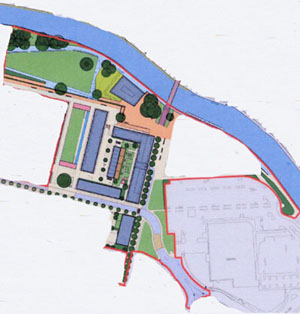 Application 06/04013/EFUL is the details of what Phase 1A consists of. It is this application that describes the appearance of the buildings as well as their size and location, and specifies shops, dwellings and other specific uses. This again is a subset of the Phase 1 to 3 scheme shown in 06/03396/EOUT. I have masked out the parts that don't apply from the diagram in the planning application so that it is easy to see what buildings and open spaces are included. Keith Bradley described the park area by the river as "about the size of the Parade Gardens", which gives a feel for the size. Similarly, the trees are described as "the size of 50 year old trees", not because they will be anything like that size when planted, but to ensure that they had room to grow to maturity once planted.
The other piece of useful information was that the buildings will be constructed in natural Bath stone. Unlike the Southgate shops where Bath stone is a token skim stuck on a concrete base that will have a very short life expectancy, Feilden Clegg Bradley plan to use a conventional cavity wall construction where the outer layer is blocks of Bath Stone, described as "75 or 100 millimetres thick", which is 3 or 4 inches in traditional quarryman's measurements. 3 inches is a bit undersized for longevity (or where it has to bear a lot of weight), but 4 inches is perfectly acceptable: it is the size used for the Georgian buildings in Kensington Place, for example.
One thing that did become clear from the presentation is that the appearance of Phase 1A has for modelling purposes been extended across the entire site (and our photo montage has done this too), because featureless cubes on graphic images convey very little. However, Crest Nicholson made it clear that later phases may possibly have different architects and a different external appearance from what is currently being shown (only the floor area and height are defined so far), so images of later phases must be regarded as illustrative only. So when you are making up your mind whether you do or don't like the external appearance of the buildings proposed, then you must bear in mind that these views only currently apply to 06/04013/EFUL. If on the other hand you have strong views for or against the size and layout of the buildings, then your views apply to 06/01733/EOUT (always) and also to 06/03396/EOUT if you also want to make reference to that smaller area.
In essence, the changes made in the latest amendments reduce a number of the rooflines. From one of the revised planning documents are the words In this revised application all five of the terraces that were taller than six storeys (having been seven storeys tall) have been reduced in height to six storeys or less. These are the buildings numbered as B3, B 5, B 7, B 8 and B 9 in the parameter plans. The ‘less’ refers to B3 which was previously split between 6 & 7 storeys, due to the changes in ground level around it, and is now split between 5 & 6 storeys. The maximum height of three of the riverside ‘object’ buildings (numbered B5, B 6 and B27 in the parameter plans) has also been reduced in response to the comments received. The number of storeys remains the same however. Keith Bradley explained that this brought the scale of the buildings and the setting to something comparable to Brock Street in terms of size and distance apart, except for the tall buildings by the river which are of similar scale to the Empire Hotel. Later, a comparison was made with the height of Pulteney Street, and the fact that the four storey block in the middle of the six storey blocks was conceptually like a mews.
The reduction of a storey was made at roof level which makes the roof profile more in proportion to the building beneath it. All other features of the buildings are unchanged.
Planning Issues
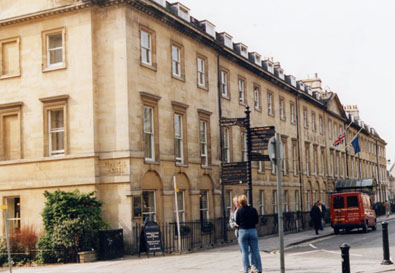 However, in our opinion, there are still problems with the plans. Whilst Brock Street and Pulteney Street might seem comparable, the buildings themselves have a rather different appearance. Pulteney Street, for example, has a floor within the roof space but only three floors down to pavement level. There are basement and sub-basement levels to bring the count of levels up to six, but from the street it is a four storey building. Indeed, this pattern of four above pavement levels can be seen throughout Bath, in Duke Street, Laura Place, Pulteney Street. Milsom Street, Queen Square (pictured), The Circus and the Royal Crescent. Vane Street is slightly different because the attic storey has a stone rather than slate frontage, but it is still only four visible storeys. So six visible above-ground storeys is completely alien to the character of Bath. The eight and nine storey riverside blocks are completely wrong.
The Western Riverside Supplementary Planning Document is quite specific: A layout will be required which is consciously based upon familiar street and urban square patterns and proportions that have regard to the user on a human scale. The buildings proposed fail this test. A number of people have reacted to the photo montages on this website expressing their dislike. It seems that they fail the "human scale" and "familiar" tests. Regardless of any measured height and comparisons made to other structures at that height, there are simply too many windows between the ground and the top of the roof, the vertical distances between the windows are too narrow, and there are too few horizontal decorations (string courses etc) to break up the scale.
So although the reduction in heights is a step in the right direction, the outcome is still not fit for a World Heritage Site which is based on a homogeneous appearance. As planned, the Western Riverside has no classical proportions and no human scale, and as such it will destroy the ambience of a city it is supposed to enhance. The committee still recommends you object, and reminds you that any objections already made are invalidated by the new drawings now submitted, so you must object again, see What you can do below.
Other snippets from the meeting
Voices in favour of student accommodation being included in the scheme, on the basis that in purpose built accommodation they get everything domestic done for them and they make good neighbours with no noise or untidy garden problems.
Voices in favour of changing the demographics of the intended residents. With a steadily aging population, there is a growing problem of where they can live. The Western Riverside is virtually flat land with good links to the shopping centre, so it is more suitable for the elderly than most of hilly Bath. As the elderly tend to own fewer cars and not have school age children, they would put less pressure on the available parking and road capacity than any other demographic group and would minimise the impact of such a large development. Crest Nicholson indicated that if the council could be persuaded of this, then such a change could be accommodated in later phases.
Voices in favour of any development on the site being better than the current vermin ridden derelict site (and also voices against accepting anything unfit for Bath).
A comment that Brock Street was a very noisy environment, partly because of the size of the buildings and the relatively small distance across the road.
Confirmation that the complete scheme would include about 500 affordable units, but no real information of the level of subsidy needed to achieve the "affordable" price level or where it would come from.
An indicative "hoped for" timetable where if work can start in May 2008, the first residents would move in during October 2009.
For those who were not able to attend the Tuesday evening (18th Sept) public meeting arranged by Crest Nicholson, the Chronicle reported some of the details from what proved to be a lively meeting and it was also reported with a different emphasis by the Western Daily Press. A member of the audience has also put his experience on the Flickr website.
The Scheme
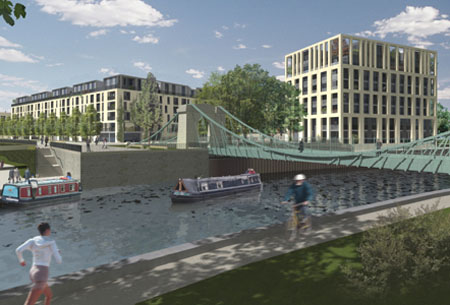 This large scale development is the city’s biggest challenge due to the mass height and scaling (see the photo montages that the committee has put together for the real horror of this). [UPDATE: Crest Nicholson have provided new images reflecting the latest amendments to their plans. The picture on the right has been amended to show the amended roofline of the block on the left of the picture. Other changes are being included on the photo montages page.] The Planning Inspectorate has reserved the right to call in this planning application after the Development Control Committee said they wanted to approve it. There is still no news on whether the Government Inspectors will call in this planning application for their own decision on whether to approve, and there is no limit on how long they might take to reach a decision. However, it is believed that the Secretary of State will not delay a decision much longer. The Western Riverside planning applications are expected to be discussed by the Development Control Committee at the end of November.
ICOMOS UK who monitor World Heritage Sites in Britain on behalf of UNESCO have informed the council that the Western Riverside development is incompatible with Bath's style and scale.
The effect of this development on the skyline of Bath has been recently documented. UNESCO and ICOMOS, the governing bodies for World Heritage sites, are very concerned about this development. The mass and height, the repetitiveness and the bulk and whether this is the best use of the site are among their concerns. These issues were discussed with the heads of these bodies by the members of Watchdog on their recent visit to Paris.
Planning Applications
06/00274/FUL is a revised planning application for "Mixed use development comprising car showroom with associated workshops and offices, 10no. residential apartments and separate valet and autowash facility including demolition and relocation of service area" on the corner where the Lower Bristol Road turns into Windsor Bridge Road. The earlier documents show that what started as a simple design for a "Mini" car showroom to largely mirror the "BMW" showroom already present changed into something rather more monstrous under council pressure for "a landmark, gateway building" with mixed use on the fringes of the Western Riverside. The current car showrooms and workshops have a temporary (but renewable) planning permission to be there, and this application would replace that with permanent permission for this part of the site. The committee regards this design as too big, too ugly and an over-development of that plot and asks you to object, either online or in writing to the planning office.
06/01733/EOUT is the outline for the entire Western Riverside area. That application was agreed by the Development Control Committee, referred to the Government Office for the South West, who eventually replied to the council saying that it would not be called in and the council could determine it.
06/01750/CA seeks conservation area consent for demolitions north of the river in the conservation area, mostly the buildings that make up the Refuse Depot and Recycling Centre. The exact text of the application location is Council Recycling Centre and Adjacent Depot, Upper Bristol Road, and Parts of North Bank of River Avon Adjacent to the Destructor Bridge and "Pipe Bridge". This application cannot be determined until a decision is made on the Western Riverside, so comments can still be made, either in writing to the planning office or online.
06/03396/EOUT was the outline for the first three phases of the Western Riverside scheme. This is currently in no mans land, because the on-line documentation does not (yet) show any revised drawings, but the drawings that are there are now incompatible with those in 06/01733/EOUT. The committee advises that you contact the council and ask for clarification of the status of this application.
06/04013/EFUL is the full proposals for the initial phase of the Western Riverside scheme. That application was agreed by the Development Control Committee, referred to the Government Office for the South West, who eventually replied to the council saying that it would not be called in and the council could determine it.
07/00449/FUL is for the construction of a public footway behind Victoria Buildings, an idea which was introduced in the Western Riverside overview 06/01733/EOUT, which has recently been amended. Most of the residents of Victoria Buildings have objected because of reduced rear security, and the expectation by Crest Nicholson that when the path that they don't want is built, the residents of Victoria Buildings would have to pay a management fee to maintain it. They would appreciate wider support, which you can do online.
07/02117/FUL is for an access road into the Western Riverside site. This road would introduce a safety hazard for pedestrians and cyclists using the Victoria Bridge, and also for pedestrians crossing from Sainsbury's petrol station to the Homebase site. Both of these routes are well used. The committee recommends objecting. Given that the decision on whether the Western Riverside is going ahead is still with the Secretary of State, this looks premature too. Please make that point, either online or in writing to the Planning Department. The Environment Agency has now lodged an objection.
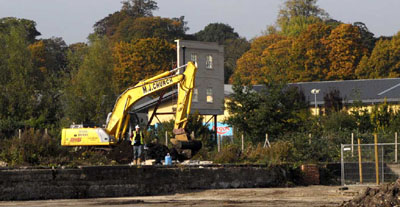 07/02879/EFUL has just appeared on the council planning on-line website and it appears to be the enabling works to allow 06/04013/EFUL to proceed.
It appears to be an application to clear away any remaining foundations to the Stothert and Pitt works that used to occupy the site, the rerouting of cables, drains and the like that are currently in the way of the planned new buildings, and the drilling of test pilings. Given that the decision on whether the Western Riverside is going ahead is still with the Secretary of State, this looks premature too. The Highways Agency has made this point in their objection to the planning application. Please make that point yourself, either online or in writing to the Planning Department. Also notice that this picture, taken on 16th October, shows that the work is still going on in advance of planning permission!
07/02879/EFUL has just appeared on the council planning on-line website and it appears to be the enabling works to allow 06/04013/EFUL to proceed.
It appears to be an application to clear away any remaining foundations to the Stothert and Pitt works that used to occupy the site, the rerouting of cables, drains and the like that are currently in the way of the planned new buildings, and the drilling of test pilings. Given that the decision on whether the Western Riverside is going ahead is still with the Secretary of State, this looks premature too. The Highways Agency has made this point in their objection to the planning application. Please make that point yourself, either online or in writing to the Planning Department. Also notice that this picture, taken on 16th October, shows that the work is still going on in advance of planning permission!
Other News
The construction plant that was originally working on the Western Riverside site went, leaving behind two large piles of spoil. It looks as though it was levelling a section of land, which has now been marked out with parking spaces.
Thanks to everyone who signed the on-line petition on the Downing Street website asking the Prime Minister to halt the development in its current form. The petition is now closed, but it did get almost three hundred signatures, which means that the Government will take notice. This has been confirmed by Hazel Blears according to a recent Times news item.
Although B&NES doesn't seem concerned by the incompatibility of World Heritage status and Crest Nicholson's tower blocks, the photo montages have been sent to UNESCO and they do seem to be taking them seriously. UNESCO have asked ICOMOS International (in Paris) to examine the issues and to raise them with national government organisations responsible for heritage. It looks as though the Western Riverside might turn into a test case on whether World Heritage Sites are properly managed.
Alongside the original poster, added to the website so that anybody who wants to show their public opposition to the Western Riverside in its current form can print it and display it in their window, we have added a second poster (in a rather different style) and a (newly corrected) leaflet highlighting the main problems with the plans as currently published. Feel free to print posters and leaflet and display them yourself or distribute them. These links display in a second window in Acrobat format, so that they can be easily printed, but please be patient because they take a little while to load.
There are now some new guidelines on tall buildings, and the link at the bottom of that page leads to the full text of the guidance. This looks like further useful grounds to object (see What you can do below).
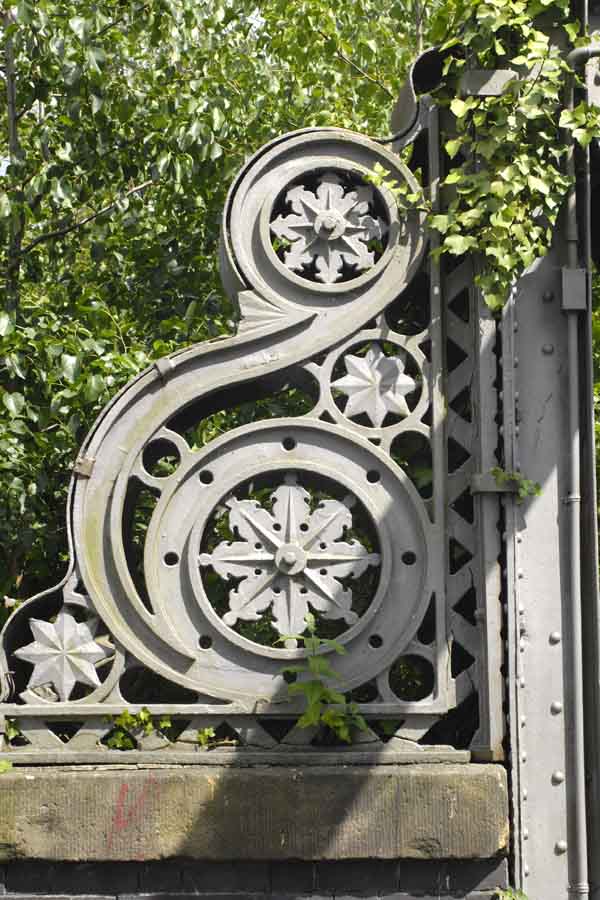 The Destructor Bridge is to be replaced as part of the Western Riverside scheme. This now rather neglected iron bridge once stood further up river and was the original Midland Bridge. Built in 1870 by the Midland Railway Company, it was replaced in 1905 and moved to its present position. A smaller bridge, known as the Accommodation Bridge, further down river was built in 1869 and is also due to be replaced as part of this scheme. After the meeting on 18th September, Crest Nicholson said they would be looking to see whether it might be possible to reuse this bridge, but they are not promising that it will be saved. We appreciated the suggestion, be we are now told that the outcome is that they cannot reuse it, but if anybody else can, they would be happy to see it go. We are looking for opportunities to reuse the bridge rather than have it go for scrap.
There was a report in the Building Design magazine dated 19 January 2007 entitled "Council Set to Approve Bath Housing Scheme" which can be viewed online.
What You Can Do
There are some things that you can do which could influence the decision process.
The public photograph album and forum website Flickr has a section for photographs of Western Riverside that you might like to browse.
- [3/2/08] You can write to your MP (depending on whether you live in Bath or Wansdyke) and point out that both 06/01733/EOUT and 06/04013/EOUT are contrary to Bath's World Heritage status according to the World Heritage Committee, and the State Party is required to provide a redesigned scheme by February 2011 , and the only way to reconcile these planning applications with the Government's obligations is by a public enquiry. Your MP is in the best position to put pressure on the Secretary of State.
- You can comment keep an eye on the application for the first phases, 06/03396/EOUT, and if new drawings appear, submit your comments again to the Council online or in writing to the Planning Department.
- You can watch out for amendments or variations to the permission for the access road, 07/02117/FUL.
- You can watch out for amendments or variations to the permission for the Victoria Buildings footpath, 07/00449/FUL.
- You can watch out for amendments or variations to the permission for the enabling works, 07/02879/EFUL.
- You can comment on planning application 06/01750/CA objecting to the loss of the recycling centre as a public amenity, and the attempt to include the Destructor Bridge in a planning application that does not include it in the location description. It may also be worth writing to the Victorian Society urging them to agitate to preserve it. Whilst not well suited to vehicles, it would make a splendid pedestrian bridge.