



Park and Ride News
Quick Finder (Follow links for more information)
| Information Sections | Planning Documents |
| Bath Rapid Transit [29/3/09] | Lansdown Application |
| Previous studies [8/3/09] | Odd Down Application |
| Before the DCC [22/2/09] | Newbridge Application |
| At the May DCC meeting [24/5/09] | Batheaston Application |
| Referred to the Secretary of State [31/5/09] | |
| Public Protest [21/6/09] | |
| At the July DCC meeting [12/7/09] | The Newbridge DCC report [5/7/09] |
| Before the August DCC meeting [2/8/09] | The August DCC meeting [9/8/09] |
| Article 14 Directions lifted [11/10/09] | The Newbridge Decision [15/11/09] |
| Compulsory Purchase Advice [18/10/09]
and More CPOs [6/6/10] |
|
| VeraCityBath Limited [30/5/10] | |
| Government Spending Review [13/6/10] | |
| Works in Donkey Field [28/10/12] | |
| Park And Ride Expansion [9/12/12] | |
| No Permission For Newbridge [13/1/13] |
The BRT
[29/3/09] Two of the Park and Ride planning applications refer to the BRT service which is supposed to link them. All but a tiny fraction of the BRT route runs through the World Heritage Site
The buses proposed are larger than the "Bright Orange" services currently operating. The only bus operator that Watchdog can find in the UK operating such buses is (surprise, surprise) First. They were introduced into Leeds, but Leeds found them an unwise addition to their roads, so the monsters were moved to York.
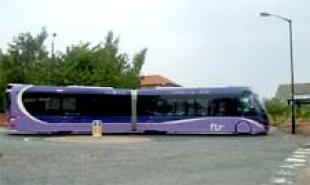 York council wisely banned them from the city centre so they now operate on the outskirts, mainly transporting students to and from the university, but at significant cost. From the York local newspaper in December 2006, reporting on a council meeting we read:
Figures obtained from council officers showed £734,300 has been spent on resurfacing work and £229,600 on junction improvements.
The original estimate of total costs had been just £450,000.
a councillor claimed the buses were causing large traffic jams, and endangering pedestrians and cyclists.
And they are causing significant damage to the road surfaces according to the same York local newspaper in January 2009:
City of York Council said it had to repair a section of St Helen’s Road after the kerbs had been continually overrun by the ftr bus.
The bus had caused considerable damage to the footway kerbing and carriageway, because of the layout of the road at that point.
A First spokesman said: It is the council’s responsibility to deal with street infrastructure issues and that is what they have done in this instance.
And according to that newspaper's Letters page between then and May 2009 there are potholes big enough to throw cyclists of their bikes, uneven surfaces that test the suspension of cars, significant subsidence at their bus stops. We think that the cost of road repairs is likely to eventually force York to ban them altogether.
So how convenient then that B&NES is mug enough to think that these oversized bendy buses are an asset. First must be rubbing their hands with glee and already planning their route from York to Bath (via a paint shop to change the colour). They can already supply buses to the B&NES specification whereas any other bus company would have to buy them, so they are effectively looking at being the only supplier.
And what will happen when they get to Bath? They will be expected to run from Newbridge along a current green corridor (the former railway line which will be covered in tarmac) then continue through the un-built and much derided Western Riverside to plough straight into the historic core of the World Heritage Site. The huge unwieldy bendy buses will then ply through Bath’s ancient and narrow streets, twisting a torturous route past the Abbey, along artisan Walcot Street to join the London Road until finally ending up at the proposed Bathampton Meadows terminus.
Those who pass that way frequently will know how the road surface across Pulteney Bridge has been repeatedly repaired, and will recognise that the bridge is restricted to buses and taxis only, so all such road damage must be caused by those vehicles, and none are currently bigger than the "Bright Orange" services. Those with long memories will remember a parapet on a listed building in Darlington Street shaken loose by heavy lorries bouncing over a subsiding trench left by road works in front of that building. Now picture buses that currently create serious road damage in York running over listed vaults in Bath, shaking the foundations of whole terraces of listed buildings.
According to the current legislation, the house owner is responsible for the road repairs if their vault which supports the road surface collapses. So each and every house and shop owner running that risk should inform the council that their vault was designed to support the weight of a horse and cart, and that the council permits heavier vehicles to use the road at the council's own risk. St James Parade, Pierrepont Street, Orange Grove and the Abbey, High Street, Walcot Street and London Road are most at risk, and some listed building damage is a virtual certainty. Because the route runs very close to the springs supplying the Thermae Spa, there could even be a risk to the thermal springs, but there is no indication that the Springs Foundation have considered that risk. There is an added complication that any vault that does give way needs Listed Building consent before it can be repaired, and that takes a minimum amount of time as defined in the planning legislation. Where are the BRT buses going to go in the meantime?
Supposing, after all the expense and upheaval creating the Rapid Transit route, insufficient people use it and the operator wants to either withdraw the service or to receive a huge subsidy from the council to maintain an unprofitable service, where is the money going to come from, or what will happen to the unused BRT route? Without such contingency plans, the current strategies are irresponsible and should not continue in their current form.
Now look at the underlying stupidity. How many passengers are going to travel the whole journey from Newbridge to Bathampton or vice versa? Almost none. Yet any delay on the London Road is going to disrupt the timetable to Newbridge, because there are only a limited number of buses. The problem is that these buses are so big that they need a large turning radius, so the park and ride sites are the most convenient places to turn round. The solution is to use much smaller buses, and gain a lot more flexibility.
The obvious solution to any park and ride scheme is to have the buses small enough to run along routes where passengers that don't use the car park might use them during off-peak times, and to turn them round near the city centre, so that each route is independent of any other. If small buses are used, a number of such routes become possible: the ones below are not recommendations, because we still think that the research to identify where park and ride parking is needed hasn't been done, but it does show the flexibility available if the adherence to the BRT is abandoned.
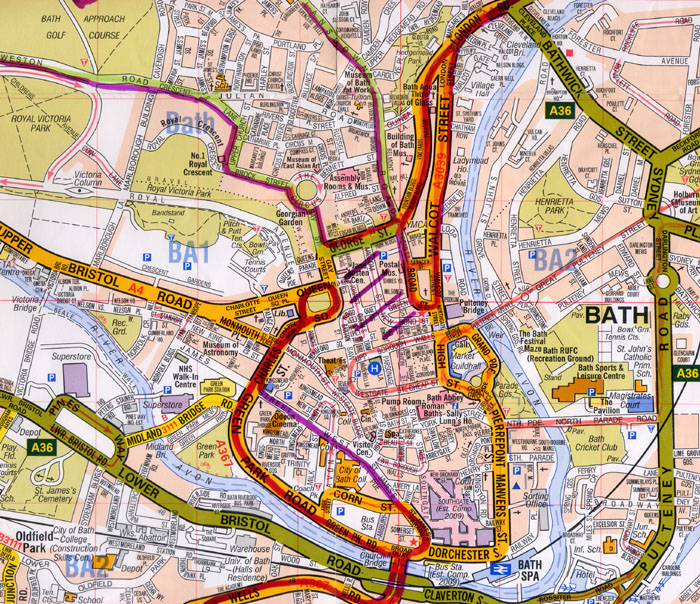
Go back to top index
From the Bristol Bath to South Coast Study
• A large adverse impact on the landscape can be expected. At this location, the site would be very visually prominent and would require extensive mitigation measures that are likely to affect the character of the local area.
• The results for the traffic reductions indicate that this Park and Ride site can be rejected on grounds of impact on the local environment and only marginal incremental benefits for traffic reduction.
• By the very nature of the size of such a site, its visual intrusiveness into the natural valley landscape is unlikely to be accepted by the local community. It is therefore recommended that it should not be progressed.
• A site at Bathampton Meadows, while potentially capable of accommodating more cars than Lambridge, is not recommended due to its serious adverse environmental impacts.
Previous Studies
[8/3/09] Watchdog has been sent some information by Bathford Parish Council, for which we thank them. In it, we were pointed to a study, jointly commissioned in 2004 by the Government Office for the South West (who represents the Secretary of State) and B&NES Council, entitled the Bristol Bath to South Coast Study (often shortened to BB2SC). Amongst the investigations the this study covered was the question of whether Bathampton Meadows was a suitable site for a Park and Ride. It came to the firm conclusion that it was not. The report, and therefore that decision, was adopted by B&NES.
Nothing has changed since then that would invalidate the conclusions of that study. However, the thought of the Government waving money under their noses for a Transport Strategy seems to have given the entire council a case of collective amnesia. So in the faint hope that there were those on the council who would not sell their integrity for a few pieces of Government silver, the box on the right reminded them what the council agreed to, just four and a half years ago.
These quotes from what is Council policy remain just as true today.
Unfortunately the planning officer and the majority of the Development Control Committee ignored their adopted policy when it came to the vote.
Go back to top index
Before the DCC Meeting
[22/2/09] The four planning applications were analysed by Watchdog and the following advice was given:
It is not within Watchdog's remit to comment on the traffic implications of these plans but we are concerned with the setting and protection of the World Heritage Site, Conservation Areas and Listed Buildings. In that context, the Green Belt is part of the setting for Bath, so any encroachment onto the Green Belt could affect that setting, and any increase in flood risk could also affect low-lying listed buildings such as the Newark Works and Norfolk Crescent.
After the recent heavy rains, there has been a debate (reported in the Chronicle) between the council and local residents about the risks to Bathampton Meadows. As usual, you have to look through the spin. The council claims that the risks of flooding the car park are less than once in 1000 years. That is the answer to the wrong question: it is the probability of the river rising high enough to inundate the proposed car park. But as any local resident knows, the area floods frequently because of water run-off from the surrounding hills and not just because the river rises. And no amount of porous surface is going to change that.
The council should refuse planning permission because of its own Local Plan policy, and the central Government guidelines concerning Green Belt land. Its own policy says: POLICY GB.1A Park and Ride development in the Green Belt will only be permitted where:
(a) there are not any more suitable or more sustainable alternative sites;
(b) the scheme will not seriously compromise the purposes of the Green Belt; ...
The only location where there has been even lip service given to examining alternatives is at Bathampton Meadows. The remainder are merely expansions of an existing facility. But this is what the Government says about expansions in PPG2: Approval of park and ride development in a particular location does not create any presumption in favour of future expansion of that site.
The Government even produced a clarifying circular (Circular 11/05) amplifying the guidance in PPS2: Where [a development on a Green Belt] will involve intensive on-site activity, large numbers of parked vehicles, considerable transport movements to, from, or around the site, or require prominent security facilities, it will have a potentially significant impact on the Green Belt.
So the council is in default because they haven't proved there are not more suitable alternatives to the depth required by PPG2 (The Government's commitment to maintaining the openness of the Green Belt means that when seeking to locate park and ride development, non-Green Belt alternatives should be investigated first [and] a thorough and comprehensive assessment of potential sites has been carried out, including both non-Green Belt and, if appropriate, other Green Belt locations), and the on-site activity will, by definition, compromise the purposes of the Green Belt.
This failure to observe the regulations an policies laid down is typical of B&NES, and we will ensure that the Workd Heritage Committee is made aware of yet another failure of stewardship. And it does matter in the areas that the council pretends that the World Heritage Site is limited to. From the point of view of the setting for Bath, the lighting at the existing Lansdown Park & Ride already produces a glow on the horizon that ruins the contrast of photographs of the Royal Crescent after dusk approaches. It is inevitable that there will be similar drawbacks in the Little Solsbury area (as well as disturbing the bat feeding areas that are currently dark).
The decision on the Batheaston location, at least, will have to be referred to the Secretary of State as a departure from the Local Plan, so it is important that as many members of the public as possible object. And individual objections have much more force in those circumstances than signatures on a petition. Use the links at the top of this section to comment on-line (by 5th March), or write to the Planning Office at Trimbridge House.
Unfortunately, the current Secretary of State is irresponsible and rarely enforces the policies laid down. PPG2 says Inappropriate development is, by definition, harmful to the Green Belt. ... In view of the presumption against inappropriate development, the Secretary of State will attach substantial weight to the harm to the Green Belt when considering any planning application or appeal concerning such development. So those who object to the council should also be prepared to lobby the Government Office (we will give address details at the appropriate time) so that the Secretary of State might actually think about the issues rather than using the customary rubber stamp.
Further Information
[1/3/09] Although Watchdog's remit does not cover traffic issues, we have noticed that the traffic statistics that have been used do not demonstrate what they are claimed to demonstrate. For instance, the evaluation of other suitable sites starts with the assumption that the existing park and ride sites are in the right place.
Take the Lansdown one, for instance. The traffic statistics show how many vehicles are parked at various times of the day, and how many use the entrance roads. On that basis, the case for extension says that it would be easier and less damaging than opening a second Park and Ride site nearby. But nothing in the documentation assesses what route the vehicles took to get there and why they parked there. If somebody arrived at the Lansdown (or Newbridge) Park and Ride because the Charlotte Street car park was full, or the RUH car park was full, it does not demonstrate that where they parked is where they wanted to park and that more capacity is required where they ended up. We can especially ask whether Lansdown is where the facilities are needed. How many drivers that make up the lunchtime peak have simply driven the short distance there from their Ensleigh or Kingswood School parking spaces because they want to go into Bath in their lunch break, and the Park and Ride bus is cheaper and more frequent than the Number 2 service? How many residents with Diamond Cards have decided it is cheaper to use the Park and Rides as a free daytime car park rather than pay for residents parking outside their house? How many people employed in the city meet up in a Park and Ride, leave most of their cars there for free parking and car share for the last bit of their journey so that they only need one parking space on arrival? Again these examples (which are nowhere near exhaustive) don't show that the facilities are needed, only that they are used (or even misused) because they are there.
So we maintain that the documentation does not assess whether there are more suitable sites, because it starts with the assumption that because people park there the existing facilities are in the most suitable places. Until that is demonstrated to be true by a proper route and purpose survey rather than just a vehicle count, the case for placing parked cars on the Green Belt is not made. So the council should refuse planning permission, but don't hold your breath!
Go back to top index
The 20th May DCC Meeting
The meeting was held on 20 May 2009 in the Council Chamber, where the public gallery holds about 30 people. The meeting was relayed to the Brunswick Room where the public could watch the proceedings on a large screen. Those in the Brunswick Room reported afterwards that the position of the camera made it difficult to identify who was speaking and the sound quality was poor, so that it was very difficult to follow the meeting properly. At the start of the meeting Cllr Coombes put on record his protest about the inadequacy of the accommodation, pointing out that that the meeting should have been held where there was enough room for the public as well. Les Kew as Chair tried to dismiss the criticism by saying it was far too late to do anything now and the point should have been made beforehand; to which Cllr Coombes reminded him that they had discussed the issue the previous week. A long silence ensued. We concluded that keeping the public out of the meeting room was a deliberate and cynical choice.
The Committee Members were given guidelines by the Planning Officer:
The Applicants will only accept changes that are minor in nature, not those that need a new planning application
The cost and availability of Government funding were not planning matters
Ideas for other locations are not a planning matter
Only the Eastern Park & Ride has to be referred to the Secretary of State
The other three are in the council plan and there had to be exceptional reasons for refusing them.
Cllr Curran considered the first unreasonable. So do we. Of the others, the funding is obviously at the forefront of the tactics employed, otherwise there would be no reason to have all four collectively described as the Transport Package, no requirement to have the Newbridge plans dependent on the BRT scheme, and there would be no reason to fear changes that needed a new planning application. (This point was made later during the discussion of the Odd Down scheme where it was pointed out that if a private developer has submitted schemes for four sites and asked for them to be considered together as a "Housing Package" the council would not have allowed them to be grouped like that. Clearly this was too difficult a question, because it was never addressed!). The ideas for other locations is a planning matter because Green Belt regulations require alternatives to have been considered. The three sites that are in the local plan are only described there in principle not in detail, so the Secretary of State should make the decision on the detail. We think that the advice given to the Committee was erroneous. This makes all the decisions made suspect and all decisions to grant permission should be referred to the Secretary of State.
We took detailed notes of who said what, but they run to 28 pages so it is not practical to reproduce them here in full. What we will do is wait for the official minutes, which should cover the key points, and then provide our own commentary where we think key points are omitted. For now, what follows is a quick summary.
Odd Down
The public speakers against were the Parish Council (concerned about landscaping, wildlife, stability of the land because of Fullers Earth workings, and flooding due to run-off), and three others (including the Watchdog comments). Six people had asked to speak in favour, but only three did.
In the subsequent discussion we learned a few things. The existing site does not often operate at full capacity, and a lot of those parking use the service to the RUH rather than that to Bath. Although the access is via a roundabout that is claimed could accommodate more traffic, queues do already build on the access road from the south at peak times. The bus operates from a stop a long way from the majority of the parking, so it will be a long walk for many of those using the site. The landscaping includes a wildlife habitat area.
At the vote, this application was passed unanimously. A Decision Notice was issued without referring the decision to the Secretary of State, the legality of which we will check. In the conditions, it specified the hours when the lights can be on, but not the hours when the Park and Ride can be open, which is a curious anomaly.
Lansdown
The extension is to be built on what is currently a sports pitch, so that pitch needs to be reprovided elsewhere. On 8 May (just 10 days after revised drawings were submitted and thus giving the public insufficient time to comment on them) application 09/00314/REG03 identifying a location on the other side of Lansdown Road was given permission; and although that application was not in the local plan, it was not referred to the Secretary of State. It is interesting that one of the conditions of that approval bans the use of external lighting "In order to protect the rural character of the site, the setting of the World Heritage Site and to protect residential amenity" yet lighting is acceptable at the Park and Ride site despite the rural character of the site, the setting of the World Heritage Site, or residential amenity. Such double standards do the council no credit.
There were three public speakers against (including the Watchdog comments). Six people had asked to speak in favour, but only three did.
During the discussion, we learned that although there is a requirement to replace the sports pitch lost, the conditions allow the construction of the new one to be delayed for up to three years after the old one is taken out of service. We heard the Committee assured by the case officer that there would be no light pollution because "Dark Skies" lighting would be installed to ensure that all the light was focused downwards, despite Watchdog writing to the case officer specifically pointing out why there would be light pollution in the valley below; and not one member of the Committee had the wit to challenge the false claim having realised that if you put lights shining downwards at the top of a hill, then it will shine down into the World Heritage Site below (and it already affects evening photographs of the Royal Crescent, so adding even more lights shining downwards is going to make the situation worse). We learned that access to the site from the north already causes traffic delays because the road isn't wide enough to provide a queuing lane, so more traffic using the Park and Ride is going to cause more delay to those who do not want to park. We learned that a lot of the traffic that uses the current Park and Ride comes from the Motorway (and we spotted the significance of that but the Committee apparently did not).
At the vote, this application was passed unanimously. A Decision Notice was issued without referring the decision to the Secretary of State, the legality of which we will check. Again in the conditions was the curious anomaly of only specifying the the hours when the lights can be on, but not the hours when the Park and Ride can be open.
Batheaston
There was an update to the Committee informing them that the Highways Agency has written in support of the application but has mandated some conditions to be added to any planning approval. The brief to the Committee also mentioned that the Highways Agency was concerned about the potential delays to the A4 traffic that might be caused by the proposed traffic lights. The Committee was told that because this site was not in the transport plan, it is by definition inappropriate development in the Green Belt, yet they were told that provided special care was taken to minimise the harm it could be acceptable if the benefits outweighed the harm. Basically, tree planting could minimise the visibility of the parked cars but not hide them entirely, and taking 1,400 cars off the road into Bath must improve the World Heritage Site. (We don't agree, but have to record what the committee was told). The Committee was also told that the Ecology Study isn't ready yet, but should be completed by the time documentation is prepared for the Secretary of State, which has to happen because it is not in the Transport Plan.
Four Parishes addressed the Committee, and collectively they reminded the council that the Green Belt was there to ensure that a meadow separates residential areas; that the guidelines for a Park and Ride say that there must be an expansion capability and there is none on this site; that a number of previous studies have ruled that this location is unsuitable and nothing has changed since those reports were written; that the council's own rules on consultation have not been followed; that the ecology of the area is unusual and important, yet a decision was to be made without the Ecological Survey being available to establish whether 120 new lights would have an adverse impact on the wildlife; that using the council's own figures, there is more suppressed demand than spaces proposed so the effect on traffic volumes and pollution levels will be negligible; that the Rapid Transit buses will be anything but rapid because they will add to not reduce the traffic on the London Road. Watchdog agrees with all these points, and believes that a Park and Ride in this location breaks so many rules that it should not have been proposed.
Fifteen members of the public spoke against (including the Watchdog comments). Eight people had asked to speak in favour, but only six did. Even those in favour included comments that indicated that the Park and Ride alone would be ineffective, with calls for further restrictions in traffic on the London Road and the use of pollution free buses (hydrogen or electric powered) to serve the Park and Ride.
During the ensuing discussion we learned that the council has no right of appeal against the decision if the application is refused (which some councillors round the table recognised for the moral blackmail it was); that the case officer had carefully omitted to provide photographic examples of the route to be taken by the Park and Ride buses; that since the public consultation a decision had been taken to prevent pedestrian access to the site so that anybody getting off a bus could only leave the site by car; that councillors had been informed that there was no other site apart from Lambridge for years, and now they were being told that there is no other site than Bathampton with no explanation of why Bathampton wasn't and now is an option; that the site is a meadow, and no matter how many trees are to be planted to hide the cars, the Green Belt will lose the appearance of an open space; that the figures originally quoted for traffic using the Park and Ride are wrong and a far higher proportion than was originally forecast would be arriving from the Motorway; that in order to approve this application, the benefits have to significantly outweigh the harm.
Anybody weighing up the regulations honestly would conclude that as presented the planning application was contrary to the guidelines and it should be refused. However, of the twelve on the Committee, only three voted that way. The other nine voted to approve. This decision will have to go to the Secretary of State, and there will almost certainly be a vociferous demand for an independent Public Inquiry to apply the rules impartially.
As an interesting footnote, the rules for permitting a Park and Ride on Green Belt land require there to be no better location, outside or inside the Green Belt. We were told that a significant proportion of the Lansdown users came from the Motorway. We were told that 46% of the Bathampton users will come from the Motorway. Simple logic shows that the total arriving from the Motorway could therefore be served by a Park and Ride near the Motorway junction, and some of that land is already in industrial use so is outside the Green Belt and even land inside the Green Belt is so far from the World Heritage Site that it would have no impact. So all those councillors who believed that the Lansdown and Bathampton facilities were in exactly the right place and there were no alternatives, jumped to the wrong conclusion. The case officer, when saying that all the viable alternatives had been considered and had been rejected, wasn't being truthful. Put simply, whoever proposed the Lansdown and Bathampton locations didn't do their job properly.
Newbridge
This application was combined with the proposal to develop the BRT route and the Committee was advised that the two could not be separated for legal reasons. We can't think of any piece of legislation that would be broken if the two were considered separately, but we do recognise that the Government funding (which isn't a planning issue, remember) could be put at risk if the complete Transport Strategy bundle wasn't approved together. Could it be that there were fears that the BRT route would not be approved if it was considered separately? Is that why the option of a split decision was not mentioned?
The Committee was briefed that the planning decision doesn't have to be sent to the Secretary of State despite the fact that this proposal isn't exactly as shown in the Local Transport Plan. The Committee was briefed that the World Heritage Site is "some distance away". The Committee was briefed that the BRT would keep to a reliable timetable because the buses wouldn't be using the main road. These are all lies. Anything not in the Local Transport Plan should be referred to the Secretary of State; the site is within the WHS boundary (as was admitted later in the discussion); and the BRT is only off the main road for part of its journey, so for the remainder it will be caught in the normal traffic congestion and thus be unable to guarantee a timetable.
Sixteen members of the public spoke against (including the Watchdog comments). Eight people had asked to speak in favour, but only four did. Three local councillors exercised their right to speak, pointing out the differences from the original plans which effectively invalidated some of the consultation; expressing concerns for the ecology; expressing worries about public safety at various places along the BRT route; objecting to the loss of safe play areas; arguing that as the BRT route defined in the documentation doesn't cross the Western Riverside land as the Transport Package requires it to, there is no value in constructing the truncated section remaining.
During the Committee discussion, we learned that there had been a technical briefing some days before, and it was there that it had first been stated that the modelling of the Newbridge Park and Ride was based on the BRT and the Park and Ride would be legally invalidated if the two are separated. We wonder if it was a lie made up on the spur of the moment to suppress the requests for the two decisions to be separated. Because if this claim is true, then the whole case for Newbridge folds, because as a Park and Ride site it should be modelled on the number of cars parking, not on the buses taking the motorists off the site. A better reason for demanding a Public Inquiry we cannot imagine.
During the ensuing discussion the Planning Officer pointed out that if the BRT didn't run through the Western Riverside, that scheme would need more parking and therefore have less housing, which seems unlikely when it is a level walk into Bath from the Western Riverside and there are buses running along both the Upper and Lower Bristol Roads, and the land reserved for the BRT could be reused for car parking. It is far more likely that without the BRT and the Government grant for it, the council can't afford the cost of the Park and Ride work, but of course the Planning Officer couldn't say that because costs are not a planning issue.
During the discussion we learned that the intention was to relocate the wildlife displaced by the Newbridge extension into the new wildlife habitat area being created at Odd Down. Of course it did not occur to anybody that the animals, reptiles and insects that happily live on the damp alluvial mud at Newbridge might not like the dry compacted Fuller's Earth clay at Odd Down. To some of them it will be like transferring a colony of penguins to the Sahara Desert, but it would not be convenient for hard facts to get in the way of a daft idea.
We learned that one part of the BRT route runs on top of a major sewer, and that Wessex Water will allow the council to reroute the sewer at the council's expense (at which the Committee was reminded that costs are not a planning issue, conveniently forgetting to mention that the question of whether the BRT route has to run over the sewer, or indeed whether the BRT route is necessary at all is a planning issue). Indeed, later in the discussion it was revealed that although land has been reserved along the Lower Bristol Road for a long time so that a bus lane would be possible, no thought has been put into actually building that bus lane, no consideration has been given to whether the BRT (if actually needed) might use that bus lane, or indeed whether the existence of that bus lane might save all the Twerton residents who currently use the Newbridge Park and Ride to get a bus into Bath, might instead use bus routes using the new bus lane. No figures have been produced to show whether the Newbridge extension is actually needed if the Twerton cars no longer use it.
We also learned that the Bath Transport Plan was written 20 years ago, six years before B&NES came into being, yet nobody has questioned whether it remains appropriate for B&NES until now. Yet a lot has happened to change the demographics of Bath in the intervening years. The discussion round the table ranged from the pathetic "We have got to start somewhere" (without explaining why this start point is better than any other) through "we need to look to the future" (from somebody who didn't seem to fully understand the present) to the more realistic "the evidence presented to us is insufficient to make a sound judgement". Indeed this last argument picked up a lot of support and eventually when it was tested as a motion it was passed by 8 votes to 3 with 1 abstention.
So no decision was taken on the Newbridge Park and Ride and the BRT route, though it was pretty clear from the discussion that if the two had been separate decisions the Newbridge Park and Ride standing alone would have been agreed. It is now left for the Planning Officer to prepare more facts and figures on the BRT scheme for the Committee Members. Perhaps at the same time it might be possible to explain why 500 extra places at Newbridge requires a BRT scheme running over a dedicated route for a small proportion of the total route distance, yet placing 1,400 parking spaces in a meadow in Bathampton is acceptable even though the buses serving it have to run over one of the most congested roads in Bath. Because, apart from the Government money the BRT will bring (which isn't a planning issue, remember) there is no logic to it.
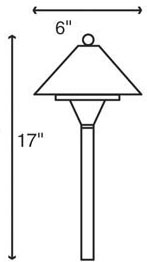 And as one final throw-away, why has nobody asked why bright lights are needed in a Park and Ride?
 Cars and buses have headlights designed to illuminate unlit roads; CCTV cameras can see perfectly well with invisible infrared illumination, so all that is needed is sufficient light at ground level to prevent pedestrians walking into parked cars or tripping over kerbs. So why has nobody considered knee height "Walkway Lights" like the one pictured, which can operate off batteries charged by the sun? They would certainly cause less interference to bats than mains powered lamps mounted on poles.
Go back to top index
Referred to the Secretary of State
Although Watchdog is concentrating on the heritage issues, those who want to make objections on a wider sweep of the issues will find plenty of facts and figures from the websites of other campaign groups: the Save Bathampton Meadows Campaign will provide information on council promises they are about to break (that no future developments would be approved to compromise the integrity of an oxbow lake and wildlife reserve, specially constructed alongside the Batheaston Bypass as mitigating environmental features) and the risks to wildlife, particularly herons and Greater Horseshoe Bats). They can also give details of three previous studies, funded by the council, that concluded that this site is unsuitable.
The other campaign group is Response 2 Route which examines the issues of the Bus Rapid Transit proposals that are intended to link the east and west car parks.
The public is allowed to lobby the Secretary of State to attempt to influence the choice made. Watchdog encouraged as many people as possible to ask GOSW to ensure that the decision is called in for a Public Inquiry.
We also received clarification from GOSW that the Secretary of State is likely to maintain separate files for each planning application (the Bathampton Meadows application also has to be referred to the Secretary of State as a departure from the Local Plan), and so to ensure that public comments are considered with the appropriate application, all correspondence should quote just one planning application reference. Of course this does not prevent the same points being made on more than one application if appropriate.
The planning application references are:
• 09/00304/EREG03 for Lansdown
• 09/00305/EREG03 for Odd Down
• 09/00307/EREG03 for Newbridge
• 09/00308/EREG03 for Batheaston
It is important that any comments from the public are submitted quickly. The GOSW target is to collate all the information for the Secretary of State within 21 days, although there are mechanisms available to extend this timescale.
And that is what happened! A letter dated 20th May 2009 has been sent by the Government Office for the South West (GOSW for short) to the planning office, issuing an Article 14 Notice on the Newbridge application. On 17th June, a second letter issued a similar Article 14 Notice for the Batheaston application.
Article 14 is a mechanism provided for in the planning legislation, where the Secretary of State for Communities and Local Government can forbid planning permission being granted while studying the documents and deciding what to do. The Article 14 Notice does not prevent the council from considering the planning application or for refusing it, but they can only go as far as wishing to grant permission. Normally after issuing an Article 14 notice, the Secretary of State will either withdraw the notice, allowing the Local Authority to make the decision, or will call for a Public Inquiry to decide the outcome.
Go back to top index
A Public Meeting
Bath Heritage Watchdog were invited to attend and speak at a meeting organised by the Save Bathampton Meadows group. This was held on Wednesday 17 June at the Batheaston Methodist Church Hall. Over 250 people packed the venue and occupied every available space.
The meeting was chaired by Steve Mackerness of Bathford Parish Council. He opened the proceedings by laying out the order of the evening and introducing those speaking and those of importance in the audience. A power-point presentation was then given by Dave Batho of Claverton Parish Council (on behalf of all the local Parish Councils) laying out the case for refusal.
The floor was then given to the three guest speakers.
• Jane Brown spoke on behalf of the Bath Preservation Trust. They argued that the evidence submitted with the application is insufficient to judge whether the benefits in terms of reducing congestion and improving air quality outweigh the damage caused to the Green Belt and the limited area of search for a alternative location given the origins of most of the traffic along with a number of other points.
• Patrick Hutton from Bath Heritage Watchdog pointed to the significance of the Green Belt as the buffer zone around the World Heritage Site and the impact of the proposal on the setting and views from the Scheduled Ancient Monuments. He reminded the audience that even the Council's own officers' advice on these issues and that of listed buildings had been ignored and how all attending should make a request for a call-in.
• Anthony Crombie for the Bath Society gave an entertaining little speech drawing attention to the forthcoming World Heritage Convention and praising all those gathered for their efforts. Everyone should make Sunday afternoon their letter writing time!
All speakers outlined the reason for refusal and the case for a call in as seen from their respective organisations' point of view.
The Chair then read out a letter from David Brown of GOSW outlining the current position regarding the Bathampton and Newbridge applications (from this it was learned that an Article 14 Directive had been issued for the Bathampton proposal and any decision was unlikely before early July). This was followed by a letter from Dan Norris MP (Wansdyke).
David Trigwell and Peter Dawson gave the views of Bath & North East Somerset Council, stating the case for approval had been fully explained in the case officer's report and how the Transport Package was just a small part of the overall scheme to reduce Bath's congestion problems. They then offered to answer any questions in the forthcoming debate that related to the Strategic and Transport issues.
A lively and well ordered debate then ensued. This ranged from environmental issues through to the possible A36/46 link road. It encompassed the World Heritage Site, Green Belt and AONB and the guest speakers interjected if they felt they could clarify on points raised.
The meeting was well organised and ably chaired and a powerful case was put forward. It was reported in The Chronicle the following day.
Bath Heritage Watchdog thanks the organisers and others for giving them the opportunity to take part.
We urged that as many people as possible lobby GOSW to ask for the applications to be called in. Many did, but it made no difference.
Go back to top index
The Second Newbridge Report
[5/7/09] The Newbridge Park and Ride application along with the BRT is back before the DCC on 8th July. The report is accompanied by an update to the drawing that shows the Station Road Weston crossing. And unsurprisingly the report shows the sharp practises that could be expected from a planning application that the council is desperate to get approved.
So it refers to a traffic survey leaflet that has not been placed on-line, referring to some timings made during the period when motorists remember all the traffic light phasings being set deliberately inconveniently to skew the results. The results might be factual, but they are definitely not typical. This is the council deliberately corrupting the results so that they say what they want them to say. And the thing they carefully omitted is the inability of the BRT to make progress at Windsor Bridge in either direction because the deliberately engineered traffic jam would not have let the BRT bus in. At the previous DCC, the route was described as going nowhere, and that still applies. We could find nothing in the report that gave a return on investment that justified the spending of money on the BRT in order to achieve this (fictitious) saving of a few minutes. The council might be hoping for Government money, but it is still taxpayers money and it buys very little.
The remainder of the justification emphasises the ability of the BRT to service the Western Riverside. This is the same Western Riverside that UNESCO say is unfit for purpose and want to see redesigned, and which the council obviously thinks it is to be occupied by people so unfit or disabled that they couldn't possibly walk another 100 yards to catch a bus on either the Upper or Lower Bristol Roads.
And let us not forget that the decision is subject to an Article 14 directive which is where the Secretary of State has told the council that they can refuse planning permission (does anybody believe in porcine aviation?) but they can only express a wish to grant approval. The Secretary of State can either withdraw the Article 14 at a later date, allowing the council to grant permission, or can order a public inquiry which is independent and will see through the spin that the DCC will pretend to believe in order not to refuse permission. So it was important that as many of the public as possible contact GOSW and ask for the application to be called in.
Meanwhile, on 22 June 2009 the case officer has quietly nodded through planning application 09/01297/REG13 for the demolition of various walls and buildings along the BRT route. Not only is this premature because the planning application for the BRT route has not yet been determined, but the justification is solely based on an assumption that the conservation area would not be adversely affected. No mention is made of the objection comments received. No mention is made of the policies affecting employment land despite the fact that the application included the demolition of two industrial premises, so this is yet another corrupt decision which should have been refused because of the conflict with policy ET3. Luckily the decision has to be referred to the Secretary of State, so once again it is important that as many of the public as possible contact GOSW (contact details in the box above) and ask for the application to be called in.
Go back to top index
The 8th July DCC Meeting
At the DCC on 8 July, Malcolm Lees was again replaced by substitute Brian Simmons. Again Cllr Coombes complained that the accommodation was not suitable, to which the Chairman replied that the Banqueting Room was already booked and even if another date had been chosen the acoustics in the Banqueting Room were not as good.
The Case Officer gave a very similar presentation to the one made in May because there were members present who had not been at the May meeting.
The only new material was the statistics on the journey times, now added to the report to Committee. The main claim was not that there would be savings in journey times (though there would be) but that there would be stability of journey times and an overall reduction in traffic into the centre. It was pointed out that members should not rely on their own experience since better weather in the summer might encourage more to leave their car at home, the recession might have had an impact on traffic volumes, some schools had broken up and Southgate was not open.
It was also pointed out that without the BRT route through the Western Riverside, that development would not take place. It was necessary to put in the infrastructure first and develop afterwards.
Cllr Curran asked for clarification about the impact of traffic lights for the BRT on ordinary traffic, and what hour is considered to be peak hour. Neither was answered in the long but unconvincing response that followed.
Cllr Coombes tried to ask for clarification of aspects of the planning process, but was cut off by the Chairman before he could even finish his question. To us it sounded like a relevant but difficult question, and the Chairman should have allowed it.
Then followed the presentations from the parish councils and the public. 24 people were listed to speak against, but only 19 actually did. Whilst we kept notes of what was said by each, we have reduced them to key points below for brevity.
• The BRT route to the east of the City would bring no benefits because of the conflict for narrow road space, and this conflict would destroy any capability for reliability at the western end.
• The Transport strategy does not include schemes for removing parking spaces from the city or reducing lorry or school run traffic, so there will be no reduction of congestion.
• There is a perfectly adequate (and much more pleasant) cycle route along the river bank so one is not needed along the BRT route.
• Any investigation of other locations than Newbridge seems to have been deliberately suppressed and earlier documents evaluating alternatives have been reported as "accidentally" destroyed. Other routes for the Park and Ride service have not been properly evaluated.
• The business case omits a number of cost items, the risk analysis is inadequate, and the modelling process is faulty introducing a significant accumulation of errors, leading to a case based on false pretences.
• Serious reservations from statutory consultees have been omitted or misrepresented in the Committee report. Likewise, the impact on biodiversity and the effects of surface water run-off have not been considered. The photo montage of the route is overly selective, omitting well used play areas and attractive views.
• The existence of the Park and Ride encourages car use because it is significantly cheaper for Twerton or Newbridge families to drive from to the car park and pay the Park and Ride fare, than it is to use the normal bus caught locally.
• Actual times recorded over a 16 week period show that the existing Park and Ride buses are quicker than the forecast BRT times to the city side of the Windsor Bridge at all times except for the 45 minute window of 8:15 to 9:00 am Monday to Friday during school term time.
Of the seven people listed to speak in support, six did. Again we took full notes, but we dismiss the claims of improved air quality and reductions in traffic that are disproved by the applicant's own figures, and the Government funding which is neither certain (it still has two approval stages to go through) nor a planning consideration (as the Committee were told), which leaves the following.
• The Park and Ride would be more effective if it were open longer.
• The scheme might face less resistance if the compensation offered were generous
• The existence of the Transport Package could encourage employers to come to Bath or remain in Bath, reducing the dependence on tourism, and to fail to approve after the publicity so far would damage Bath's reputation.
• Without the BRT, the low car ownership for the Western Riverside would be unobtainable and the scheme would need to be redesigned.
Ward Councillors then made their representations to the Committee. The points they raised that have not previously been covered by parish or public speakers are as follows.
• Landscaping to hide views of the car park doesn't remove the noise nuisance.
• For most of the day there is room in the car park and the existing buses run part empty so the need for the BRT is unproven.
• The business case omits the cost impact of free travel for the over 60s.
• There is no highways legislation that will both permit the necessary access by maintenance vehicles yet restrict the BRT route to buses only. Sharing the route space with cyclists and pedestrians is unsafe at the width proposed. Signs will not keep out joy-riders.
• The public trust in democracy is at an all-time low, yet consultation has become secondary to securing funding.
• The loss of children's play areas will put them in danger, forcing them to cross busy roads to other play spaces.
As far as the decision making process (described in both the Western Daily Press and the Chronicle Online) is concerned, Watchdog has sought legal opinion and understands that the following is the outcome of these events.
The motion put to the Committee was that they should support the case officer's recommendation to permit. The motion was amended slightly during the discussion as additional desirable conditions were identified, but when it came to the vote, that vote was to decide whether to permit the planning application as presented, with the conditions recommended by the case officer, plus those agreed as supplementary conditions during the discussion.
Voted for: Les Kew, Richard Maybury, Brian Simmons, Steve Willcox and John Whittock (5 votes)
Voted Against: John Bull, Nicholas Coombes, Gerry Curran, Eleanor Jackson, Carole Paradise, Brian Webber (6 votes)
No vote: Colin Darracott
Decision: REFUSE
The motion was defeated: 5 voted for, 6 voted against and 1 abstained (or rather Cllr Darracott asked this to be minuted as "did not vote", but the effect is the same). So the decision of the Development Control Committee was to not permit the planning application; the vote was to refuse permission. Watchdog will be examining the draft minutes, when they are available, to check that they accurately record that outcome. There were a large number of witnesses!
Planning legislation requires that the reasons for refusing permission must be stated. That legislation does not say that it must be be decided by a motion voted on by the Committee, or that it is necessary to have a same-day timescale for defining the reasons for refusing. So the chaos that followed is the direct responsibility of the Chairman, who either did not know the planning legislation sufficiently to take the correct action, or who deliberately tried to undermine the decision just taken by initiating incorrect action; we are not mind readers so have no opinion on which applied.
Section 72 of the Planning (Listed Buildings and Conservation Areas) Act requires the council to pay special attention to the preservation or enhancement of the character of the surrounding Conservation Area.
Policy BH.6 requires the council to preserve the character and landscape of Conservation Areas
Policy BH.15 requires the protection of open spaces.
What happened next was that the Chairman asked the Committee to propose a motion to refuse permission, which was to be voted on by the full Committee. This is the Chairman making up his own procedure despite the legislation, which exceeds his authority. All that was necessary was for those who did not vote for the previous motion (6 against plus one abstention) to identify their planning reasons for refusing, and that could have been done "out of committee". It is not rocket science. From our seats in the public gallery it was clear that the majority of the Committee did not think that the applicants had made a sufficiently strong case for the benefits of what they applied for to override the duty of the Local Planning Authority to preserve the character of the Conservation Area and the World Heritage Site, and we are fairly certain that the seven people concerned would have come to a conclusion similar to that if they had discussed it amongst themselves.
Yet instead, a motion was made up on the spot and put to the entire Committee, including those who had voted for the previous motion. Because of the way that motion had been worded, one of the members who had voted against the first motion felt unable to support the second (and his reasons were entirely valid) and the result was a 5-5 vote with two abstentions. Putting aside for just a moment the fact that the motion should not have been raised for the full Committee to vote on, the Chairman's role in the event of a tied vote is to cast the deciding vote, either Yes or No (and traditionally the Chairman should vote No unless there is any new and important factor that had not been brought out in the preceding discussion that the Chairman considers important enough to introduce with a casting Yes vote).
What the Chairman is not allowed to do at that point is to introduce another new idea. But that is what he did. He suggested a deferral. It is clear from the press comments and the comment placed on the council website that he intended that to be a deferral of the planning application. But he can't actually do that. The vote on that had been taken and the result was to refuse, and there is no provision in any of the planning legislation for a Local Planning Authority to rescind a decision to refuse. So the only thing that can be proposed to be deferred is a decision on the motion to refuse, which was not legally necessary and should not in any case involve anybody who voted to permit the planning application. And that one should not have been capable of being deferred because a vote had been taken and was tied and the casting vote must be either Yes or No, so a Defer recommendation must be interpreted as a No vote. This gives a majority No vote and the motion is defeated. So there is nothing to defer.
We have to question whether the current Chairman is the right person for the job, because he is either unsure of, or over-confident about, the extent of his authority to the point where he misleads others.
So we will spell out for him what the position really is.
• Planning application 09/00307/EREG03 has been refused permission and the Local Planning Authority has no legal powers to change that decision. It does have a legal obligation to state planning reasons for that refusal to complete the documentation, but there is no requirement for anything more than a consensus from the members who were responsible for the decision to refuse.
• The second motion (to refuse permission) is irrelevant, but in any case is defeated by a casting vote that was not Yes.
• The Applicant is at liberty to raise new planning applications in the hope of achieving something similar to 09/00307/EREG03, but any new application has to be considered on its own merits and not as part of a package, and must be subject to the proper consultation process before any decision is reached.
• Now that 09/00307/EREG03 has been refused, the Compulsory Purchase Orders it would have authorised cannot proceed.
The council website currently says that the "Committee resolved to not determine the application and requested that it be brought back to a future meeting of the Development Control Committee." This is untrue (see above) and any attempt by the council to revoke the refusal of 09/00307/EREG03 or to proceed with another vote on it is unlawful, and a Judicial Review will almost certainly rule so.
Anybody who has lobbied GOSW about the Batheaston Park and Ride might like to update their correspondence with the news that the BRT has failed to secure planning permission and therefore will not be servicing Batheaston.
The Local Government Act 1972 makes the council's position worse.
Schedule 12 Section 39 says "All questions coming before a local authority shall be decided by a majority of the members present and voting thereon" and "In the case of an equality of votes the person presiding at the meeting shall have a second or casting vote".
The Act does not say that the vote has to be in favour of a motion; thus the first 5-6 vote decided the application. The Act also says the Chairman must cast a deciding vote, despite Part 4F Rule 46 saying he doesn't.
The publication of the draft minutes coincided with a statement in the press where the council claims yet again that the BRT was not rejected. We are not going to enter into a debate in the press about Part 4F Rule 46 of the council's constitution, because it starts with the words "Subject to the provisions of any enactment"; and we remain convinced that the "enactments" (ie the appropriate legislation), which the constitution admits takes precedence, is unambiguous about the outcome of the vote. It is unlikely that the Local Government Act 1972 referred to in the news item conflicts with the Town & Country Planning Act 1990 which has been our guide so far, because the 1990 Act includes amendments to the 1972 one. But we will check one against the other in time for the next update. [26/7/09] We have checked. There is no conflict, but some reinforcement, see box right.
We have the following comments on the draft minutes, (with quotation from the minutes in brown). The paragraph numbers refer to the paragraphs following the heading Item 1:
The essence of Section 14 of Statutory Instrument 419 of 1995 says "The Secretary of State may give directions restricting the grant of permission by a local planning authority ...", and also "A local planning authority shall deal with applications for planning permission for development to which a direction given under this article applies in such manner as to give effect to the direction".
Paragraph 1: ... this was due to an Article 14 Direction which prevented the Council from determining the application. An Article 14 Direction (which refers to Section 14 of Statutory Instrument 419 of 1995) removes from the council the power to grant planning permission. The council still has the authority to determine the planning application if that decision is to refuse permission. Sections from the Statutory Instrument are reproduced in the box on the right. We do not deny that the Case Officer said it, but in doing so he misled the Committee, and the minutes ought to recognise that this was wrong advice.
Paragraph 3: The Development Manager ... advised Members that there had been no objection on the grounds of flooding or ecology (from the Council's ecologist or Natural England, although Avon Wildlife Trust had objected). The Development Manager misinformed the members. The letter from Natural England on the planning file specifically states their objection to the scheme. The most recent letter from the Environment Agency imposed six conditions that had to be in place before Planning permission could be granted and only five appeared among the list of conditions in the Case Officer's report, so there remained some part of their objection not addressed and the absence of any objection could not therefore be assumed.
Where an application is made to a local planning authority for planning permission- (a) they may grant planning permission, either unconditionally or subject to such conditions as they think fit; or (b) they may refuse planning permission.
Paragraph 5-6: The motion was then put to the vote. Voting: 5 in favour and 6 against with 1 Member not voting. Motion lost. Councillor Gerry Curran moved that permission be refused. The Town & Country Planning Act 1990 is very clear that when an application is decided the council must either grant development consent or refuse permission (see box right). Thus when the vote to grant consent resulted in a majority against, then the decision defaults to refuse. No further votes or discussion is supported by the legislation.
Paragraph 7: Voting: 9 in favour and 2 against with 1 abstention. Watchdog members who attended report scenes of confusion rather than a formal vote. Indeed nobody that we recognised in the public gallery who we have been unable to contact since remembers such a vote. Two members of the public and one parish councillor who all sat in the main auditorium because they spoke to the Committee have said that they do not remember a formal vote. We conclude that if a vote was actually taken, it was not immediately after the other two votes as the minutes suggest. The motion allegedly voted on to defer consideration to allow the applicants the opportunity to reconsider the proposal is not possible because the consideration has already taken place and the outcome determined.
There is time enough before the next DCC meeting to correct the minutes. We hope that the Secretary is guided by the information above.
Go back to top index
The August Waste of Time
A quick one-liner on our reaction to the agenda of the 5th August DCC including the Newbridge application is: If they want to waste their time, who are we to stop them?
The Newbridge application has in law been refused. The reasoning is quite simple:
The Local Government Act 1972, Schedule 12 Section 39 says "All questions coming before a local authority shall be decided by a majority of the members present and voting thereon"
The Town & Country Planning Act 1990, Section 70(1) says "Where an application is made to a local planning authority for planning permission—
(a) subject to sections 91 and 92, they may grant planning permission, either unconditionally or subject to such conditions as they think fit; or
(b) they may refuse planning permission."
The first is relevant because the majority voted against and thereby decided the application. The second is relevant because there are only two choices, (a) and (b), and if (a) does not apply, then (b) must.
There is nothing to say that a council committee cannot discuss anything they choose, so they can have the discussion on Newbridge and the BRT as often as they like. What they can't do is make a decision that supersedes the one already made. And there are a number of long-stops.
The first is that the Newbridge planning application is subject to an Article 14 Directive (see the relevant box above), so the committee can't even pretend to determine the application, all they can say they are mindful to permit. They can be mindful to do whatever they like, have toast for breakfast, fly in a hot air balloon, or anything else that takes their fancy. Being mindful doesn't make it happen.
The next question is what happens to that Article 14 Directive.
It could be replaced by a decision to call in the Transport Package (GOSW have already said that they will not treat the individual planning applications in isolation) and then the next step is to appoint an independent Planning Inspector to conduct an Inquiry. That planning inspector is required to determine the applications according to planning law, with no thought to Government policy, funding availability or party politics. We would expect anything that happened to the Newbridge application after the first vote in July to be ignored during that process, but for the Inquiry to continue to a conclusion on the Batheaston application. There are appeal procedures and complaints procedures and ultimately court proceedings that can be invoked if the Inquiry treats the Newbridge application as not yet determined.
Alternatively, the Secretary of State can choose not to call in the applications and leave the council to determine them. The correct approach would be to make it clear that the permission is restricted to the Batheaston application, but it is possible that the paperwork will not be sufficiently specific. At that point, the Secretary of State is accidentally or deliberately condoning the actions of the council to unlawfully decide the same planning application twice. Therefore the Secretary of State can be investigated by the Parliamentary Ombudsman. If the council tries to act on the instructions of the Secretary of State, then that action can be reported as a material fact to the Parliamentary Ombudsman, with the option of also mounting a challenge in the High Court.
As an interesting aside, now that the Department for Transport has exerted pressure on the council to grant planning permission for the full package or lose the possibility of central funding (as reported in The Chronicle) when part of that package has already been decided and refused, the Secretary of State for Transport can also be reported to the Parliamentary Ombudsman or be called as a witness in any court case. We suspect that as soon as an official investigation into the Department for Transport starts, they will not insist on spending their money on Bath, particularly when they have an easy way out by rejecting the business case that B&NES have yet to submit, and which will have to include everything omitted so far, like the cost of rerouting major sewers.
But right now, nothing needs to be done. We can let the committee go through the motions of reaching a second refuse decision or more likely a "Mindful to approve" decision (this is the third attempt, so they surely must have done enough organising and coercing behind the scenes to eventually get the answer they want?). It is only at the point that anybody operates outside the law that action can or need be taken. And we (and a number of other groups, some of which are rumoured to be already fund-raising for future court action) will be watching every move!
Meanwhile we can enjoy the case officer giving the committee enough rope to hang themselves.
He says The potential loss of funding is not in itself a material consideration to be taken into account in the determination of this application. Unfortunately he precedes that with a warning that the Department for Transport would not be willing to fund the package without the BRT route, which immediately makes it a planning issue because his report specifically brings it to the committee's attention. And he follows that with reference to the deliverability of the whole package, when the planning guidelines are absolutely specific that every planning application has to be determined on its own merits without reference to any other planning application. If the council wanted the package to be treated as a package, it needed to raise a single application covering all the park and ride sites plus the BRT route under a single application number. It didn't do that, and it can't now proceed as though it had. In just a few paragraphs, the case officer has prejudiced the integrity of any decision made. Luckily, this application has already been determined and refused, otherwise the case officer's brief would be clear grounds for a judicial review.
He says that the BWR layout and implementation would need to be reconsidered if the BRT is not progressed. And later on insists The BRT is critical to the development of the BWR site. He made that up! We have looked through the Western Riverside planning documentation, and nowhere does it say it would need to be redesigned if the BRT did not go through it. The BWR plans show the BRT runs along ordinary roads, so any other bus service could also run along the same roads. However what he fails to mention is the UNESCO Mission Report on Bath, which says of the Western Riverside that it requires the State Party (ie the British Government) to submit to the World Heritage Centre and ICOMOS, for review, a time-bound revised plan, including reduced density and volume of the ensemble ... The development of those two phases should be submitted to an international architectural competition. In other words, the Western Riverside will be redesigned in any case, and there is no reason to suppose that after such a redesign the BRT route currently in the plans will be appropriate (and would the Department for Transport ask for their money back, we wonder?).
Any committee member who believes the case officer in preference to UNESCO hasn't thought it through. We have though, and have written to both the State Party and UNESCO to warn them that B&NES wishes to pre-empt the outcome of the requested "time-bound revised plan" by reserving land usage for a particular route for a road. UNESCO only deal with central Government and never with Local Authorities, so central Government needs to know when Local Authorities are undermining their room to manoeuvre.
Incidentally, we notice that the August DCC also includes plans for the corner plot where the Lower Bristol Road meets Windsor Bridge Road. We wonder why the site boundary marked on the outline application for the Western Riverside runs part way through the buildings proposed by BFI Waste systems. One of the applications must be wrong because the former railway embankment can't belong to both sets of plans. And we wonder which comes first, the Western Riverside building work or the new BFI Waste systems buildings, because they are so close together that the building of one must surely prevent some of the plant that would build the other from obtaining access. That will wreak havoc with any development timetable!
We will attend the DCC meeting and we will enjoy the show, but we will do so in the knowledge that any decision other than to endorse the previous refusal will ultimately be undeliverable, but that might be proved at a cost. Is the council prepared to lose the £50Million grant and then fund an expensive high court defence, we wonder? Council Tax payers have a right to know.
Go back to top index
The False Sense of Security
We attended the August 5th Development Control Committee meeting, and despite our conviction that it was a waste of time, we bring a summary of events for those who couldn't be there but would like to know what happened.
The minutes of last months meeting were agreed but Cllr Curran wanted it made clear to all and have it recorded that their were 2 Council solicitors present last month, one giving information in public and one advising members privately. (We will wait to see if the formal record is amended, but meanwhile, your request for an amendment is recorded here, Cllr Curran).
Voted for: John Bull, Les Kew,
Richard Maybury, Brian Simmons, Brian Webber, John Whittock and Steve Willcox (7 votes)
Voted Against: Neil Butters, Nicholas Coombes, Gerry Curran, Eleanor Jackson, Carole Paradise (5 votes)
Decision: Mindful to permit
As expected, the process of substitution (this time Cllrs Darracott and Lees were substituted by Cllrs Symonds and Butters) and Party pressure did eventually achieve a majority who were "mindful to permit" (see voting figures in box, right).
There was virtually nothing new in the case officers report to the meeting other than the two letters received, one from GOSW and one from the Department of Transport. There was a comment from the applicant that they planned to alter the cycle path to achieve better segregation from the buses, but because of the date of the meeting there wasn't time to prepare details. Why the meeting hadn't been scheduled for a date after they had worked out the details wasn't stated. The other little throw-aways were the fact that HGVs form 60% of the traffic surveyed (which makes the Transport plan even more expensive per car) and that the BRT traffic lights would be controlled by the current traffic management system (which means additional costs from extra control cabling).
Cllr Curran pointed out the anomaly of trying to get people out of cars by providing a car park, and the stupidity of approving earlier that day the planning application for the BMW garage, located at precisely the point where the BRT discharges onto Bath's most congested road. His refreshing voice of reason was of course ignored.
A similar fate of being ignored befell the Parish Councillors, from Bathampton Batheaston, Bathford and Claverton who spoke against. This was unjustified, but perhaps inevitable given that the points raised were precisely what the majority of the committee who were going to vote in favour didn't want to hear:
• The fact that the quoted benefits were insufficient to justify the damage to a Site of Special Scientific Interest, the loss of gardens and play space and the fact that the statistics prove that a workable park and ride system can be supported by conventional buses.
• The fact that only 17% of the BRT mileage would be on dedicated routes, so at best the savings in travel time would be insignificant, and at worst the larger buses would have increased journey times compared with smaller conventional
buses over the whole route.
• The fact that the hidden costs of the route, including but not exclusively the rerouting of underground services, could undermine the perceived value in the business plan.
• The fact that the committee had no legal right to discuss this matter. (More about this later).
• The fact that the case officer's report fails to reflect the applicant's own figures that improvements in congestion and air quality would be negligible.
The objections from the members of the public added some new facts:
• The fact that a long-held wish to install a bus lane along the Lower Bristol Road is a better solution than building a new road parallel with it.
• The fact that UNESCO requires a redesign of the Western Riverside, yet the case officer still insists that the BRT and the Western Riverside in its current form are inextricably linked.
• The fact that any decision other than refusal could be grounds for a Judicial Review because of the inaccuracy of the paperwork presented to the Committee.
• The fact that the availability of Government money is not a planning issue, yet the latest brief to the Committee makes great emphasis on that money.
• The fact that the presence of the BRT route behind houses provided a new access route for criminals to those houses and the risk of extra overlooking.
• The fact that it is not possible to improve congestion by installing additional traffic lights.
• The fact that planning permission for the houses in Ashley Avenue was granted conditional on adding the very land as gardens that the BRT now wants to remove.
• The fact that the land to be excavated for the Newbridge extension is a currently capped and safe former rubbish dump containing hazardous waste, that if disturbed could blow towards and contaminate a local school.
• The fact that no consultation with local people who might have offered more practical solutions took place until after Government funding had been applied for and the council was committed to one plan.
• The fact that despite being grouped into a single transport package, the mathematical models for the sites were different and inconsistent and so couldn't be used together.
• The fact that the current Park and Ride buses are rarely full and rarely delayed by traffic, so the need for the BRT is not proven.
• The fact that by 2010 the council is obliged to protect the biodiversity and the rare species that inhabit the field they want to turn into a car park in 2011.
• The concern that if the council's figures are wrong, or the Government money is not made available in sufficient amounts, both of which seem likely, any overspend will have to come from Council Tax.
A number of supposedly members of the public spoke in favour, but three of them were either members of the council or employed by the council and most of the others represented organisations. We have to admire the industry of those who went round raking up support, but the fact that eight of them didn't feel sufficiently opposed to speak at the previous DCC meetings didn't go unnoticed.
Neither were we impressed by the quality of the arguments. When announcing statistics that show that a third of small businesses think the Transport Package will be the solution to traffic problems, it only takes simple arithmetic to work out that two thirds don't. The claim that the Transport Package would encourage new businesses looks doubtful when existing businesses have to be shut down to clear the BRT route, and the news that viable businesses are not safe in Bath is hardly going to be a magnet.
It is not worth reporting the claims of improved air quality or reduced congestion that are disproved by the applicant's own figures, nor all the claims that Bath can't let the money slip when the availability of funding is not a planning issue, nor the claims of benefits of showcase bus routes that form no part of the planning applications.
We loved the illogical comment that the roads are so full of cars that there is no room for a single extra car, so let's add frequent giant buses to those roads. And we enjoyed the story of the company whose employees didn't want to move from Warminster to Bath, delivered without any recognition that it is the "from Warminster" that is significant, not the "to Bath", and very few employees would be prepared to move house and change their children's schools given a choice. Some invention took place as well, like the expectation that electric buses would be used when the documentation clearly shows that they will not.
We took copious notes of what was said, but couldn't find any planning issues to report here. The only positive thing to come out of those speaking in favour was the promise from the applicant's agent of a new pedestrian crossing on Newbridge Road; something the Ward Councillors had been requesting for years.
Among the points raised by the ward councillors was the fact that when the route was first earmarked the area was all industrial but now it is residential and that affects both the impact and the costings. It is time to reconsider the original southern location option. Attention was drawn to the objections by the Cotswold Conservation Board and English Countryside which were given scant coverage in the case officer's report, and the geographical split of councillors, such that none of those in favour of this application live in Bath and will have to live with it if approved. They ended with a question that was never answered, of how using existing roads can be more expensive than building a new road.
Cllr Maybury proposed the motion to approve. In a long and rambling speech he assumed that each of the public speeches in favour represented the unanimous view of their membership and therefore the sum of those memberships gave more in favour than against. (If he actually believed that to be true, then he is far too gullible to be passing judgement on planning cases, so we assume that it was known to be a meaningless sound-bite).
Watchdog has now seen a copy of the Inspector's comments, and we can inform Cllr Maybury that the Inspector was asked to comment on a 1500 space car park (compared with the 500 in the current application), and rejected the proposal on two main grounds: a) That the council had provided insufficient evidence of the need for this scale of spaces, and b) that on the land area identified, 1500 spaces could only be accommodated by a decked car park which would be inappropriate in a Green Belt location.
He assured everyone that the southern alternative location was rejected by the Planning Inspector for good sound reasons, when previously everyone had heard that the papers relating to that decision had been accidentally destroyed. So has he got a crystal ball that will give a reassembled view of shredded papers? (We did look it up though, see box right).
He said that 20 years ago the council decided on the Bath Transportation plan to increase the availability of jobs in Bath. He failed to mention that In those intervening years there has been a mass exodus of civil servants as the DWP and Inland Revenue abandoned Bath completely and the MOD significantly reduced numbers. Clearly corporate policies are ignoring the supposed benefits.
The rest of his reasoning was based on funding and investment in Bath and the region and how disappointed Government Ministers would be, none of which are planning reasons.
Cllr Webber seconded the motion. He claimed to have changed his mind about the benefits based on additional information, yet the only additional information he mentioned was the correspondence threatening to withdraw the funding, which should not be a planning issue. He dismissed the idea of suppressed demand, even though it is recognised in the applicant's paperwork, and he thought the ecological measures were reasonable, which only proved he had not read the consultation responses from the Cotswold Conservation Board and English Countryside. The remainder of his reasoning was because the package had to be considered as a whole and the Western Riverside plans depended on it, which ignored the fact that planning law says that each application has to be evaluated without reference to any other application.
The ensuing comments from other committee members were lengthy - too long to reproduce here in detail - but a flavour can be given.
Cllr Curran systematically destroyed all the arguments that the public speakers in favour had offered, then countered all the arguments put forward by the proposer and seconder. Finally he threw in a couple of examples where the existence of the BRT would make worse some of the things it claimed to improve.
Cllr Paradise showed how the plans had been insufficiently thought through and that if the council had asked for ideas rather than insisting it knew best, there were better solutions.
Cllr Butters endorsed this view, and thought that with a new Minister of Transport in place there ought to be an opportunity to rethink.
Cllr Coombes said that the council had elicited the letters that were now part of the update brief even though they were not planning issues, but he could see no signs of any modifications to the proposals previously voted on, and he would have expected changes if a deferred application is being reconsidered. If anything, there was now less information on the benefits and more on the risks of losing funding. He believed the Public Relations offensive had failed.
Cllr Bull assumed that if alternatives were offered they too would face objections and given that it had not proved possible to separate the BRT from the Park and Ride as he had wished, he would support the Local Plan and emerging Core Strategy by voting in favour.
Cllr Jackson pointed out potential traffic safety issues that hadn't been addressed, and the fact that by the council's own figures, the expanded Newbridge site was too small, so a different solution was needed. There was also a timely reminder that the Batheaston decision could not be taken for granted because it was still in the hands of the Secretary of State.
Cllr Wilcox reminded everybody that congestion and air quality were getting worse so doing nothing was not an option. Clearly he hadn't read the applicant's documents that showed that the Transport Plan would have a negligible effect on both. He speculated on the opportunities for converting the BTP to tram or monorail, but didn't explain why the was introducing ideas that were not in the plans under discussion, or why he thought that an alternative to a bus was useful for just 17% of the route.
The Senior Manager rounded off the discussion by reminding everybody that the funding was at risk (despite the knowledge that this shouldn't be a planning issue), by announcing that the applicants had thought about changes (but offering no assurances that they would be followed up), and dismissing the shortened gardens in Ashley Avenue as acceptable by modern standards (despite the fact that it is inappropriate to retrospectively apply new development standards to existing buildings).
Then the vote was taken. We concluded that the 7-5 in favour outcome was not as a result of applying intellect to the facts. Of course, the outcome is only mindful to permit an application that has already been refused, so it doesn't really matter anyway. All it served to do was give those who were desperate to get their hands on Government money a false sense of security.
Postscript
After the meeting, Watchdog was given a lot of supplementary information from a number of sources. They are offered as hearsay because we haven't checked them ourselves, but we have no reason to doubt their accuracy.
We were told that because one part of GOSW has issued the Article 14 Direction and another part of GOSW had written the letter that formed part of the update report, the question of a conflict of interest had been raised with GOSW. We understand that there is now an ongoing investigation within GOSW to establish the circumstances under which the letter from Hilary Neal was written, and whether there was any expectation that the letter addressed personally to the Chief Executive of B&NES should be diverted into a planning file and thus made public.
We regard this statement as an open invitation for Save Bathampton Meadows, Response 2 Route, Newbridge Matters, or any other organisation who has a petition against any of the Park and Ride plans to send a copy of their petition responses to the DfT so that the scale of opposition is apparent.
We were told that the originator of the letter from the Department for Transport (Julian Abel) is very surprised to discover that a scheme presented to him as for the benefit of the residents of Bath is facing such opposition from the residents of Bath, and feels obliged to bring this to the attention of the Minister alongside the business case for funding if and when he receives it. Meanwhile he is happy to receive information and enquiries by telephone (0207 944 6735) or by e-mail, though he will refer questions to B&NES for explanations rather than try to answer them himself.
We were told that a Cabinet Member was seen on more than one occasion berating a DCC Member in public during the interval between the two DCC meetings. We won't name names, but you know who you are! We are not at all surprised at the behaviour of the Cabinet Member. We are disappointed by (yet have some sympathy for) the DCC Member, but point out that the decision about when to raise his hand at the vote remained his and his alone.
We were told that when asked to explain the Fundamental Legal Principle that required the second vote at the July 8th meeting, which a council spokesperson told the Chronicle, the council have failed to provide an answer. This backs up our own research which indicates that there is no legislative basis for it.
We were told that at least two groups are already exploring the possibility of mounting a legal challenge. Our advice is to wait for a bit, because as we have said before "mindful to permit" achieves nothing and a legal challenge can only be mounted against a definite event (see What happens next, below). The only other real opportunity comes if the council initiates any activity regarding Compulsory Purchase in Ashley Avenue or of the industrial premises on the proposed BRT route. We stand by our earlier advice:
We recommend that all those property owners who are threatened with compulsory purchase of their land to accommodate the BRT refuse point blank to discuss details with the council (which will reserve their position as objectors), and formally object to all later compulsory purchase paperwork on the grounds that planning permission was refused on 8th July so the compulsory purchase is inappropriate. Then the council must prove the legitimacy of the Compulsory Purchase Orders to an Inquiry, and it is our view that they will not be able to do so. That will sink the council's spin once and for all. We have checked, and the formula for calculating the Compulsory Purchase value is fixed. The council cannot offer more if you are helpful, and they cannot offer less if you are not. So you have nothing to lose by refusing to discuss details, and everything potentially to gain.
More legal bits.
We were provided with a transcript of the very detailed presentation that Bathford Parish Council made to the DCC. It reinforces our research, and even provides legal terms (in Latin) for the concepts we had previously identified. You can read the full text here, but we summarise it in an easier to understand form below.
Despite the current claims that procedures required the vote against on 8th July 2009 after the original vote in favour was lost, the then General Development Control Committee (GDCC) considered applications to permit the carrying out of flood compensation works on Bathampton Meadows on 25th May 2005 and again on 18th January 2006. On both occasions the GDCC, contrary to officers' recommendations, voted against a motion that they should be "minded to approve" and those minutes do not record any voting on subsequent motions to refuse. Clearly, if it was not considered to be necessary on those occasions, it was not necessary on 8th July 2009.
We looked up the latin terms:
Functus officio: "having performed the authorised act and being unable to go back to it a second time". One who is functus officio is precluded from again considering the matter even if new arguments or evidence are presented.
If the council's advice is that the Batheaston decision cannot be revisited, the same must apply to the Newbridge decision.
RES JUDICATA: "the thing has been decided". The principle that a final judgement of a competent court is conclusive upon the parties in any subsequent litigation involving the same cause of action. Res judicata is a general principle of international law under Article 38 (1)(c) of the International Court of Justice Statute.
The fact that the council is both the decider and the recipient of the decision does not invalidate this principle, that having decided the matter once on 8th July, then that refusal is restated as the start condition on 5th August.
After the Bathampton Meadows vote, five Councillors wrote to B&NES Standards Committee. Their letter included a question as to whether and how the DCC decision on Bathampton Meadows Park and Ride could be overturned. The reply from the Council's monitoring officer included the following statement: "As a general principle of law, it is not possible for a decision-making body such as a Development Control Committee that had made its decision, to reconsider the same decision. This is on the basis of a legal principle known as "functus officio". The only way in which such a decision or decisions could be overturned would be were a court to order this to happen on application of an interested party by way of judicial review.".
At the DCC on 8th July 2009 this Newbridge Park & Ride/BRT application was considered. A motion that the Committee was "minded to permit" was defeated by 6 votes to 5. This fact is recorded in the minutes approved earlier. On normal principles of law, that should be an end to this Application. The legal term for the status of the Application is 'Res Judicata', meaning 'a thing already determined'.
When the case officer pushed members of the DCC for reasons, the meeting created a formal motion to refuse, with reasons. It is questionable whether or not reasons need to be provided since they are normally provided to allow the applicant to appeal an adverse decision, and in this case when the Council is the applicant, it cannot appeal against its own decision, and so the need to provide reasons, whilst providing clarity, is not strictly necessary but is a choice available. BUT there is no basis for a further motion to refuse the application. It is 'Res Judicata', determined when the motion 'minded to permit' failed.
When an issue has two outcomes, as in this case - permit or refuse - it is not logical to consider two motions: first to permit; and if defeated, then to refuse. Supposing you did this, and defeated both the motion to permit and the motion to refuse. The matter would then be in eternal limbo, incapable of being determined - since it was neither permitted nor refused (and could not be further discussed under the principle of 'Functus Officio'). This is patently and logically absurd. The law can sometimes be an ass, but it is never logically absurd.
Let us look, therefore, at the motion to refuse giving reasons, which was neither passed nor defeated on the 8th July. It was not the 'refusal' which was undetermined by the tied vote, it was the 'reasons' which were not agreed. The 'refusal' had already previously been determined by the loss of the motion 'minded to permit'. The 'reasons' were the only thing the second motion could seek to provide. Thus the Committee is not legally able to consider a motion to refuse or permit the application which has already been determined. It is 'Res Judicata'. The DCC is 'Funtus Officio' with respect to this decision. If the Committee wishes to waste its time, it could consider a motion to retrospectively provide reasons for defeating the 8th July motion 'minded to permit' but then it is patently absurd to request all committee members to take part in such a discussion, since those who voted for the motion on 8th July, clearly have 'no reasons'. They voted for the motion. The decision on the reasons can only logically be taken by those 6 members (or their substitutes) who voted against the motion on 8th July. There is a precedent: this is precisely what happened in the case of the defeat of the 'minded to permit' motion in 2006 on the Flood Compensation works.
Ultra vires: Latin for "beyond powers." It refers to conduct by a corporation or its officers that exceeds the powers granted by law. Narrow ultra vires applies if an administrator did not have the substantive power to make a decision or it was wrought with procedural defects. Broad ultra vires applies if there is an abuse of power.
The constitutional theory of judicial review maintains that a decision of a public authority can only be set aside if it exceeds the powers granted to it by Parliament.
The process which occurred last month after the motion 'minded to permit' was defeated will not withstand legal challenge. In administrative law, the second vote may be judicially reviewable ultra vires.
Money Matters
When the Transport Package had what was laughingly called a public consultation, a cost of £50Million. Deeper digging revealed that the Department for Transport expected to contribute just over £48Million.
Recent comments in the press mentioned £60Million. So what was the true figures? The Freedom of Information Act allows the truth to be requested. The answer was enlightening:
The current cost of the Bath Transport Package is £57.5Million. Of that, land acquisition accounts for £7.1Million and the BRT £13.2Million. The total figure also includes a contingency margin of £3.2Million, or 5.5%.
None of our contacts in DfT have suggested that any increase over the original £48Million is being considered, so even if the contingency is not used and it is deducted, it still leaves a shortfall of £6Million to be found from council funds, for something which very few people want and which won't bring the benefits claimed. What a waste of money!
What happens next?
That really depends on how determined the council is to dig itself into a bigger hole.
They could recognise the legal advice of its own Monitoring Officer that a decision once made cannot be reconsidered, and issue itself a notice that planning permission for the Newbridge application has been refused.
Alternatively, they could carry on the pretence that they can still see the application approved, and submit papers to GOSW to that effect. GOSW should then reject the papers as Res Judicata. Both the council and GOSW are vulnerable to a legal challenge if such a rejection does not take place.
The rules of natural justice require that the decision maker approaches the decision making process with 'fairness'. Neither the second vote on 8th July nor the motion put to the vote on 5th August follow that principle.
Go back to top index
No Call-in
We have been provided with copies of the letters dated 9 October 2009 sent by GOSW to the council lifting the Article 14 Directions and permitting the council to determine the planning applications. The letters are identical, apart from the title and reference; they even include the identical misprints. (We have put the Newbridge letter on-line.) Normally, such letters include in the sentence permitting the council to make a decision, the phrase "in accordance with the extant legislation" but these omit that condition. So at first we wondered: did the Secretary of State acknowledge that B&NES will unlawfully determine them in defiance of the current legislation? Probably not, we concluded, because in each letter from GOSW it says "We have carefully considered all the matters raised about this application", so it appears that the Secretary of State was not involved in reaching the decision; GOSW staff decided it.
That could explain why the contents of these letters stretch credibility to breaking point. Look at what they say:
"The secretary of State has considered carefully these [meaning PPS1, PPG2, PPS7, PPS9, PPG13 and PPG15] and other planning issues raised by this proposal". Of course he didn't. We would place a small wager that the papers didn't even arrive on his desk! The Batheaston application was referred to the Secretary of State because it represented a departure from the Local Plan. The Secretary of State cannot just pass it back to the Local Authority using the words in that letter; the Secretary of State is required to give reasons why such a departure from the local plan is acceptable to him. In stating those reasons, PPS2 requires a full analysis of the exceptional circumstances that outweigh the wish of Parliament to protect land designated as Green Belt from such developments. The Secretary of State is not in a position to ignore his own policies, even if it would be expedient to do so. So the assertion that the Secretary of State carefully considered the issues is incompatible with the content of the letter issued, and is therefore a lie.
"The planning issues raised do not relate to matters of more than local importance". The Secretary of State has policies on Cities and Regions, and so should be fully aware of the existence of a Regional Transport Strategy, of which these Bath plans are part. It should be clear to him therefore that as a minimum these plans are of Regional importance. But unless he is totally incompetent, his responsibilities for Cities should make him aware that Bath is a World Heritage Site. Furthermore, it is a World Heritage Site currently under the international spotlight because of its development plans. The World Heritage Committee in their meeting in Seville this year decided to write to the UK State Party expressing their concern about the lack of stewardship of the World Heritage Site of the City of Bath. The report before the Committee that led to the decision was that from the Mission which visited Bath, and included in that report was concern about the Park and Ride plans which represented the failure to preserve the Green Belt that frames the World Heritage Site. This makes the plans of International importance (and we will be conveying to UNESCO the Secretary of State's contempt for the international importance of Bath). The assertion that the issues raised do not relate to matters of more than local importance is a lie.
"The planning issues raised do not relate to matters of national controversy". The Secretary of State, if he had been carefully considering the issues, would have been aware from the Watchdog's submission that the Local Authority had lawfully refused planning permission for the Newbridge application and then unlawfully proceeded as though they had not. This is an attempt to subvert the will of Parliament as expressed in the Local Government Act. That fact, coupled with the apparent collusion of the Secretary of State to such unlawful actions, makes this a matter of national controversy: if a Secretary of State cannot be trusted to uphold the will of Parliament, who can?
Watchdog has made our contempt for the untruthful letters abundantly clear to the Secretary of State through the appropriate channels. We recommend that anybody who is sufficiently incensed by the lies being peddled on behalf of the Secretary of State should do the same.
The Newbridge Decision
There is an old saying: "When you find yourself in a hole, stop digging". The wisdom of this seems to have escaped the council.
On 9th November, the decision to permit the Newbridge Park and Ride and the BRT Route was issued, we assume to give an appearance of legality to the Compulsory Purchase Order letters. However, this decision opens up a whole new can of worms.
To start with, until that date, the council always had the option to issue a notice refusing permission. This would have been compatible with the vote taken on the 8th July and would have been unchallengeable in law. The legal advice offered to Watchdog so far was that until a decision letter has been issued, any legal challenge to the council's actions would have to be argued on procedural grounds, but once a decision is made, the council has committed a decisive act and the legality of that act can be examined in court, should any person or group wish to challenge it.
We know that the council has previously argued in the press that it is necessary to have a vote in favour of any course of action, but the legislation doesn't actually say that, and we would expect a judge to interpret the law exactly as written.
The Newbridge SNCI was identified for protection because (among other things) it contains some very rare plants and insects. Yet nowhere in the decision letter conditions is any reference made to preserving the plants.
In the explanation of why the permission was granted, the planning decision letter says "It is considered that there will be some effect on ecology/biodiversity on both parts of the application site, but that this can be mitigated and compensated for by the measures set out in the application." In the consultation documents in the planning file is one from Natural England, which includes the statement "It may be impossible to replace the quality of the SNCI which will be lost as a result of the development. Natural England’s view is that it will not be possible to adequately mitigate for this loss and that the loss can only be compensated. We have not seen evidence in the planning application that the loss will be adequately compensated."
We note that the permission letter makes no specific reference to the site being a Site of Nature Conservation Importance, despite the definition of SNCIs as "Locally important sites of nature conservation adopted by local authorities for planning purposes and identified in the local development plan." So now we have a council that has previously identified the land as a place that requires nature conservation and has maintained the site properly until the planning application was lodged after which maintenance virtually ceased, has ignored the fact that it is a SNCI in giving itself planning permission, and has then agreed to a condition to be attached to that permission to produce an ecological management plan for the very site it intends to destroy for a car park, and then that management plan is to be approved by the council. We believe that the resultant conflict of interest is sufficient grounds for Natural England to demand a Public Inquiry.
When all the dust has settled, Watchdog will try to discover just how much the council's stubbornness in pursuing the Transport Plan regardless, will have cost the council tax payers in legal fees. The first case comes before the County Court on November 16th (see below).
CPO Advice
The best summary of any grounds for objection were printed in the Bath Chronicle on 8th October. Unfortunately we cannot find this article on-line so cannot make a connection to it, but anyone who still has that edition can find in in the middle of Page 4. To avoid any copyright complications, we have decided not to reproduce it, but to search for the underlying documentation on which it is based.
Last week, to assist we identified this document which explains how the Compulsory Purchase process works, and this document gives an insight into the background; the typical reasons for objecting are given on Page 9. We have now managed to trace a Government Circular on Compulsory Purchase Orders, ODPM Circular 06/2004, but at over 120 pages it is hard work. We have extracted some useful quotes from it, which we reproduce below, with our guidance based on it.
"A compulsory purchase order should only be made where there is a compelling case in the public interest. An acquiring authority should be sure that the purposes for which it is making a compulsory purchase order sufficiently justify interfering with the human rights of those with an interest in the land affected." The council will of course insist there is a compelling case in the public interest. The key words here are "in the land affected". It is pointless arguing against the principle of the Park and Ride bus service because they feature in the Regional Spatial Strategy, but you are entitled to argue that there are alternative routes apart from across the Compulsory Purchase land. The information collected by local residents, and presented to the DCC included the statistics we quoted from the 8 July DCC meeting "Actual times recorded over a 16 week period show that the existing Park and Ride buses are quicker than the forecast BRT times to the city side of the Windsor Bridge at all times except for the 45 minute window of 8:15 to 9:00 am Monday to Friday during school term time." It is perfectly valid to suggest that the buses from the enlarged Park and Ride could follow the route the existing service uses, and there is no need for a Compulsory Purchase of an alternative route that the council's figures show would generally be slower. If it can be backed by documentary proof that it is also feasible to use the Lower Bristol Road (we have not had time to research this, but other protest groups may have done), then that too could be shown to be an alternative.
"In demonstrating that there is a reasonable prospect of the scheme going ahead, the acquiring authority will also need to be able to show that it is unlikely to be blocked by any impediments to implementation. In addition to potential financial impediments, physical and legal factors need to be taken into account. These include the programming of any infrastructure accommodation works or remedial work which may be required, and any need for planning permission or other consent or licence. Where planning permission will be required for the scheme, and has not been granted, there should be no obvious reason why it might be withheld". See the Court Action section above. The decision to refuse planning permission on 8th July followed by the inability of the council to show by what legislation they were authorised to pursue the second and subsequent votes, has landed the council with defending its actions in court. This is a clear indication that the scheme is likely to be blocked and therefore you can object to the scheme on the basis that there is no requirement for the land. Anybody affected who has positive evidence that infrastructure requirements (water, gas, electricity or sewage services) would prevent the scheme being implemented can quote those reasons as well.
"The Secretary of State can be expected to consider the potential financial viability of the scheme for which the land is being acquired. A general indication of funding intentions, and of any commitments from third parties, will usually suffice to reassure the Secretary of State that there is a reasonable prospect that the scheme will proceed. The greater the uncertainty about the financial viability of the scheme, however, the more compelling the other grounds for undertaking the compulsory purchase will need to be". Given the quote at the DCC that if one part of the Transport Package fails the rest is unlikely to proceed, the pressure from the DfT that the funding is unlikely to remain available if a full business case is not presented by March 2010 and the fact that the legal action currently in train and the difficulty of justifying the Compulsory Purchase Orders when other routes are available, the financial viability of the scheme must be considered to be poor.
It is vital that anybody objecting to their Compulsory Purchase Order letter adheres to the deadline date quoted in their letter. Late submissions are likely to be ignored, despite the threat of postal strikes. If there is any doubt that an objection might be delayed, consider using FAX or e-mail in addition to the post.
The Outcome
On 14th December 2009, Watchdog received a letter from the Department for Transport that a Public Inquiry would be held (on a date still to be notified) and that Watchdog as a non-statutory objector (ie one with a valid reason to object without being directly affected by the Local Purchase Orders) will be permitted to submit evidence to the Inspector. We were also informed that statutory objectors (ie those who are directly affected by the Compulsory Purchase Orders) have an automatic right to provide evidence to the Inspector.
The date for the hearing was later communicated. It will begin on 1st September 2010 and last for approximately two weeks.
More CPOs
It seems that the Council made an error in their original Compulsory Purchase Orders as they have now issued supplementary CPOs which update the originals.
Notices appeared in the 3 June 2010 edition of the Chronicle and public notices have been put up in the streets locally.
We have been assured by Response2Route that any objection made to the previous orders (last October) will be carried forward for the new ones. However, if anybody who did not object the first time would now like to do so, or if anybody who did comment would like to submit new objections, such objections must be submitted by 25th June by writing to:
The Secretary of State for Transport
Government Office for the North East,
Local Authority Orders Section,
Citygate,
Gallowgate,
Newcastle upon Tyne, NE1 4WH.
Response2Route offered the following advice to anybody considering objecting:
You will need to state the title of the order (The BANES Bath Transportation Package – Bus Rapid Transit Segregated Route Supplementary Compulsory Purchase Order 2010), your grounds for objection, and include your address and your interest in the land.
As a reminder, here are some of the things we suggested you might want to include in an objection letter, although you will probably have plenty of reasons of your own!
1) I oppose the scheme because it is located in the wrong place. The route runs between two uncongested roads into town which could accommodate bus lanes. The Council has not carried out sufficient research into this to prove the BRT route is the best, or most economic alternative.
2) The Council refused planning permission for this scheme on 8th July 2009. At this confused meeting the Committee first took a vote on a motion to permit planning permission for this scheme. The motion was defeated. That should have been the end of the matter but the Committee followed on with invalid votes which ultimately ended up with a vote to grant permission at a later meeting.
As planning permission was refused on 8th July, and the Council does not have the legal right to override that decision, planning permission has not been legally granted and the compulsory purchase is inappropriate. In short, proper procedures were not observed.
3) I believe the building of an unnecessary motorway-width route so close to my house violates my human rights. It will severely affect my enjoyment of my property and my private life both by the building work or by the way in which the area will change as a result of the CPO. As such it an interference with my rights under Article 8 of the Human Rights Act.
4) The environmental and social consequences of this unnecessary bus route which runs through a residential area and people's back gardens are unacceptable in the face of the minimal benefits claimed (but not proven) by the Council.
5) I will be seeking financial compensation if the scheme goes ahead.
The Watchdog's earlier advice on objecting (see above) also remains valid.
You can now also state that the proposed BRT route includes 2 Village Green applications (see Press Release) which are pending and there is another one on land proposed for the expanded Newbridge Park and Ride. Should any of the Village Green applications prove successful there will be no need for the CPOs as the BRT will not be able to go ahead.
[4/9/11] The Council wrote to landowners and interested residents to state that they will not be proceeding with the Bath Transportation Package CPOs. They said they had also written to the relevant Government Departments to withdraw the applications. These Departments formally withdrew the applications and notified residents shortly afterwards.
Go back to top index
Village Greens
In April 2010, an application was submitted to B&NES Council by a representative of "Newbridge Matters", an organisation set up to enhance and protect the area of Newbridge, in full co-operation with the Ward Councillors, for the Newbridge Meadow Fields to be registered as a Town or Village Green.
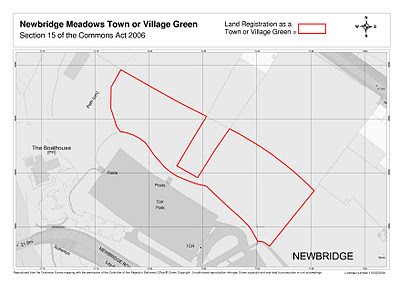 The application was considered to be valid and a Non-Statutory Public Inquiry was held in The Guildhall in April 2011, after which the Inspector holding the Inquiry issued a report recommending that
the two large fields and the narrow corridor between them, forming the Meadows, be registered as a Town or Village Green.
The application was considered to be valid and a Non-Statutory Public Inquiry was held in The Guildhall in April 2011, after which the Inspector holding the Inquiry issued a report recommending that
the two large fields and the narrow corridor between them, forming the Meadows, be registered as a Town or Village Green.
A meeting of B&NES's Regulatory (Access) Committee was held in The Guildhall on Tuesday 25th October 2011 to consider the Inspector's report and, after hearing from their Senior Rights of Way Officer who recommended that as all requirements under Section 15 of the Open Spaces Act 2006 were satisfied, as detailed by the Inspector, he recommended that the two large Meadow Fields and the Corridor between them, be Registered as a Village Green.
The Committee resolved to accept the report and Register the area accordingly. The meeting was attended by the applicant, another member of "Newbridge Matters", a member of The Bath Society and Councillor Loraine Morgan-Brinkhurst, one of the Ward Councillors, all of whom spoke in favour of Registration. Also in attendance were members of the public including children and Ward Councillor Caroline Roberts, who had supported the application.
Now that the Meadows have been registered, they will be protected from future development so that present and future generations may continue to enjoy their use, for leisure and environmental purposes.
The Committee was advised that next year, 2012, marks the Queen's Diamond Jubilee, sixty years on the throne and, that in order to celebrate the occasion her grandson Prince William, now the Duke of Cambridge, has as Patron set up a scheme to protect Playing Fields and Outdoor Spaces. If areas of land conformed to criteria set down under this scheme, these areas could be named "Queen Elizabeth II Fields". The owners of the land, in the case of Newbridge Meadows being B&NES, could if they so desired, be able to request that the name "Queen Elizabeth II Fields" be applied to the Meadows, in a similar way to that for Bath's "Royal Victoria Park". Newbridge Matters stated that "A formal request will be made to B&NES in due course for this action to be taken."
The other two applications, for Rudmore Park and Keynton Mead were sponsored by Response2Route and each application was considered to be valid and a Non-Statutory Public Inquiry was held in The Guildhall. The outcomes were different to the Newbrige one.
Unlike the Newbridge application, neither of these resulted in an Inspector's recommendation that they should be registered as village greens. The reports recognised that there was sufficient evidence that they had been used as village greens for more than the 20 years needed to qualify. The reason for refusal was a legal technicality. Because of the rather curious wording in the Act, it was necessary to not only prove that the land had been used as a village green, but also that the landowner had no expectation that it should be put to that use. It is that second point that caused the refusal.
The council is due to meet in the coming months to decide what to do about the Inspector's report recommending refusal, because the Inspector's opinion is advisory only. We strongly suggest that because the land has been used as a village green, and the only reason the inspector recommended refusal was because there was evidence that the council as landowner expected it to be so used, the appropriate course of action would be to adopt both areas of land as village greens and formalise what has been an informal arrangement for more than 20 years.
Go back to top index
VeraCityBath Limited
VeraCityBath Ltd has set up a company blog where the latest news will be posted. We recommend that you check there regularly.
It is very difficult for a group of concerned individuals to take legal action, so an umbrella company has been set up to present a single point of contact for the courts. That company is called VeraCityBath Limited, and it was set up specifically to mount a legal challenge against the Transport Package, though it's constitution would permit a wider remit should that prove necessary in the future. A Press Release followed the company launch and the news that papers had been lodged in the High Court requesting a Judicial Review of the decision by the Secretary of State for Communities and Local Government not to call a Public Inquiry into the Transport Package planning applications that he had called in to review. The papers also name Bath and North East Somerset Council as applicant and decision maker.
Judicial Review
There are a number of stages to a Judicial Review. First the applicant (in this case VeraCityBath Ltd) outlines the basis of its case to its own lawyers, to verify that there are legal grounds to mount the challenge.
Then the applicant in conjunction with its lawyers prepares a statement of case, which is sent to the defendants (in this case the Secretary of State and B&NES), inviting their comments. This is known as the pre-action protocol, and indicates whether or not the case would be defended.
A full set of all relevant documents is sent to the High Court along with an application form and the appropriate fee, and these are examined by a judge, who decides whether the case is strong enough to grant a Judicial Review. At this stage the judge will also rule on the application for a Protected Costs Order for the full hearing.
If he does, a further fee is payable, after which the case is entered into the court schedule, and it is subsequently heard on the appointed date.
Protective Costs Order
It is UK (and EU) policy that if a case should be heard in the public interest, the public should not be deterred from lodging the case by the fear of having to meet all the costs if the case is lost. A judge can grant grant a Protective Costs Order which limits the exposure to costs if the case is lost (if the case is won, the costs are met by the other side).
VeraCityBath has been awarded an interim Protective Costs Order to protect it from large legal bills if the judge decides that the case lodged as papers is not strong enough for a full hearing. A further application will be considered if the case is allowed to go to a full hearing.
On 27th January, VeraCityBath Ltd called a public meeting, which Watchdog attended. Various reports of the events have been put online, by VeraCityBath, by Newbridge Matters and by Save Bathampton Meadows. Below is our summary of events.
We estimate that just under 200 local residents and representatives of various groups and organisations packed into the Methodist Church hall at Batheaston. Members of parish councils were in attendance along with various members of the newly formed VeraCityBath.
A summary of the current position regarding the Bath Transport package was given out. A key point raised here was that any proposals requiring funding over £50M will be subject to intense scrutiny by the next Government, and the Bath Transportation Package falls into that category.
The reasons were then given for why it was important to challenge the package (where the planning permission granted for Bathampton Meadows was the last decision notice of the entire package). A series of four key points was presented.
A brief resume of the aims of Veracity Bath and the current position regarding the legal challenge was given to the audience. This highlighted the complexities of mounting such challenges, and the scale of costs that could be faced, hence the need to raise money through membership or donations. This was supplemented by a small brochure. (Those on dial-up should allow enough time to download a 1.2Mb PDF.). A short question and answer session was then held.
The meeting was well chaired and the message distinctly put across. The various points were well argued and illustrated. Everyone came away in no doubts about the terrible impact these proposals will have on the landscape and setting of this city, and the need for continued action.
Outside the Public Meeting, some of the Watchdog Committee met some of VeraCityBath Directors. It was agreed that because Watchdog as an organisation is a registered non-statutory objector to the Compulsory Purchase Orders, then Watchdog Committee members should not become members of VeraCityBath to avoid all possible risk (real or imaginary) of accusations of conflict of interests. We agreed though that the ordinary members of Watchdog were free to join if they wish. We will also be keeping in touch with VeraCityBath developments, reporting them here when appropriate.
[30/5/10] We received a Press Release from VeraCityBath Ltd which was not quite reproduced in full in Western Daily Press nor the printed version of the Chronicle on 3rd June. The press release was followed by an interview with VeraCityBath Ltd on BBC Radio Bristol's "Drive Time" on Tuesday 1st June. Our understanding is that the Judicial Review failed because the council had talked and written about taking action to implement the Transport package in a way that meant that they had misled the DCC over the planning applications, but the council hadn't actually taken the actions they described. This made a Judicial Review premature. However, the explanation given by the judge included the specific legal advice that the Transport Package had to be implemented in its entirety or not at all, and any deviation from this could reopen the Judicial Review on the grounds that the Council had misled the High Court.
Go back to top index
Bath Transport Package - Government Spending Review.
[13/6/10] A letter has been sent out from the organiser of the Public Inquiry announcing that the Public Inquiry scheduled to start on 1st September has been postponed until a date not yet decided, and the Pre-Inquiry Meeting scheduled for Monday 14th June has also been postponed. For those who have not seen the letter, a copy is readable here.
The letter announcing the postponement says that a statement has been issued by the Secretary of State. We have tracked it down and reproduce it here along with the accompanying Press Release. It is headed "interim guidance" which suggests that it may be reviewed and refined at a later date. Nevertheless, it remains the most up-to-date advice.
Included in this advice, we read "DfT will not encourage or assist LAs to progress potentially abortive work on schemes until the funding position is clear." This was in addition to the recent announcement on the news that the Government Grant to B&NES was being reduced by a million pounds this year.
Finally, to keep it in the public eye we remind you of the Press Release from Response 2 Route. It announces their Village Green initiative, and requests as many people as possible to support it. All the details are in that notification.
[12/12/10] Two weeks ago we reported that the Chronicle had published an article reporting that the Bath Transport Package is to be pursued exactly as it was originally presented. At the time we pointed out that such an approach was doomed to failure.
It therefore comes as no surprise that a Government minister has stated that costs must be reduced if a bid is to have any chance of success. And suddenly B&NES takes notice and states that is is intending to revise its bid, but it can't tell us how. In the press statement it says it has to do this to provide essential infrastructure for key employment sites across the district. What employment sites, we wonder? The Western Riverside is almost entirely housing. Southgate is for shopping, and most of those shops have left an empty premises somewhere else in the city, while Fossway and Bath Press schemes are also mainly shops. Green Park is hotel accommodation for tourists. There are a large number of planning permissions granted for constructing offices that have resulted in empty offices or are not proceeding because nobody wants the offices, and a tour round existing office accommodation reveals a forest of "To Let" signs; whilst the printed copy of the Chronicle (but not the on-line news) reports plans to abandon the idea of offices on the former Clark's Factory site and open a care home there instead. There are more than enough offices available to meet current demand, which is well below the council's aspirations. So we have to assume that the "key employment sites" are a ruse to make the Transport Package sound attractive rather than a reality, because the documentation on the package that went through the planning system made it clear that there would be no practical benefits.
But look at the cost of pursuing it. There will have to be a Public Inquiry for the Compulsory Purchase Orders, and our assessment of the criteria for CPOs (see above) is that the Inquiry should reject at least some of the CPOs, thus blocking the BRT route, but the council will have to spend money to find that out. Then there will be the cost of fighting the "Village Green" bid, because that too would block the BRT route. VeraCityBath has already established in the courts that unless new planning applications are raised the Transport Package has to be implemented in its entirety or not at all, so any one of these hurdles could prove to be a show-stopper. At a time when essential services are being cut, it has to be asked why money can be found for a pet transport scheme but not for the council functions that are the greatest concern to the public.
[24/1/11] Two articles on this subject are in the Chronicle's on-line news. The first, also appearing in the printed edition, mainly focuses on funding, and how the council is preparing to spend £8.7 Million on preparatory work and £9.1 Million on paying for some of the work, so that the bid to the Department of Transport could be a reduced sum. Some of this money would be saved by not implementing the few parts of the Transport Package that are popular with the public, like bus shelters and bus arrival information (thus effectively throwing away the baby but retaining the dirty bath water), and some of it by selling the family silver to property developers and companies, exchanging a short term gain for a long term loss. Remember how the council sold off all the Southgate land to the developers for a lump sum, thus losing for ever the annual income from the Ham Gardens Car Park? Expect more of the same!.
The second article reports that the council approved these plans, thus ensuring that money that could have been spent on retaining some of the services that are due to be cut will now be wasted on things of no benefit to the residents of B&NES. As we said in our item on Compulsory Purchase Orders, all the Government guidelines indicate that at least some of the CPOs should not be granted (and if they are, the guidelines give a clear case for a Judicial Review). If the council can't compulsorily purchase the land, they can't build all the BRT road, which means that having voted to persist with that element, they won't qualify for the Government funding if they can't deliver it. As far as the B&NES residents are concerned, that is £8.7 Million spent on preparatory work (plus everything spent on the package to date) totally wasted. There is also an interesting side effect if the BRT cannot proceed, in that the conditions for developing the Western Riverside include building something specifically named as part of the BRT route, rather than referring to it as a particular length of on-site road (which is what it actually is). So if the BRT doesn't proceed, will that technically put Crest Nicholson in breach of its planning conditions, we wonder?
The public comments to the Chronicle include aspirations that the elections in May might change things, and yes, they might, because any new council has the authority to overturn the decisions of the previous one if they are so inclined.
[6/2/11] We previously reported on the council's vote to spend (we think waste) more council tax money on pursuing the transport package. In the recent Chronicle update, it is clear that the council (or rather the West of England Partnership on the council's behalf) did provide an expression of interest for a lower grant. The figures are in the Expression of Interest (beware, the link is to a 12Mb file): Instead of a DfT grant of £59Million just £39Million is now being sought, but the local contribution to the scheme has nearly doubled from £12Million to £23Million, of which £17.8 comes directly from council funds.
Interestingly, the new housing plans that the Expression of Interest claims would benefit from the Transportation Package exceeds the figures in the Core Strategy for developments within the Central Area and Western Corridor which are the only ones that could potentially benefit from the Transport Package as scaled down without the bus shelters and information signs (unless there covert plans to develop around Newton St Loe still!). In the absence of the Newton St Loe housing, the expansion of the Newbridge Park and Ride claimed to cater for the additional Newton St Loe population seems to be unnecessary. We will have to wait for the eventual bid to see exactly what is put forward, and whether these apparent holes are addressed.
Also in the Chronicle, it says that the pool of competitors for DfT funding has increased to 45. The reason for this and the identities of all 45 are in the DfT Update Report. The sum total of the 45 schemes (£945Million) exceeds the money available (£630Million) so they can't all succeed.
[10/4/11] Watchdog had its attention brought to one news item on the Response2Route website, and the link to a copy of correspondence sent to the DfT.
One criticism in that letter is particularly telling: "B&NES council have never carried out a like-for-like comparison between the BRT and its alternatives. This should have been done at the beginning of the project. Without it, there is no data to back up the claim that it is the best option."
Watchdog representatives sat through all the DCC meetings which discussed the Transport Package, and can confirm that according to the notes taken at the time, no discussion of possible alternatives was allowed at any of them. Nor, to the best of our knowledge, has anybody checked whether the historic vaults along the BRT route in the centre of Bath could continuously support the weight of the BRT buses. Judging by the obvious road damage in that part of Green Park Road alongside the Avon Street car park where the current (rather smaller) bendy buses wait at bus stops, this is not a trivial question.
Unless the entire route is demonstratively capable of running the service, it is unlikely that the Compulsory Purchase Orders for just part of it will be granted at a Public Inquiry.
[13/7/11] The agenda for the council meeting on 13th July included a document for discussion on the Transport Package. There were some things in the document that were encouraging: the proposed removal of the BRT and the Bathampton Meadows Park and Ride site were welcomed, and we hoped that the council would endorse these proposals.
There were some omissions though: the fact that any extension of the Newbridge Park and Ride would be over a Site of Special Scientific Interest, which the Core Strategy commits to protecting; the fact that the Newbridge extension was originally to service the additional housing at Newton St Loe which has already been removed from the housing plans; the fact that the DCC considered the Park and Ride planning applications as a complete package meaning that any alterations require new planning applications, because VeraCityBath obtained this advice from the judge during their High Court action. The option of cherry-picking from the extant permissions is therefore not available, and new applications will be necessary for all parts of the package including the Lansdown and Odd Down extensions.
Other parts of the document were a little economical with the truth. The Bathampton Meadows site wasn't chosen after a thorough review of the alternatives but a cursory one; nor would the retention of the Bathampton Meadows site reduce the amount of traffic entering from the east, because the council's own paperwork shows that the site is too small and suppressed demand would take up all spare capacity leaving traffic volumes unaltered. All that is before the impact of transferring the MOD staff from their Bath sites to Abbey Wood creates additional through traffic as they commute from Wiltshire to Bristol.
When the Cabinet met, an amended set of Recommendations had been submitted and were subject to debate. In the panel below is the decision of the Cabinet, as written in the minutes.
[The Cabinet] RESOLVED (unanimously):
(1) To AGREE and RECOMMEND to Council that the following elements of the BTP
should not be included in the Best & Final Bid to DfT:
• The Bus Rapid Transit Segregated Route.
• The A36 Lower Bristol Road Bus Lane.
• The A4 London Road Lambridge Bus Lane.
• New A4 Eastern P&R (1400 spaces), plus bus lane priority on the A4/A46 slip road.
• And in addition reduce the size of the P&R expansion at Newbridge.
(2) To AGREE that as a result the BTP would comprise of the following elements:
• Upgrades to bus stop infrastructure on 9 service routes, including real time passenger information.
• Expansion of Odd Down P&R by 250 spaces, of Lansdown P&R by 390 spaces and of Newbridge P&R by 250 spaces on the proposed site or a suitable alternative.
• Variable Message signs on the main approaches to Bath, and within the city centre.
• City centre works: High Street improvements and timed access restrictions (currently ongoing).
• Works to support BWR including a bus rapid transit system serving the site.
(3) To AGREE as a result of the above to formally withdraw the CPOs agreed at its meeting on 3rd September 2008 and subsequently served to allow for the implementation of the BTP.
(4) To AGREE and RECOMMEND to Full Council that the Council contribution towards the BTP would be no more £17.8m as set out in the updated Financial Implications. The schemes costs as recommended in this report have been reduced from £58.8m to £34.3m.
(5) To AGREE and RECOMMEND to Full Council that the final submission to DfT be approved by the Strategic Director Service Delivery and Chief Executive in consultation with the portfolio holder, the S151 officer and monitoring officer, and with a report back to Cabinet only if necessary notably if there is a material change in the financial costs or scope of the scheme which go beyond the parameters set out in this report.
(6) To RECOMMEND to Full Council additional borrowing of £3M to fully finance the costs of the Council contribution of up to £17.8M with an additional annual revenue cost of approximately £190K which will need to be included in revenue budgets for future years following completion of the scheme.
(7) To NOTE the revenue reversion risk as set out in the report and the potential need to fund the costs of project work on aspects of the scheme which are no longer going ahead from reserves with the appropriate financing to be dealt with in a later report to Cabinet and Council as appropriate and if the need arises.
(8) To AGREE and RECOMMEND to Full Council to instruct officers to:
• work on alternatives to Bathampton Meadows P&R, possibly involving rail, as part of our future Transport Strategy
• work with the Highways Agency to improve signage on the A46 to direct more traffic to an extended Lansdown Park and Ride
• talk to Wiltshire Council about measures to remove some of the through traffic along the London Road and other cross border transport issues
• evaluate measures to remove HGVs from London Road - this 10% of traffic creates 40% of the pollution
• examine how we can obtain substantial "modal shift" from the private car to rail in recognition of potential for rail expansion with the electrification of the GWR and the awarding of an extended rail franchise
• evaluate options to address the problems caused by a lack of affordable home to school transport
• consider measures to make the whole area much more cycle friendly - we have already secured Govt funding through the Regional Sustainable Transport Fund to link Batheaston to NCR 4 on the canal towpath, thereby taking many cyclists off the London Road and encouraging others to get out of their cars and cycle into Bath.
The following day, the Cabinet decision was discussed by the full council. In the panel below is the decision of the full Council, as written in the minutes.
BATH TRANSPORT PACKAGE - BEST & FINAL BID TO DFT
The Council considered a report setting out a Best & Final bid to Department for Transport for the funding of the Bath Transport Package. Following the Comprehensive Spending Review, Department for Transport have indicated that they wished to reduce costs, enhance value, improve deliverability of major transport schemes and increase Local Authority contribution. Following the election, further work had been undertaken to reduce the cost of the package.
In addition to the reports circulated with the agenda, Councillors received copies of an update report at the meeting containing revised recommendations and a new Section 3 - Financial Implications. This was made available to Press and public too.
On a motion from Councillor Roger Symonds, seconded by Councillor Paul Crossley, it was RESOLVED that
The Council agrees, as recommended by Cabinet, that the following elements of the BTP should not be included in the Best & Final Bid to DfT:
1.1 The Bus Rapid Transit Segregated Route;
1.2 The A36 Lower Bristol Road Bus Lane;
1.3 The A4 London Road Lambridge Bus Lane;
1.4 New A4 Eastern P&R (1400 spaces), plus bus lane priority on the A4/A46 slip road;
1.5 And, in addition, reduce the size of the P&R expansion at Newbridge.
As a result the BTP would comprise of the following elements;
a. Upgrades to bus stop infrastructure on 9 service routes, including real time passenger information;
b. Expansion of Odd Down P&R by 250 spaces, of Lansdown P&R by 390 spaces and of Newbridge P&R by 250 spaces on a suitable alternative site;
c. Variable Message signs on the main approaches to Bath, and within the city centre;
d. City centre works: High Street improvements and timed access restrictions (currently ongoing); and
e. Works to support BWR including a bus rapid transit system serving the site.
1.6 In the light of the Cabinet agreeing to formally withdraw the CPOs which were approved at its meeting on 3rd September 2008 and subsequently served to allow for the implementation of the BTP, Council agrees that the local contribution towards the BTP will be no more than £17.8m as set out in Section 3 of the report. [The schemes costs as recommended in this report have been reduced from £58.8m to £34.3m.]
1.7 Council agrees that the final submission to DfT be approved by the Strategic Director Service Delivery and Chief Executive, in consultation with the portfolio holder, the S151 officer and Monitoring Officer, and with a report back to Cabinet only if necessary (notably if there is a material change in the financial costs or scope of the scheme which go beyond the parameters set out in the report)
1.8 To agree additional borrowing of £3M to fully finance the costs of the the Council contribution of up to £17.8M with an additional revenue cost of approximately £190K which will need to be included in the revenue budgets for future years following completion of the scheme;
In addition, Council agrees to instruct officers to;
1.9 work on alternatives to Bathampton Meadows P&R, possibly involving rail, as part of our future Transport Strategy;
1.10 work with the Highways Agency to improve signage on the A46 to direct more traffic to an extended Lansdown P&R;
1.11 talk to Wiltshire Council about measures to remove some of the through traffic along the London Road and other cross border transport issues
1.12 evaluate measures to remove HGVs from London Road - [this 10% of traffic creates 40% of the pollution]
1.13 examine how we can obtain substantial "modal shift" from the private car to rail in recognition of potential for rail expansion with the electrification of the GWR and the awarding of an extended rail franchise;
1.14 evaluate options to address the problems caused by a lack of affordable home to school transport; and
1.15 consider measures to make the whole area much more cycle friendly - we have already secured Government funding through the Regional Sustainable Transport Fund to link Batheaston to NCR 4 on the canal towpath, thereby taking many cyclists off the London Road and encouraging others to get out of their cars and cycle into Bath.
(Note: 1. The above resolution was carried with 29 Councillors present voting in favour, 24 Councillors present voting against and 10 Councillors present abstaining from voting. A minor adjustment to the wording of the motion was suggested by Councillor Lorraine Morgan-Brinkhurst with the effect of removing some words regarding the proposed Newbridge P&R site which was accepted by the mover and seconder of the motion.
At about the same time we were informed that Case Number CO/1787/2011 was still proceeding through the High Court processes, and the case had been scheduled for a hearing on the 29th November 2011 with the court number and time to be announced nearer that date.
We understand that the essence of the case is that by including the Bath Transport Package in the pool of competitors for DtT funding, the Secretary of State had endorsed an unlawful decision because the planning application for the Newbridge Park and Ride and BRT route was not determined in accordance with planning legislation. The case, if it proceeds, should establish case law on the correct procedure when a motion to approve a planning application is defeated when put to the vote.
The Council decision on the amendments to the Transport Package as described above will require new planning applications. The council cannot rely on the existing Odd Down and Lansdown decisions because they formed part of the complete package which is now sub judice. A full set of new applications will have to be raised.
[13/7/11] The agenda for the council meeting on 13th July includes a document for discussion on the Transport Package. There are some things in the document that are encouraging: the proposed removal of the BRT and the Bathampton Meadows Park and Ride site is welcomed, and we hope that the council endorse these proposals.
There are some omissions though: the fact that any extension of the Newbridge Park and Ride would be over a Site of Special Scientific Interest, which the Core Strategy commits to protecting; the fact that the Newbridge extension was originally to service the additional housing at Newton St Loe which has already been removed from the housing plans; the fact that the DCC considered the Park and Ride planning applications as a complete package meaning that any alterations require new planning applications, because VeraCityBath obtained this advice from the judge during their High Court action. The option of cherry-picking from the extant permissions is therefore not available, and new applications will be necessary for all parts of the package including the Lansdown and Odd Down extensions.
Other parts of the document are a little economical with the truth. The Bathampton Meadows site wasn't chosen after a thorough review of the alternatives but a cursory one; nor would the retention of the Bathampton Meadows site reduce the amount of traffic entering from the east, because the council's own paperwork shows that the site is too small and suppressed demand would take up all spare capacity leaving traffic volumes unaltered. All that is before the impact of transferring the MOD staff from their Bath sites to Abbey Wood creates additional through traffic as they commute from Wiltshire to Bristol.
It looks as though in the dash to meet the DfT deadline, one casualty will be the full facts. It remains to be seen how the council meeting interprets this misinformation.
[27/7/11] There was an interesting quote in the Chronicle, that "The aim of the transport plan is about increasing economic growth and freeing up development sites." Nothing published on the Transport Package up to that time, including the most recent Expression of Interest has made that connection. When you could throw a stone from both the sites mentioned and hit the bus station or the railway station, the availability of public transport is not an apparent shortfall for those sites. The financial implications of surrendering an income forever in exchange for a one-off capital gain on the other hand, is something that ought to be carefully explained and then consulted on, not presented as an assumption in a meeting convened for a completely different purpose.
Of particular interest though is why, when council officers are supposed to implement policy as defined by councillors, is there no statement from the councillor with the transport portfolio in that news item? Does he substantiate or refute the statement made by the council officer? The public should be told whether they were being misled in the past about the purpose of the Transport Package because there was a hidden agenda all along, or whether they are being misled now.
[9/9/11] According to a Chronicle article, the council did submit a proposal for Government funding for a scaled down package. However, the details of exactly what was submitted does not yet appear on the council website, so we can't offer an opinion on what has been submitted.
[25/10/11] On Tuesday 25th October 2011 a decision was made by the council to accept the recommendation for a Village Green at Newbridge; and that the Newbridge Matters website has the full story.
Soon afterwards we were informed that because Village Green status permanently protects the land (some of which is a Site of Special Natural Interest) from any aspirations to extend the Park and Ride site over it, there is no longer a need to argue in the the High Court that the Secretary of State cannot overlook the illegality of that planning decision. Consequently, Case Number CO/1787/2011, due to be heard on 29 November, would be withdrawn.
Work Starts at Newbridge
[28/10/12] We were asked by a Newbridge resident whether the work being planned for "Donkey Field" would prevent the planning consent for the extension of Newbridge Park & Ride from time expiring.
We are not convinced that the Newbridge application is now valid: There are reasons why it might be considered void rather than being concerned about time expiry. It originally encompassed an area which included the land that has now been granted Village Green status so as applied for it cannot be built. It also included the works required for the BRT route which was been officially discontinued. Furthermore, VeraCityBath Ltd in their court action established that because the Park & Ride applications were presented to the DCC as a package of four applications to be proceeded with on an "all or nothing basis" for the Transport Package in the form that it existed at the time, then the council could not treat the individual applications on a piecemeal basis.
With the removal of the BRT and the Batheaston Park & Ride from the current plans preventing the delivery of all the original proposals, the only remaining option under the original permissions is "nothing". Newbridge, Odd Down and Lansdown Park and Ride extensions therefore need new planning applications before the parking allocation can be increased.
From a heritage point of view, the Newbridge site is particularly sensitive, incorporating as it does a Site of Special Scientific Interest as well as forming part of the character of the World Heritage Site. It is important that any work that might impact on that scientific interest should be properly described and assessed for potential consequences in a planning application: it is the worst possible place for the cavalier approach that the council adopted instead.
This enquiry led us to wonder when the revised Transport Package would be offered for public consultation. It is very different from the original, so the public opinions expressed for the earlier one cannot be assumed to be still relevant. Ideally the consultation on the new package should precede any planning applications.
Park And Ride Expansion.
[9/12/12] In a news item in the Chronicle about the inclusion of Bathampton Meadows in the list of potential Park And Ride sites east of Bath there are statements that are apparently intended to reassure. A B&NES spokesman said "The cabinet has no intention of putting forward the original Bath Package site." However the devil is in the detail. The statement did not say that no part of the original site is being considered; nor did it say that a larger site incorporating the original site is ruled out. The precise brief given to the consultants is not publicly available so this remains an issue to watch.
The same spokesman also said "The cabinet is actively considering the original Bath Package site to be included as part of a flood alleviation scheme" but did not explain what contribution it was supposed to make. Anyone who was keeping an eye on the worryingly high river levels recently will be aware that a large volume of water was moving swiftly through Bath and because it moved on it did not rise high enough to flood properties although parts of the riverbank were submerged. To improve the flood risk for those at risk the moving volume of water needs to be bigger or the speed needs to increase. This means that the effective methods require the moving volume of water in the river to be widened, deepened or straightened to increase the flow. Bathampton Meadows does not provide any of these solutions, all that it can provide is storage capacity for overflowing water, a role most of it already performs (see this photo on Flikr). If it were to be enlarged to store more water, one of our members calculated that at the rate of flow seen recently, the entire meadows storage capacity would fill in about 30 minutes after which it would have no influence on the flood risk whatever, because it is stationary rather than flowing water. Using more of the meadows, currently an important wildlife habitat, for flood alleviation might sound attractive to those who don't understand fluid dynamics, because it looks as if it ticks useful boxes, but it would be ineffective and therefore a waste of money.
We are speculating because again the current underlying intentions are not publicly available, but the clue is that the word alleviation is used rather than prevention, and upstream storage has been mentioned in the past.
We also note that no new planning applications have been raised for the other Park And Ride sites despite statements being made that these are to be extended. VeraCityBath Ltd in their High Court case against the original Bathampton Meadows plans obtained a Legal Opinion that because the four original applications were presented to the DCC as a package with an "all or nothing" warning, they had to be implemented on an all or nothing basis and the council could not cherry pick from them. Their Press Release at the time confirmed that. The adoption of the Newbridge Village Green, the abandoning of the BRT element, and the announcement of the Bathampton Meadows not proceeding in its original form thus invalidated all four of the earlier applications and new ones are required to make any extensions lawful.
No Permission For Newbridge.
[13/1/13] The latest Chronicle news item that the council has been forced to admit that the work underway at the Newbridge Park And Ride site has no planning permission and a planning application will now be raised (which is also covered by a press release by Newbridge Matters) doesn't really go far enough. A new planning application for Newbridge needs to include an impact assessment for the unauthorised work that has already taken place, and it ought to be accompanied by a retrospective application for Odd Down where work is claimed to be complete, and Lansdown which the Chronicle item hints will soon be underway so that all the currently stated intentions have been input into the planning processes.
These works (which should now cease until planning permissions have been sought and granted) are part of a revised Transport Package which has still not been offered for public consultation despite it being radically different from the original which was subject to a consultation process, so it is not yet able to become adopted policy.
Go back to top index